Appendix A · THEORY → DERIVATION → DEFENSE附录 A · 理论 → 推导 → 答辩

Hydrogel versus liquid platforms

水凝胶与液体平台

Unit

单元

Contents

内容

Question

问题

Appendix A: Hydrogel versus liquid

附录A:水凝胶与液体平台

Gel confinement, response times, finite-energy models, and embedded-PFC comparisons.

凝胶约束、响应时间、有限能量模型与嵌入式 PFC 比较。

How does gel confinement change transfer?

凝胶约束如何改变转印?

Derive gel resistance and work. Compare four architectures using intact-transfer measurements.

推导凝胶阻力与功。用完整转印测量比较四种结构。

Awaiting answers待作答

Learning goals

学习目标

  • Derive finite-strain neo-Hookean cavity resistance and elastic work from volume, stress and equilibrium.

    从体积、应力与平衡推导有限应变 neo-Hookean 腔体阻力与弹性功。

  • Separate reversible storage, viscous loss, stress memory, communication and drainage.

    区分可逆储存、黏性损耗、应力记忆、传播与排水。

  • Compare conventional liquid, open pockets, bulk embedding and sealed cavities using intact-transfer evidence.

    用完整转印证据比较常规液体、开放液腔、体相嵌入及密封腔体。

Prerequisite. Prerequisites: Chapters 1–4’s inventory, liquid motion, loading and selective fracture.

先修知识。 前提:第一至四章的物质量、液体运动、加载及选择性断裂。

Hydrogel support and transfer performance

水凝胶支撑与转印性能

Hydrogel can locate PFC droplets, support liquid patterns and conform under small preload. Its network also stores energy, dissipates motion and changes transport. It can tear. Compare absorbed energy, phase source, motion, selective release, intact placement and reset. Smaller cavities or higher pressure leave overall improvement unresolved.

水凝胶可定位 PFC 液滴、支撑液体图案,并在小预载下贴合。其网络也储存能量、耗散运动、改变输运,并可能撕裂。应比较吸收能量、相变源、运动、选择性释放、完整落位及复位。空腔更小或压力更高仍未确定整体改善。

Architecture

结构方案

Where displaced material can go

被排开材料的去向

Benefit to test; new cost

待检验的收益与新增代价

Conventional liquid site containing PFC

含 PFC 的常规液体位点

Toward an exposed meniscus or defined outlet; the carrier remains a liquid.

朝暴露液面或明确出口运动;载液保持液体状态。

Direct liquid displacement; wetting drift, spreading and neighboring flows can vary.

直接排开液体;润湿漂移、铺展和邻近流动可能发生变化。

Open liquid pocket supported by gel

凝胶支撑的开放液腔

Liquid leaves an opening while the gel wall deforms.

液体经开口离开,同时凝胶壁发生变形。

A located outlet and compliant support; moving walls consume, return or redirect energy.

定位出口与柔顺支撑;运动壁面会消耗、返还能量或改变其方向。

PFC embedded directly in bulk gel

PFC 直接嵌入体相凝胶

Initially into network deformation; an external liquid path must exist or be created.

起初转化为网络变形;必须已有或形成通往外部的液体路径。

Stable inclusion locations; large strain, trapped vapor, network rupture and solid contamination.

稳定的夹杂位置;大应变、滞留蒸气、网络破裂及固体污染。

Sealed cavity under a gel/composite stamp

凝胶/复合印章下的密封腔体

Boundary bulging and pressure transmission rather than an open liquid outlet.

通过边界鼓起与压力传递,而不是开放液体出口。

Distributed deformation and local peeling; this can be a blister actuator with a different release mechanism.

分布式变形与局部剥离;它可以是具有不同释放机制的鼓泡致动器。

Li et al. demonstrated a sealed hydrogel-composite stamp. Laser heating formed water vapor, deformed covering layers and released a platelet. This establishes a pressure–deformation–fracture route. External PFC jetting from bulk gel remains unestablished. The millisecond event requires separate justification before informing microsecond material laws. [R11]

Li 等展示了密闭水凝胶复合印章。激光加热形成水蒸气,使覆盖层变形并释放片状对象。这确立了压力—变形—断裂路径。体相凝胶中的 PFC 外部喷射尚未确立。毫秒事件用于微秒材料规律前,须另给依据。 [R11]

1. Intact spherical model

1. 完整球形模型

Use an infinite homogeneous isotropic incompressible neo-Hookean medium. Its network remains continuous and intact. Existing cavity radii are stress-free Rref>0R_{\mathrm{ref}}>0 and current R(t)>0R(t)>0. Material lies outside the cavity. Far-field radial stress is −p∞(t)-p_\infty(t). Internal pressure pb(t)p_b(t) is spatially uniform. Interface tension σ\sigma is constant. Tensile Cauchy stress is positive. Radius points outward; positive speed means expansion. Omit gravity, nearby boundaries, outlets, drainage, damage, shell stress and phase slip.

采用无限、均匀、各向同性、不可压缩 neo-Hookean 介质,网络连续且完整。已有空腔无应力半径为 Rref>0R_{\mathrm{ref}}>0,当前半径为 R(t)>0R(t)>0。材料位于空腔外。远场径向应力为 −p∞(t)-p_\infty(t),内压 pb(t)p_b(t) 空间均匀,界面张力 σ\sigma 恒定。拉伸 Cauchy 应力取正。径向向外,正速率表示膨胀。忽略重力、附近边界、出口、排水、损伤、壳层应力及相变滑移。

Initially t=0t=0, R=RrefR=R_{\mathrm{ref}}, R˙=0\dot R=0, and the network is unstretched. Mechanical equilibrium requires pb(0)−p∞(0)=2σ/Rrefp_b(0)-p_\infty(0)=2\sigma/R_{\mathrm{ref}}. Laser and phase dynamics must supply later pb(t)p_b(t). Polymerization around a loaded inclusion can create a different stress-free shape. Initial liquid-core radius a0a_0 defines PFC inventory. Determine it separately from reference and vapor-cavity radii.

初始 t=0t=0、R=RrefR=R_{\mathrm{ref}}、R˙=0\dot R=0,网络未伸长。力学平衡要求 pb(0)−p∞(0)=2σ/Rrefp_b(0)-p_\infty(0)=2\sigma/R_{\mathrm{ref}}。后续 pb(t)p_b(t) 由激光及相变动力学提供。围绕受载夹杂聚合可产生不同无应力形状。初始液核半径 a0a_0 定义 PFC 物质量,应与参考半径及蒸气空腔半径分别确定。

Symbol

符号

Physical meaning

物理意义

SI units

SI 单位

Role and convention

作用与约定

tt

Time

时间

s

Independent coordinate of the transient cavity event; the reference state is specified at zero.

瞬态腔体事件的独立坐标;参考状态规定在零时刻。

r0r_0

Reference material radial coordinate

参考材料径向坐标

m

Labels a material shell in the stress-free configuration; held fixed for material motion.

标识无应力构形中的材料壳层;追踪材料运动时保持不变。

rr

Current material radial coordinate

当前材料径向坐标

m

Current position of the shell labeled by r₀; distinct from current wall radius R.

由 r₀ 标识的壳层当前所在位置;不同于当前壁面半径 R。

RrefR_{\mathrm{ref}}

Stress-free reference cavity radius

无应力参考腔体半径

m

Reference geometry for network stretch; not automatically an observed loaded cavity radius.

网络伸长的参考几何;不能自动等同于观测到的受载腔体半径。

RR

Current cavity radius

当前腔体半径

m

Locates the moving cavity boundary in the current configuration.

定位当前构形中的运动腔体边界。

R˙\dot R

Cavity wall radial velocity

腔体壁面径向速度

m s⁻¹

First time derivative of R; positive expansion and negative inward motion.

R 的一阶时间导数;正值表示膨胀,负值表示向内运动。

R¨\ddot R

Cavity wall radial acceleration

腔体壁面径向加速度

m s⁻²

Second time derivative of R in the inertial radial balance.

惯性径向平衡中的 R 的二阶时间导数。

a0a_0

Initial liquid-PFC core radius

初始液态 PFC 核半径

m

Inventory geometry; neither R nor the network reference radius is silently substituted for it.

存量几何;不能默默用 R 或网络参考半径替代它。

λr\lambda_r

Radial principal stretch

径向主伸长

1

Ratio of current to reference radial line elements at a material shell.

材料壳层处当前与参考径向线元的比值。

λθ\lambda_\theta

First tangential principal stretch

第一切向主伸长

1

Circumferential line-element ratio in the θ direction.

θ 方向周向线元的比值。

λϕ\lambda_\phi

Second tangential principal stretch

第二切向主伸长

1

Circumferential line-element ratio in the φ direction; equals the other tangential stretch under spherical symmetry.

φ 方向周向线元的比值;在球对称下等于另一切向伸长。

F\mathbf F

Deformation-gradient tensor

变形梯度张量

1

Maps reference line elements into the current configuration.

将参考线元映射到当前构形。

B\mathbf B

Left Cauchy–Green tensor

左 Cauchy—Green 张量

1

Product of deformation gradient and its transpose; enters the neo-Hookean stress.

变形梯度与其转置的乘积;进入 neo-Hookean 应力。

GgG_g

Gel-network shear modulus

凝胶网络剪切模量

Pa

Elastic material parameter controlling stored network resistance; relevant strain/rate dependence must be validated.

控制所储存网络阻力的弹性材料参数;相关应变/速率依赖需验证。

ηg\eta_g

Represented Kelvin–Voigt viscosity

所描述的 Kelvin—Voigt 黏度

Pa s

Coefficient of the adopted viscous stress; avoid counting the same solvent dissipation twice.

所采用黏性应力的系数;避免对同一溶剂耗散重复计数。

ρg\rho_g

Effective medium mass density

有效介质质量密度

kg m⁻³

Density of the moving surrounding medium, not the PFC core or vapor alone.

周围运动介质的密度,不是单独的 PFC 核或蒸气密度。

σ\sigma

Cavity-interface tension

腔体界面张力

N m⁻¹

Constant coefficient for the declared interface; separate from network elastic stress.

指定界面的恒定系数;与网络弹性应力不同。

Te\mathbf T^e

Elastic Cauchy-stress tensor

弹性 Cauchy 应力张量

Pa

Tensile-positive stress contributed by the network constitutive law; e denotes elasticity.

网络本构规律产生的应力,拉伸为正;e 表示弹性。

T\mathbf T

Total Cauchy-stress tensor

总 Cauchy 应力张量

Pa

Includes elastic and represented viscous contributions in the radial momentum balance.

包含径向动量平衡中的弹性及所描述黏性贡献。

χ\chi

Incompressibility multiplier

不可压缩约束乘子

Pa

Unknown isotropic stress multiplier; unlike Chapter 3’s interaction parameter, it has pressure units here.

未知各向同性应力乘子;与第三章的相互作用参数不同,此处具有压力单位。

pbp_b

Uniform cavity absolute pressure

均匀腔内绝对压力

Pa

Supplied by the laser/phase source calculation, not derived from the elastic resistance.

由激光/相变源计算提供,不由弹性阻力推导。

p∞p_\infty

Far-field absolute pressure

远场绝对压力

Pa

Sets the exterior radial-traction condition under the stated stress convention.

在指定应力约定下确定外部径向牵引条件。

pelp_{\mathrm{el}}

Signed elastic cavity resistance

带符号弹性腔体阻力

Pa

Stress-difference integral resisting expansion; its intact-network formula is not a fracture threshold.

抵抗膨胀的应力差积分;其完整网络公式不是断裂阈值。

uru_r

Radial material velocity

材料径向速度

m s⁻¹

Velocity of the surrounding material, consistent with the stated no-phase-slip control.

周围材料的速度,与所声明无相间滑移对照一致。

D\mathbf D

Symmetric velocity-gradient tensor

对称速度梯度张量

s⁻¹

Strain-rate tensor used by the represented viscous constitutive law.

所描述黏性本构规律使用的应变率张量。

WgW_g

Stored network elastic work

储存的网络弹性功

J

Integrated recoverable network work measured from the stress-free reference cavity.

从无应力参考腔体起算的可恢复网络功积分。

KgK_g

Surrounding-medium kinetic energy

周围介质动能

J

Integrated energy of the radial exterior motion.

外部径向运动能量的积分。

EσE_\sigma

Cavity surface energy

腔体表面能

J

Interface-area energy under the declared constant-tension assumption.

指定恒张力假设下的界面面积能量。

PdisP_{\mathrm{dis}}

Nonnegative viscous dissipation power

非负黏性耗散功率

W

Rate of irreversible mechanical-energy loss; differs from recoverable storage.

不可逆力学能损失速率;不同于可恢复储能。

τe\tau_e

Event duration

事件持续时间

s

Specified loading/evolution time used to test material-response assumptions.

检验材料响应假设采用的指定受载/演化时间。

τrel\tau_{\mathrm{rel}}

Measured stress-relaxation time

测量的应力松弛时间

s

Independently identified memory time; not Kelvin–Voigt retardation time.

独立确定的记忆时间;不是 Kelvin—Voigt 延迟时间。

LgL_g

Specified gel communication length

指定凝胶传播长度

m

Distance over which shear support or solvent drainage must communicate.

剪切支撑或溶剂排水需要传播的距离。

De\mathrm{De}

Deborah number

Deborah 数

1

Stress-relaxation time divided by event duration in the declared memory test.

在指定记忆检验中为应力松弛时间除以事件持续时间。

tst_s

Shear communication time

剪切传播时间

s

Small-disturbance elastic communication scale over Lg; not a universal cavity-collapse time.

跨越 Lg 的小扰动弹性传播尺度;不是通用腔体塌缩时间。

tporot_{\mathrm{poro}}

Poroelastic drainage time scale

孔弹性排水时间尺度

s

Diffusion-scale solvent/network pressure equilibration under the stated linear approximation.

在指定线性近似下溶剂/网络压力平衡的扩散时间尺度。

Powers, products and comparisons use ordinary meanings. Subscripts label directions, materials or states. d/drd/dr differentiates current radius. Partial derivatives fix other coordinates. ∫\int uses the stated limits; lim⁡\lim denotes limits; π\pi is dimensionless. Each display defines all visible symbols. Gaudron, Warnez and Johnsen supply the nonlinear-elastic cavity framework. The transformations and work calculation below follow the stated spherical assumptions. [R13]

幂、乘积及比较采用通常意义。下标表示方向、材料或状态。d/drd/dr 对当前半径求导,偏导固定其他坐标。∫\int 采用所写积分限,lim⁡\lim 表示极限,π\pi 为无量纲常数。每个公式前定义全部符号。Gaudron、Warnez 与 Johnsen 提供非线性弹性空腔框架。下文变换与功计算基于已声明球形假设。 [R13]

2. Elastic pressure derivation

2. 弹性压力推导

Step 1 — Conserve material volume. Follow a shell from reference to current radius. Incompressibility preserves volume between shell and cavity. Differentiate at fixed time for radial stretch. Every divided radius is strictly positive.

步骤 1——材料体积守恒。跟踪球壳从参考半径至当前半径。不可压缩性保持球壳与空腔之间的体积。在固定时间求导,得到径向伸长。所有被除半径均严格为正。

Symbols before Eq. (A-E01).

式(A-E01)前的符号定义。

First individual definition第一项单独定义Second individual definition第二项单独定义

r0≥Rref>0r_0\geq R_{\mathrm{ref}}>0 — Reference material radius (m)

r0≥Rref>0r_0\geq R_{\mathrm{ref}}>0 — 参考物质半径(m)

r≥R>0r\geq R>0 — Current material radius (m)

r≥R>0r\geq R>0 — 当前物质半径(m)

RrefR_{\mathrm{ref}} — Stress-free reference cavity radius (m)

RrefR_{\mathrm{ref}} — 无应力参考腔体半径(m)

RR — Current cavity radius (m)

RR — 当前腔体半径(m)

λr\lambda_r — Radial principal stretch (dimensionless)

λr\lambda_r — 径向主伸长比(无量纲)

λθ\lambda_\theta — Polar tangential principal stretch (dimensionless)

λθ\lambda_\theta — 极角切向主伸长比(无量纲)

λϕ\lambda_\phi — Azimuthal tangential principal stretch (dimensionless)

λϕ\lambda_\phi — 方位角切向主伸长比(无量纲)

θ\theta — Polar tangential coordinate label (—)

θ\theta — 极角切向坐标标记(—)

ϕ\phi — Azimuthal tangential coordinate label (—)

ϕ\phi — 方位角切向坐标标记(—)

Conventions and conditions. ∂r/∂r0\partial r/\partial r_0 is the derivative with respect to the reference material coordinate at fixed time.

约定与条件。 ∂r/∂r0\partial r/\partial r_0 表示构形映射中固定时刻的材料坐标导数。

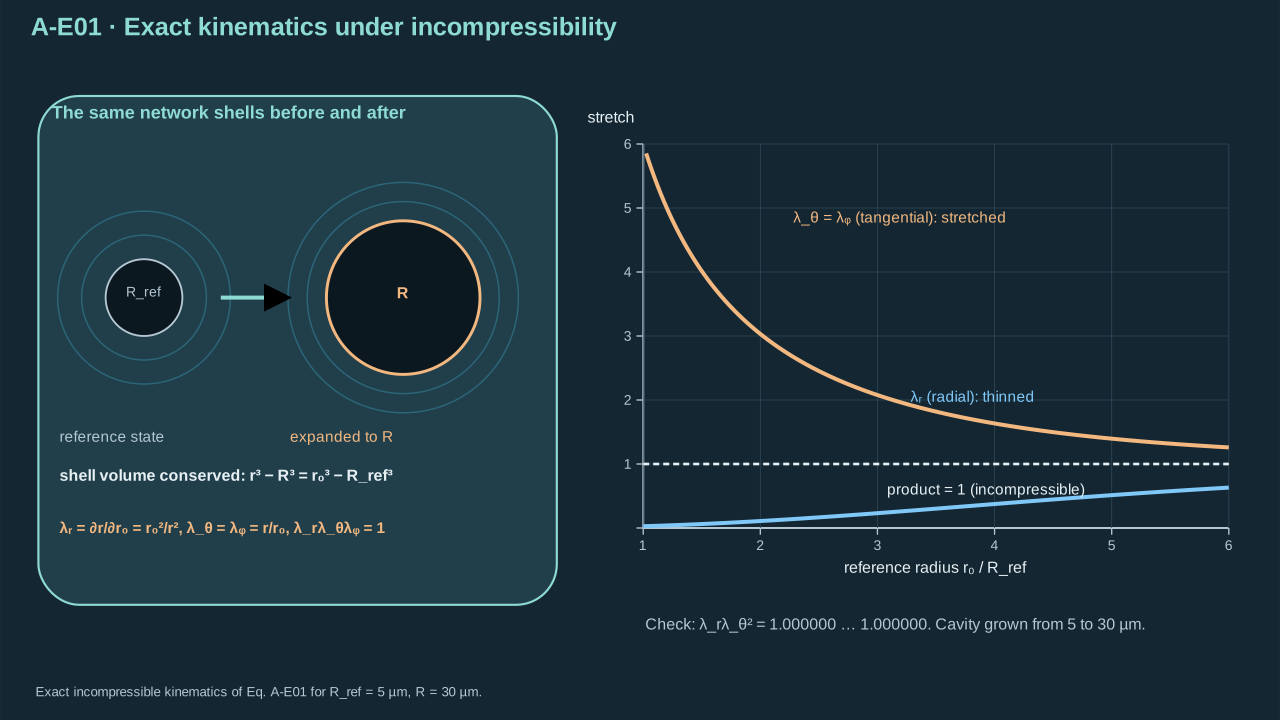
(A-E01) · Exact kinematics under incompressibility

不可压缩条件下的精确运动学关系

r3−R3=r03−Rref3,3r2∂r∂r0=3r02,λr:=∂r∂r0=r02r2,λθ=λϕ=rr0,λrλθλϕ=1.\begin{aligned}r^3-R^3&=r_0^3-R_{\mathrm{ref}}^3,\\3r^2\frac{\partial r}{\partial r_0}&=3r_0^2,\\\lambda_r:=\frac{\partial r}{\partial r_0}&=\frac{r_0^2}{r^2},\qquad\lambda_\theta=\lambda_\phi=\frac{r}{r_0},\\\lambda_r\lambda_\theta\lambda_\phi&=1.\end{aligned}
The same network shell moves outward while thinning radially and stretching tangentially.

The same network shell moves outward while thinning radially and stretching tangentially.

同一网络球壳向外移动,同时径向变薄、切向伸长。

Step 2 — Apply neo-Hookean stress. Each principal stress contains a common incompressibility multiplier and stretch contribution. Subtract radial from tangential stress to remove the multiplier. This constitutive assumption requires material validation.

步骤 2——应用 neo-Hookean 应力。各主应力包含共同不可压缩乘子及伸长项。切向减径向应力,消去乘子。该本构假设需要材料验证。

Symbols before Eq. (A-E02).

式(A-E02)前的符号定义。

First individual definition第一项单独定义Second individual definition第二项单独定义

Te\mathbf T^e — Elastic Cauchy stress tensor, tension positive (Pa)

Te\mathbf T^e — 拉伸取正的弹性柯西应力张量(Pa)

χ\chi is the incompressibility multiplier (Pa)

χ\chi 为不可压缩约束乘子(Pa)

I\mathbf I is the dimensionless identity tensor

I\mathbf I 为无量纲单位张量

Gg>0G_g>0 is network shear modulus (Pa)

Gg>0G_g>0 为网络剪切模量(Pa)

F\mathbf F is the dimensionless deformation gradient

F\mathbf F 为无量纲变形梯度

B\mathbf B its left Cauchy–Green tensor (dimensionless)

B\mathbf B 为左 Cauchy–Green 张量(无量纲)

λr\lambda_r — Radial principal stretch (dimensionless)

λr\lambda_r — 径向主伸长比(无量纲)

λθ\lambda_\theta — Polar tangential principal stretch (dimensionless)

λθ\lambda_\theta — 极角切向主伸长比(无量纲)

rr — Current material radius (m)

rr — 当前物质半径(m)

r0>0r_0>0 — Reference material radius (m)

r0>0r_0>0 — 参考物质半径(m)

TrreT^e_{rr} — Radial elastic Cauchy stress (Pa)

TrreT^e_{rr} — 径向弹性柯西应力(Pa)

TθθeT^e_{\theta\theta} — Polar tangential elastic Cauchy stress (Pa)

TθθeT^e_{\theta\theta} — 极角切向弹性柯西应力(Pa)

TϕϕeT^e_{\phi\phi} — Azimuthal tangential elastic Cauchy stress (Pa)

TϕϕeT^e_{\phi\phi} — 方位角切向弹性柯西应力(Pa)

Conventions and conditions. T\mathsf T denotes transpose; Elastic stress is positive in tension..

约定与条件。 T\mathsf T 表示转置;弹性应力以拉伸为正。。

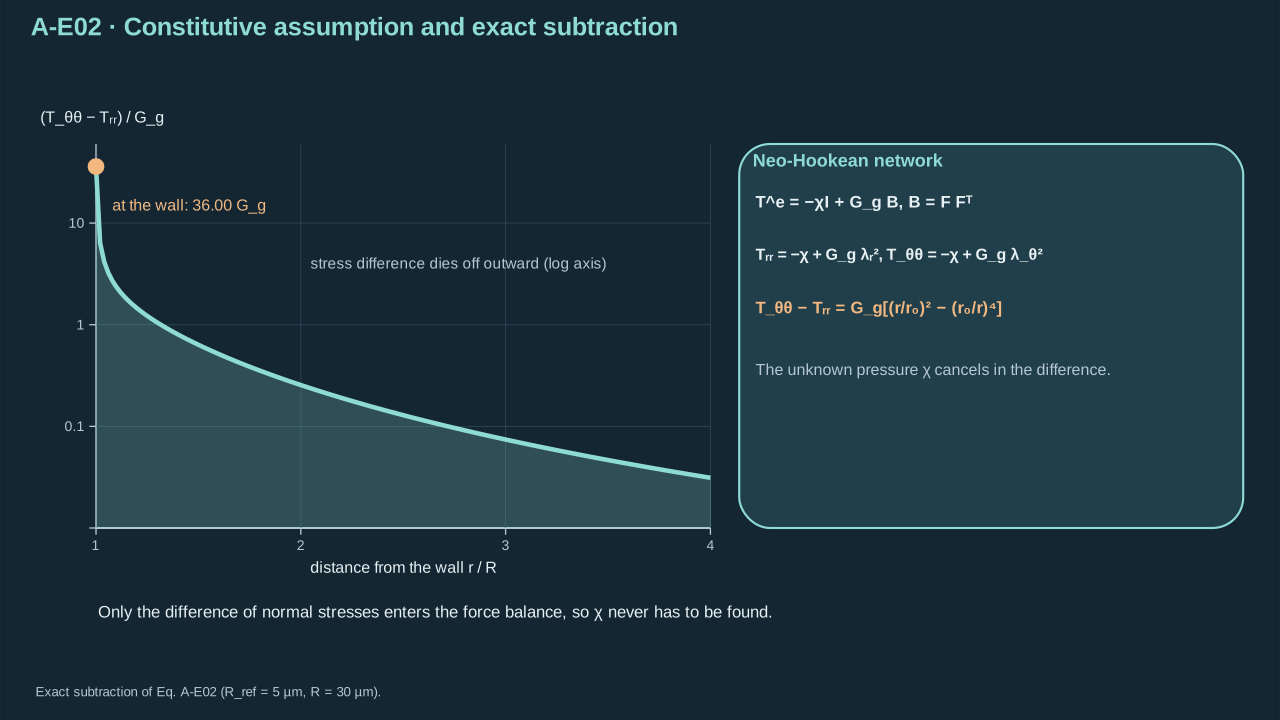
(A-E02) · Constitutive assumption and exact subtraction

本构假设与精确相减关系

Te=−χI+GgB,B=FFT,Trre=−χ+Ggλr2,Tθθe=Tϕϕe=−χ+Ggλθ2,Tθθe−Trre=Gg[(rr0)2−(r0r)4].\begin{aligned}\mathbf T^e&=-\chi\mathbf I+G_g\mathbf B,\qquad\mathbf B=\mathbf F\mathbf F^{\mathsf T},\\T^e_{rr}&=-\chi+G_g\lambda_r^2,\qquad T^e_{\theta\theta}=T^e_{\phi\phi}=-\chi+G_g\lambda_\theta^2,\\T^e_{\theta\theta}-T^e_{rr}&=G_g\left[\left(\frac r{r_0}\right)^2-\left(\frac{r_0}r\right)^4\right].\end{aligned}
Radial and tangential stretches produce different network stresses around the cavity.

Radial and tangential stretches produce different network stresses around the cavity.

空腔周围的径向与切向伸长产生不同的网络应力。

Step 3 — Integrate spherical elastic balance. Radial stress derivative equals twice tangential-minus-radial stress divided by radius. Wall and far-field tractions determine elastic resistance. The same stress-difference integral enters dynamic balance later. That use retains the separate dynamic inertia.

步骤 3——积分球形弹性平衡。径向应力导数等于切向减径向应力的两倍除以半径。壁面及远场牵引确定弹性阻力。同一应力差积分随后进入动力学平衡,同时保留独立动力学惯性。

Symbols before Eq. (A-E03).

式(A-E03)前的符号定义。

First individual definition第一项单独定义Second individual definition第二项单独定义

TrreT^e_{rr} — Radial elastic Cauchy stress (Pa)

TrreT^e_{rr} — 径向弹性柯西应力(Pa)

TθθeT^e_{\theta\theta} — Polar tangential elastic Cauchy stress (Pa)

TθθeT^e_{\theta\theta} — 极角切向弹性柯西应力(Pa)

rr is current radius (m)

rr 为当前半径(m)

r0=r0(r)r_0=r_0(r) the reference coordinate (m)

r0=r0(r)r_0=r_0(r) 为参考坐标(m)

R>0R>0 the cavity radius (m)

R>0R>0 为腔体半径(m)

pbp_b — Cavity pressure (Pa)

pbp_b — 空腔压力(Pa)

p∞p_\infty — Far-field pressure (Pa)

p∞p_\infty — 远场压力(Pa)

σ≥0\sigma\geq0 is constant tension (N m⁻¹)

σ≥0\sigma\geq0 为恒定张力(N m⁻¹)

Gg>0G_g>0 is shear modulus (Pa)

Gg>0G_g>0 为剪切模量(Pa)

pelp_{\mathrm{el}} is the signed elastic resistance (Pa)

pelp_{\mathrm{el}} 为带符号的弹性阻力(Pa)

Conventions and conditions. d/drd/dr differentiates in rr, ∫R∞\int_R^\infty integrates over exterior material, and ∞\infty labels the infinite far field.

约定与条件。 d/drd/dr 表示对 rr 求导,∫R∞\int_R^\infty 对外部材料积分,∞\infty 标记无限远场。

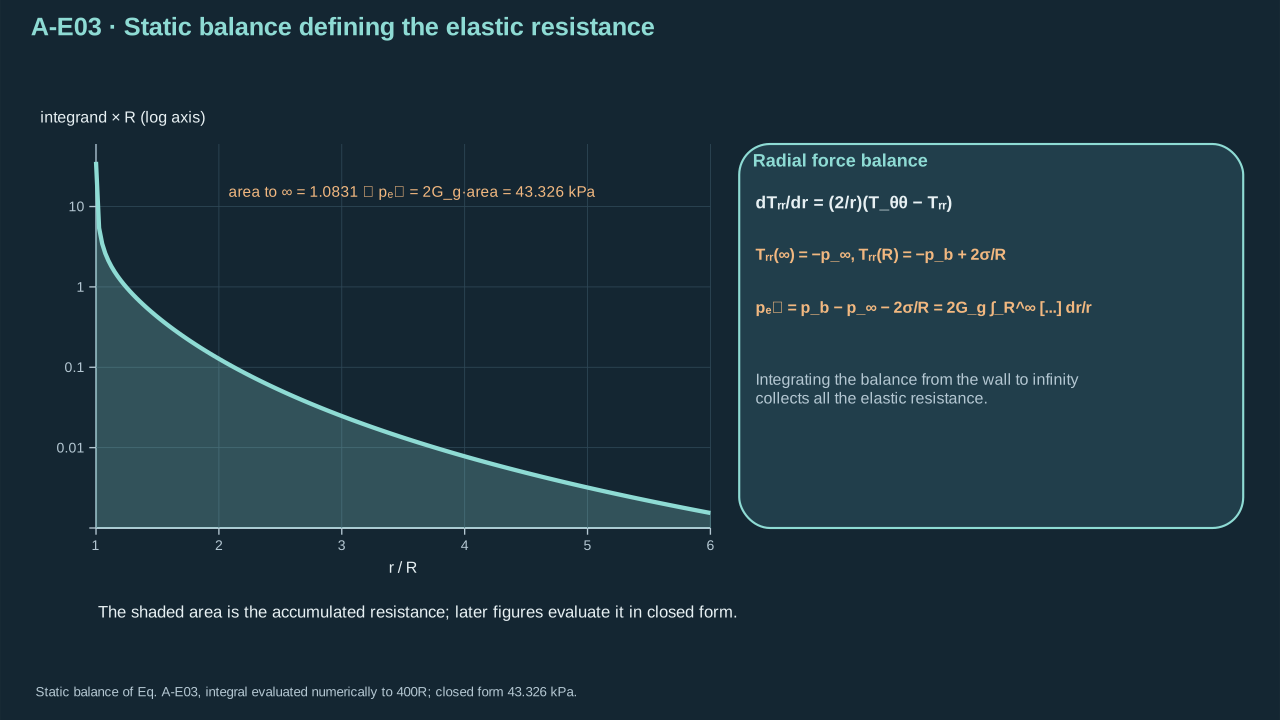
(A-E03) · Static balance defining the elastic resistance

定义弹性阻力的静态平衡

dTrredr=2r(Tθθe−Trre),Trre(∞)=−p∞,Trre(R)=−pb+2σR,pel(R):=pb−p∞−2σR=2Gg∫R∞[(rr0)2−(r0r)4]drr.\begin{aligned}\frac{dT^e_{rr}}{dr}&=\frac{2}{r}(T^e_{\theta\theta}-T^e_{rr}),\\T^e_{rr}(\infty)&=-p_\infty,\qquad T^e_{rr}(R)=-p_b+\frac{2\sigma}{R},\\p_{\mathrm{el}}(R):=p_b-p_\infty-\frac{2\sigma}{R}&=2G_g\int_R^\infty\left[\left(\frac r{r_0}\right)^2-\left(\frac{r_0}r\right)^4\right]\frac{dr}{r}.\end{aligned}
The wall pressure supports capillary traction and the accumulated elastic resistance.

The wall pressure supports capillary traction and the accumulated elastic resistance.

壁面压力同时支撑毛细牵引与积分后的弹性阻力。

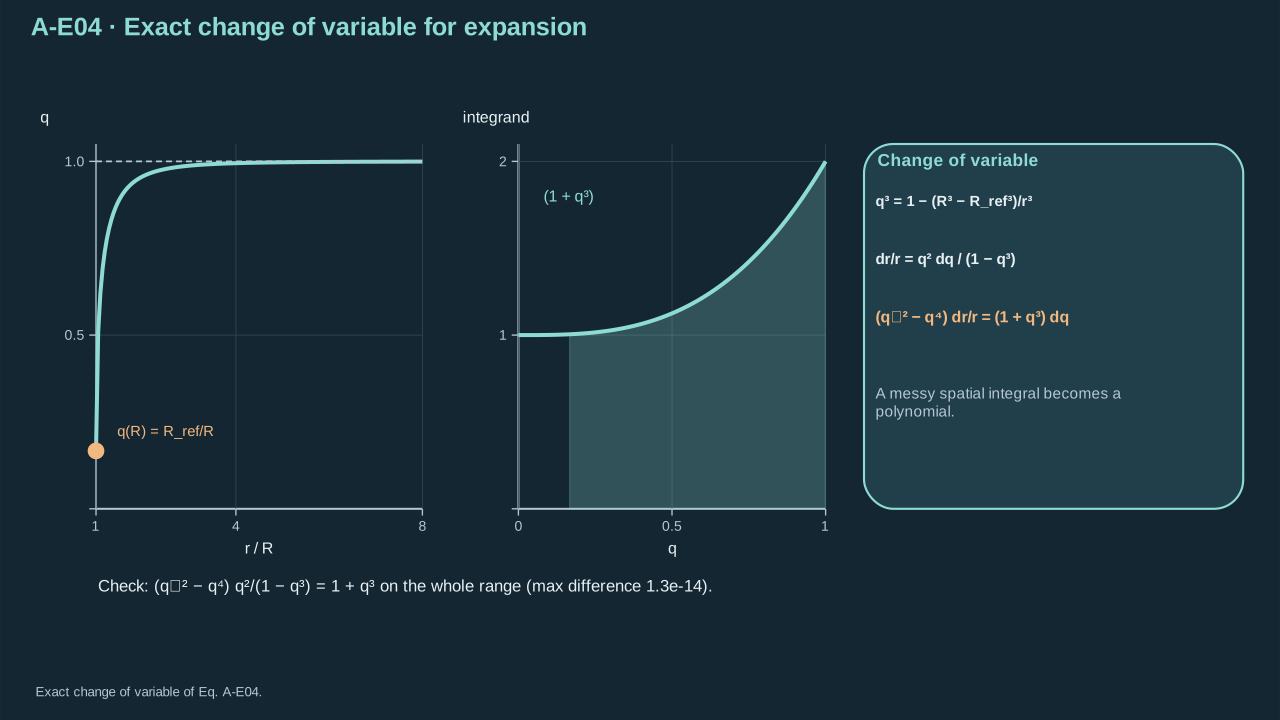
Step 4 — Transform radius with its Jacobian. For R>RrefR>R_{\mathrm{ref}}, set q=r0/rq=r_0/r. It rises from Rref/RR_{\mathrm{ref}}/R to one. Differentiate its cube and cancel the positive square. Finite exterior positions have positive 1−q31-q^3. The undeformed transformation is degenerate. Evaluate its zero resistance directly.

步骤 4——连同雅可比变换半径。R>RrefR>R_{\mathrm{ref}} 时令 q=r0/rq=r_0/r,它从 Rref/RR_{\mathrm{ref}}/R 增至一。对其三次方求导并约去正平方。有限外域位置满足 1−q3>01-q^3>0。未变形时换元退化,直接计算零阻力。

Symbols before Eq. (A-E04).

式(A-E04)前的符号定义。

First individual definition第一项单独定义Second individual definition第二项单独定义

q=r0/rq=r_0/r is a positive dimensionless coordinate ratio

q=r0/rq=r_0/r 为正的无量纲坐标比

r0r_0 — Reference material radius (m)

r0r_0 — 参考物质半径(m)

rr — Current material radius (m)

rr — 当前物质半径(m)

R>Rref>0R>R_{\mathrm{ref}}>0 — Current cavity radius (m)

R>Rref>0R>R_{\mathrm{ref}}>0 — 当前腔体半径(m)

RrefR_{\mathrm{ref}} — Stress-free reference cavity radius (m)

RrefR_{\mathrm{ref}} — 无应力参考腔体半径(m)

q(R)q(R) — Coordinate-ratio value at the cavity wall (dimensionless)

q(R)q(R) — 空腔壁面处的坐标比值(无量纲)

q(∞)q(\infty) denote endpoint values (dimensionless)

q(∞)q(\infty) 表示端点值(无量纲)

dqdq — Dimensionless coordinate-ratio integration element (dimensionless)

dqdq — 无量纲坐标比积分微元(无量纲)

drdr — Current-radius integration element (m)

drdr — 当前半径积分微元(m)

Conventions and conditions. ∞\infty denotes the far-field limit; The factorization 1−q6=(1−q3)(1+q3)1-q^6=(1-q^3)(1+q^3) applies for q<1q<1 before taking the endpoint limit.

约定与条件。 ∞\infty 表示远场极限;因式分解 1−q6=(1−q3)(1+q3)1-q^6=(1-q^3)(1+q^3) 先在 q<1q<1 时使用,再取端点极限。

(A-E04) · Exact change of variable for expansion

膨胀过程的精确变量代换

q3=1−R3−Rref3r3,q(R)=RrefR,q(∞)=1,3q2 dq=3(1−q3)drr,drr=q2 dq1−q3,(q−2−q4)drr=1−q61−q3 dq=(1+q3) dq.\begin{aligned}q^3&=1-\frac{R^3-R_{\mathrm{ref}}^3}{r^3},\qquad q(R)=\frac{R_{\mathrm{ref}}}{R},\qquad q(\infty)=1,\\3q^2\,dq&=3(1-q^3)\frac{dr}{r},\qquad \frac{dr}{r}=\frac{q^2\,dq}{1-q^3},\\\left(q^{-2}-q^4\right)\frac{dr}{r}&=\frac{1-q^6}{1-q^3}\,dq=(1+q^3)\,dq.\end{aligned}
The material coordinate ratio converts a spatial stress integral into a regular polynomial integral.

The material coordinate ratio converts a spatial stress integral into a regular polynomial integral.

材料坐标比将空间应力积分转化为正则的多项式积分。

Symbols before Eq. (A-E05).

式(A-E05)前的符号定义。

First individual definition第一项单独定义Second individual definition第二项单独定义

pelp_{\mathrm{el}} is elastic cavity resistance (Pa)

pelp_{\mathrm{el}} 为弹性腔体阻力(Pa)

Gg>0G_g>0 is network shear modulus (Pa)

Gg>0G_g>0 为网络剪切模量(Pa)

R≥Rref>0R\geq R_{\mathrm{ref}}>0 — Current cavity radius (m)

R≥Rref>0R\geq R_{\mathrm{ref}}>0 — 当前腔体半径(m)

RrefR_{\mathrm{ref}} — Stress-free reference cavity radius (m)

RrefR_{\mathrm{ref}} — 无应力参考腔体半径(m)

qq is the dimensionless integration variable

qq 为无量纲积分变量

Conventions and conditions. ∫\int is a definite integral; [f(q)]ab[f(q)]_a^b means upper-endpoint minus lower-endpoint evaluation of the bracketed function.

约定与条件。 ∫\int 为定积分;[f(q)]ab[f(q)]_a^b 表示括号中函数的上端点值减去下端点值。

(A-E05) · Derived neo-Hookean elastic resistance

推导得到的新胡克弹性阻力

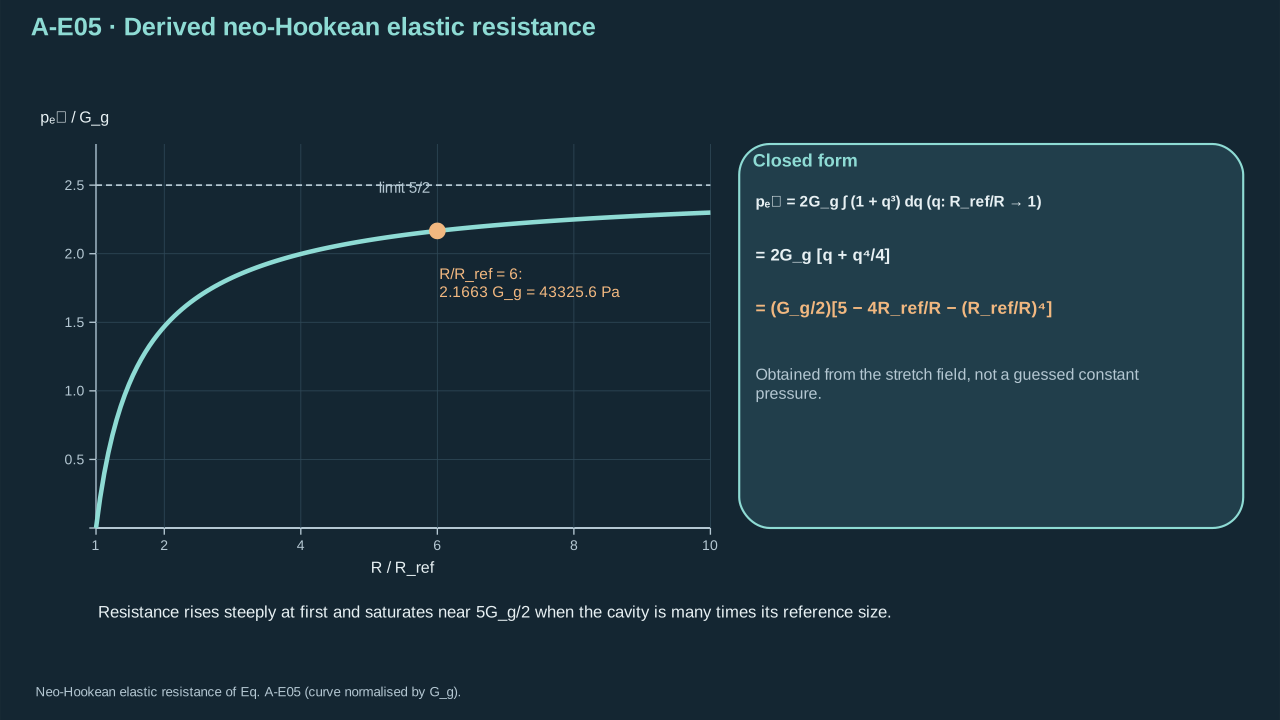
pel(R)=2Gg∫Rref/R1(1+q3) dq=2Gg[q+q44]Rref/R1=2Gg[54−RrefR−14(RrefR)4]=Gg2[5−4RrefR−(RrefR)4].\begin{aligned}p_{\mathrm{el}}(R)&=2G_g\int_{R_{\mathrm{ref}}/R}^{1}(1+q^3)\,dq\\&=2G_g\left[q+\frac{q^4}{4}\right]_{R_{\mathrm{ref}}/R}^{1}\\&=2G_g\left[\frac54-\frac{R_{\mathrm{ref}}}{R}-\frac14\left(\frac{R_{\mathrm{ref}}}{R}\right)^4\right]\\&=\frac{G_g}{2}\left[5-4\frac{R_{\mathrm{ref}}}{R}-\left(\frac{R_{\mathrm{ref}}}{R}\right)^4\right].\end{aligned}
Elastic resistance follows from the full stretch field, not from a guessed constant pressure.

Elastic resistance follows from the full stretch field, not from a guessed constant pressure.

弹性阻力来自完整伸长场,而不是猜测的恒定压力。

The rows apply Eq. (A-E04), integrate 1+q31+q^3, evaluate endpoints, then multiply. This reproduces Gaudron et al., Eq. (2.18). Large expansion approaches a constitutive pressure plateau. Fracture threshold remains unestablished. Finite geometry, prestress, stiffening or rupture can change the response. [R13]

各行依次应用式(A-E04)、积分 1+q31+q^3、计算端点并相乘。这恢复 Gaudron 等式(2.18)。大膨胀趋于本构压力平台。断裂阈值尚未确立。有限几何、预应力、硬化或破裂可改变响应。 [R13]

Symbols before Eq. (A-E06).

式(A-E06)前的符号定义。

First individual definition第一项单独定义Second individual definition第二项单独定义

pelp_{\mathrm{el}} is pressure resistance (Pa)

pelp_{\mathrm{el}} 为压力阻力(Pa)

Gg>0G_g>0 is shear modulus (Pa)

Gg>0G_g>0 为剪切模量(Pa)

R≥Rref>0R\geq R_{\mathrm{ref}}>0 — Current cavity radius (m)

R≥Rref>0R\geq R_{\mathrm{ref}}>0 — 当前腔体半径(m)

RrefR_{\mathrm{ref}} — Stress-free reference cavity radius (m)

RrefR_{\mathrm{ref}} — 无应力参考腔体半径(m)

Conventions and conditions. d/dRd/dR is the radius derivative (giving Pa m⁻¹ here); lim⁡\lim takes the positive large-radius-ratio limit; ∞\infty denotes an unbounded ratio.

约定与条件。 d/dRd/dR 表示半径导数(此处单位为 Pa m⁻¹);lim⁡\lim 取正的大半径比极限;∞\infty 表示比值无界。

(A-E06) · Limiting-state and sign checks

极限状态与符号检验

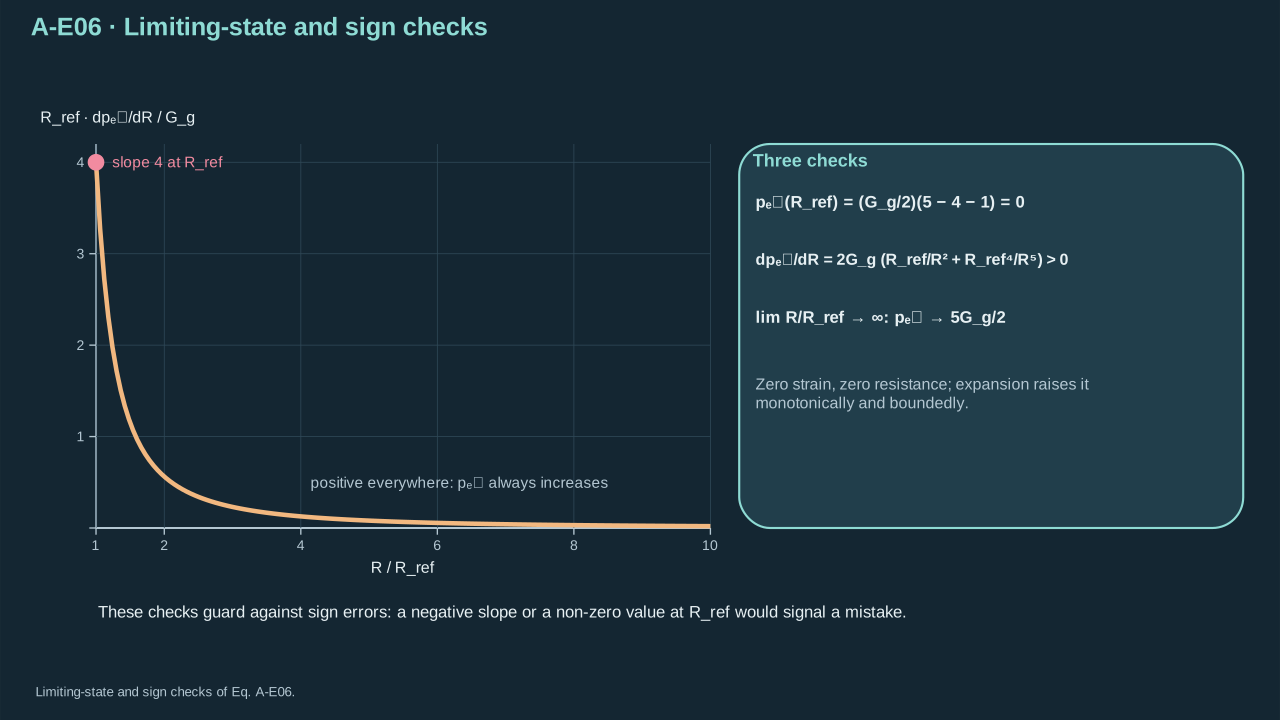
pel(Rref)=Gg2(5−4−1)=0,dpeldR=2Gg(RrefR2+Rref4R5)>0,lim⁡R/Rref→∞pel(R)=52Gg.\begin{aligned}p_{\mathrm{el}}(R_{\mathrm{ref}})&=\frac{G_g}{2}(5-4-1)=0,\\\frac{dp_{\mathrm{el}}}{dR}&=2G_g\left(\frac{R_{\mathrm{ref}}}{R^2}+\frac{R_{\mathrm{ref}}^4}{R^5}\right)>0,\\\lim_{R/R_{\mathrm{ref}}\to\infty}p_{\mathrm{el}}(R)&=\frac52G_g.\end{aligned}
Zero deformation gives zero elastic resistance, and positive expansion raises it monotonically.

Zero deformation gives zero elastic resistance, and positive expansion raises it monotonically.

零变形给出零弹性阻力,正向膨胀使阻力单调增大。

3. Elastic work

3. 弹性功

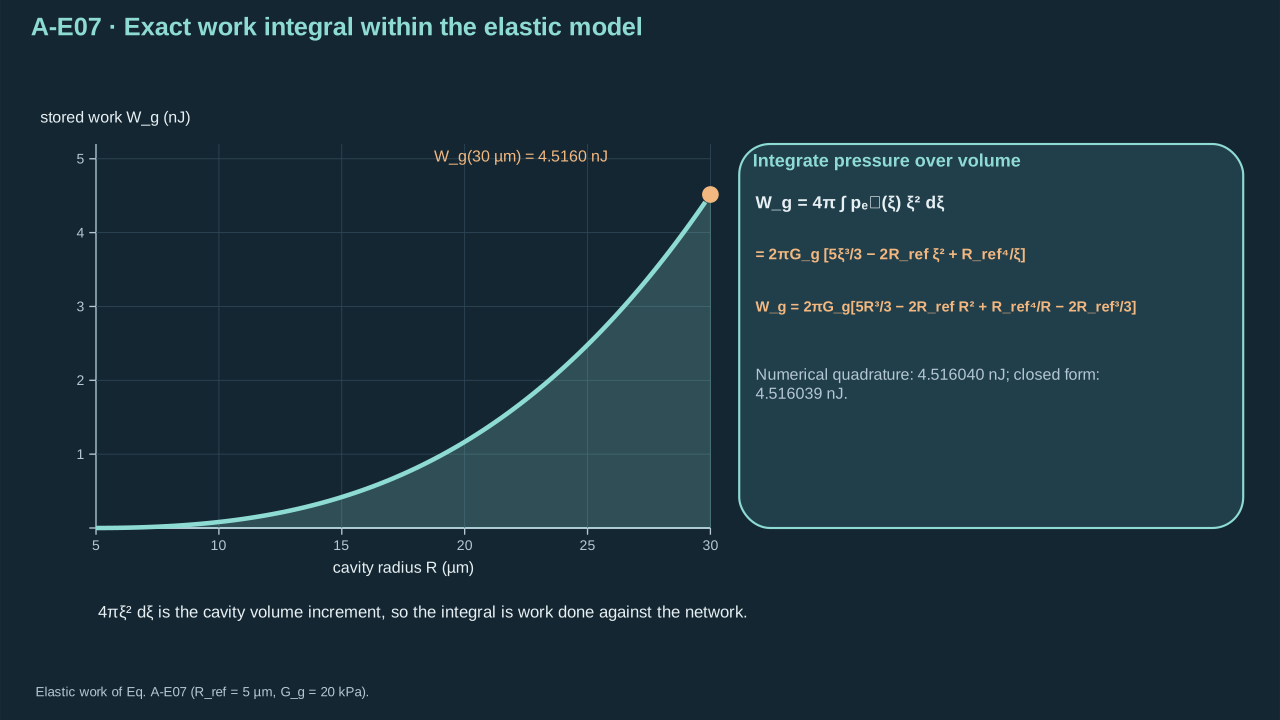
Step 5 — Integrate pressure against volume change. Multiply elastic pressure by spherical area. Insert Eq. (A-E05) and integrate each dummy-radius power. The antiderivative of ξ−2\xi^{-2} is −1/ξ-1/\xi. Keep both endpoints to enforce zero reference work.

步骤 5——对体积变化积分压力功。将弹性压力乘球面面积,代入式(A-E05),积分各哑半径幂。ξ−2\xi^{-2} 的原函数为 −1/ξ-1/\xi。保留两端点,使参考功为零。

Symbols before Eq. (A-E07).

式(A-E07)前的符号定义。

First individual definition第一项单独定义Second individual definition第二项单独定义

WgW_g is stored elastic work relative to the unstretched state (J)

WgW_g 为相对未伸长状态的储存弹性功(J)

pel(ξ)p_{\mathrm{el}}(\xi) is signed elastic resistance (Pa)

pel(ξ)p_{\mathrm{el}}(\xi) 为带符号弹性阻力(Pa)

Gg>0G_g>0 is modulus (Pa)

Gg>0G_g>0 为模量(Pa)

R≥Rref>0R\geq R_{\mathrm{ref}}>0 — Current cavity radius (m)

R≥Rref>0R\geq R_{\mathrm{ref}}>0 — 当前腔体半径(m)

RrefR_{\mathrm{ref}} — Stress-free reference cavity radius (m)

RrefR_{\mathrm{ref}} — 无应力参考腔体半径(m)

dξd\xi is its differential (m)

dξd\xi 为其微分(m)

π\pi is the circle constant (dimensionless)

π\pi 为圆周率(无量纲)

ξ\xi — Dummy cavity-radius integration coordinate (m)

ξ\xi — 空腔半径积分哑坐标(m)

Conventions and conditions. [ ]RrefR[\ ]_{R_{\mathrm{ref}}}^{R} denotes endpoint subtraction.

约定与条件。 [ ]RrefR[\ ]_{R_{\mathrm{ref}}}^{R} 表示端点相减。

(A-E07) · Exact work integral within the elastic model

弹性模型内的精确功积分

Wg(R)=4π∫RrefRpel(ξ)ξ2 dξ=2πGg∫RrefR(5ξ2−4Rrefξ−Rref4ξ−2)dξ=2πGg[5ξ33−2Rrefξ2+Rref4ξ]RrefR=2πGg[5R33−2RrefR2+Rref4R−2Rref33].\begin{aligned}W_g(R)&=4\pi\int_{R_{\mathrm{ref}}}^{R}p_{\mathrm{el}}(\xi)\xi^2\,d\xi\\&=2\pi G_g\int_{R_{\mathrm{ref}}}^{R}\left(5\xi^2-4R_{\mathrm{ref}}\xi-R_{\mathrm{ref}}^4\xi^{-2}\right)d\xi\\&=2\pi G_g\left[\frac{5\xi^3}{3}-2R_{\mathrm{ref}}\xi^2+\frac{R_{\mathrm{ref}}^4}{\xi}\right]_{R_{\mathrm{ref}}}^{R}\\&=2\pi G_g\left[\frac{5R^3}{3}-2R_{\mathrm{ref}}R^2+\frac{R_{\mathrm{ref}}^4}{R}-\frac{2R_{\mathrm{ref}}^3}{3}\right].\end{aligned}
The area factor converts radius increments into cavity volume increments before integrating work.

The area factor converts radius increments into cavity volume increments before integrating work.

先用面积因子将半径增量转化为腔体体积增量,再积分功。

The lower endpoint is (5/3−2+1)Rref3=2Rref3/3(5/3-2+1)R_{\mathrm{ref}}^3=2R_{\mathrm{ref}}^3/3. Subtract it in the final row. Pressure can plateau while work grows with volume. Units are Pa m³ = J. Differentiating work recovers pressure × area.

下端点为 (5/3−2+1)Rref3=2Rref3/3(5/3-2+1)R_{\mathrm{ref}}^3=2R_{\mathrm{ref}}^3/3,在末行减去。压力可形成平台而功随体积增加。单位为 Pa m³ = J。对功求导可恢复压力 × 面积。

Symbols before Eq. (A-E08).

式(A-E08)前的符号定义。

First individual definition第一项单独定义Second individual definition第二项单独定义

WgW_g is elastic work (J)

WgW_g 为弹性功(J)

pelp_{\mathrm{el}} resistance (Pa)

pelp_{\mathrm{el}} 为阻力(Pa)

Gg>0G_g>0 shear modulus (Pa)

Gg>0G_g>0 为剪切模量(Pa)

RR — Current cavity radius (m)

RR — 当前腔体半径(m)

Rref>0R_{\mathrm{ref}}>0 — Stress-free reference cavity radius (m)

Rref>0R_{\mathrm{ref}}>0 — 无应力参考腔体半径(m)

δR=R−Rref\delta R=R-R_{\mathrm{ref}} a small radius change (m), with ∣δR∣/Rref≪1|\delta R|/R_{\mathrm{ref}}\ll1

δR=R−Rref\delta R=R-R_{\mathrm{ref}} 为小半径变化(m),满足 ∣δR∣/Rref≪1|\delta R|/R_{\mathrm{ref}}\ll1

π\pi is dimensionless

π\pi 为无量纲量

Conventions and conditions. d/dRd/dR is differentiation in radius; OO denotes terms bounded by a constant times the indicated scale as that ratio tends to zero.

约定与条件。 d/dRd/dR 表示对半径求导;OO 表示当该比值趋于零时,被某常数乘所示尺度界定的项。

(A-E08) · Work-conjugacy and small-deformation checks

功共轭关系与小变形检验

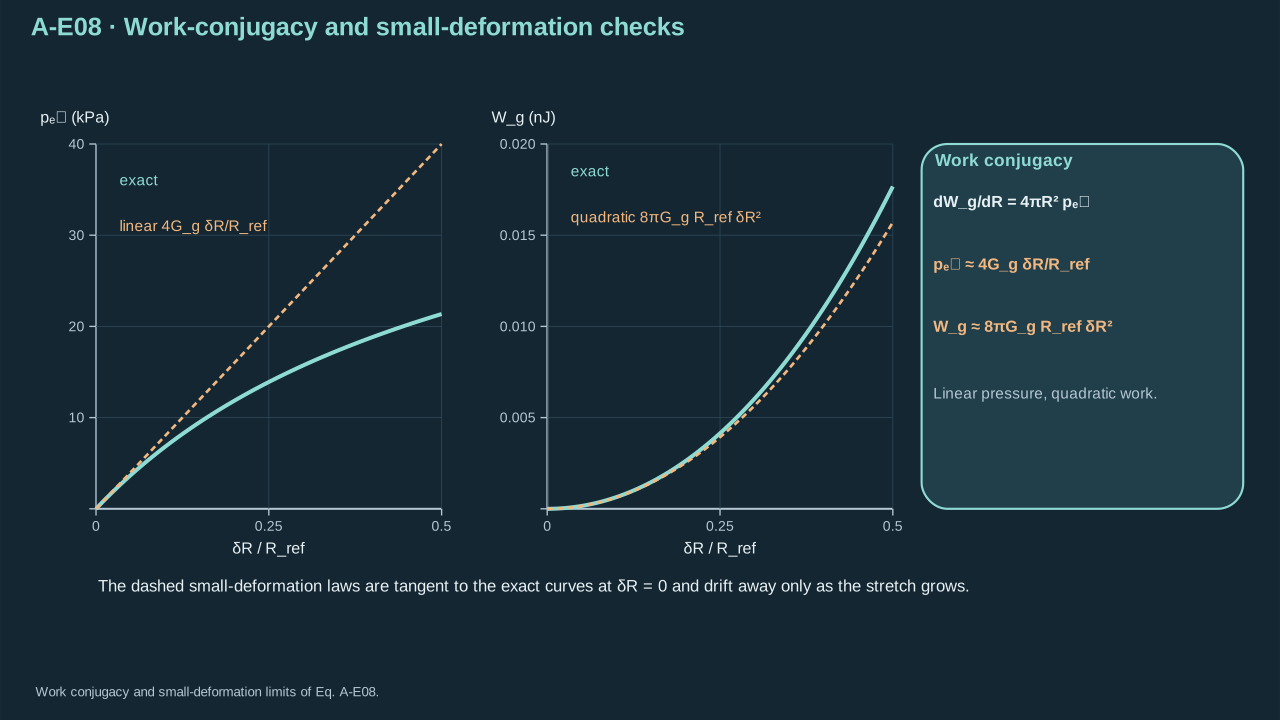
dWgdR=2πGg(5R2−4RrefR−Rref4R2)=4πR2pel(R),R=Rref+δR ⁣:pel=4GgδRRref+O ⁣(GgδR2Rref2),Wg=8πGgRrefδR2+O(GgδR3).\begin{aligned}\frac{dW_g}{dR}&=2\pi G_g\left(5R^2-4R_{\mathrm{ref}}R-\frac{R_{\mathrm{ref}}^4}{R^2}\right)=4\pi R^2p_{\mathrm{el}}(R),\\R=R_{\mathrm{ref}}+\delta R\colon\qquad p_{\mathrm{el}}&=\frac{4G_g\delta R}{R_{\mathrm{ref}}}+O\!\left(G_g\frac{\delta R^2}{R_{\mathrm{ref}}^2}\right),\\W_g&=8\pi G_gR_{\mathrm{ref}}\delta R^2+O(G_g\delta R^3).\end{aligned}
Near the reference cavity, pressure is linear in radius change and stored work is quadratic.

Near the reference cavity, pressure is linear in radius change and stored work is quadratic.

在参考腔体附近,压力与半径变化呈线性关系,储存功则呈二次关系。

Differentiate Eq. (A-E05) at reference radius for the linear term. Integrate it with area 4πRref24\pi R_{\mathrm{ref}}^2 for quadratic work. A reference-volume strain-energy integral also recovers Eq. (A-E07). Intact hyperelastic storage is reversible. Its useful return depends on timing and geometry. Distinguish stored energy from irreversible heat loss.

在参考半径对式(A-E05)求导,得到线性项。乘面积 4πRref24\pi R_{\mathrm{ref}}^2 后积分,得到二次功。参考体积应变能积分也恢复式(A-E07)。完整超弹性储能可逆,其有用返还取决于时序和几何。应区分储能与不可逆热损失。

4. Inertia and viscous loss

4. 惯性与黏性损失

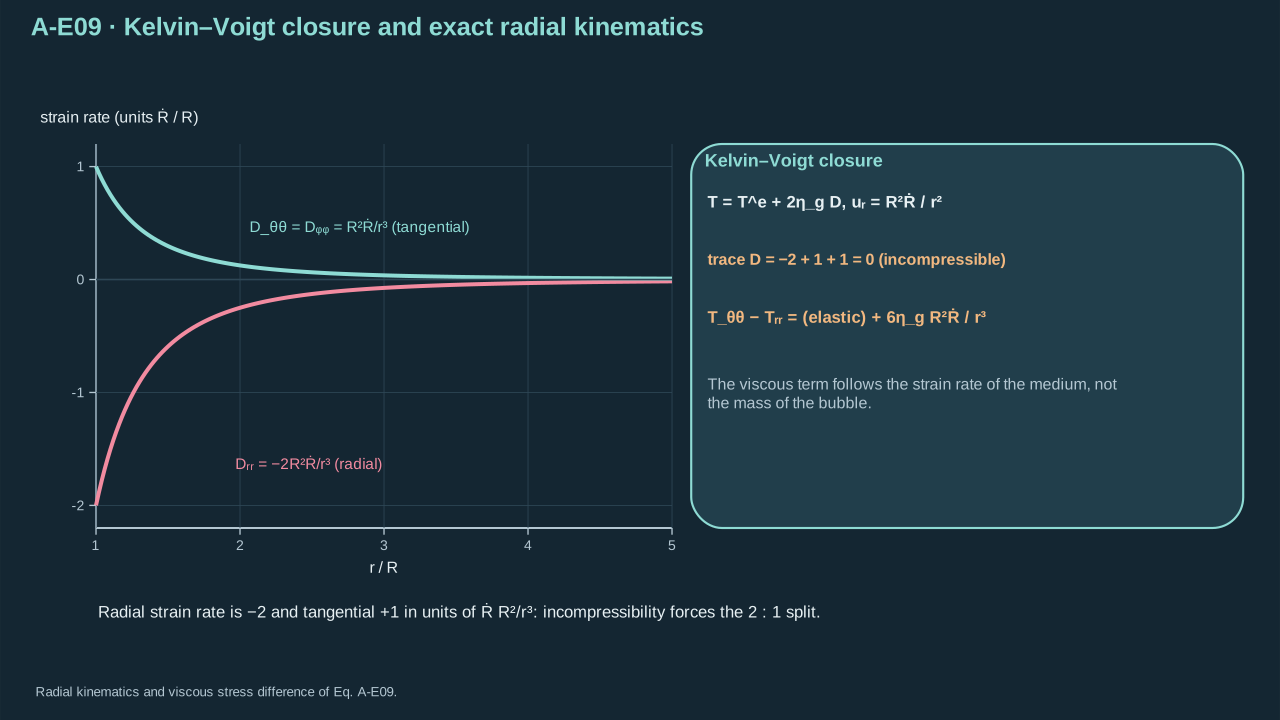
Step 6 — Add Kelvin–Voigt viscosity. Total stress adds 2ηgD2\eta_g\mathbf D to elastic stress. D\mathbf D is symmetric velocity gradient. Incompressibility and equal material/wall normal velocity give the radial field. Expansion produces negative radial gradient and positive tangential extension.

步骤 6——加入 Kelvin–Voigt 黏性。总应力在弹性应力上加入 2ηgD2\eta_g\mathbf D,其中 D\mathbf D 为对称速度梯度。不可压缩性及材料/壁面法向速度相等给出径向流场。膨胀产生负径向梯度及正切向伸长。

Symbols before Eq. (A-E09).

式(A-E09)前的符号定义。

First individual definition第一项单独定义Second individual definition第二项单独定义

T\mathbf T — Total Cauchy stress tensor (Pa)

T\mathbf T — 总柯西应力张量(Pa)

Te\mathbf T^e — Elastic Cauchy stress tensor, tension positive (Pa)

Te\mathbf T^e — 拉伸取正的弹性柯西应力张量(Pa)

ηg≥0\eta_g\geq0 is the chosen medium viscosity (Pa s)

ηg≥0\eta_g\geq0 为所选介质黏度(Pa s)

D\mathbf D — Material strain-rate tensor (s⁻¹)

D\mathbf D — 物质应变率张量(s⁻¹)

uru_r is radial material speed (m s⁻¹)

uru_r 为径向材料速度(m s⁻¹)

r≥R(t)>0r\geq R(t)>0 is current position (m)

r≥R(t)>0r\geq R(t)>0 为当前位置(m)

RR wall radius (m)

RR 为壁面半径(m)

tt time (s)

tt 为时间(s)

R˙\dot R wall speed (m s⁻¹)

R˙\dot R 为泡壁速度(m s⁻¹)

TrrT_{rr} — Total radial Cauchy stress (Pa)

TrrT_{rr} — 总径向柯西应力(Pa)

TθθT_{\theta\theta} — Total polar tangential Cauchy stress (Pa)

TθθT_{\theta\theta} — 总极角切向柯西应力(Pa)

TrreT^e_{rr} — Radial elastic Cauchy stress (Pa)

TrreT^e_{rr} — 径向弹性柯西应力(Pa)

TθθeT^e_{\theta\theta} — Polar tangential elastic Cauchy stress (Pa)

TθθeT^e_{\theta\theta} — 极角切向弹性柯西应力(Pa)

DrrD_{rr} — Radial strain-rate component (s⁻¹)

DrrD_{rr} — 径向应变率分量(s⁻¹)

DθθD_{\theta\theta} — Polar tangential strain-rate component (s⁻¹)

DθθD_{\theta\theta} — 极角切向应变率分量(s⁻¹)

DϕϕD_{\phi\phi} — Azimuthal tangential strain-rate component (s⁻¹)

DϕϕD_{\phi\phi} — 方位角切向应变率分量(s⁻¹)

Conventions and conditions. ∂/∂r\partial/\partial r is the fixed-time spatial derivative.

约定与条件。 ∂/∂r\partial/\partial r 为固定时刻的空间导数。

(A-E09) · Kelvin–Voigt closure and exact radial kinematics

Kelvin–Voigt 闭合关系与精确径向运动学

T=Te+2ηgD,ur(r,t)=R2R˙r2,Drr=∂ur∂r=−2R2R˙r3,Dθθ=Dϕϕ=urr=R2R˙r3,Tθθ−Trr=Tθθe−Trre+6ηgR2R˙r3.\begin{aligned}\mathbf T&=\mathbf T^e+2\eta_g\mathbf D,\qquad u_r(r,t)=\frac{R^2\dot R}{r^2},\\D_{rr}&=\frac{\partial u_r}{\partial r}=-\frac{2R^2\dot R}{r^3},\qquad D_{\theta\theta}=D_{\phi\phi}=\frac{u_r}{r}=\frac{R^2\dot R}{r^3},\\T_{\theta\theta}-T_{rr}&=T^e_{\theta\theta}-T^e_{rr}+\frac{6\eta_gR^2\dot R}{r^3}.\end{aligned}
The viscous term derives from the surrounding-medium strain rate, not from bubble mass.

The viscous term derives from the surrounding-medium strain rate, not from bubble mass.

黏性项来自周围介质的应变率,而不是气泡质量。

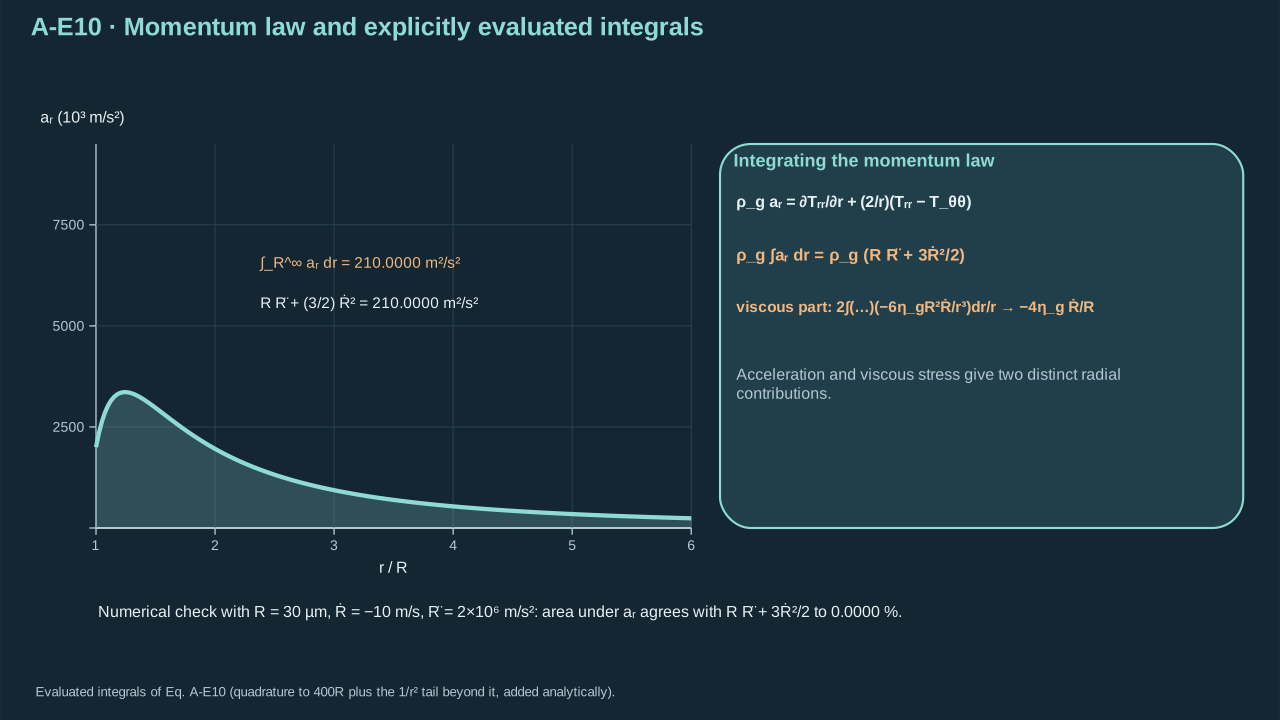
Step 7 — Integrate radial momentum. Retain fixed-position and convective acceleration. Eq. (A-E09) gives an integrable acceleration field. Wall total stress is −pb+2σ/R-p_b+2\sigma/R; far-field stress is −p∞-p_\infty. Integrate their difference to fix the signs.

步骤 7——积分径向动量。保留固定位置及对流加速度。式(A-E09)给出可积加速度场。壁面总应力为 −pb+2σ/R-p_b+2\sigma/R,远场为 −p∞-p_\infty。积分两者之差以确定符号。

Symbols before Eq. (A-E10).

式(A-E10)前的符号定义。

First individual definition第一项单独定义Second individual definition第二项单独定义

ara_r is material radial acceleration (m s⁻²)

ara_r 为材料径向加速度(m s⁻²)

uru_r radial speed (m s⁻¹)

uru_r 为径向速度(m s⁻¹)

r≥R>0r\geq R>0 — Current material radial position outside the cavity (m)

r≥R>0r\geq R>0 — 空腔外部的当前物质径向位置(m)

tt time (s)

tt 为时间(s)

R˙\dot R — Cavity-wall radial velocity (m s⁻¹)

R˙\dot R — 空腔壁面径向速度(m s⁻¹)

R¨\ddot R wall speed/acceleration (m s⁻¹, m s⁻²)

R¨\ddot R 为泡壁速度/加速度(m s⁻¹、m s⁻²)

ρg>0\rho_g>0 is density (kg m⁻³)

ρg>0\rho_g>0 为密度(kg m⁻³)

ηg≥0\eta_g\geq0 viscosity (Pa s)

ηg≥0\eta_g\geq0 为黏度(Pa s)

TrrT_{rr} — Total radial Cauchy stress (Pa)

TrrT_{rr} — 总径向柯西应力(Pa)

TθθT_{\theta\theta} — Total polar tangential Cauchy stress (Pa)

TθθT_{\theta\theta} — 总极角切向柯西应力(Pa)

RR — Current cavity radius (m)

RR — 当前腔体半径(m)

Conventions and conditions. ∂\partial denotes fixed-other-coordinate derivatives and the integrals run through the exterior to infinity; Integrated acceleration times density has units Pa.

约定与条件。 ∂\partial 表示保持其他坐标不变的偏导,积分经外部材料到无穷远;积分后的加速度乘以密度的单位为 Pa。

(A-E10) · Momentum law and explicitly evaluated integrals

动量定律与明确求值的积分

ar:=∂ur∂t+ur∂ur∂r=2RR˙2+R2R¨r2−2R4R˙2r5,ρgar=∂Trr∂r+2r(Trr−Tθθ),ρg∫R∞ar dr=ρg[RR¨+2R˙2−R˙22]=ρg(RR¨+32R˙2),2∫R∞6ηgR2R˙r4 dr=12ηgR2R˙(13R3)=4ηgR˙R.\begin{aligned}a_r&:=\frac{\partial u_r}{\partial t}+u_r\frac{\partial u_r}{\partial r}=\frac{2R\dot R^2+R^2\ddot R}{r^2}-\frac{2R^4\dot R^2}{r^5},\\\rho_g a_r&=\frac{\partial T_{rr}}{\partial r}+\frac{2}{r}(T_{rr}-T_{\theta\theta}),\\\rho_g\int_R^\infty a_r\,dr&=\rho_g\left[R\ddot R+2\dot R^2-\frac{\dot R^2}{2}\right]=\rho_g\left(R\ddot R+\frac32\dot R^2\right),\\2\int_R^\infty\frac{6\eta_gR^2\dot R}{r^4}\,dr&=12\eta_gR^2\dot R\left(\frac{1}{3R^3}\right)=\frac{4\eta_g\dot R}{R}.\end{aligned}
Integrating the material acceleration and the viscous stress difference gives their distinct radial contributions.

Integrating the material acceleration and the viscous stress difference gives their distinct radial contributions.

对材料加速度与黏性应力差积分,得到各自不同的径向贡献。

Symbols before Eq. (A-E11).

式(A-E11)前的符号定义。

First individual definition第一项单独定义Second individual definition第二项单独定义

ρg\rho_g is effective medium density (kg m⁻³)

ρg\rho_g 为有效介质密度(kg m⁻³)

R>0R>0 is the cavity radius (m)

R>0R>0 为腔体半径(m)

R˙\dot R — Cavity-wall radial velocity (m s⁻¹)

R˙\dot R — 空腔壁面径向速度(m s⁻¹)

R¨\ddot R — Cavity-wall radial acceleration (m s⁻²)

R¨\ddot R — 空腔壁面径向加速度(m s⁻²)

pbp_b — Cavity pressure (Pa)

pbp_b — 空腔压力(Pa)

p∞p_\infty — Far-field pressure (Pa)

p∞p_\infty — 远场压力(Pa)

pel(R)p_{\mathrm{el}}(R) — Signed elastic cavity-pressure resistance (Pa)

pel(R)p_{\mathrm{el}}(R) — 带符号弹性空腔压力阻力(Pa)

σ\sigma is tension (N m⁻¹)

σ\sigma 为张力(N m⁻¹)

ηg\eta_g is the represented medium viscosity (Pa s)

ηg\eta_g 为所描述介质的黏度(Pa s)

Conventions and conditions. Each term has units Pa.

约定与条件。 每一项的单位均为 Pa。

(A-E11) · Derived intact-medium radial control

推导得到的完整介质径向对照模型

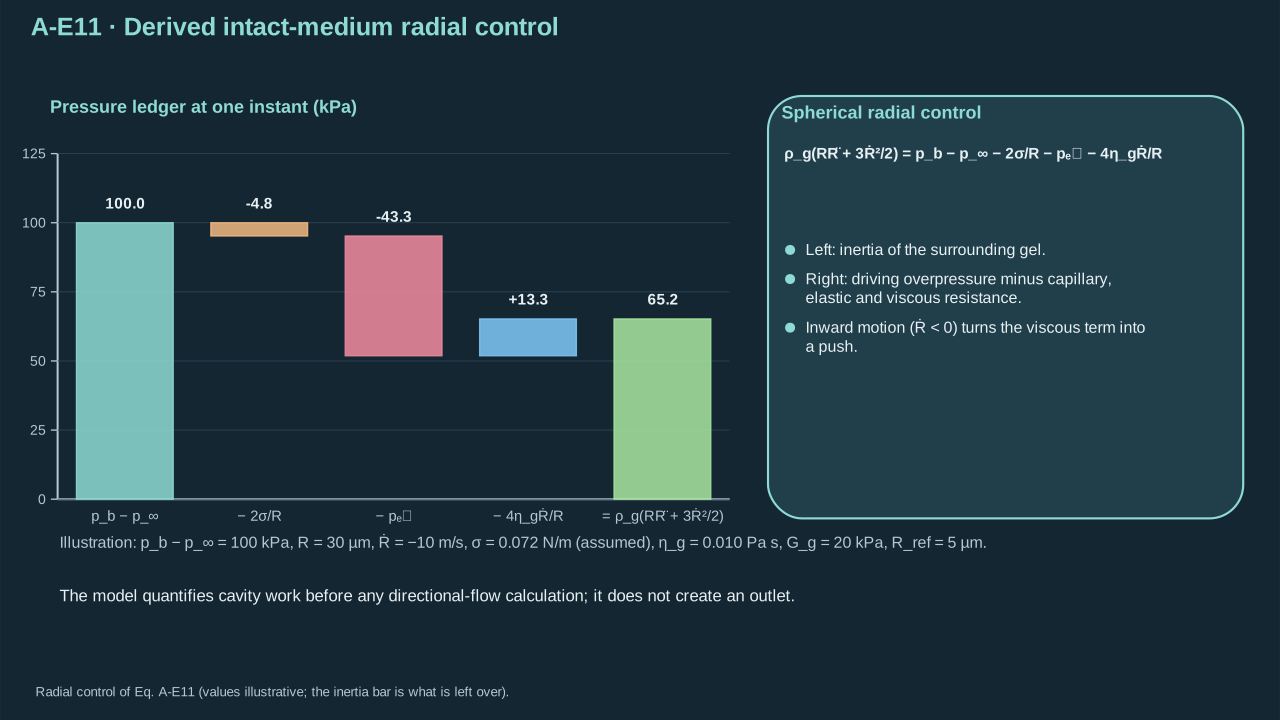
ρg(RR¨+32R˙2)=pb−p∞−2σR−pel(R)−4ηgR˙R.\rho_g\left(R\ddot R+\frac32\dot R^2\right)=p_b-p_\infty-\frac{2\sigma}{R}-p_{\mathrm{el}}(R)-\frac{4\eta_g\dot R}{R}.
The spherical control quantifies cavity work and wall motion before any directional-flow calculation.

The spherical control quantifies cavity work and wall motion before any directional-flow calculation.

球形控制模型先量化腔体功与泡壁运动,再进行定向流动计算。

Integrating the stress derivative gives far-field minus wall stress. Subtract both stress-difference integrals for Eq. (A-E11). Setting Gg=0G_g=0 recovers the liquid model. Viscosity resists expansion and collapse with opposite pressure signs. If fitted ηg\eta_g includes solvent loss, count that dissipation once. Separate solvent/network models need relative-motion closure. Appreciable phase slip changes the wall-kinematic assumption.

积分应力导数得到远场减壁面应力。减去两种应力差积分,得到式(A-E11)。取 Gg=0G_g=0 恢复液体模型。黏性以相反压力符号阻碍膨胀与塌缩。拟合 ηg\eta_g 已包含溶剂损失时,该耗散计入一次。独立溶剂/网络模型需要相对运动闭合。显著相变滑移会改变壁面运动假设。

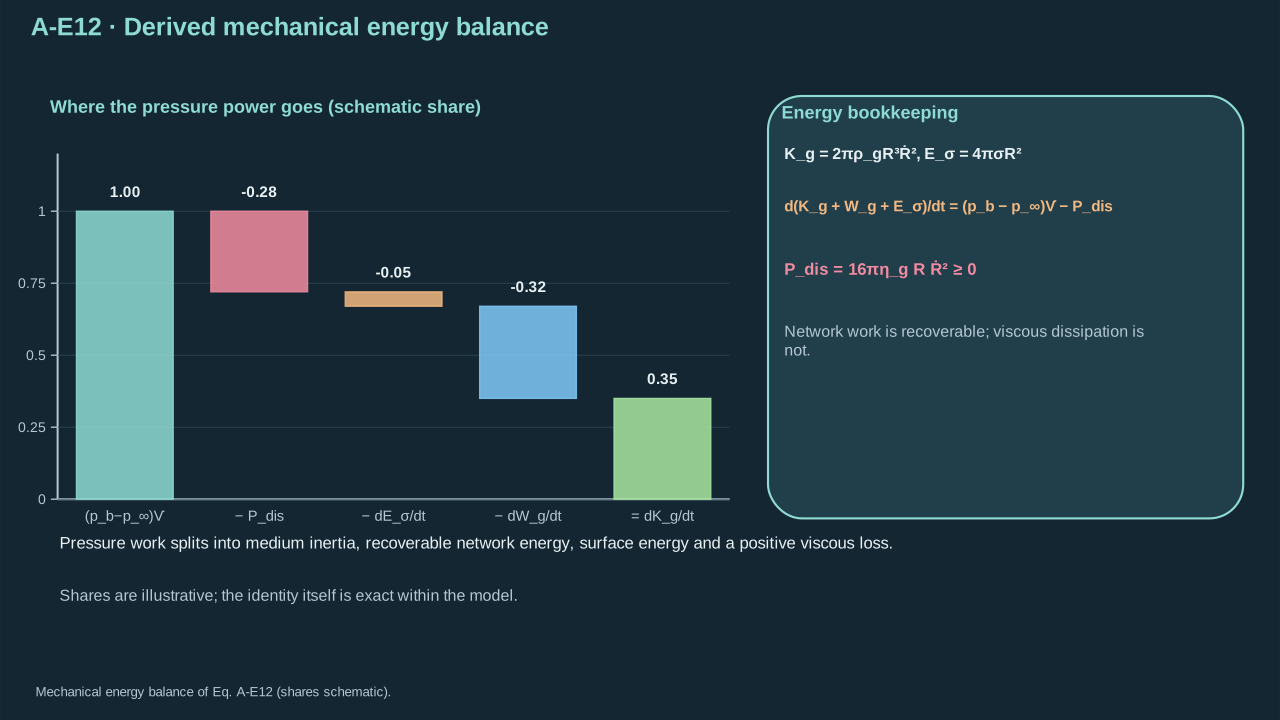
Step 8 — Multiply by volume-change rate. The radial field gives kinetic energy. The checked elastic-work derivative supplies storage rate. Viscosity changes signed acceleration but always dissipates mechanical energy. Its loss contains squared speed.

步骤 8——乘体积变化率。径向流场给出动能,已检验弹性功导数给出储能率。黏性改变带符号加速度,但始终耗散机械能,损失包含速度平方。

Symbols before Eq. (A-E12).

式(A-E12)前的符号定义。

First individual definition第一项单独定义Second individual definition第二项单独定义

KgK_g — Surrounding-medium kinetic energy (J)

KgK_g — 周围介质动能(J)

WgW_g — Stored network elastic work (J)

WgW_g — 储存的网络弹性功(J)

EσE_\sigma — Interface energy (J)

EσE_\sigma — 界面能(J)

ρg\rho_g density (kg m⁻³)

ρg\rho_g 为密度(kg m⁻³)

R>0R>0 radius (m)

R>0R>0 为半径(m)

R˙\dot R wall speed (m s⁻¹)

R˙\dot R 为泡壁速度(m s⁻¹)

σ\sigma tension (N m⁻¹)

σ\sigma 为张力(N m⁻¹)

V˙\dot V is cavity volume-change rate (m³ s⁻¹)

V˙\dot V 为腔体体积变化率(m³ s⁻¹)

pbp_b — Cavity pressure (Pa)

pbp_b — 空腔压力(Pa)

p∞p_\infty — Far-field pressure (Pa)

p∞p_\infty — 远场压力(Pa)

PdisP_{\mathrm{dis}} nonnegative viscous power (W)

PdisP_{\mathrm{dis}} 为非负黏性功率(W)

ηg≥0\eta_g\geq0 viscosity (Pa s)

ηg≥0\eta_g\geq0 为黏度(Pa s)

tt time (s)

tt 为时间(s)

π\pi the circle constant (dimensionless)

π\pi 为圆周率(无量纲)

Conventions and conditions. d/dtd/dt is the full time derivative.

约定与条件。 d/dtd/dt 为全时间导数。

(A-E12) · Derived mechanical energy balance

推导得到的机械能平衡

Kg=2πρgR3R˙2,Eσ=4πσR2,V˙=4πR2R˙,ddt(Kg+Wg+Eσ)=(pb−p∞)V˙−Pdis,Pdis=16πηgRR˙2≥0.\begin{aligned}K_g&=2\pi\rho_gR^3\dot R^2,\qquad E_\sigma=4\pi\sigma R^2,\qquad \dot V=4\pi R^2\dot R,\\\frac{d}{dt}(K_g+W_g+E_\sigma)&=(p_b-p_\infty)\dot V-P_{\mathrm{dis}},\\P_{\mathrm{dis}}&=16\pi\eta_gR\dot R^2\geq0.\end{aligned}
Pressure work divides into inertia, recoverable network energy, surface energy and viscous loss.

Pressure work divides into inertia, recoverable network energy, surface energy and viscous loss.

压力功分配到惯性、可恢复的网络能、表面能和黏性损耗。

5. Pressure and work example

5. 压力与功示例

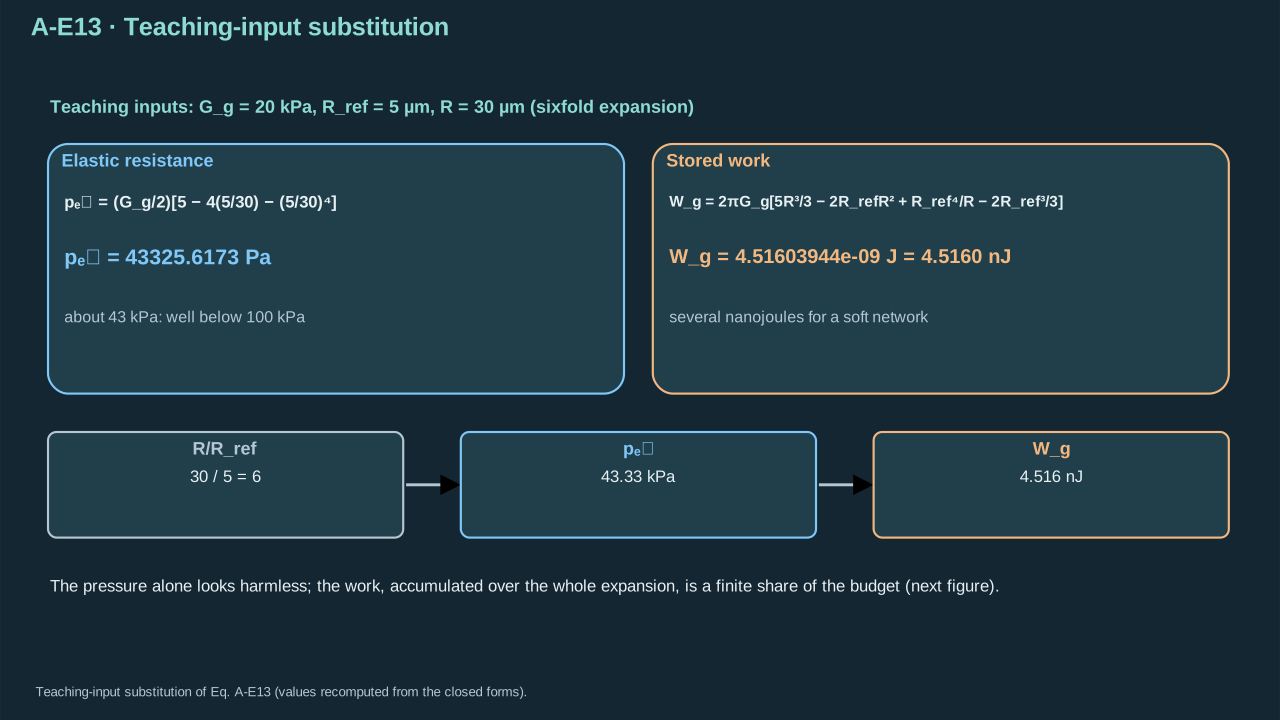
Prescribe shear modulus 20 kPa, reference radius 5 µm, current radius 30 µm and density 1000 kg m⁻³. These are teaching inputs. Calculate resistance and stored work first. Sixfold wall stretch assumes an intact neo-Hookean network. Validate that assumption for any proposed gel.

规定剪切模量 20 kPa、参考半径 5 µm、当前半径 30 µm、密度 1000 kg m⁻³。这些为教学输入。先计算阻力及储存功。六倍壁面伸长假设 neo-Hookean 网络保持完整。用于实际凝胶前须验证该假设。

Symbols before Eq. (A-E13).

式(A-E13)前的符号定义。

First individual definition第一项单独定义Second individual definition第二项单独定义

pelp_{\mathrm{el}} is elastic resistance (Pa)

pelp_{\mathrm{el}} 为弹性阻力(Pa)

WgW_g is stored elastic work (J)

WgW_g 为储存弹性功(J)

π\pi is dimensionless

π\pi 为无量纲量

Gg=20000G_g=20000 — Substituted network shear modulus (Pa)

Gg=20000G_g=20000 — 代入的网络剪切模量(Pa)

Rref=5×10⁻⁶R_{\mathrm{ref}}=5\times10^{-6} — Substituted reference cavity radius (m)

Rref=5×10⁻⁶R_{\mathrm{ref}}=5\times10^{-6} — 代入的参考空腔半径(m)

R=30×10−6R=30\times10^{-6} — Substituted current cavity radius (m)

R=30×10−6R=30\times10^{-6} — 代入的当前空腔半径(m)

Conventions and conditions. The numbers 5 and 30 in radius ratios both use µm. Powers denote numerical exponents; Pa means pascal, J joule, and the cross denotes multiplication..

约定与条件。 半径比值中的数值 5 与 30 均采用 µm。幂表示数值指数;Pa 为帕斯卡,J 为焦耳,叉号表示乘法。。

(A-E13) · Teaching-input substitution

教学输入参数的代入

pel=200002[5−4(530)−(530)4]=43325.6173 Pa,Wg=2π(20000)[53(30×10−6)3−2(5×10⁻⁶)(30×10−6)2+(5×10⁻⁶)430×10−6−23(5×10⁻⁶)3]=4.51603944×10⁻⁹ J.\begin{aligned}p_{\mathrm{el}}&=\frac{20000}{2}\left[5-4\left(\frac5{30}\right)-\left(\frac5{30}\right)^4\right]=43325.6173\ \mathrm{Pa},\\W_g&=2\pi(20000)\left[\frac53(30\times10^{-6})^3-2(5\times10^{-6})(30\times10^{-6})^2\right.\\&\hspace{30mm}\left.+\frac{(5\times10^{-6})^4}{30\times10^{-6}}-\frac23(5\times10^{-6})^3\right]\\&=4.51603944\times10^{-9}\ \mathrm J.\end{aligned}
This soft network still stores several nanojoules when the cavity radius expands sixfold.

This soft network still stores several nanojoules when the cavity radius expands sixfold.

腔体半径膨胀六倍时,即使这个柔软网络也会储存数纳焦耳能量。

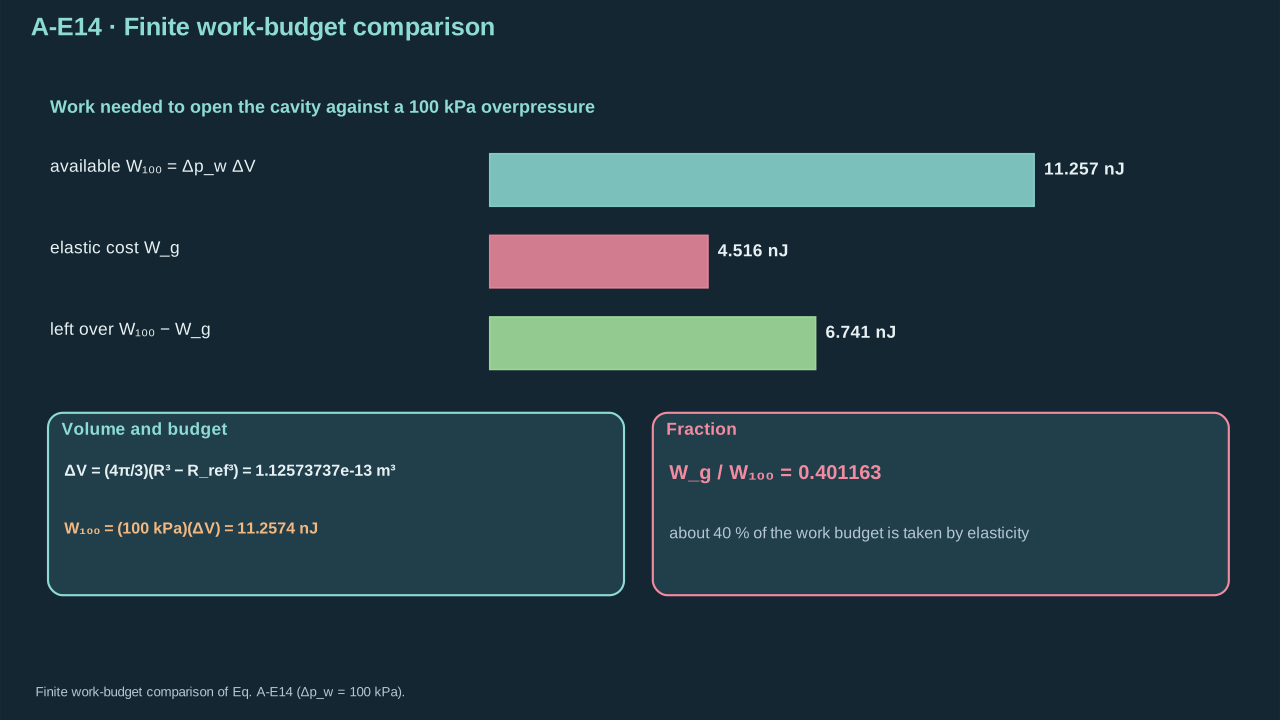
Prescribe net work pressure 100 kPa over the same volume increase. This gives 11.2574 nJ. Network storage consumes 40.1163%. Residual 6.74133 nJ bounds kinetic, surface and loss increments in this artificial ledger. External jet energy remains unestablished. Use the surface-energy increment so initial energy cancels consistently.

在相同体积增量上规定净做功压力 100 kPa,得到 11.2574 nJ。网络储存占 40.1163%。剩余 6.74133 nJ 是该人工账目中动能、表面能及损失增量的上界。外部射流能量尚未确立。采用表面能增量,使初始能量一致相消。

Symbols before Eq. (A-E14).

式(A-E14)前的符号定义。

First individual definition第一项单独定义Second individual definition第二项单独定义

ΔV\Delta V is expanded cavity volume (m³)

ΔV\Delta V 为腔体膨胀体积(m³)

R=30R=30 µm (m)

R=30R=30 µm(m)

Rref=5R_{\mathrm{ref}}=5 — Stress-free reference cavity radius (m)

Rref=5R_{\mathrm{ref}}=5 — 无应力参考腔体半径(m)

Δpw=100000\Delta p_w=100000 Pa is a constant illustrative net pressure-work input

Δpw=100000\Delta p_w=100000 Pa 为恒定的示例净压力功输入

W100W_{100} is the resulting work scale (J), with subscript 100 labeling its 100 kPa input

W100W_{100} 为由此得到的功尺度(J),下标 100 标记其 100 kPa 输入

Wg=4.51603944W_g=4.51603944 nJ is stored network work (J)

Wg=4.51603944W_g=4.51603944 nJ 为储存网络功(J)

π\pi is dimensionless

π\pi 为无量纲量

Conventions and conditions. nJ means 10−910^{-9} J.

约定与条件。 nJ 表示 10−910^{-9} J。

(A-E14) · Finite work-budget comparison

有限功预算的比较

ΔV=4π3(R3−Rref3)=1.12573737×10⁻¹³ m3,W100:=ΔpwΔV=11.2573737 nJ,WgW100=0.401162791,W100−Wg=6.74133424 nJ.\begin{aligned}\Delta V&=\frac{4\pi}{3}(R^3-R_{\mathrm{ref}}^3)=1.12573737\times10^{-13}\ \mathrm{m^3},\\W_{100}&:=\Delta p_w\Delta V=11.2573737\ \mathrm{nJ},\\\frac{W_g}{W_{100}}&=0.401162791,\qquad W_{100}-W_g=6.74133424\ \mathrm{nJ}.\end{aligned}
The elastic cost occupies a finite fraction of the work budget even though its pressure is below 100 kPa.

The elastic cost occupies a finite fraction of the work budget even though its pressure is below 100 kPa.

即使弹性压力低于 100 kPa,其能量代价也占据功预算的有限份额。

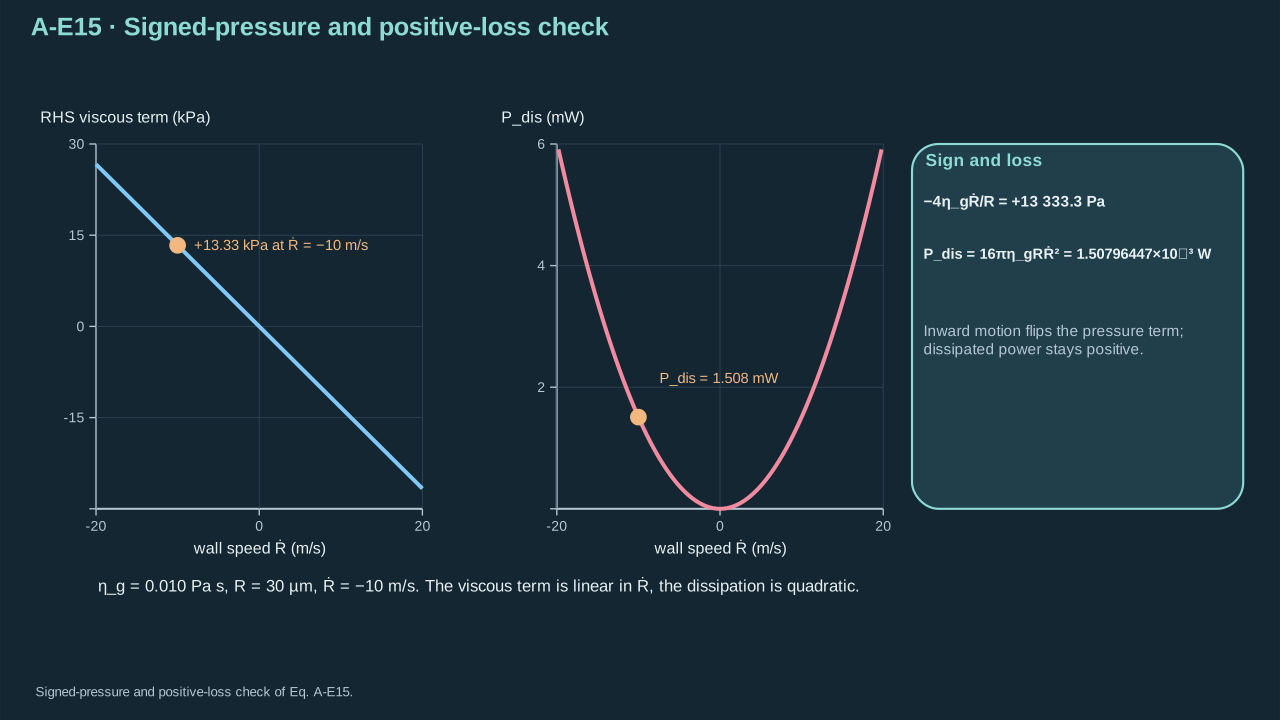
Prescribe viscosity 0.010 Pa s, radius 30 µm and inward speed −10 m s⁻¹. The signed momentum contribution is +13.3333 kPa. Dissipative power is +1.50796 mW. Positive collapse resistance still removes energy. Total dissipation requires integration over the velocity history.

规定黏度 0.010 Pa s、半径 30 µm、向内速度 −10 m s⁻¹。带符号动量项为 +13.3333 kPa,耗散功率为 +1.50796 mW。正塌缩阻力仍消耗能量。总耗散需对速度历程积分。

Symbols before Eq. (A-E15).

式(A-E15)前的符号定义。

First individual definition第一项单独定义Second individual definition第二项单独定义

pvisc,RHSp_{\mathrm{visc,RHS}} is the signed viscous pressure term on the radial equation's right-hand side (Pa)

pvisc,RHSp_{\mathrm{visc,RHS}} 为径向方程右侧的带符号黏性压力项(Pa)

PdisP_{\mathrm{dis}} is dissipated power (W)

PdisP_{\mathrm{dis}} 为耗散功率(W)

ηg=0.010\eta_g=0.010 Pa s is illustrative viscosity

ηg=0.010\eta_g=0.010 Pa s 为示例黏度

R=30×10−6R=30\times10^{-6} m radius

R=30×10−6R=30\times10^{-6} m 为半径

R˙=−10\dot R=-10 m s⁻¹ wall speed

R˙=−10\dot R=-10 m s⁻¹ 为泡壁速度

π\pi the circle constant (dimensionless)

π\pi 为圆周率(无量纲)

Conventions and conditions. RHS labels that side; The number 100 is the squared speed in m² s⁻².

约定与条件。 RHS 标记右侧;数值 100 为以 m² s⁻² 表示的速度平方。

(A-E15) · Signed-pressure and positive-loss check

有符号压力与正耗散检验

pvisc,RHS=−4ηgR˙R=−4(0.010)(−10)30×10−6=13333.3333 Pa,Pdis=16πηgRR˙2=16π(0.010)(30×10−6)(100)=1.50796447×10⁻³ W.\begin{aligned}p_{\mathrm{visc,RHS}}&=-\frac{4\eta_g\dot R}{R}=-\frac{4(0.010)(-10)}{30\times10^{-6}}=13333.3333\ \mathrm{Pa},\\P_{\mathrm{dis}}&=16\pi\eta_gR\dot R^2=16\pi(0.010)(30\times10^{-6})(100)=1.50796447\times10^{-3}\ \mathrm W.\end{aligned}
Inward motion changes the pressure sign but leaves dissipated power positive.

Inward motion changes the pressure sign but leaves dissipated power positive.

向内运动改变压力项符号,但耗散功率仍为正。

6. Material memory and transport times

6. 材料记忆与输运时间

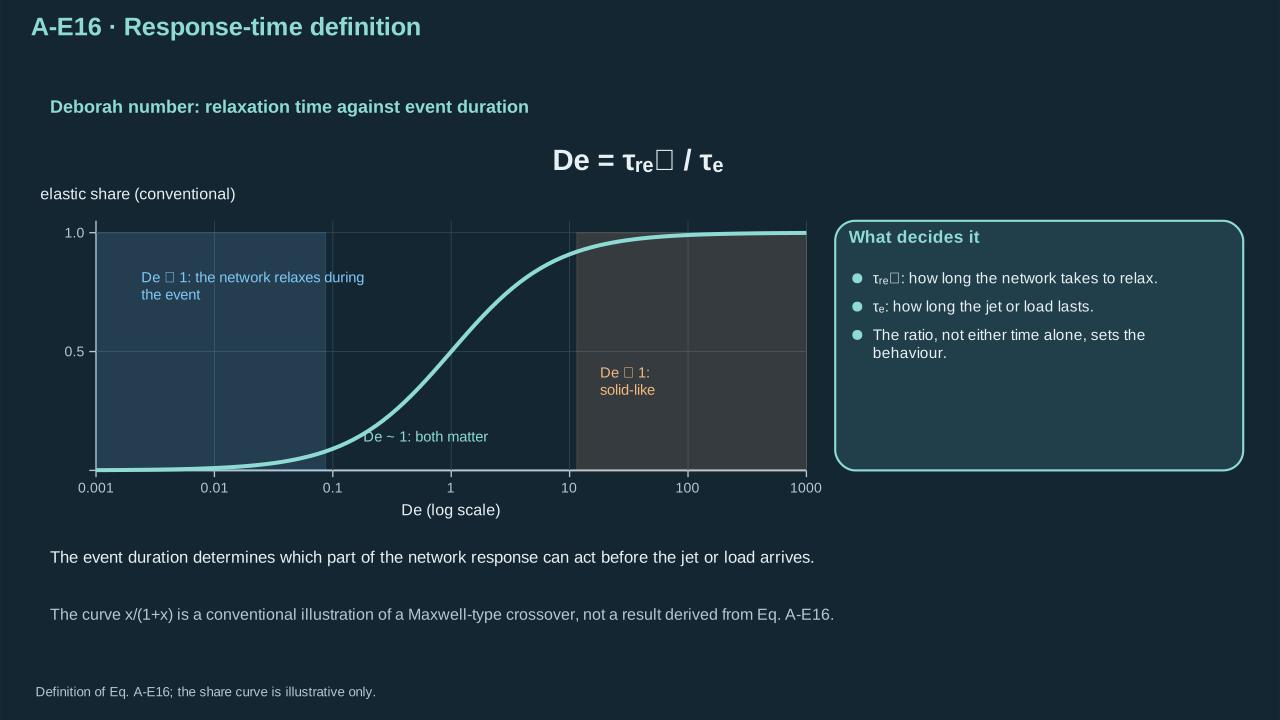
Step 9 — Compare measured relaxation time with event duration. Large Deborah number means stress memory persists during the event. Infinite stiffness remains unestablished. Small Deborah number permits relaxation. Confinement and solvent drainage remain separate questions. A relaxation spectrum can require several times.

步骤 9——比较实测松弛时间与事件时长。大 Deborah 数表示应力记忆在事件期间持续,无限刚度尚未确立。小 Deborah 数允许松弛。约束与溶剂排水是独立问题。松弛谱可需要多个时间尺度。

Symbols before Eq. (A-E16).

式(A-E16)前的符号定义。

First individual definition第一项单独定义Second individual definition第二项单独定义

De\mathrm{De} is the dimensionless event Deborah number

De\mathrm{De} 为无量纲事件 Deborah 数

τrel>0\tau_{\mathrm{rel}}>0 is an independently identified network stress-relaxation time (s)

τrel>0\tau_{\mathrm{rel}}>0 为独立确定的网络应力松弛时间(s)

τe>0\tau_e>0 is the specified cavity/jet event duration (s)

τe>0\tau_e>0 为指定的腔体/射流事件持续时间(s)

Conventions and conditions. Subscripts rel and e label relaxation and event respectively.

约定与条件。 下标 rel、e 分别表示松弛与事件。

(A-E16) · Response-time definition

响应时间的定义

De:=τrelτe.\mathrm{De}:=\frac{\tau_{\mathrm{rel}}}{\tau_e}.
The event duration determines which part of the network response can act before the jet or load arrives.

The event duration determines which part of the network response can act before the jet or load arrives.

事件持续时间决定网络响应的哪一部分能在射流或载荷到达前发挥作用。

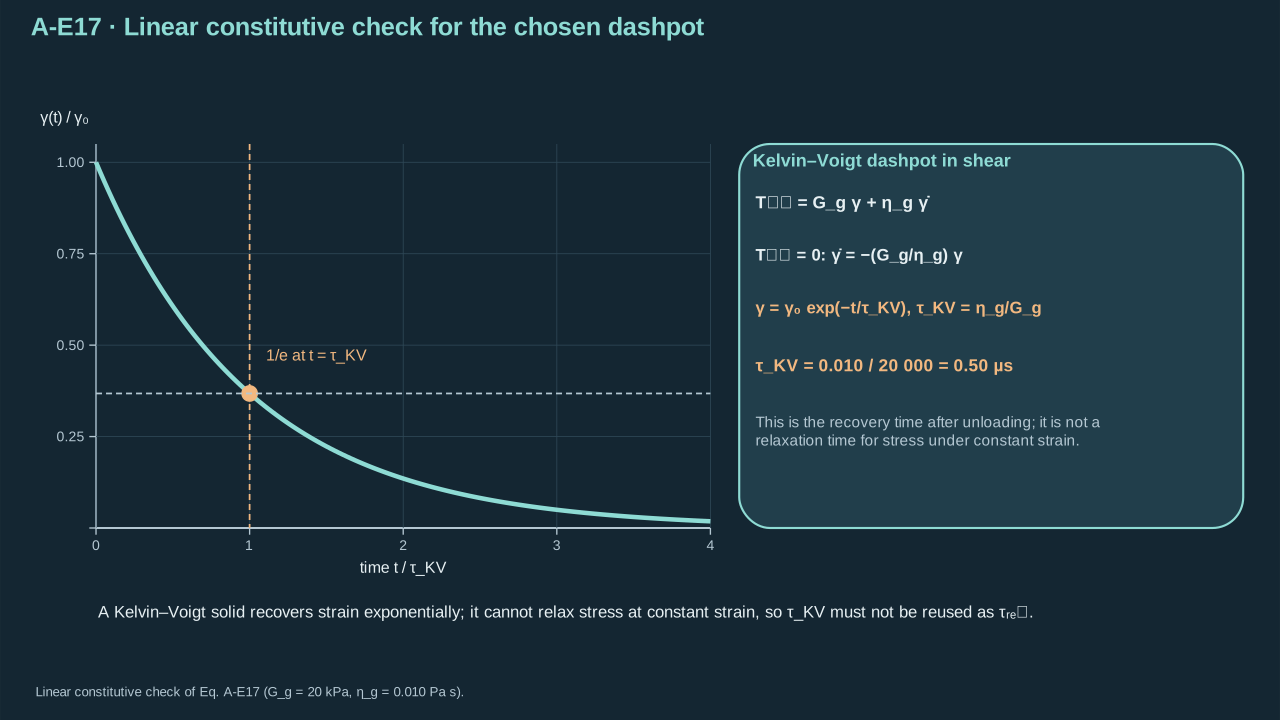
In Kelvin–Voigt shear, held strain leaves constant elastic stress after strain rate vanishes. Releasing stress instead gives exponential strain recovery. Its retardation time is ηg/Gg\eta_g/G_g. Distinguish this recovery time from stress relaxation.

Kelvin–Voigt 剪切中,保持应变时,应变率消失后弹性应力恒定。释放应力则产生指数应变恢复,其迟滞时间为 ηg/Gg\eta_g/G_g。应区分恢复时间与应力松弛。

Symbols before Eq. (A-E17).

式(A-E17)前的符号定义。

First individual definition第一项单独定义Second individual definition第二项单独定义

TshT_{\mathrm{sh}} is shear stress (Pa)

TshT_{\mathrm{sh}} 为剪切应力(Pa)

γ\gamma is dimensionless small shear strain

γ\gamma 为无量纲小剪切应变

γ˙\dot\gamma its rate (s⁻¹)

γ˙\dot\gamma 为其速率(s⁻¹)

Gg>0G_g>0 shear modulus (Pa)

Gg>0G_g>0 为剪切模量(Pa)

ηg>0\eta_g>0 viscosity (Pa s)

ηg>0\eta_g>0 为黏度(Pa s)

t≥0t\geq0 is time after release (s)

t≥0t\geq0 为卸载后的时间(s)

γ0\gamma_0 initial strain (dimensionless)

γ0\gamma_0 为初始应变(无量纲)

τKV\tau_{\mathrm{KV}} the Kelvin–Voigt zero-stress recovery/retardation time (s), and exp⁡\exp the exponential of a dimensionless argument

τKV\tau_{\mathrm{KV}} 为 Kelvin–Voigt 零应力恢复/迟滞时间(s),exp⁡\exp 表示对无量纲参数取指数

Conventions and conditions. sh and KV are labels, not multiplication.

约定与条件。 sh 与 KV 是标签,不是乘法。

(A-E17) · Linear constitutive check for the chosen dashpot

所选黏性阻尼元件的线性本构检验

Tsh=Ggγ+ηgγ˙,Tsh=0:γ˙=−Ggηgγ,γ(t)=γ0exp⁡(−t/τKV),τKV:=ηgGg.\begin{aligned}T_{\mathrm{sh}}&=G_g\gamma+\eta_g\dot\gamma,\\T_{\mathrm{sh}}=0:\quad\dot\gamma&=-\frac{G_g}{\eta_g}\gamma,\qquad\gamma(t)=\gamma_0\exp(-t/\tau_{\mathrm{KV}}),\qquad\tau_{\mathrm{KV}}:=\frac{\eta_g}{G_g}.\end{aligned}
Kelvin–Voigt strain recovery illustrates what its parameter ratio means and what it does not mean.

Kelvin–Voigt strain recovery illustrates what its parameter ratio means and what it does not mean.

Kelvin–Voigt 应变恢复说明其参数比值的意义及不能代表的意义。

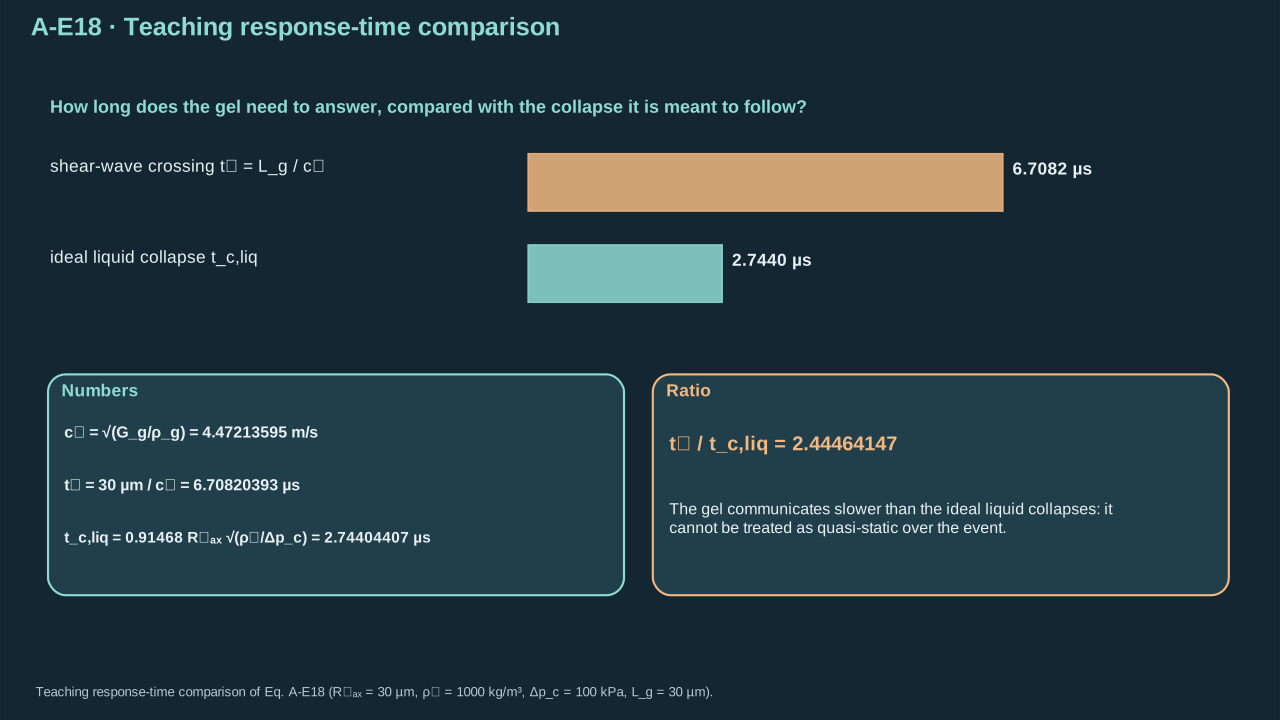
Step 10 — Compare spatial communication times. Shear speed estimates small-strain network motion. Ideal liquid collapse estimates radial carrier inertia. Use comparison length 30 µm for both. Their time ratio is 2.44464. Global shear equilibration can therefore be slow relative to liquid collapse. Check nonradial support dynamics. The spherical equation already retains radial inertia.

步骤 10——比较空间通信时间。剪切波速估算小应变网络运动,理想液体塌缩估算径向载液惯性。两者采用比较长度 30 µm。时间比为 2.44464,整体剪切平衡可慢于液体塌缩。须检查非径向支撑动力学。球形方程已经保留径向惯性。

Symbols before Eq. (A-E18).

式(A-E18)前的符号定义。

First individual definition第一项单独定义Second individual definition第二项单独定义

csc_s is a small-strain shear speed estimate (m s⁻¹)

csc_s 为小应变剪切波速估计(m s⁻¹)

Gg=20000G_g=20000 Pa modulus

Gg=20000G_g=20000 Pa 为模量

ρg=1000\rho_g=1000 kg m⁻³ medium density

ρg=1000\rho_g=1000 kg m⁻³ 为介质密度

Lg=30L_g=30 µm comparison length

Lg=30L_g=30 µm 为比较长度

tst_s its shear crossing time (s)

tst_s 为该长度上的剪切传播时间(s)

tc,liqt_{c,\mathrm{liq}} is ideal empty-liquid-cavity collapse time (s)

tc,liqt_{c,\mathrm{liq}} 为理想空液体腔的塌缩时间(s)

Rmax⁡=30R_{\max}=30 µm maximum radius

Rmax⁡=30R_{\max}=30 µm 为最大半径

ρl=1000\rho_l=1000 kg m⁻³ liquid density

ρl=1000\rho_l=1000 kg m⁻³ 为液体密度

Δpc=100000\Delta p_c=100000 Pa collapse pressure gap

Δpc=100000\Delta p_c=100000 Pa 为塌缩压力差

Conventions and conditions. The coefficient is the Rayleigh integral; liq labels the liquid control, ≃\simeq is an estimate, and µs means 10−610^{-6} s.

约定与条件。 系数来自 Rayleigh 积分;liq 标记液体控制模型,≃\simeq 表示估计,µs 表示 10−610^{-6} s。

(A-E18) · Teaching response-time comparison

响应时间的教学比较

cs≃Gg/ρg=4.47213595 m s−1,ts:=Lg/cs=6.70820393 μs,tc,liq=0.9146813565 Rmax⁡ρl/Δpc=2.74404407 μs,tstc,liq=2.44464147.\begin{aligned}c_s&\simeq\sqrt{G_g/\rho_g}=4.47213595\ \mathrm{m\,s^{-1}},\qquad t_s:=L_g/c_s=6.70820393\ \mathrm{\mu s},\\t_{c,\mathrm{liq}}&=0.9146813565\,R_{\max}\sqrt{\rho_l/\Delta p_c}=2.74404407\ \mathrm{\mu s},\qquad\frac{t_s}{t_{c,\mathrm{liq}}}=2.44464147.\end{aligned}
The gel communication estimate exceeds the ideal liquid-collapse reference for the declared inputs.

The gel communication estimate exceeds the ideal liquid-collapse reference for the declared inputs.

对已声明输入,凝胶传播时间估计大于理想液体塌缩参考时间。

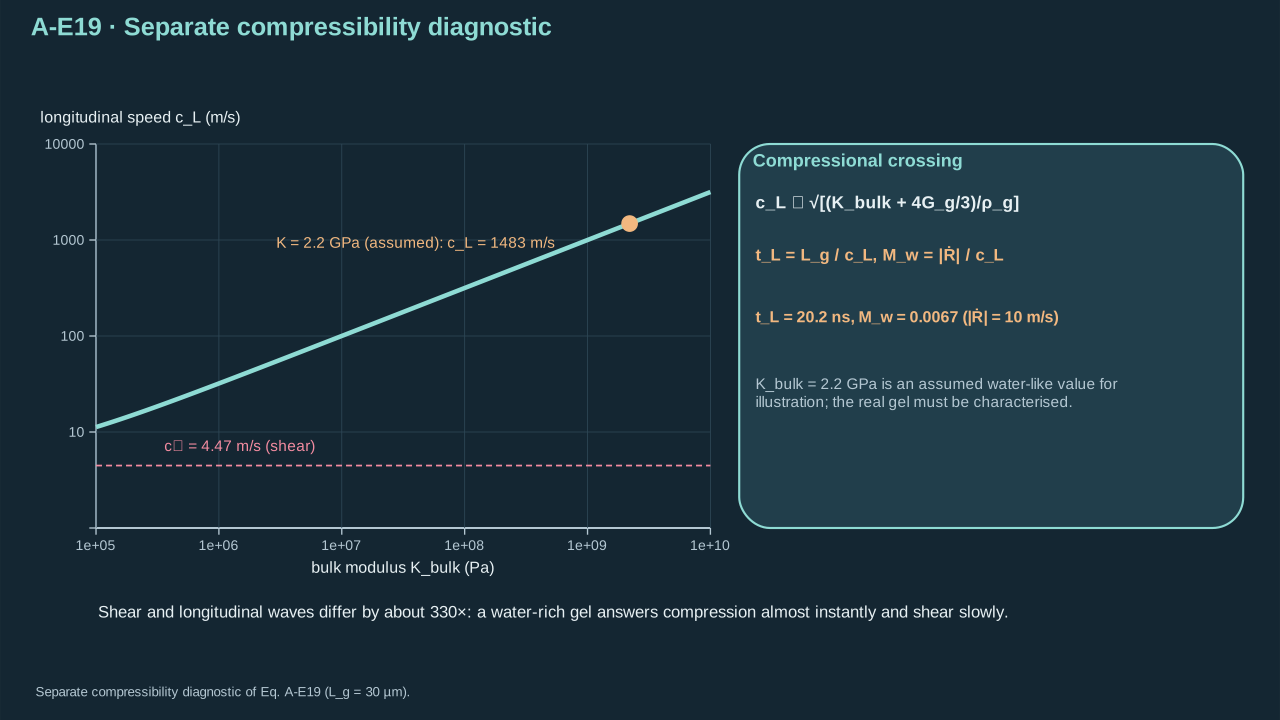
Low shear modulus leaves rapid compression resistance unresolved. Longitudinal motion also depends on bulk modulus. Restore compressibility for finite acoustic travel or high wall speed. The incompressible spherical control idealizes that propagation. Shock pressure and arrival time require a compressible model.

低剪切模量仍未确定快速压缩阻力。纵向运动还取决于体积模量。有限声传播或高壁速时须恢复可压缩性。不可压缩球形对照将传播理想化。激波压力及到达时间需要可压缩模型。

Symbols before Eq. (A-E19).

式(A-E19)前的符号定义。

First individual definition第一项单独定义Second individual definition第二项单独定义

cLc_L is longitudinal wave speed estimate (m s⁻¹) in a separate small-strain compressible extension

cLc_L 为独立小应变可压缩扩展中的纵波波速估计(m s⁻¹)

Kgbulk>0K_g^{\mathrm{bulk}}>0 is bulk modulus (Pa), distinctly labeled from kinetic energy KgK_g

Kgbulk>0K_g^{\mathrm{bulk}}>0 为体积模量(Pa),其明确标签使之区别于动能 KgK_g

GgG_g shear modulus (Pa)

GgG_g 为剪切模量(Pa)

ρg\rho_g density (kg m⁻³)

ρg\rho_g 为密度(kg m⁻³)

LgL_g length (m)

LgL_g 为长度(m)

tLt_L longitudinal crossing time (s)

tLt_L 为纵波传播时间(s)

MwM_w dimensionless wall Mach number

MwM_w 为无量纲泡壁 Mach 数

R˙\dot R wall speed (m s⁻¹)

R˙\dot R 为泡壁速度(m s⁻¹)

KgK_g — Surrounding-medium kinetic energy (J)

KgK_g — 周围介质动能(J)

Conventions and conditions. ∣ ∣|\ | takes absolute value; ≃\simeq denotes an estimate.

约定与条件。 ∣ ∣|\ | 表示绝对值;≃\simeq 表示估计。

(A-E19) · Separate compressibility diagnostic

独立的可压缩性诊断

cL≃Kgbulk+4Gg/3ρg,tL:=LgcL,Mw:=∣R˙∣cL.c_L\simeq\sqrt{\frac{K_g^{\mathrm{bulk}}+4G_g/3}{\rho_g}},\qquad t_L:=\frac{L_g}{c_L},\qquad M_w:=\frac{|\dot R|}{c_L}.
Shear and longitudinal propagation test different aspects of a water-rich gel's transient response.

Shear and longitudinal propagation test different aspects of a water-rich gel's transient response.

剪切与纵向传播检验富水凝胶瞬态响应的不同方面。

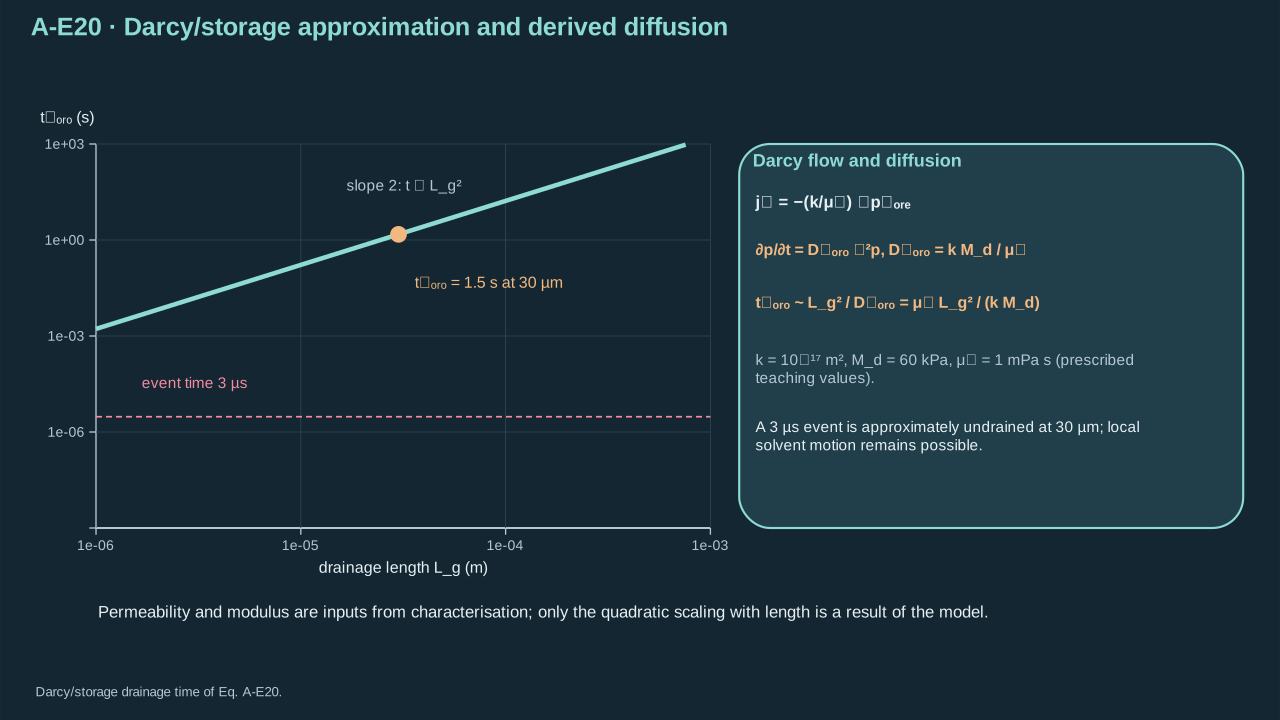
Step 11 — Derive drainage in a separate two-phase model. Assume small perturbations in uniform gel. Adopt Darcy relative solvent flux and constant storage modulus. Solvent conservation gives pressure diffusion. Large-strain interface drainage requires additional coupling.

步骤 11——在独立两相模型中推导排水。假设均匀凝胶的小扰动,采用 Darcy 相对溶剂通量及恒定储存模量。溶剂守恒给出压力扩散。大应变界面排水需要额外耦合。

Symbols before Eq. (A-E20).

式(A-E20)前的符号定义。

First individual definition第一项单独定义Second individual definition第二项单独定义

jl\mathbf j_l is relative solvent volume flux (m s⁻¹)

jl\mathbf j_l 为相对溶剂体积通量(m s⁻¹)

kperm>0k_{\mathrm{perm}}>0 permeability (m²)

kperm>0k_{\mathrm{perm}}>0 为渗透率(m²)

μl>0\mu_l>0 solvent viscosity (Pa s)

μl>0\mu_l>0 为溶剂黏度(Pa s)

pporep_{\mathrm{pore}} incremental pore pressure (Pa)

pporep_{\mathrm{pore}} 为增量孔隙压力(Pa)

Md>0M_d>0 storage/constrained drained modulus adopted for this scalar approximation (Pa)

Md>0M_d>0 为该标量近似采用的储存/受约束排水模量(Pa)

tt time (s)

tt 为时间(s)

DporoD_{\mathrm{poro}} diffusion coefficient (m² s⁻¹)

DporoD_{\mathrm{poro}} 为扩散系数(m² s⁻¹)

LgL_g drainage length (m)

LgL_g 为排水长度(m)

tporot_{\mathrm{poro}} drainage time estimate (s)

tporot_{\mathrm{poro}} 为排水时间估计(s)

Conventions and conditions. ∇\nabla, ∇⋅\nabla\cdot, ∇2\nabla^2 are gradient, divergence and Laplacian in space; the dot here is the vector divergence operator, not an equation separator; ∼\sim means scaling estimate.

约定与条件。 ∇\nabla、∇⋅\nabla\cdot、∇2\nabla^2 为空间梯度、散度和 Laplace 算子;此处点号属于向量散度算子,不是方程分隔符;∼\sim 表示尺度估计。

(A-E20) · Darcy/storage approximation and derived diffusion

达西流动与储存近似及所推导的扩散关系

jl=−kpermμl∇ppore,1Md∂ppore∂t+∇⋅jl=0,∂ppore∂t=Dporo∇2ppore,Dporo:=kpermMdμl,tporo∼Lg2Dporo=μlLg2kpermMd.\begin{aligned}\mathbf j_l&=-\frac{k_{\mathrm{perm}}}{\mu_l}\nabla p_{\mathrm{pore}},\qquad\frac{1}{M_d}\frac{\partial p_{\mathrm{pore}}}{\partial t}+\nabla\cdot\mathbf j_l=0,\\\frac{\partial p_{\mathrm{pore}}}{\partial t}&=D_{\mathrm{poro}}\nabla^2p_{\mathrm{pore}},\qquad D_{\mathrm{poro}}:=\frac{k_{\mathrm{perm}}M_d}{\mu_l},\\t_{\mathrm{poro}}&\sim\frac{L_g^2}{D_{\mathrm{poro}}}=\frac{\mu_lL_g^2}{k_{\mathrm{perm}}M_d}.\end{aligned}
Pressure gradients drive solvent through the network, producing a length-dependent drainage time.

Pressure gradients drive solvent through the network, producing a length-dependent drainage time.

压力梯度驱动溶剂通过网络,产生依赖长度的排水时间。

Insert Darcy flux into conservation. Constant coefficients factor out of the derivatives. Balance time and second spatial derivatives over LgL_g for drainage time. Primary measurements support this scaling; actual permeability and modulus require characterization. Prescribe permeability 10−1710^{-17} m², modulus 60 kPa, viscosity 0.001 Pa s and length 30 µm. Drainage time is 1.5 s. A 3 µs event is approximately undrained at that length. Local solvent motion remains possible. Primary drainage study.

将 Darcy 通量代入守恒,常系数移出导数。按 LgL_g 平衡时间导数与空间二阶导数,得到排水时间。原始测量支持该尺度,实际渗透率与模量须表征。规定渗透率 10−1710^{-17} m²、模量 60 kPa、黏度 0.001 Pa s、长度 30 µm,排水时间为 1.5 s。该长度上的 3 µs 事件近似不排水,局部溶剂运动仍可能发生。原始排水研究。

7. Architecture tests and operating windows

7. 结构检验与工作窗口

Gel stabilization of PFC jets: Not established. Brujan et al. observed deformation, recoil, both jet directions and boundary-material ejection. Their reported 960 m s⁻¹ maximum belongs to one laser-bubble/gel geometry. It supplies a counterexample to universal stabilization. PFC transfer limits require their own measurements. [R12]

凝胶稳定 PFC 射流尚未确立。Brujan 等观测到变形、回弹、双向射流及边界材料喷出。其报告的 960 m s⁻¹ 最大值属于特定激光气泡/凝胶几何,可反驳普遍稳定化判断。PFC 转印极限需要独立测量。 [R12]

Test all four architectures. Open pockets need coupled liquid momentum, wall traction and outlet shape. Bulk embedding needs an existing or rupture-created liquid path. Alternatively, identify solid deformation as the actuator. Sealed cavities need pressure–layer–fracture coupling. In film/PVC stacks, distinguish direct film loading from transmission through intact PVC. Specify release interface and payload stress for each route.

检验四种结构。开放液腔需耦合液体动量、壁面牵引及出口形状。体相嵌入需已有或破裂形成的液体通路,也可明确固体变形作为致动机制。密闭空腔需压力—层运动—断裂耦合。薄膜/PVC 叠层中,区分直接薄膜加载与完整 PVC 传递。各路径均须规定释放界面及载荷应力。

Control or observation

控制或观测

What it discriminates

可区分的机制

Match PFC inventory, distribution, shell survival, absorber position, initial temperature and measured absorbed energy.

匹配 PFC 物质量、分布、壳层存活、吸收体位置、初始温度及实测吸收能量。

Separates optical/activation changes from mechanical support changes; equal incident energy alone does not do this.

将光学/激活变化与力学支撑变化区分开;仅使入射能量相等做不到这一点。

Synchronize cavity contour, gel/film motion, emitted liquid composition, finite jet mass, speed, angle and arrival.

同步记录腔体轮廓、凝胶/薄膜运动、喷出液体成分、有限射流质量、速度、角度及到达时间。

Distinguishes a liquid jet, a recoil-driven second jet, solid fragments and a membrane/blister actuator.

区分液体射流、回弹驱动的第二股射流、固体碎片及膜片/鼓泡致动器。

Specify pressure location, area, bandwidth and time window; record displacement and crack progression.

明确压力位置、面积、带宽及时间窗口;记录位移和裂纹进展。

Connects fluid output to interface work and selective release rather than an isolated peak.

将流体输出连接到界面功和选择性释放,而不是孤立峰值。

Across independent events, compare angular spread, mass/speed variation, breakup, release success, damage and placement error.

在独立事件间比较角度分散、质量/速度变异、破碎、释放成功率、损伤及定位误差。

Tests repeatability at a useful delivered load; a lower speed variation with insufficient release is not an improved process.

在有用的实际传递载荷下检验重复性;若载荷不足以释放,仅速度变异降低不代表工艺改善。

Measure cooling, retained vapor, swelling, residue, network damage and reset before repeated pulses.

重复脉冲前测量冷却、滞留蒸气、溶胀、残留物、网络损伤及复位。

Tests whether positional benefits survive reuse and whether activation/geometry drift accumulates.

检验定位优势能否在复用中持续,以及激活/几何漂移是否累积。

Report verified single-event pressure or finite-mass speed separately from repeatable intact transfer. Gel can trade peak speed for peeling control or lower scatter. Improved alignment can coexist with reduced useful impulse. The radial formula leaves these tradeoffs unresolved. Missing: rate laws, inclusion/reference geometry, phase and damage kinetics, outlet evolution, release and landing laws.

已验证单事件压力或有限质量速率,与可重复完整转印分别报告。凝胶可用峰值速率换取剥离控制或更小离散。更好对准可与更低有用冲量共存。径向公式仍未确定这些权衡。缺失:速率规律、夹杂/参考几何、相变和损伤动力学、出口演化、释放与落位规律。

Finite-energy cavitation models

有限能量空化模型

Compare an existing outlet in rigid and gel-confined cavities. At 2 nJ source work and a 5 μm outlet radius, peak speeds are 15.376 and 1.625 m/s. The sealed control emits zero liquid.

比较刚性腔体与凝胶约束腔体中的已有出口。源功为 2 nJ,出口半径为 5 μm 时,峰值速度分别为 15.376 与 1.625 m/s。密闭对照排液量为零。

These initialized ideal-gas controls describe expansion through an existing channel. Laser activation, PFC phase change, rupture, collapse jets, and impact remain outside their scope.

这些给定初态的理想气体对照描述经已有通道的膨胀排液。激光激活、PFC 相变、破裂、塌缩射流与冲击不在其范围内。

PFC droplets in hydrogel

水凝胶中的 PFC 液滴

Compare PFP and PFH across droplet size, gel modulus, and viscosity. The model retains finite PFC mass and a liquid shell. Sixty stationary and six seeded transient comparisons pass.

按液滴尺寸、凝胶模量与黏度比较 PFP 和 PFH。模型保留有限 PFC 质量与液体壳层。60 项稳态及 6 项预设种子瞬态对照通过。

Reported velocities are radial wall speeds. Exterior emission is zero. Target activation, rupture, collapse jets, and impact pressure remain unvalidated.

报告速度为径向壁面速度。外部排出量为零。目标系统的激活、破裂、塌缩射流与冲击压力仍未验证。

8. Oral questions

8. 口头问题

Trace matter and force paths in the three gel actuators.

追踪三种凝胶致动器中的物质与传力路径。

Explain the mechanism, assumptions, and limits in your own words.

用自己的话解释机制、假设与限制。

Reference answer and mastery criteria参考答案与掌握标准

Symbols before Eq. (A-E21).

式(A-E21)前的符号定义。

First individual definition第一项单独定义Second individual definition第二项单独定义

ρg\rho_g is effective exterior density (kg m⁻³)

ρg\rho_g 为外部有效密度(kg m⁻³)

R>0R>0 cavity radius (m)

R>0R>0 为腔体半径(m)

R˙\dot R — Cavity-wall radial velocity (m s⁻¹)

R˙\dot R — 空腔壁面径向速度(m s⁻¹)

R¨\ddot R — Cavity-wall radial acceleration (m s⁻²)

R¨\ddot R — 空腔壁面径向加速度(m s⁻²)

pbp_b — Cavity pressure (Pa)

pbp_b — 空腔压力(Pa)

p∞p_\infty — Far-field pressure (Pa)

p∞p_\infty — 远场压力(Pa)

pelp_{\mathrm{el}} — Signed elastic cavity resistance (Pa)

pelp_{\mathrm{el}} — 带符号弹性腔体阻力(Pa)

σ\sigma tension (N m⁻¹)

σ\sigma 为张力(N m⁻¹)

ηg\eta_g represented medium viscosity (Pa s)

ηg\eta_g 为所描述介质的黏度(Pa s)

Conventions and conditions. This quoted original formula has the intact spherical, no-slip assumptions of Eq; (A-E11).

约定与条件。 这一引用的原始公式采用式(A-E11)的完整球形、无滑移假设。

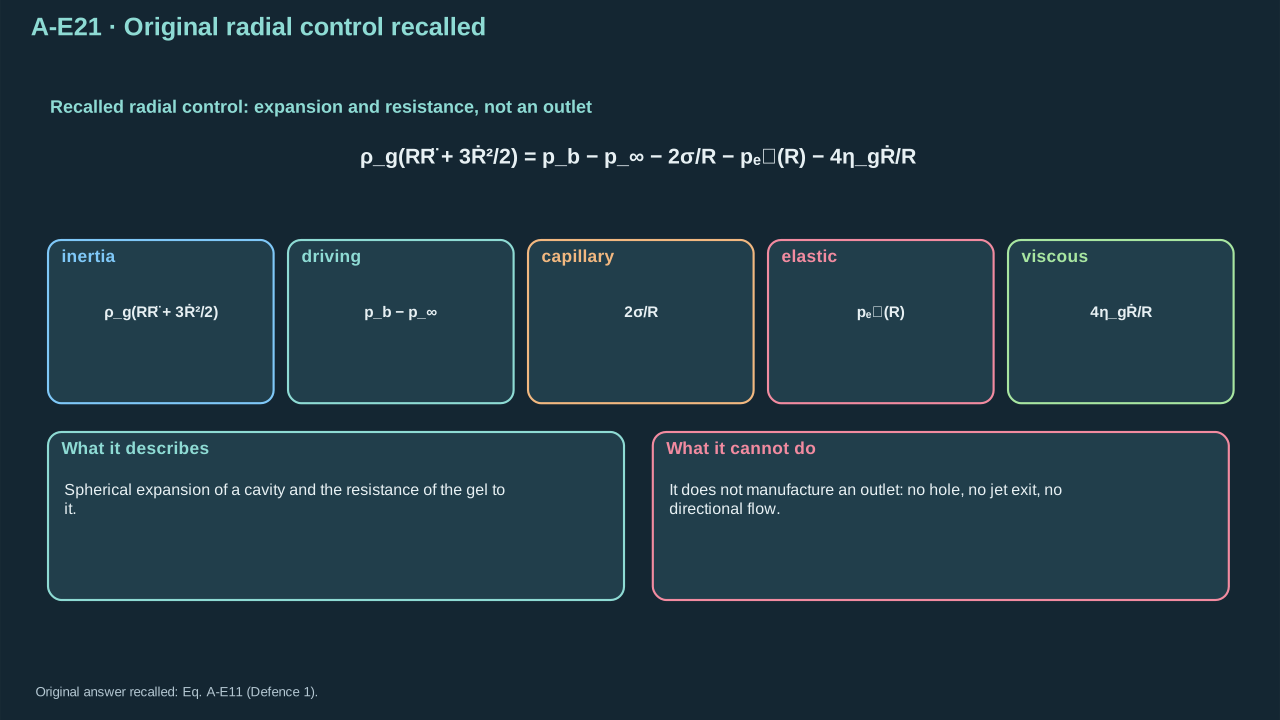
(A-E21) · Original radial control recalled

回顾原始径向对照模型

ρg(RR¨+32R˙2)=pb−p∞−2σR−pel(R)−4ηgR˙R.\rho_g\left(R\ddot R+\frac32\dot R^2\right)=p_b-p_\infty-\frac{2\sigma}{R}-p_{\mathrm{el}}(R)-\frac{4\eta_g\dot R}{R}.
A radial model describes expansion and resistance; it does not manufacture an outlet.

A radial model describes expansion and resistance; it does not manufacture an outlet.

径向模型描述膨胀及阻力,不会凭空产生出口。

Identify where displaced matter can go. Liquid sites and open pockets can emit carrier through an outlet. Bulk inclusions may inflate without external liquid emission. Rupture or channels add damage and contamination mechanisms. Sealed cavities can bend covers and drive cracks without an emitted jet. The hydrogel stamp paper establishes this sealed pressure–deformation–release route.

先确定排开材料的去向。液体位点与开放液腔可经出口喷出载液。体相夹杂可能膨胀而无外部液体喷出。破裂或通道会增加损伤及污染机制。密闭空腔可弯曲覆盖层并驱动裂纹,而无需喷出射流。水凝胶印章论文确立了该密闭压力—变形—释放路径。

The spherical model gives intact-medium pressure and work. Jet direction needs a spatial moving-interface model. Blisters and intact PVC paths need solid/interface mechanics. State the required closure for each architecture. Activation leaves carrier emission and selective transfer unresolved.

球形模型给出完整介质中的压力和功。射流方向需空间运动界面模型,鼓泡与完整 PVC 路径需固体/界面力学。各结构须注明所需闭合。激活仍未确定载液喷出与选择性转印。

Review criteria

审阅标准

  • Identifies the displaced-material path and distinguishes external liquid flow from solid deformation or damage.

    明确被排开材料的路径,区分外部液体流动、固体变形与损伤。

  • Connects pressure to an explicit outlet or solid/interface load path and states what the spherical equation cannot calculate.

    将压力连接到明确出口或固体/界面载荷路径,并说明球形方程不能计算什么。

  • Uses the hydrogel paper as architecture-specific evidence and keeps the other possibilities conditional rather than discarded.

    将水凝胶论文作为特定结构的证据,保留其他条件性可能,而不是排除它们。

Explain the 5Gg/2 plateau and its work requirement.

解释 5Gg/2 平台及其功需求。

Explain the mechanism, assumptions, and limits in your own words.

用自己的话解释机制、假设与限制。

Reference answer and mastery criteria参考答案与掌握标准

Symbols before Eq. (A-E22).

式(A-E22)前的符号定义。

First individual definition第一项单独定义Second individual definition第二项单独定义

pelp_{\mathrm{el}} is elastic resistance (Pa)

pelp_{\mathrm{el}} 为弹性阻力(Pa)

WgW_g stored work (J)

WgW_g 为储存功(J)

Gg>0G_g>0 shear modulus (Pa)

Gg>0G_g>0 为剪切模量(Pa)

R≥Rref>0R\geq R_{\mathrm{ref}}>0 — Current cavity radius (m)

R≥Rref>0R\geq R_{\mathrm{ref}}>0 — 当前腔体半径(m)

RrefR_{\mathrm{ref}} — Stress-free reference cavity radius (m)

RrefR_{\mathrm{ref}} — 无应力参考腔体半径(m)

π\pi is dimensionless

π\pi 为无量纲量

Conventions and conditions. These quote Eqs; (A-E05) and (A-E07) for the intact infinite incompressible neo-Hookean medium.

约定与条件。 这些公式引用式(A-E05)与(A-E07),适用于完整、无限、不可压缩 neo-Hookean 介质。

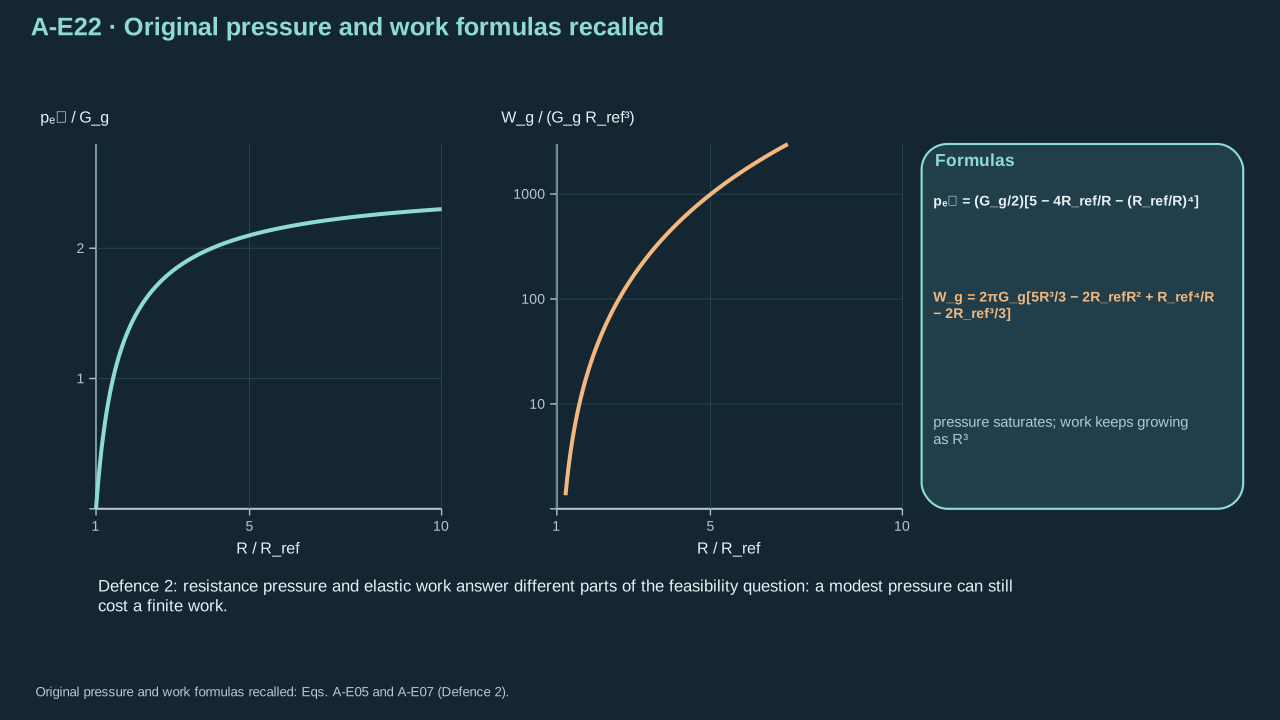
(A-E22) · Original pressure and work formulas recalled

回顾原始压力与功公式

pel(R)=Gg2[5−4RrefR−(RrefR)4],Wg(R)=2πGg[5R33−2RrefR2+Rref4R−2Rref33].\begin{aligned}p_{\mathrm{el}}(R)&=\frac{G_g}{2}\left[5-4\frac{R_{\mathrm{ref}}}{R}-\left(\frac{R_{\mathrm{ref}}}{R}\right)^4\right],\\W_g(R)&=2\pi G_g\left[\frac{5R^3}{3}-2R_{\mathrm{ref}}R^2+\frac{R_{\mathrm{ref}}^4}{R}-\frac{2R_{\mathrm{ref}}^3}{3}\right].\end{aligned}
Pressure resistance and elastic work answer different parts of the feasibility calculation.

Pressure resistance and elastic work answer different parts of the feasibility calculation.

压力阻力与弹性功回答可行性计算中的不同部分。

At modulus 20 kPa and 5 → 30 µm expansion, resistance is 43.3256 kPa. Network work is 4.51604 nJ. Constant net pressure 100 kPa supplies 11.2574 nJ over the same volume. Storage is 40.1163%. Remaining surface, viscous and kinetic demands require the full work balance. Reference 5 µm describes the cavity/network state. PFC core size needs separate identification.

模量 20 kPa、5 → 30 µm 膨胀时,阻力为 43.3256 kPa,网络功为 4.51604 nJ。同一体积上恒定净压 100 kPa 提供 11.2574 nJ,储存占 40.1163%。其余表面、黏性及动能需求须用完整功平衡检查。5 µm 参考描述空腔/网络状态。PFC 核心尺寸须单独辨认。

The 5Gg/25G_g/2 plateau follows the intact constitutive model. Fracture and jet stability remain unestablished. Work still grows with volume; real networks can stiffen or tear. Recoil may return storage late, sideways or into damage. Viscous dissipation stays nonnegative. Useful conversion requires phase-pressure history, moving geometry and energy partition.

5Gg/25G_g/2 平台来自完整本构模型。断裂与射流稳定性尚未确立。功仍随体积增长,实际网络可硬化或撕裂。回弹可能将储能延迟、侧向或通过损伤返还。黏性耗散保持非负。有用转换需要相变压力历程、运动几何及能量分配。

Review criteria

审阅标准

  • Explains the stretch-based elastic origin, zero reference resistance, and constitutive rather than fracture meaning of the plateau.

    说明基于伸长的弹性来源、参考状态零阻力,以及平台属于本构而非断裂意义。

  • Uses pressure times volume change to interpret the 4.51604 nJ storage and its 40.1163% benchmark fraction without calling it a predicted jet energy.

    用压力乘体积变化解释 4.51604 nJ 储存及其 40.1163% 示例比例,不将其称为预测射流能量。

  • Separates recoverable storage from irreversible viscosity and identifies damage, timing and nonspherical flow as unresolved links.

    区分可恢复储存与不可逆黏性,指出损伤、时序和非球形流动仍是未闭合环节。

Which matched measurements establish improved PFC transfer with gel?

哪些匹配测量能确立凝胶改善 PFC 转印?

Explain the mechanism, assumptions, and limits in your own words.

用自己的话解释机制、假设与限制。

Reference answer and mastery criteria参考答案与掌握标准

Symbols before Eq. (A-E23).

式(A-E23)前的符号定义。

First individual definition第一项单独定义Second individual definition第二项单独定义

De\mathrm{De} is dimensionless event Deborah number

De\mathrm{De} 为无量纲事件 Deborah 数

τrel\tau_{\mathrm{rel}} measured stress-memory time (s)

τrel\tau_{\mathrm{rel}} 为实测应力记忆时间(s)

τe\tau_e event duration (s)

τe\tau_e 为事件持续时间(s)

tst_s — Shear crossing-time estimate (s)

tst_s — 剪切跨越时间估计(s)

tporot_{\mathrm{poro}} — Drainage-time estimate (s)

tporot_{\mathrm{poro}} — 排水时间估计(s)

LgL_g is a specified length (m)

LgL_g 为指定长度(m)

GgG_g shear modulus (Pa)

GgG_g 为剪切模量(Pa)

ρg\rho_g density (kg m⁻³)

ρg\rho_g 为密度(kg m⁻³)

μl\mu_l solvent viscosity (Pa s)

μl\mu_l 为溶剂黏度(Pa s)

kpermk_{\mathrm{perm}} permeability (m²)

kpermk_{\mathrm{perm}} 为渗透率(m²)

MdM_d adopted drained storage modulus (Pa)

MdM_d 为所采用的排水储存模量(Pa)

Conventions and conditions. ∼\sim denotes scaling and the square root is the small-strain shear-speed estimate; These recall Eqs; (A-E16), (A-E18) and (A-E20).

约定与条件。 ∼\sim 表示尺度关系,平方根为小应变剪切波速估计;这些公式引用式(A-E16)、(A-E18)、(A-E20)。

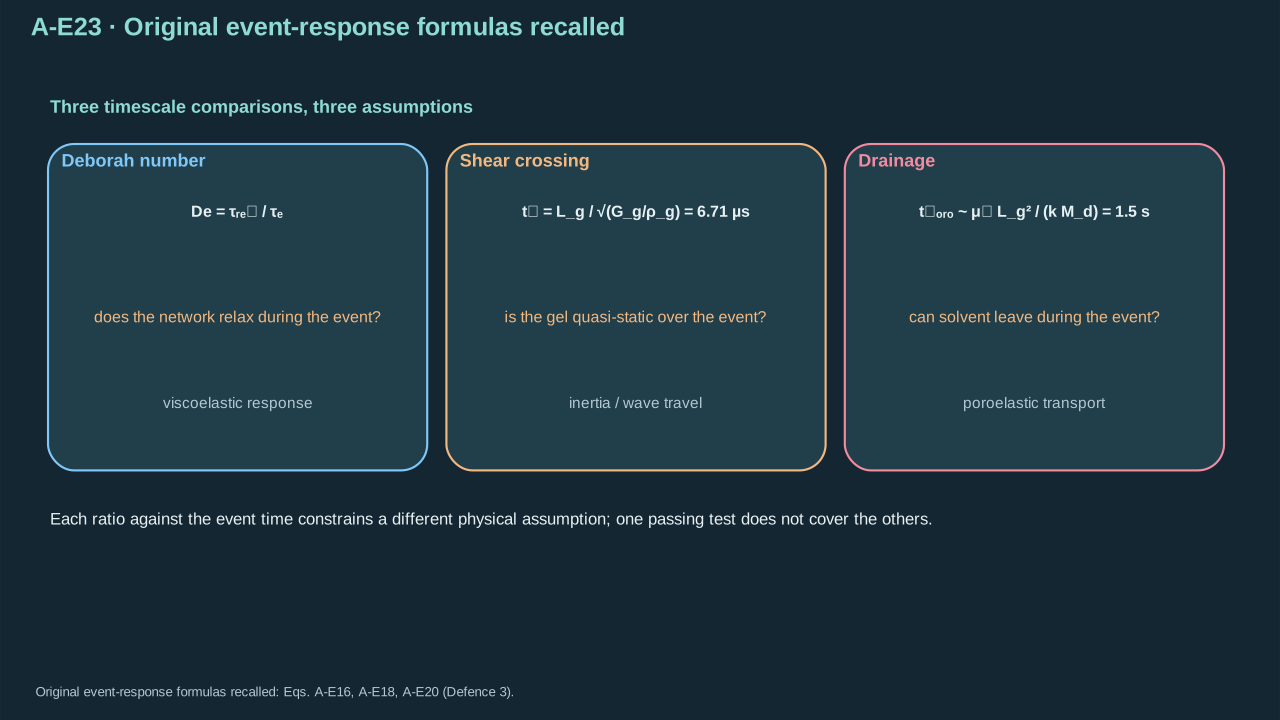
(A-E23) · Original event-response formulas recalled

回顾原始事件响应公式

De=τrelτe,ts=LgGg/ρg,tporo∼μlLg2kpermMd.\mathrm{De}=\frac{\tau_{\mathrm{rel}}}{\tau_e},\qquad t_s=\frac{L_g}{\sqrt{G_g/\rho_g}},\qquad t_{\mathrm{poro}}\sim\frac{\mu_lL_g^2}{k_{\mathrm{perm}}M_d}.
Three timescale comparisons constrain three different physical assumptions.

Three timescale comparisons constrain three different physical assumptions.

三个时间尺度比较分别约束三个不同的物理假设。

Symbols before Eq. (A-E24).

式(A-E24)前的符号定义。

First individual definition第一项单独定义Second individual definition第二项单独定义

Jtarget\mathbf J_{\mathrm{target}} is vector impulse delivered to the specified target (N s)

Jtarget\mathbf J_{\mathrm{target}} 为传递到指定目标的向量冲量(N s)

tload\mathbf t_{\mathrm{load}} is external load traction (Pa)

tload\mathbf t_{\mathrm{load}} 为外加载荷牵引(Pa)

AtA_t target loading area (m²)

AtA_t 为目标受载面积(m²)

t0t_0 — Specified event start time (s)

t0t_0 — 指定事件开始时刻(s)

t1t_1 — Specified event end time (s)

t1t_1 — 指定事件结束时刻(s)

Wsep,minW_{\mathrm{sep,min}} is necessary fracture-work budget (J)

Wsep,minW_{\mathrm{sep,min}} 为必要断裂功预算(J)

ArelA_{\mathrm{rel}} intended released interface area (m²)

ArelA_{\mathrm{rel}} 为目标释放界面面积(m²)

Γc\Gamma_c relevant interface fracture energy (J m⁻²), conditional on mode and rate

Γc\Gamma_c 为相关界面断裂能(J m⁻²),取决于模态与速率

dAdA — Area integration element (m²)

dAdA — 面积积分微元(m²)

dtdt — Time integration element (s)

dtdt — 时间积分微元(s)

Conventions and conditions. Neither integral alone proves crack onset or intact landing.

约定与条件。 这两个积分都不能独自证明裂纹起始或完整落点。

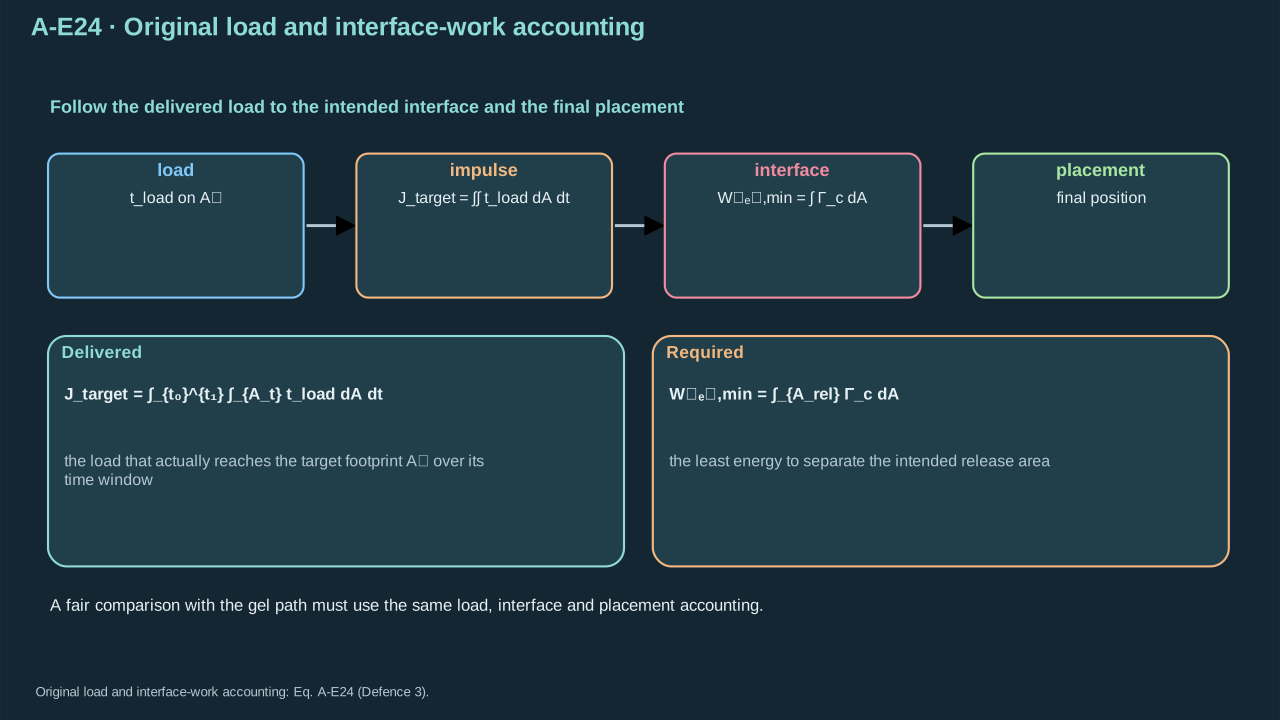
(A-E24) · Original load and interface-work accounting

原始载荷与界面功的收支核算

Jtarget=∫t0t1∫Attload dA dt,Wsep,min=∫ArelΓc dA.\mathbf J_{\mathrm{target}}=\int_{t_0}^{t_1}\int_{A_t}\mathbf t_{\mathrm{load}}\,dA\,dt,\qquad W_{\mathrm{sep,min}}=\int_{A_{\mathrm{rel}}}\Gamma_c\,dA.
A fair comparison follows the delivered load into the intended interface and the final placement.

A fair comparison follows the delivered load into the intended interface and the final placement.

公平比较要跟踪实际载荷进入目标界面及最终定位。

Compare all architectures with matched PFC inventory, absorber, absorbed energy and initial temperature. Match outlet and release interface where possible. Measure unavoidable architecture changes and report conditional comparisons. Characterize network response at event strain, rate and temperature. Test shell survival and heat deposition. Shear estimate 6.7082 µs differs from liquid-collapse reference 2.7440 µs. Actual gel-cavity time and longitudinal load remain unresolved.

比较各结构时匹配 PFC 物质量、吸收体、吸收能量及初温。条件允许时匹配出口及释放界面。测量不可避免的结构变化,并报告有条件比较。在事件应变、速率及温度下表征网络。检验壳层存续和热沉积。剪切估计 6.7082 µs 不同于液体塌缩参照 2.7440 µs。实际凝胶空腔时间及纵向载荷仍未确定。

Synchronize cavity, liquid composition, solid motion, calibrated load and crack images. Compare independent-shot distributions, intact placement, contamination and reset. Stabilization means reduced angle, speed, mass or footprint variability at sufficient load. One smaller bubble leaves that result unestablished. Report single-event maxima separately from repeatable transfer. Missing rate mechanics, permeability, phase kinetics or fracture data remain explicit inputs.

同步记录空腔、液体组成、固体运动、标定载荷及裂纹图像。比较独立发射分布、完整落位、污染和复位。稳定化意味着载荷足够时角度、速率、质量或面积变异降低。单个更小气泡仍未确立该结果。单事件最大值与可重复转印分别报告。速率力学、渗透率、相变动力学或断裂数据仍列为明确缺失输入。

Review criteria

审阅标准

  • Defines a fair absorbed-energy/material/geometry comparison while retaining each architecture and both film/PVC load paths.

    定义公平的吸收能量/材料/几何比较,同时保留每种结构及两条薄膜/PVC 载荷路径。

  • Distinguishes stress memory, shear communication, solvent drainage and longitudinal compression, with the assumptions of each estimate.

    区分应力记忆、剪切传播、溶剂排水与纵向压缩,并说明各估计的假设。

  • Links synchronized mechanism measurements to useful impulse, selective fracture, intact placement, variability and reset; separates extreme output from repeatable transfer.

    将同步机制测量连接到有效冲量、选择性断裂、完整定位、变异与复位;区分极端输出与可重复转印。

Submit your three answers

提交三个回答

Answer in your own words, in either language. Paste your answers into the teaching chat. Review covers reasoning, assumptions, and limits. All three accepted answers establish appendix mastery.
用自己的话作答,可选任一语言。将回答粘贴到教学对话。审阅包括推理、假设与限制。三个回答均被接受后,判定本附录已掌握。