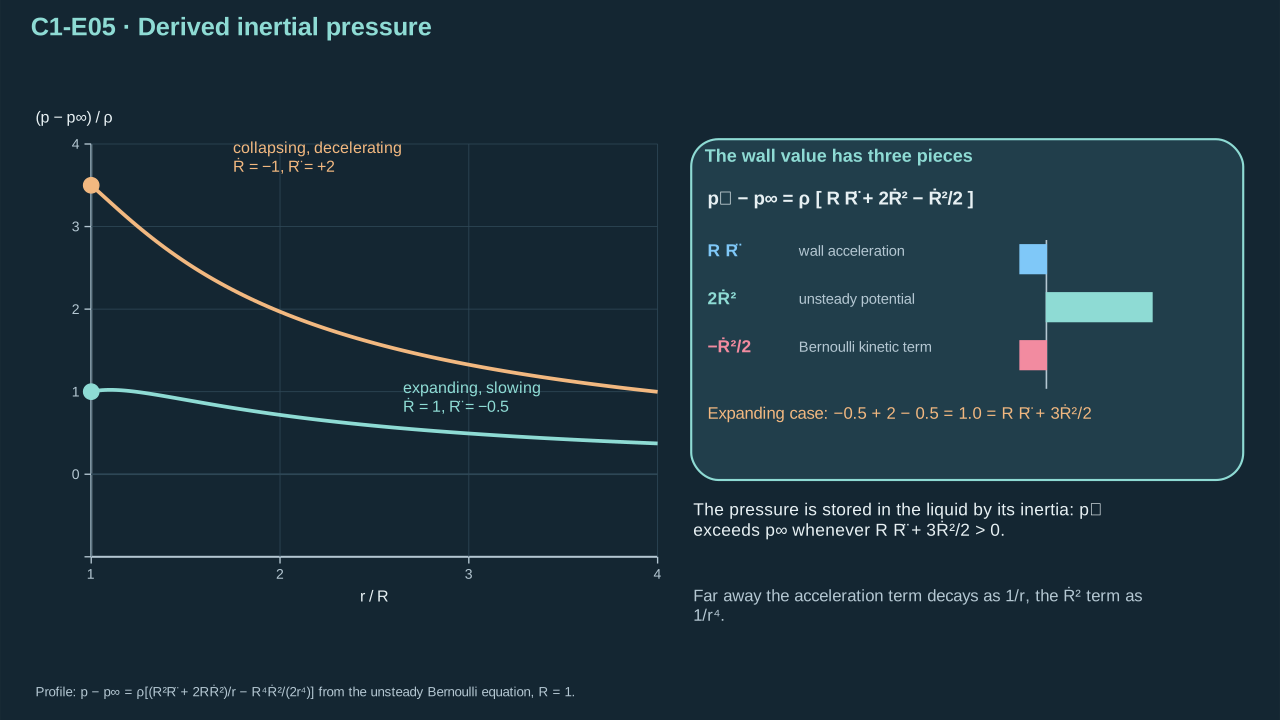
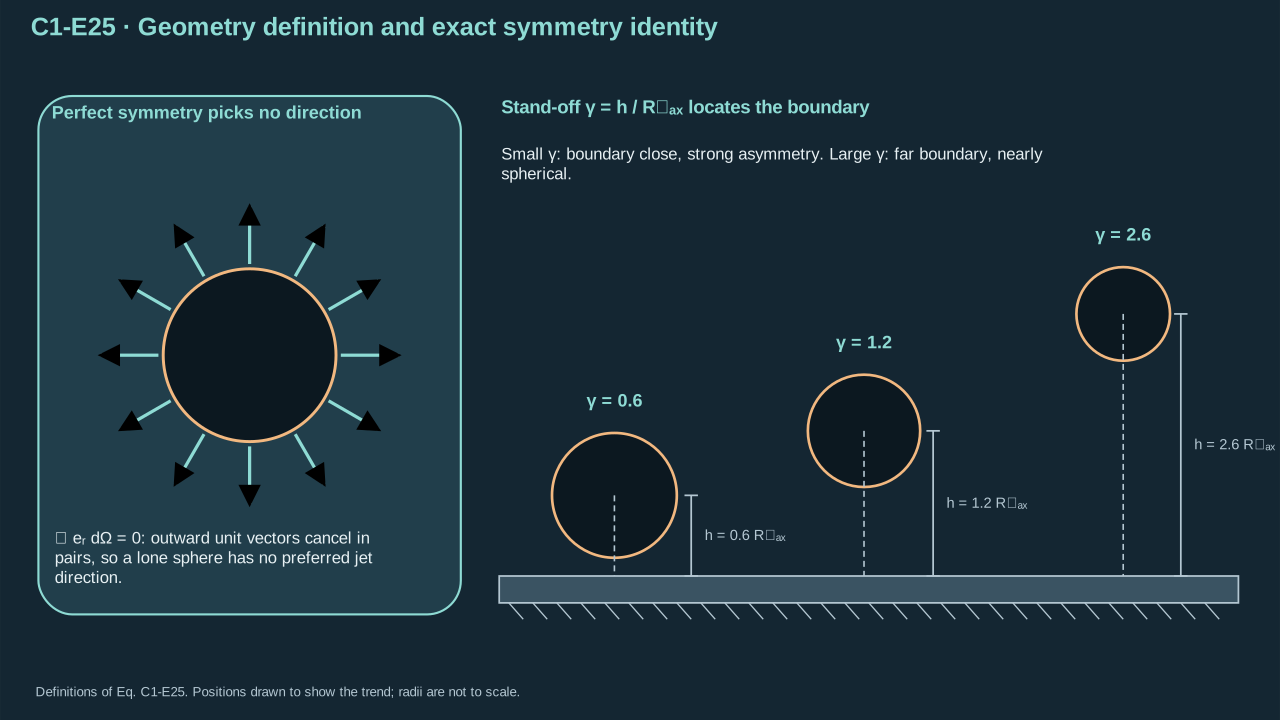
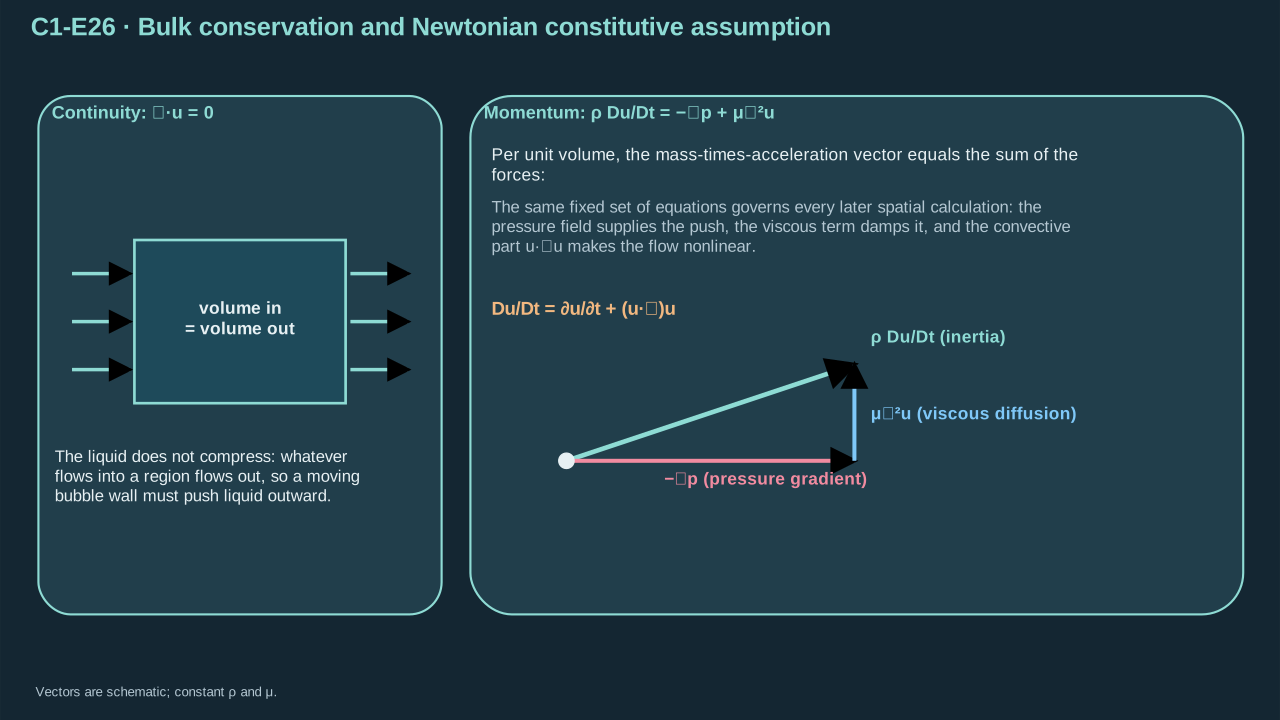
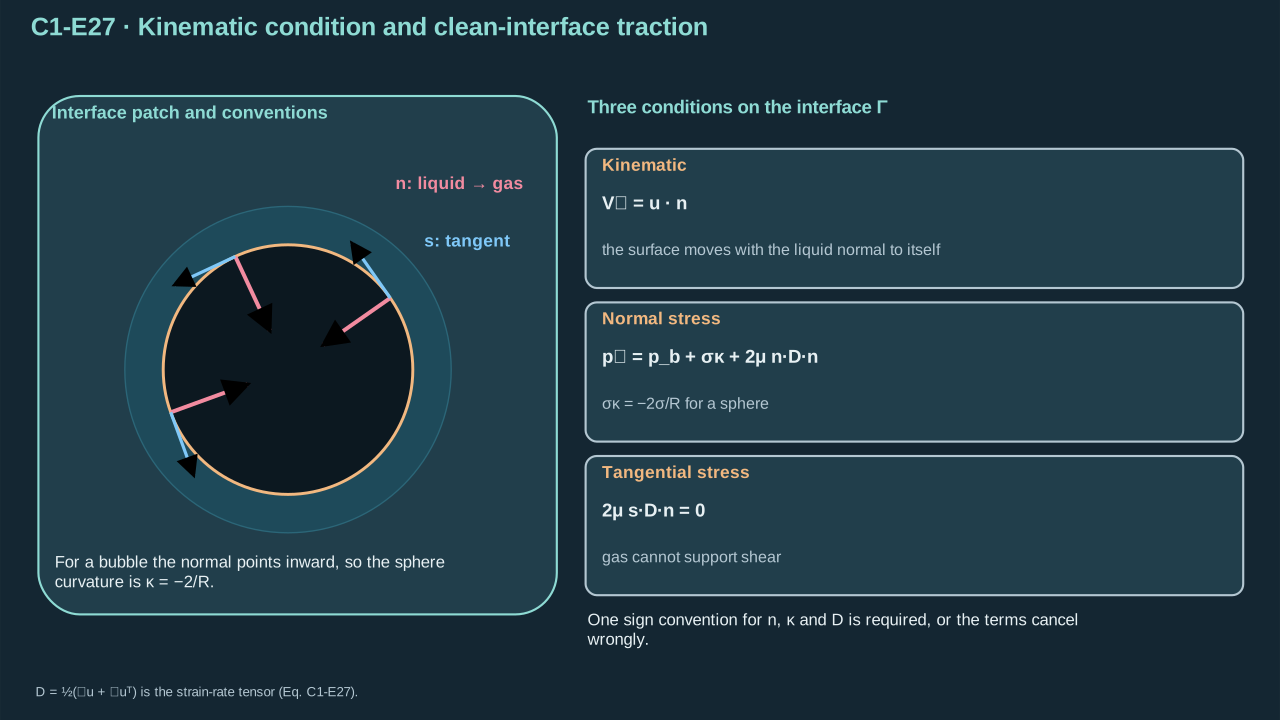
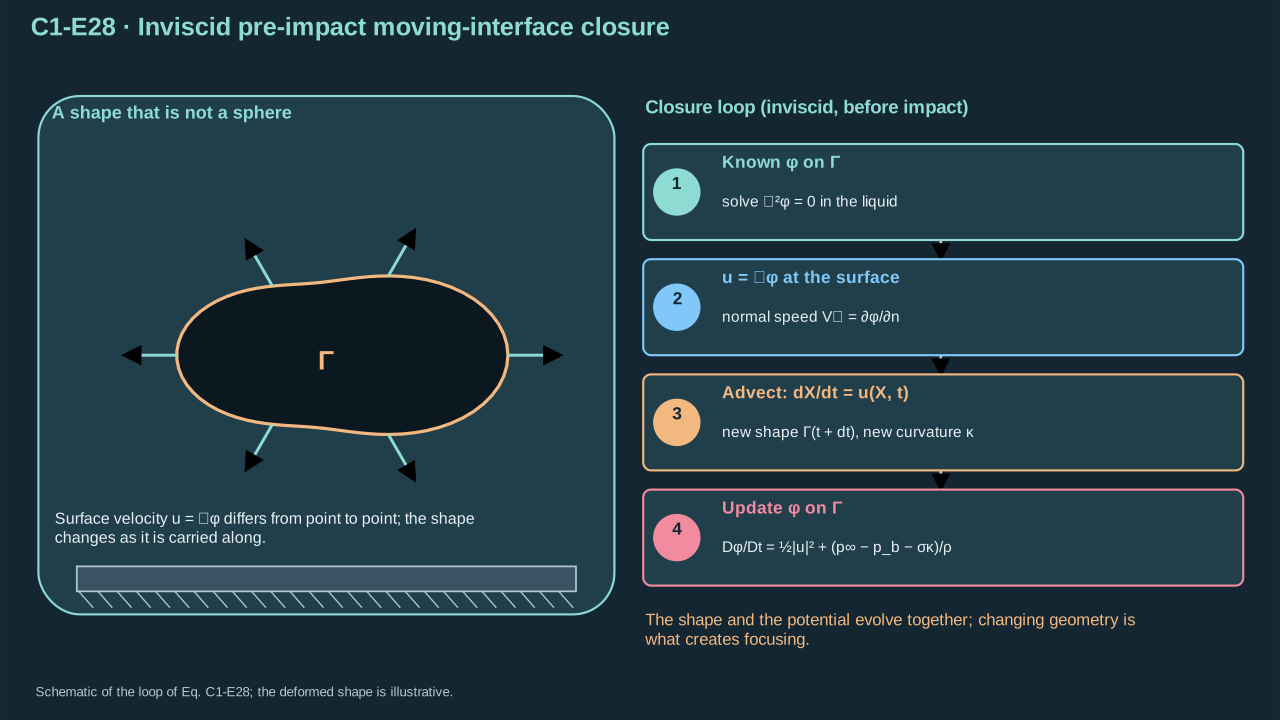
How does cavity pressure accelerate liquid, and why does a directional jet require asymmetry?
腔体压力如何加速液体?为什么形成定向射流必须有不对称性?
Derive cavity motion, energy and collapse time. Specify boundaries for directional jets.
推导空腔运动、能量和塌缩时间。规定定向射流边界。
Mastered已掌握
Learning goals
学习目标
Classify the cavity and liquid force path before using a jet model.
使用射流模型之前,辨认空腔与液体传力路径。
Reconstruct Rayleigh–Plesset with the correct fixed-position potential derivative.
使用正确的固定位置速度势导数,重建 Rayleigh–Plesset 方程。
Derive pressure-work conservation and the beta-function collapse coefficient.
推导压力功守恒与贝塔函数塌缩系数。
Explain why impulse, boundaries and evolving interface shape are needed for a directional jet.
解释定向射流为何需要冲量、边界与演化界面形状。
Prerequisite. Prerequisites: basic mechanics and calculus. Chapter 2 supplies the thermodynamic pressure source.
先修知识。 前提:基础力学与微积分。第二章给出热力学压力源。
1.1 Cavity growth, collapse and ejection
1.1 空腔增长、塌缩与喷射
This chapter derives how a cavity accelerates the surrounding liquid. It then identifies the boundaries needed to direct a jet. A PFC droplet starts as a finite liquid inventory. A bubble contains vapor, permanent gas, or both. Their radii measure different objects. Remaining PFC mass requires a separate inventory balance.
Pressure reduction and thermal vaporization can each create a moving cavity. Here, laser-induced cavitation covers heating, activation, growth, collapse and possible jetting. Identify the activation mechanism for each case. Chapter 2 supplies absorption, heat transfer, nucleation and phase inventory. This chapter takes internal pressure as a prescribed input.
The growing cavity displaces carrier toward an outlet or meniscus; the emitted jet is outside the cavity.
增长空腔将载液推向出口或弯月面;喷出射流位于空腔之外。
Track cavity growth and the outgoing liquid together.
同时追踪空腔增长与向外喷出的液体。
Collapse-driven re-entrant jet
塌缩驱动的再入射流
An asymmetric liquid interface penetrates the collapsing cavity and can strike its opposite side or a wall.
非对称液体界面穿入塌缩空腔,可撞击另一侧界面或壁面。
Show penetration into the cavity; do not rename it an external transfer jet.
观测射流穿入空腔;不能直接把它称为外部转印射流。
Sealed-cavity inflation
密闭空腔膨胀
Pressure deforms an intact membrane or stamp; liquid need not cross a gap.
压力使完整膜或印章变形;液体不必跨越间隙。
Locate the closed boundary and the transmitted deformation.
确定封闭边界及其传递的变形。
Liquid-bridge stretching
液桥拉伸
A moving solid pulls a filament; the filament need not originate as a cavitationjet.
运动固体拉出液丝;液丝不一定起源于空化射流。
Establish which moved first: the liquid tip or the solid.
辨明最先运动的是液体前端还是固体。
Mechanism identification requires the cavity boundary and liquid trajectories. Also track the outlet, receiver and event order. A bright cavity and detached payload leave the mechanism unresolved. The cited meniscus and collapse studies use different geometries. Apply their results after matching the boundary conditions. [R3][R4]
Model one spherical cavity in an infinite incompressible Newtonian carrier. Fix its center. Radius increases outward into the liquid. Positive wall velocity means expansion. Density, viscosity and effective surface tension remain constant. Omit gravity, bulk vorticity, phase-transfer velocity slip and gas viscous stress. Internal pressure is spatially uniform and may vary with time. The model describes one transient without periodic acoustic forcing.
Independent time coordinate; the initial instant is t = 0.
独立时间坐标;初始时刻取 t = 0。
r
Liquid radial coordinate
液体径向坐标
m
Distance from the fixed cavity center to an observation point in the carrier; r ≥ R.
从固定空腔中心到载液中观察点的距离;r ≥ R。
R
Instantaneous cavity radius
瞬时空腔半径
m
Locates the moving liquid–bubble interface; it is not the initial PFC-core radius.
定位运动的液体—气泡界面;并非初始 PFC 核半径。
R˙
Wall radial velocity
壁面径向速度
m s⁻¹
First time derivative of R; positive means expansion and negative means collapse.
R 对时间的一阶导数;正值表示膨胀,负值表示塌缩。
R¨
Wall radial acceleration
壁面径向加速度
m s⁻²
Second time derivative of R; its sign describes velocity change, not motion direction alone.
R 对时间的二阶导数;其符号描述速度变化,不能单独代表运动方向。
R0
Prescribed initial cavity radius
给定初始空腔半径
m
Positive initial value R(0); a state input to the mechanical model.
正的初始值 R(0);是力学模型的状态输入。
U0
Initial wall velocity
初始壁面速度
m s⁻¹
Prescribed value of the first time derivative of R at the initial instant.
初始时刻给定的 R 的一阶时间导数。
ρ
Carrier mass density
载液质量密度
kg m⁻³
Sets surrounding-liquid inertia; it must not be replaced by PFC vapor density.
决定周围液体的惯性;不能替换成 PFC 蒸气密度。
μ
Carrier dynamic viscosity
载液动力黏度
Pa s
Newtonian stress coefficient; viscous resistance dissipates energy in either motion direction.
牛顿流体应力系数;黏性阻力在两个运动方向均耗散能量。
σ
Effective bubble–carrier surface tension
有效气泡—载液表面张力
N m⁻¹
Belongs to the specified interface; contributes the spherical capillary pressure 2σ/R.
属于指定界面;产生球形毛细压力 2σ/R。
pb
Uniform bubble absolute pressure
均匀气泡绝对压力
Pa
Pressure on the cavity side of the interface; its history is supplied here.
界面空腔侧压力;本章将其时间历程作为输入。
pl
Adjacent-liquid absolute pressure
邻近液体绝对压力
Pa
Liquid-side pressure at the moving interface; stress balance relates it to bubble pressure.
运动界面的液体侧压力;通过应力平衡与泡内压力关联。
p∞
Far-field absolute pressure
远场绝对压力
Pa
Pressure prescribed far from the cavity; pressure differences drive acceleration.
远离空腔处的给定压力;加速度由压力差驱动。
p
Liquid pressure field
液体压力场
Pa
Pressure at a general liquid observation point, evaluated at the stated position and time.
指定位置与时间的普通液体观察点压力。
u
Scalar radial carrier velocity
标量载液径向速度
m s⁻¹
Positive outward from the center; differs from the spatial velocity vector below.
从中心向外取正;与下文空间速度矢量区别使用。
C(t)
Radial volume-flux factor
径向体积流量因子
m³ s⁻¹
Continuity makes r²u independent of r; this function is not a material constant.
连续性使 r²u 与 r 无关;该函数并非材料常数。
ϕ
Velocity potential
速度势
m² s⁻¹
Its spatial derivative gives radial velocity; the reference value is fixed at infinity.
其空间导数给出径向速度;参考值固定在无穷远。
Vb
Cavity volume
空腔体积
m³
Geometric volume enclosed by the bubble boundary; pressure work uses its rate of change.
气泡边界围成的几何体积;压力功使用其变化率。
Kl
Carrier kinetic energy
载液动能
J
Integrates motion throughout the exterior liquid, rather than mass inside the bubble.
对外部液体的运动进行积分,而不是计算气泡内部质量。
Eσ
Interfacial energy
界面能
J
Surface tension multiplied by spherical interface area under the constant-tension assumption.
在张力恒定假设下,等于表面张力乘球形界面面积。
Rmax
Radius at the start of ideal collapse
理想塌缩开始时的半径
m
Maximum cavity radius with zero initial wall velocity in the Rayleigh control.
Rayleigh 对照中壁面初始速度为零时的最大空腔半径。
pv
Stipulated constant vapor pressure
假定恒定蒸气压
Pa
Ideal-collapse internal-pressure input; real thermal or finite-inventory evolution may change it.
理想塌缩的内部压力输入;实际热过程或有限存量变化可能改变它。
Δpc
Positive ideal-collapse pressure difference
正的理想塌缩压差
Pa
Defined as far-field pressure minus the stipulated vapor pressure in this control.
在该对照中定义为远场压力减去假定蒸气压。
tc
Ideal collapse time
理想塌缩时间
s
Time from the initial maximum radius to the excluded zero-radius limit of the ideal model.
从初始最大半径到理想模型所排除的零半径极限的时间。
EB
Displaced-volume pressure-work scale
排开体积的压力功尺度
J
Uses the stated pressure difference and initial cavity volume; not an assigned jet energy.
由所声明压差与初始空腔体积构成;并非预设的射流能量。
x
Spatial position vector
空间位置矢量
m
Locates a point in the nonspherical liquid domain.
定位非球形液体域中的一点。
u
Spatial carrier velocity vector
空间载液速度矢量
m s⁻¹
Contains direction and spatial variation needed for a jet; scalar wall speed is insufficient.
包含射流所需的方向与空间变化;标量壁面速度不足以替代它。
Π
Pressure impulse per unit area
单位面积压力冲量
Pa s
Time integral of the specified excess pressure; its gradient changes liquid velocity.
指定超压对时间的积分;其梯度改变液体速度。
Γ
Moving liquid–gas interface
运动液—气界面
—
Geometric surface, not fracture energy; its position evolves with the interface condition.
几何曲面,不是断裂能;其位置按界面条件演化。
n
Liquid-to-gas unit normal
液体指向气体的单位法向
1
Fixes traction and signed-curvature conventions; reversing it changes those signs.
确定牵引与带符号曲率约定;反转法向会改变相关符号。
κ
Signed sum of principal curvatures
带符号的两主曲率之和
m⁻¹
For the stated liquid-to-gas normal on a spherical cavity, κ = −2/R.
对于所声明的球形空腔液体指向气体法向,κ = −2/R。
Superscripts denote powers unless stated otherwise. Bold symbols denote vectors or tensors. π is the dimensionless circle constant. Gradient, divergence and Laplacian use Cartesian definitions. Partial time derivatives hold position fixed. Each display defines its symbols locally. The positive initial radius permits division by radius. Zero radius is an excluded limit.
Purpose in this chapter. Choose the initial radius, wall speed, and far-field conditions. These inputs make the radial dynamics in Section 1.3 a defined initial-value problem.
本章作用。 选定初始半径、壁面速度与远场条件。这些输入使第1.3节的径向动力学成为明确的初值问题。
Derivation.
推导。
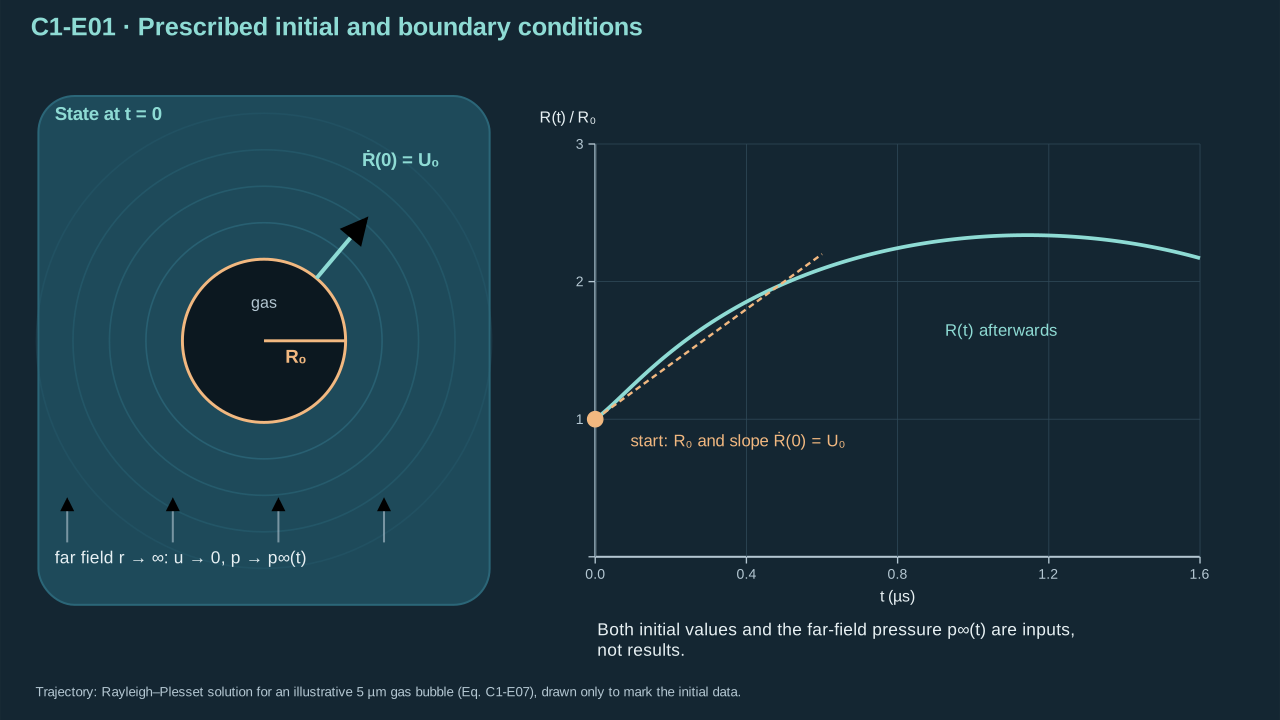
(C1.2-E01) · Prescribed initial and boundary conditions
(C1.2-E01) · 给定的初始条件与边界条件
In C1.2-E01, the symbol is R˙(0), not R(0). The equation specifies two initial conditions: R(0)=R0>0 (initial cavity radius) and R˙(0)=U0 (initial radial wall velocity).
U0 is a general initial-condition parameter, not a claim that the cavity must already be moving. The Rayleigh–Plesset equation is second-order in time, so the radius and wall velocity both need to be specified. Setting U0=0 is fully allowed.
The choice depends on the initial event. If time zero is before activation, with the cavity at rest, choose U0=0; a subsequent pressure imbalance can still give R¨(0)=0. If time zero is partway through growth or collapse, U0 may be nonzero (positive for expansion, negative for collapse). At the maximum radius immediately before an ideal collapse, U0=0, precisely as specified in Section 1.5.
Therefore, C1.2-E01 is the general formulation; zero initial velocity is a physically important special case, not a universal condition. The value must be consistent with the chosen initial state and pressure history.
Set the initial wall speed to zero. The viscous and squared-speed terms vanish, but a pressure imbalance can still produce acceleration.
令初始壁面速度为零。黏性项与速度平方项消失,但压力失衡仍可产生加速度。
U0=0⟹R¨(0)=ρR0pb(0)−p∞(0)−2σ/R0.
Prescribe a positive initial cavity radius.
给定正的空腔初始半径。
R(0)=R0>0
Prescribe initial wall speed separately; it may be zero.
独立给定初始壁面速度,其值可以为零。
R˙(0)=U0
Complete the exterior problem with zero far-field velocity and prescribed far-field pressure.
用零远场速度与给定远场压力补全外域问题。
u(r,t)→0,p(r,t)→p∞(t)(r→∞)
Symbols for Eq. (C1.2-E01).
式(C1.2-E01)的符号定义。
First individual definition第一项单独定义
Second individual definition第二项单独定义
R is the cavity radius (m)
R 为空腔半径(m)
t is time (s), with 0 the chosen initial instant
t 为时间(s),0 为选定的初始时刻
R0 is its prescribed positive initial value (m)
R0 为给定的正初始半径(m)
R˙ is wall speed (m s⁻¹)
R˙ 为壁面速度(m s⁻¹)
U0 its initial value (m s⁻¹)
U0 为其初值(m s⁻¹)
r is radial position (m)
r 为径向位置(m)
u is radial liquid speed (m s⁻¹)
u 为液体径向速度(m s⁻¹)
p is liquid pressure (Pa)
p 为液体压力(Pa)
p∞ is prescribed far-field pressure (Pa)
p∞ 为给定远场压力(Pa)
ρ — positive carrier density (kg m⁻³)
ρ — 正载液密度(kg m⁻³)
pb — bubble pressure (Pa)
pb — 气泡压力(Pa)
σ — constant surface tension (N m⁻¹)
σ — 常数表面张力(N m⁻¹)
μ — dynamic viscosity (Pa s)
μ — 动力黏度(Pa s)
R¨ — wall acceleration (m s⁻²)
R¨ — 壁面加速度(m s⁻²)
Conventions and conditions. The arrow denotes the far-field limit; All pressures share an absolute reference.
约定与条件。 箭头表示远场极限;全部压力采用同一绝对参考值。
The evolving spherical boundary and the prescribed far-field state.
运动球形边界与给定的远场状态。
Check and interpretation. Positive initial pressure excess over capillarity gives outward acceleration. Initial zero speed therefore does not imply equilibrium. The acceleration expression has units Pa/(kg m⁻²) = m s⁻².
检验与解释。 初始内外压差超过毛细压差时产生向外加速度。因此初速为零不代表平衡。加速度表达式单位为 Pa/(kg m⁻²) = m s⁻²。
1.3 Rayleigh–Plesset derivation
1.3 Rayleigh–Plesset 方程推导
Step 1.3.1 — Obtain the liquid velocity from cavity motion
步骤 1.3.1——由空腔运动求载液速度
Purpose in this chapter. Use the spherical conditions in Eq. (C1.2-E01). Volume conservation converts wall motion into the exterior velocity field needed for momentum and energy calculations.
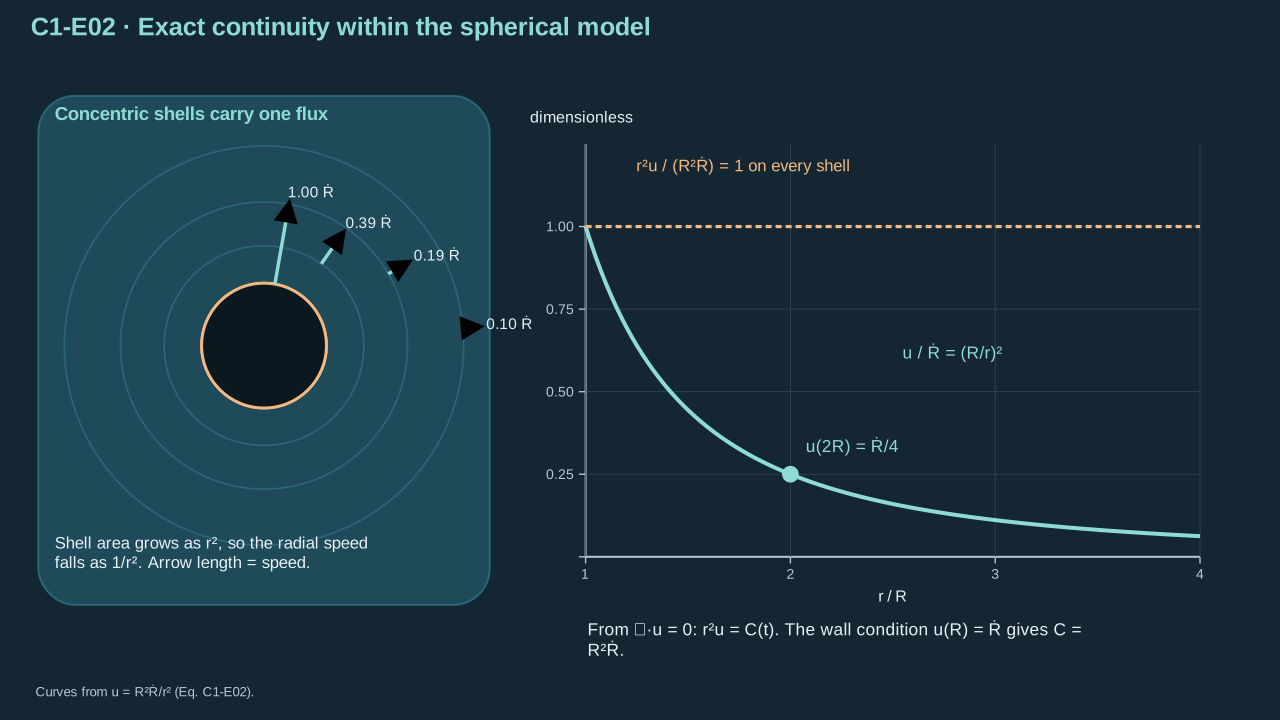
Conserve carrier volume. Radial incompressibility makes volume flux independent of radius. Integrate its radial derivative. Apply equal normal liquid and interface velocities at the wall. Vapor density does not enter this carrier-flow calculation.
Derivation. Apply mass conservation to a spherical shell. Constant density reduces it to zero divergence. Integrate in radius at fixed time. The integration function can depend on time. A material cavity wall supplies the final boundary value. Appreciable phase transfer changes that boundary value.
Divide by the positive squared radius to obtain the spherical divergence form of incompressibility.
除以正的半径平方,得到不可压缩条件的球坐标散度形式。
0=r21∂r∂(r2u),
Integrate with respect to radius at fixed time. The integration function may vary with time but cannot vary with radius.
在固定时间对半径积分。积分函数可以随时间变化,但不能随半径变化。
∂r∂(r2u)=0⟹r2u=C(t),
Apply equal liquid and interface normal speeds at the material cavity wall. This determines the integration function.
在物质空腔壁面令液体与界面法向速度相等。由此确定积分函数。
u(R,t)=R˙⟹C(t)=R2R˙,
Check the inverse-square decay at twice the wall radius. The ratio is defined here for nonzero wall speed.
在两倍壁面半径处检验平方反比衰减。此处速度比要求壁面速度非零。
R˙u(2R,t)=(2R)2R2=41(R˙=0).
The integrated continuity equation leaves a time-dependent radial flux factor.
积分连续性方程后,留下随时间变化的径向通量因子。
r21∂r∂(r2u)=0⟹r2u=C(t)
The material-wall condition fixes that factor.
物质壁面条件确定该因子。
u(R,t)=R˙⟹C(t)=R2R˙
Divide by squared radius to recover the exterior velocity used below.
除以半径平方,恢复下文所用外域速度。
u(r,t)=r2R2R˙
Symbols for Eq. (C1.3-E02).
式(C1.3-E02)的符号定义。
First individual definition第一项单独定义
Second individual definition第二项单独定义
r≥R(t)>0 is radial position (m)
r≥R(t)>0 为径向位置(m)
R is cavity radius (m)
R 为空腔半径(m)
t is time (s)
t 为时间(s)
u is radial carrier velocity (m s⁻¹)
u 为载液径向速度(m s⁻¹)
R˙ is wall speed (m s⁻¹)
R˙ 为壁面速度(m s⁻¹)
C(t) is the radius-independent flux factor (m³ s⁻¹), not a material constant
C(t) 为与径向位置无关的流量因子(m³ s⁻¹),并非材料常数
ρ — positive constant liquid density (kg m⁻³)
ρ — 正常数液体密度(kg m⁻³)
δr — positive fixed shell thickness (m)
δr — 固定球壳正厚度(m)
π — circle constant (1)
π — 圆周率(1)
∂r — radial derivative at fixed time (m⁻¹)
∂r — 固定时间的径向导数(m⁻¹)
Conventions and conditions.∂/∂r differentiates at fixed time; The implication arrows indicate integration and use of the interface condition; The fixed shell stays liquid; r≥R(t)>0.
Inverse-square velocity decay places the inertia in the surrounding carrier.
速度按距离平方反比衰减,惯性来自周围载液。
Check and interpretation. The flux factor divided by radius squared has velocity units. Setting wall speed to zero gives a stationary liquid everywhere.
检验与解释。 通量因子除以半径平方具有速度单位。壁面速度为零时,全部液体静止。
Step 1.3.2 — Prepare the velocity field for momentum integration
步骤 1.3.2——为动量积分建立速度势
Purpose in this chapter. Integrate the velocity from Eq. (C1.3-E02) and fix its reference. The resulting potential lets the radial momentum equation become a pressure relation.
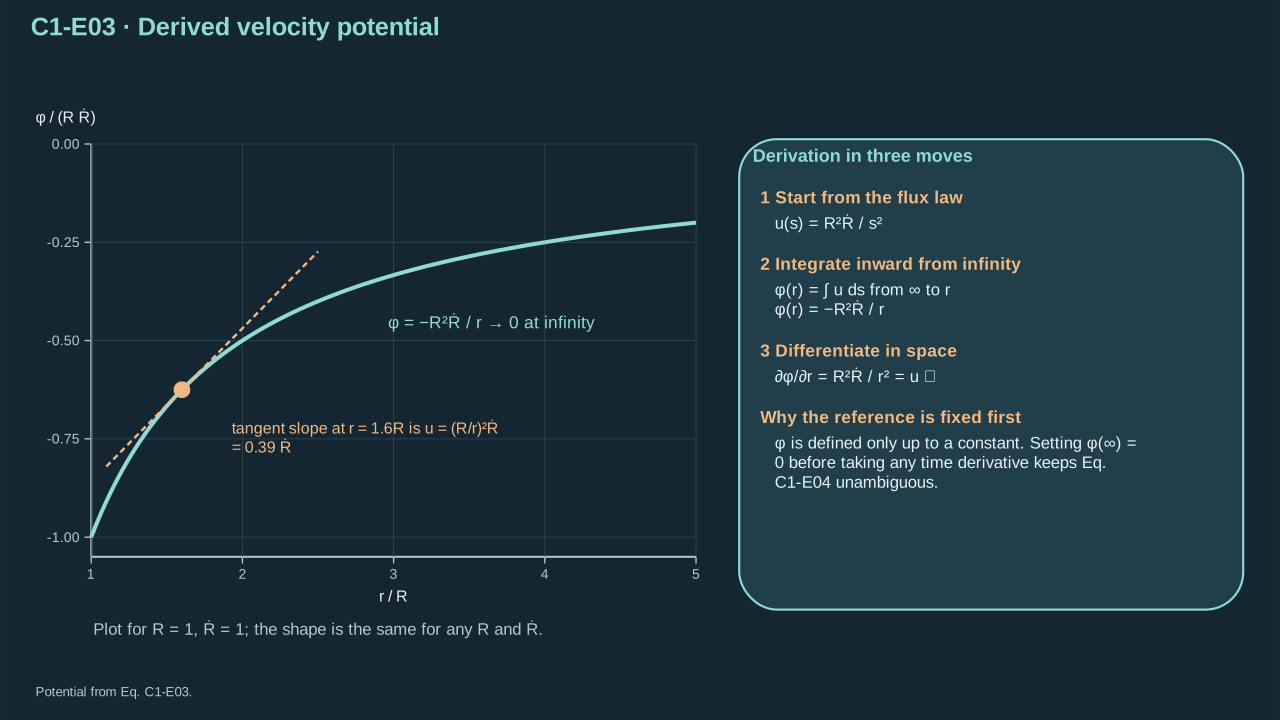
Fix the potential reference. Integrate velocity from infinity to the observation point. The potential applies outside the cavity. Zero potential at infinity fixes the time-dependent integration constant.
Under the assumptions of Chapter 1, the exterior liquid flow is spherically symmetric and purely radial. Its vorticity is zero. Therefore, a scalar velocity potential exists such that:
Integrating with respect to r, and choosing ϕ(∞,t)=0, we obtain C1.3-E03:
对 r 积分,并选择 ϕ(∞,t)=0,便得到 C1.3-E03:
ϕ(r,t)=−rR2R˙
Thus, the potential is simply another mathematical representation of the velocity field already obtained from mass conservation.
因此,速度势只是对已经通过质量守恒得到的速度场进行另一种数学表示。
2. What does it simplify?
它简化了什么?
The radial Euler momentum equation contains both local acceleration and convective acceleration:
径向欧拉动量方程同时包含局部加速度和对流加速度:
∂t∂u+u∂r∂u=−ρ1∂r∂p
Using u=∇ϕ for irrotational flow allows us to integrate this equation into the unsteady Bernoulli relation:
对于无旋流动,利用 u=∇ϕ,可以将其积分为非定常伯努利关系:
∂t∂ϕ+21∣∇ϕ∣2+ρp=ρp∞
Here, the time derivative is taken at a fixed spatial position, and the right-hand side follows from the zero-potential, zero-velocity reference at infinity.
这里的时间偏导数是在固定空间位置计算的,右端则由无穷远处速度势和速度均为零的参考条件确定。
Substituting C1.3-E03 and evaluating at the moving cavity boundary r=R(t), we obtain:
将 C1.3-E03 代入,并在运动空腔边界 r=R(t) 处取值,可得:
∂t∂ϕr=R=−(2R˙2+RR¨),
Use the material-wall condition to identify liquid speed at the interface.
利用物质壁面的运动学条件确定界面处液体速度。
u(R,t)=R˙,
Evaluate Bernoulli at the wall and isolate the pressure difference.
在壁面计算伯努利关系,并解出压力差。
ρpl−p∞=−∂t∂ϕr=R−21R˙2
Insert the fixed-position derivative and combine the squared-speed terms.
代入固定位置导数,并合并速度平方项。
ρpl−p∞=RR¨+23R˙2.
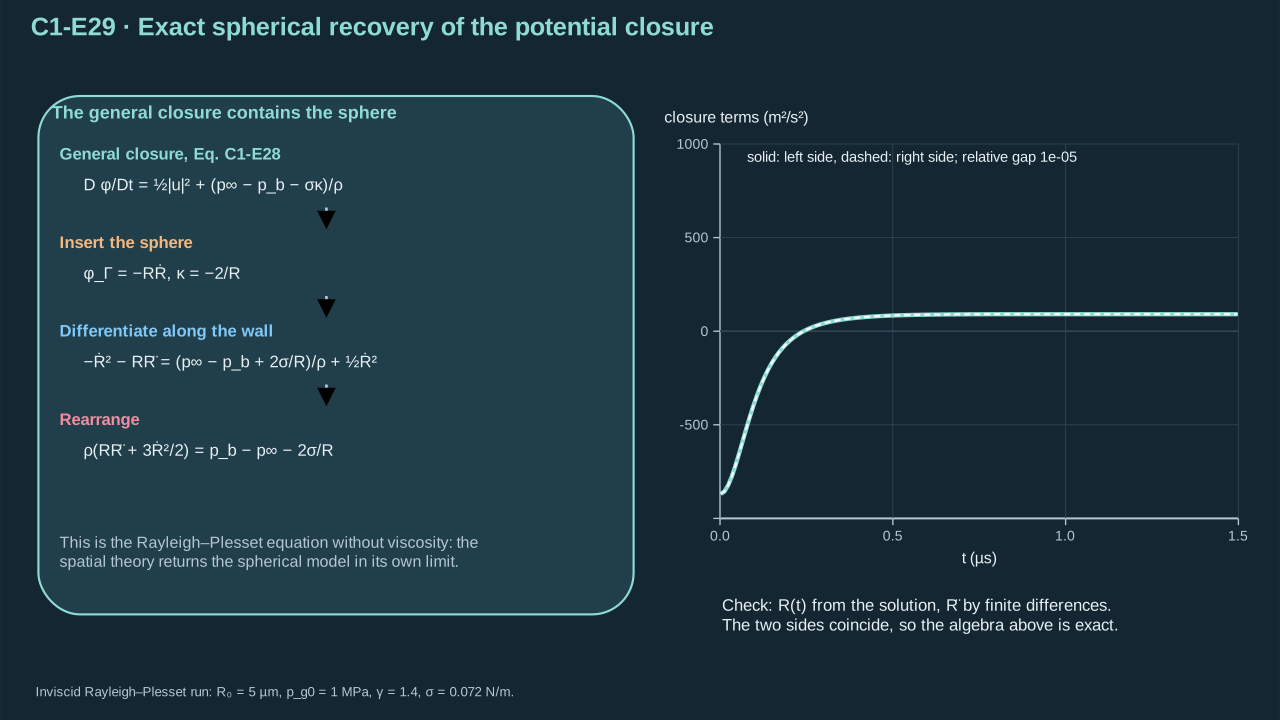
This is C1.3-E05, which directly supplies the liquid-inertia term of the Rayleigh–Plesset equation.
这就是 C1.3-E05,它直接给出了 Rayleigh–Plesset 方程中的液体惯性项。
3. Is the velocity potential necessary?
速度势是必需的吗?
No. We can substitute C1.3-E02 directly into the radial Euler equation and integrate the pressure gradient from the cavity surface to infinity. The resulting pressure–inertia equation is identical.
The advantage of ϕ is mathematical convenience. It also provides a natural formulation for the potential-flow models later used to examine bubble interactions and nonspherical jet formation. Those applications require their own boundary conditions and do not establish that every cavitation flow is irrotational.
Defense conclusion: C1.3-E03 is a mathematical bridge from the incompressible velocity field to the pressure–inertia relationship. It simplifies the derivation but is not indispensable, and its validity depends on the irrotational-flow assumption.
Conventions and conditions. the integral is an improper integral convergent for r≥R>0; ∂/∂r is the fixed-time spatial derivative.
约定与条件。 该广义积分在 r≥R>0 时收敛;∂/∂r 为固定时间的空间导数。
The potential reference is fixed at infinity before differentiation.
在求导之前,先固定无穷远处的速度势参考值。
Check and interpretation. Spatial differentiation recovers positive outward velocity during expansion. Potential has units length × speed. The construction excludes rotational flow and unresolved vortex sheets.
Step 1.3.3 — Separate fixed-position and moving-wall time changes
步骤 1.3.3——区分固定位置与运动壁面的时间变化
Purpose in this chapter. Differentiate the potential from Eq. (C1.3-E03). Bernoulli requires the fixed-position derivative, so this distinction prevents an incorrect wall-inertia term.
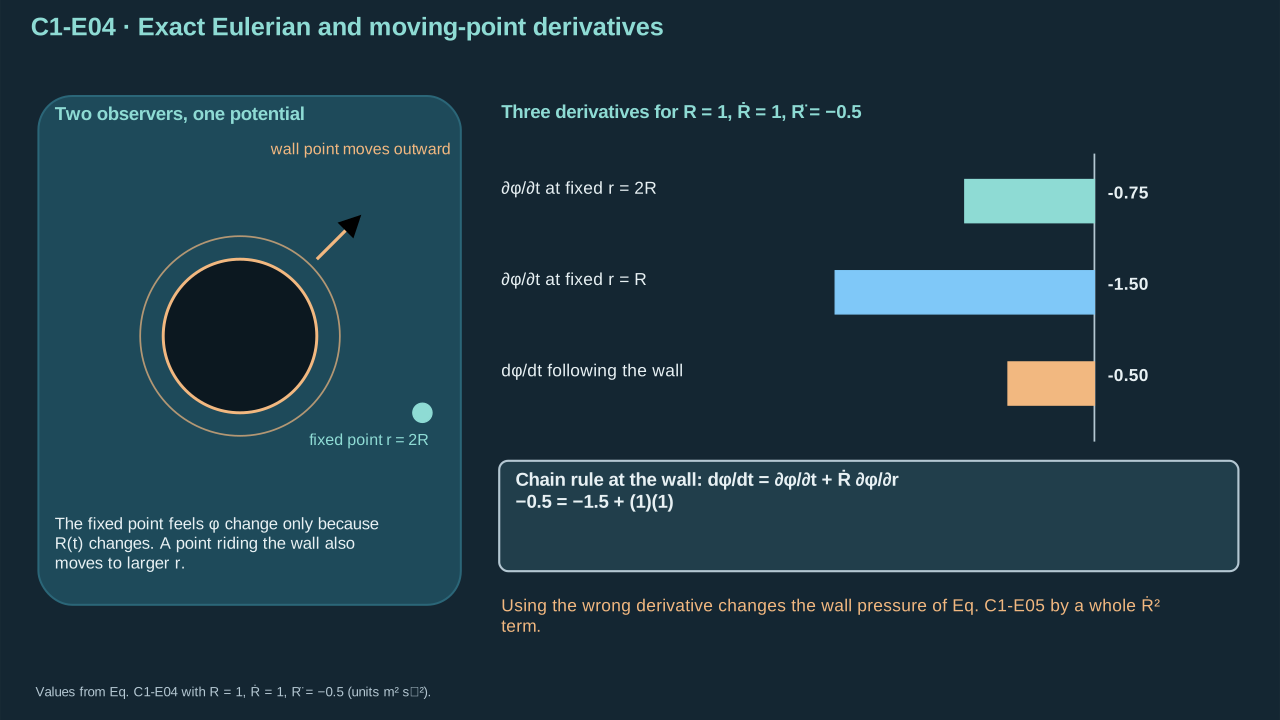
Differentiate at fixed position. Hold the denominator fixed while differentiating the potential numerator. Then evaluate the result at the moving wall. Differentiating the wall value instead includes a convective contribution.
(C1.3-E04) · Exact Eulerian and moving-point derivatives
(C1.3-E04) · 精确的欧拉导数与运动点导数
From C1.3-E03,
根据 C1.3-E03:
ϕ(r,t)=−rR2R˙.
Differentiating with respect to time at fixed r gives
在固定 r 的条件下对时间求偏导:
∂t∂ϕ=−r2RR˙2+R2R¨.
Then evaluating at r=R(t),
随后在 r=R(t) 处取值:
∂t∂ϕr=R=−2R˙2−RR¨.(8)
Additional worked steps. The following steps supply details beyond the preserved handoff passage.
补充的完整步骤。 以下步骤补充所保留交接材料之外的细节。
Apply the product rule to the radius-squared times wall-speed numerator. Both radius factors depend on time.
对半径平方与壁面速度的乘积应用乘积法则。两个半径因子均随时间变化。
dtd(R2R˙)=2RR˙R˙+R2R¨,
Apply the chain rule along the moving wall. The total derivative includes the fixed-position derivative and the radial transport term.
沿运动壁面应用链式法则。全导数包含固定位置导数与径向输运项。
dtdϕ(R(t),t)=∂tϕ∣r=R+R˙∂rϕ∣r=R,
Insert the fixed-position potential derivative and the wall velocity. The transport contribution is the squared wall speed.
代入固定位置速度势导数及壁面速度。输运项为壁面速度的平方。
dtdϕ(R(t),t)=−(2R˙2+RR¨)+R˙R˙
Combine the two squared-speed contributions. This gives the moving-wall derivative, which differs from the fixed-position derivative.
合并两个速度平方项。由此得到运动壁面导数,它与固定位置导数不同。
dtdϕ(R(t),t)=−R˙2−RR¨.
Hold the observation radius fixed while differentiating the potential.
对速度势求导时保持观察半径固定。
∂t∂ϕr=−r2RR˙2+R2R¨
Evaluate this fixed-position derivative at the instantaneous wall radius.
在瞬时壁面半径处计算该固定位置导数。
∂t∂ϕr=R=−(2R˙2+RR¨)
Keep the moving-wall total derivative distinct when it is used later.
后续使用时,须区分沿运动壁面的全导数。
dtdϕ(R(t),t)=−R˙2−RR¨
Symbols for Eq. (C1.3-E04).
式(C1.3-E04)的符号定义。
First individual definition第一项单独定义
Second individual definition第二项单独定义
ϕ is velocity potential (m² s⁻¹)
ϕ 为速度势(m² s⁻¹)
t is time (s)
t 为时间(s)
r is fixed radial position (m)
r 为固定径向位置(m)
R(t)>0 is moving cavity radius (m)
R(t)>0 为运动空腔半径(m)
R˙ — Wall radial velocity (m s⁻¹)
R˙ — 壁面径向速度(m s⁻¹)
R¨ — Wall radial acceleration (m s⁻²)
R¨ — 壁面径向加速度(m s⁻²)
Conventions and conditions. vertical bars specify where the derivative is taken or evaluated; d/dt follows the moving wall value; Each derivative has units m² s⁻².
约定与条件。 竖线表示求导或取值条件;d/dt 跟随运动壁面的取值;各导数的单位均为 m² s⁻²。
A fixed liquid observation point and a moving interface point have different time derivatives.
固定液体观察点与运动界面点对应不同的时间导数。
Check and interpretation. The moving derivative exceeds the Eulerian wall evaluation by wall speed squared. Both derivatives have energy-per-mass units.
检验与解释。 运动导数比欧拉导数的壁面取值大一个壁面速度平方。两者均具有单位质量能量的单位。
Step 1.3.4 — Connect liquid inertia to wall pressure
步骤 1.3.4——将液体惯性与壁面压力联系起来
Purpose in this chapter. Insert Eqs. (C1.3-E02)–(C1.3-E04) into the integrated momentum law. This expresses liquid-side wall pressure through radius, speed, and acceleration.
Integrate radial momentum. The exterior field is irrotational with zero vector Laplacian. Bulk viscous force therefore vanishes. Viscous wall stress and dissipation remain. Reference unsteady Bernoulli to infinity. Insert the fixed-position derivative and wall velocity. Subtracting one half from two gives the inertial coefficient.
1. Derive unsteady Bernoulli from momentum conservation
1. 从动量守恒推导非定常伯努利方程
Under the chapter's assumptions of constant liquid density, incompressibility, spherical symmetry, irrotational flow, and no body force, the bulk radial momentum equation is
在本章采用的恒定液体密度、不可压缩、球对称、无旋流动及无体积力假设下,流体内部的径向动量方程为:
∂t∂u+u∂r∂u=−ρ1∂r∂p.(1)
The bulk viscous-force term vanishes for this velocity field, although viscous normal stress remains at the cavity interface. From C1.3-E03, u=∂ϕ/∂r. Therefore,
Rearranging equation (6) and evaluating it at r=R(t), where liquid pressure is pl, gives
整理式 (6),并在 r=R(t) 的运动边界处取值,此处液体压力为 pl,得到:
ρpl−p∞=−∂t∂ϕr=R−21u(R,t)2.(7)
From C1.3-E03,
根据 C1.3-E03:
ϕ(r,t)=−rR2R˙.
Differentiating with respect to time at fixed r gives
在固定 r 的条件下对时间求偏导:
∂t∂ϕ=−r2RR˙2+R2R¨.
Then evaluating at r=R(t),
随后在 r=R(t) 处取值:
∂t∂ϕr=R=−2R˙2−RR¨.(8)
The kinematic boundary condition supplies u(R,t)=R˙. Substitution into equation (7) yields
运动学边界条件给出 u(R,t)=R˙。将其与式 (8) 代入式 (7):
ρpl−p∞=−(−2R˙2−RR¨)−21R˙2
Remove the outer minus sign while retaining the kinetic contribution.
展开外部负号,同时保留动能项。
ρpl−p∞=RR¨+2R˙2−21R˙2
Combine two minus one half to obtain three halves.
将二减去二分之一合并为二分之三。
ρpl−p∞=RR¨+23R˙2.
This reproduces C1.3-E05 exactly. The coefficient 3/2 follows from the acceleration and kinetic-energy contributions; it is not an empirical coefficient.
这就完整恢复了 C1.3-E05。系数 3/2 来自加速度项和动能项的合并,并不是经验系数。
Symbols for Eq. (C1.3-E05).
式(C1.3-E05)的符号定义。
First individual definition第一项单独定义
Second individual definition第二项单独定义
pl is liquid pressure at the wall (Pa)
pl 为壁面液体压力(Pa)
p∞ far-field pressure (Pa)
p∞ 为远场压力(Pa)
ρ>0 is carrier density (kg m⁻³)
ρ>0 为载液密度(kg m⁻³)
ϕ is velocity potential (m² s⁻¹)
ϕ 为速度势(m² s⁻¹)
t is time (s)
t 为时间(s)
r is radial position (m)
r 为径向位置(m)
R>0 cavity radius (m)
R>0 为空腔半径(m)
u is radial velocity (m s⁻¹)
u 为径向速度(m s⁻¹)
R˙ wall speed (m s⁻¹)
R˙ 为壁面速度(m s⁻¹)
R¨ is wall acceleration (m s⁻²)
R¨ 为壁面加速度(m s⁻²)
u — liquid velocity, ∇ϕ (m s⁻¹)
u — 液体速度,即 ∇ϕ(m s⁻¹)
∇ — spatial gradient operator (m⁻¹)
∇ — 空间梯度算子(m⁻¹)
∇⋅ — spatial divergence operator (m⁻¹)
∇⋅ — 空间散度算子(m⁻¹)
∇× — spatial curl operator (m⁻¹)
∇× — 空间旋度算子(m⁻¹)
∇2 — vector Laplacian operator (m⁻²)
∇2 — 矢量拉普拉斯算子(m⁻²)
ui — Cartesian velocity component indexed by i (m s⁻¹)
ui — 指标 i 对应的笛卡尔速度分量(m s⁻¹)
uj — Cartesian velocity component indexed by j (m s⁻¹)
uj — 指标 j 对应的笛卡尔速度分量(m s⁻¹)
i — Cartesian component index, 1, 2 or 3 (1)
i — 笛卡尔分量指标,取 1、2 或 3(1)
j — Cartesian component index, 1, 2 or 3 (1)
j — 笛卡尔分量指标,取 1、2 或 3(1)
∂i — coordinate derivative indexed by i (m⁻¹)
∂i — 指标 i 对应的坐标导数(m⁻¹)
∂j — coordinate derivative indexed by j (m⁻¹)
∂j — 指标 j 对应的坐标导数(m⁻¹)
∑ — summation over the indicated index (1)
∑ — 对指定指标求和(1)
B0(t) — Bernoulli integration function (m² s⁻²)
B0(t) — 伯努利积分函数(m² s⁻²)
p — local liquid pressure (Pa)
p — 局部液体压力(Pa)
C(t) — Bernoulli integration function; same role as B0(t) (m² s⁻²)
C(t) — 伯努利积分函数;与 B0(t) 作用相同(m² s⁻²)
Conventions and conditions.∂t is taken at fixed position before wall evaluation; Zero vorticity gives ∂jui=∂iuj; smooth fields permit derivative exchange; ∣∣ denotes Euclidean magnitude; ∞ denotes the far-field limit.
Liquid inertia relates the interface pressure to wall acceleration and squared speed.
液体惯性把界面压力与壁面加速度及速度平方联系起来。
Check and interpretation. The coefficient is 2 − 1/2 = 3/2. Constant potential gauge has been fixed; an arbitrary time gauge would change the integration function together with the potential derivative.
Step 1.3.5 — Transfer bubble pressure across the interface
步骤 1.3.5——将气泡压力传递至液体界面
Purpose in this chapter. Apply normal-stress balance at the spherical wall. Surface tension and viscosity connect bubble pressure to the liquid pressure required by Eq. (C1.3-E05).
Balance normal stress. Expansion gives a negative radial strain rate at the wall. The capillary jump lowers liquid pressure relative to cavity pressure. Balance normal traction with Newtonian viscous stress included.
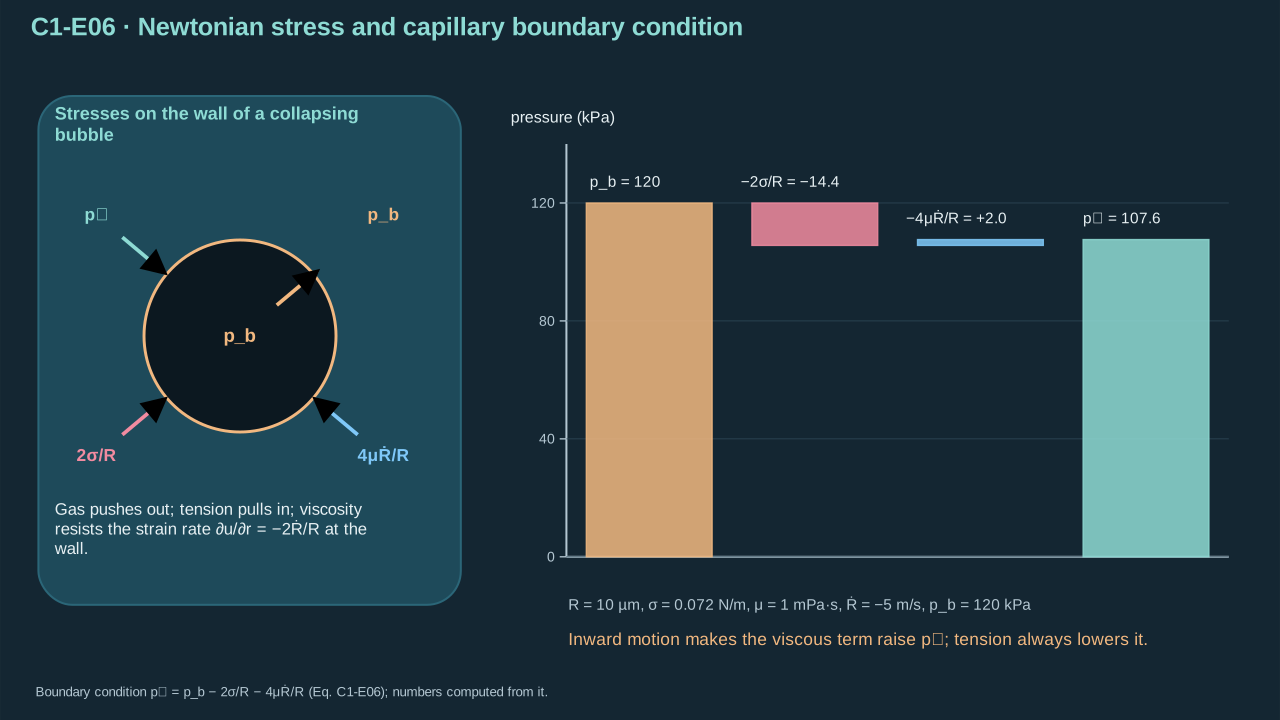
Derivation. Use a normal pointing from liquid into gas. At an inner spherical cavity this normal points inward and curvature is negative. The normal stress jump gives the liquid pressure. Differentiate the radial speed to evaluate the normal viscoustraction.
∂ru — Radial strain rate, evaluated at the wall (s⁻¹)
∂ru — 在壁面取值的径向应变率(s⁻¹)
n — unit normal directed from liquid into gas (1)
n — 液体指向气体的单位法向(1)
er — outward radial unit vector (1)
er — 向外径向单位矢量(1)
κ — signed interface curvature (m⁻¹)
κ — 带符号界面曲率(m⁻¹)
∇s⋅ — surface divergence operator (m⁻¹)
∇s⋅ — 表面散度算子(m⁻¹)
∇⋅ — volume divergence operator (m⁻¹)
∇⋅ — 体散度算子(m⁻¹)
Conventions and conditions. wall evaluation is performed at r=R; Extend the unit normal radially without radial variation; its normal derivative vanishes, so surface and volume divergences agree at the sphere.
Capillary and viscous stresses act at the interface even when the radial bulk viscous force is zero.
即使径向体内黏性力为零,毛细与黏性应力仍作用于界面。
Check and interpretation. For a static sphere the gas pressure exceeds liquid pressure by 2σ/R. The viscous pressure reverses with velocity. This local traction calculation remains necessary after deleting the separate tensor-dissipation check.
Step 1.3.6 — Assemble the radial equation of motion
步骤 1.3.6——组合得到径向运动方程
Purpose in this chapter. Combine Eqs. (C1.3-E05) and (C1.3-E06). The resulting Rayleigh–Plesset equation converts a prescribed pressure history into spherical cavity motion.
Combine inertia and traction. Insert Eq. (C1.3-E06) into Eq. (C1.3-E05). Multiply by carrier density to obtain radial momentum balance. Internal pressure still requires a source model. Use aqueous carrier density for the exterior inertia. PFC density describes a different material domain.
Derivation. Multiply the inertial-pressure relation by density. Replace liquid wall pressure with the traction balance. Collect all pressures with their signs. Divide by positive density and radius when acceleration is required.
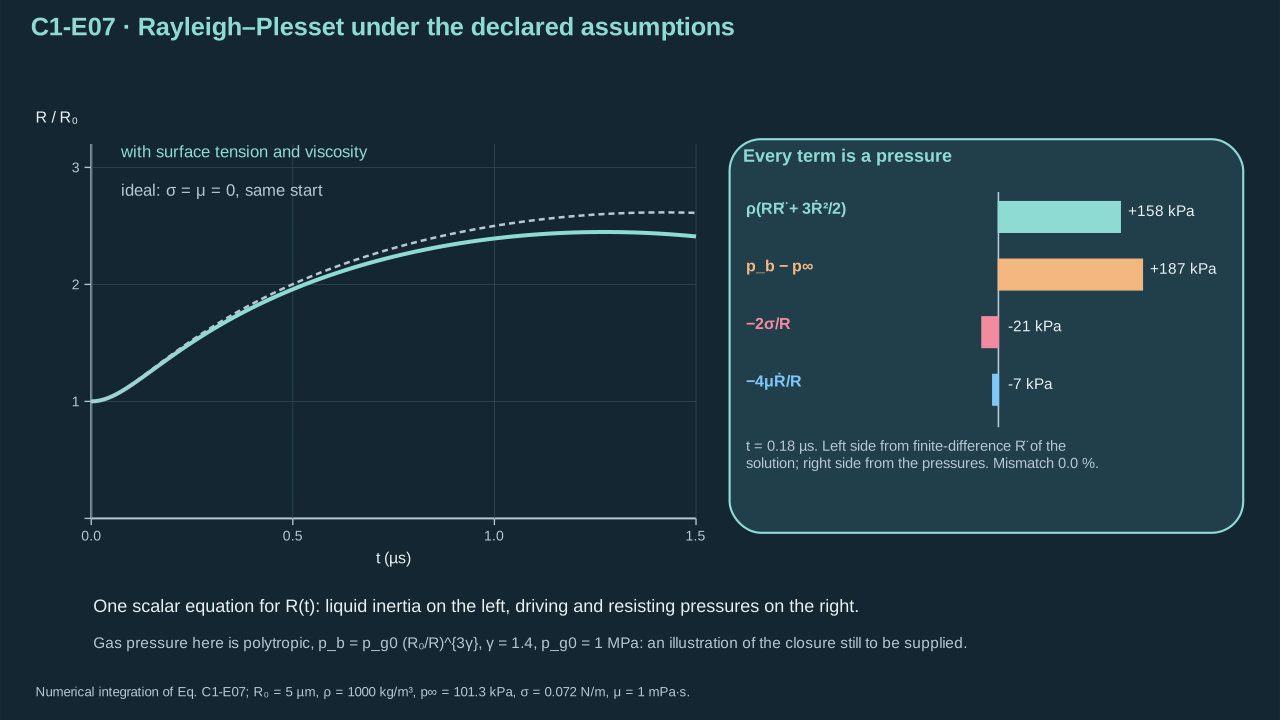
(C1.3-E07) · Rayleigh–Plesset under the declared assumptions
(C1.3-E07) · 所述假设下的 Rayleigh–Plesset 方程
Start with the liquid-side pressure–inertia relation obtained from Bernoulli.
从伯努利关系得到的液体侧压力—惯性关系出发。
ρ(RR¨+23R˙2)=pl−p∞,
Replace liquid-side wall pressure with bubble pressure minus the capillary and viscous corrections.
用气泡压力减去毛细与黏性修正,替代壁面液体侧压力。
pl−p∞=(pb−2σ/R−4μR˙/R)−p∞,
Divide by positive density and radius, then isolate acceleration. The squared-speed term must also be subtracted.
除以正的密度与半径,再解出加速度。还必须减去速度平方项。
R¨=ρRpb−p∞−2σ/R−4μR˙/R−2R3R˙2,
Set both speed and acceleration to zero. The remaining pressure excess must equal the spherical capillary pressure.
令速度与加速度均为零。剩余内外压差必须等于球形毛细压力。
R˙=R¨=0⟹pb−p∞=2σ/R.
Equating interface pressure with liquid inertia gives the complete constant-property spherical motion law.
令界面压力与液体惯性相等,得到完整的常物性球形运动规律。
ρ(RR¨+23R˙2)=pb−p∞−R2σ−R4μR˙
Symbols for Eq. (C1.3-E07).
式(C1.3-E07)的符号定义。
First individual definition第一项单独定义
Second individual definition第二项单独定义
ρ>0 is carrier density (kg m⁻³)
ρ>0 为载液密度(kg m⁻³)
R>0 is cavity radius (m)
R>0 为空腔半径(m)
R˙ — Wall radial velocity (m s⁻¹)
R˙ — 壁面径向速度(m s⁻¹)
R¨ — Wall radial acceleration (m s⁻²)
R¨ — 壁面径向加速度(m s⁻²)
pb — Uniform bubble absolute pressure (Pa)
pb — 均匀气泡绝对压力(Pa)
p∞ — Far-field absolute pressure (Pa)
p∞ — 远场绝对压力(Pa)
σ is constant surface tension (N m⁻¹)
σ 为常数表面张力(N m⁻¹)
μ is constant carrier viscosity (Pa s)
μ 为常数载液黏度(Pa s)
Conventions and conditions. Every term is a pressure.
约定与条件。 各项均具有压力单位。
The spherical pressure–inertia balance has a scalar radial state.
球形压力—惯性平衡只具有标量径向状态。
Check and interpretation. The inviscid limit removes the viscous term continuously. At rest capillarity requires positive bubble overpressure. Each original balance term has units Pa.
检验与解释。 无黏极限连续消去黏性项。静止时毛细作用要求气泡内过压为正。原平衡各项单位均为 Pa。
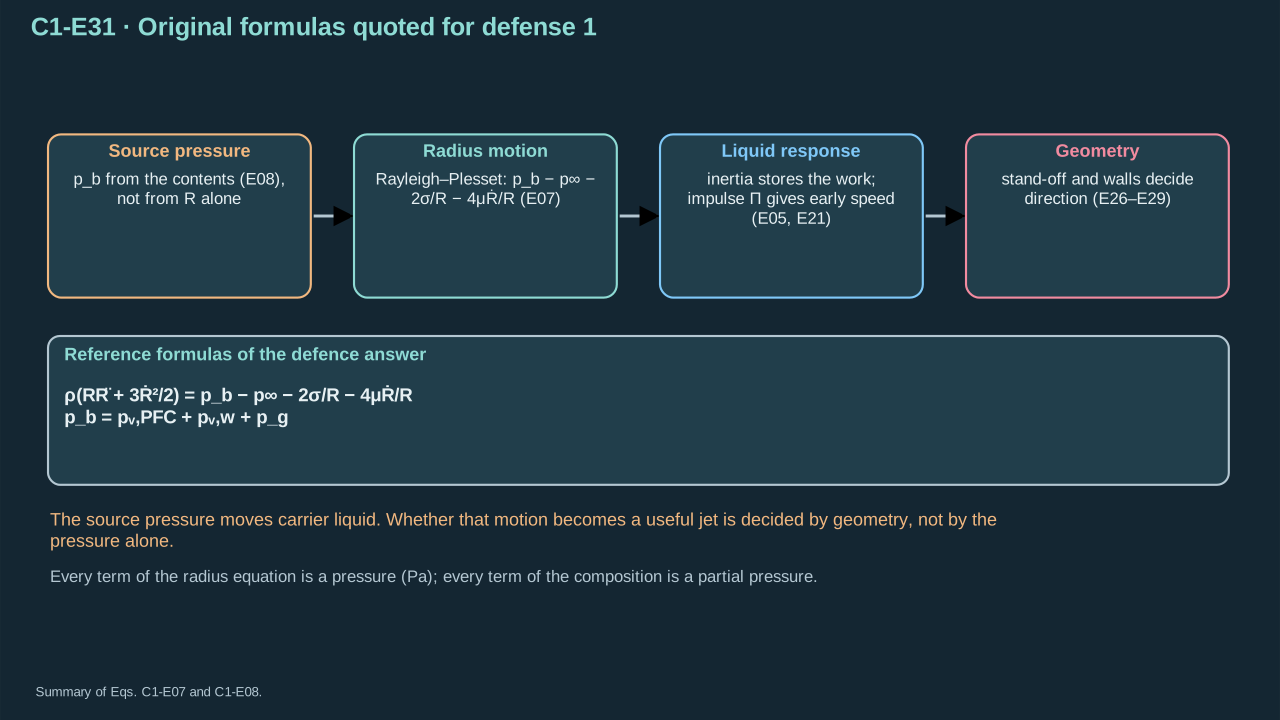
Every term has pressure units: density × length × acceleration, tension/radius, and viscosity × speed/radius. At rest, internal overpressure equals the capillary jump. During collapse, the viscous term resists inward motion. To obtain acceleration, also subtract the squared-speed term. This matches the classical spherical model. [R1][Brennen, Ch. 2]
Step 1.3.7 — Identify the pressure input still needing closure
步骤 1.3.7——明确仍需闭合的压力输入
Purpose in this chapter. Separate vapor and permanent-gas contributions to the pressure in Eq. (C1.3-E07). Chapter 2 must supply their thermal, phase, and inventory evolution.
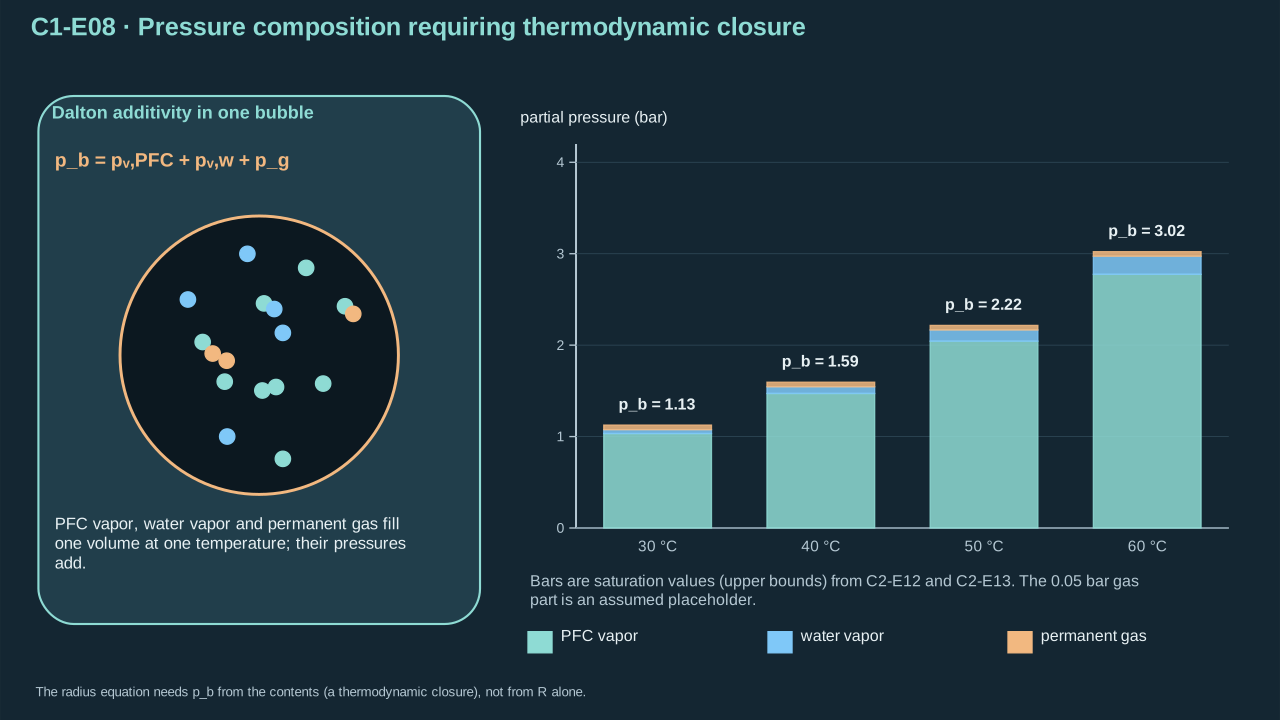
Derivation. This is an adopted ideal-mixture closure. For components sharing temperature and volume, each ideal-gas partial pressure is proportional to its amount. Add component amounts to obtain total pressure. These algebraic steps do not determine evaporation, temperature, or saturation. Real mixtures can require a different equation of state.
Adopt an ideal-mixture component equation of state with common gas temperature and positive bubble volume.
采用具有共同气体温度与正气泡体积的理想混合物组分状态方程。
piVb=niRTb(i∈{v,PFC;v,w;g}),
Sum the component equations. The total amount is the sum of PFC vapor, water vapor, and permanent-gas amounts.
对各组分状态方程求和。总物质的量为 PFC 蒸气、水蒸气及非凝结气体物质的量之和。
pbVb=(nv,PFC+nv,w+ng)RTb,
Divide by bubble volume and separate the three terms. Each term is the corresponding partial pressure.
除以气泡体积,并将三项分开。每一项均为相应组分的分压。
pb=Vbnv,PFCRTb+Vbnv,wRTb+VbngRTb.
Identify each equation-of-state contribution as a partial pressure. Their sum is the bubble pressure used by the radial model.
将每一项状态方程贡献识别为分压。其总和为径向模型所用气泡压力。
pb=pv,PFC+pv,w+pg
Symbols for Eq. (C1.3-E08).
式(C1.3-E08)的符号定义。
First individual definition第一项单独定义
Second individual definition第二项单独定义
pb is uniform total bubble pressure (Pa)
pb 为空间均匀的气泡总压力(Pa)
pv,PFC is the PFC-vapor partial pressure (Pa)
pv,PFC 为 PFC 蒸气分压(Pa)
pv,w water-vapor partial pressure (Pa)
pv,w 为水蒸气分压(Pa)
pgpermanent-gas partial pressure (all Pa)
pg 为非凝结气体分压(均为 Pa)
i — component index: PFC vapor, water vapor or permanent gas (1)
i — 组分指标:PFC 蒸气、水蒸气或非凝结气体(1)
pi — component partial pressure (Pa)
pi — 组分分压(Pa)
ni — component amount of substance (mol)
ni — 组分物质的量(mol)
Vb — positive bubble volume (m³)
Vb — 气泡正体积(m³)
R — universal gas constant (J mol⁻¹ K⁻¹)
R — 通用气体常数(J mol⁻¹ K⁻¹)
Tb — positive common gas temperature (K)
Tb — 共同气体正温度(K)
Conventions and conditions. Subscript v labels vapor, PFC its chemical family; Additivity assumes a gas-mixture pressure description with the stated partial pressures; w water; gnoncondensable gas.
约定与条件。 下标 v 表示蒸气,PFC 表示该化学物质族;相加关系采用具有上述分压定义的气体混合物压力描述;w 表示水;g 表示非凝结气体。
The mechanical input comes from the evolving contents, not from radius alone.
力学输入来自不断变化的气泡内容物,不能仅由半径决定。
Check and interpretation. Pressure × volume has energy units. A vanishing component amount removes its partial pressure. Missing: component mass-transfer rates, energy balance and appropriate phase equilibrium or kinetics.
A fixed-mass polytropic gas control requires its stated thermal assumptions. Evaporation and condensation exchange mass and latent heat. A permanent-gas closure omits those exchanges. Uniform internal pressure requires communication faster than state evolution. Chapter 2 supplies a finite-inventory closure. [R5]
Step 1.4.1 — Measure the inertia carried by the exterior liquid
步骤 1.4.1——计算外部载液携带的动能
Purpose in this chapter. Integrate the velocity field from Eq. (C1.3-E02). Exterior kinetic energy provides the energy measure for checking the radial pressure-driven motion.
本章作用。 积分式(C1.3-E02)的速度场。外域动能提供能量尺度,用于检验压力驱动的径向运动。
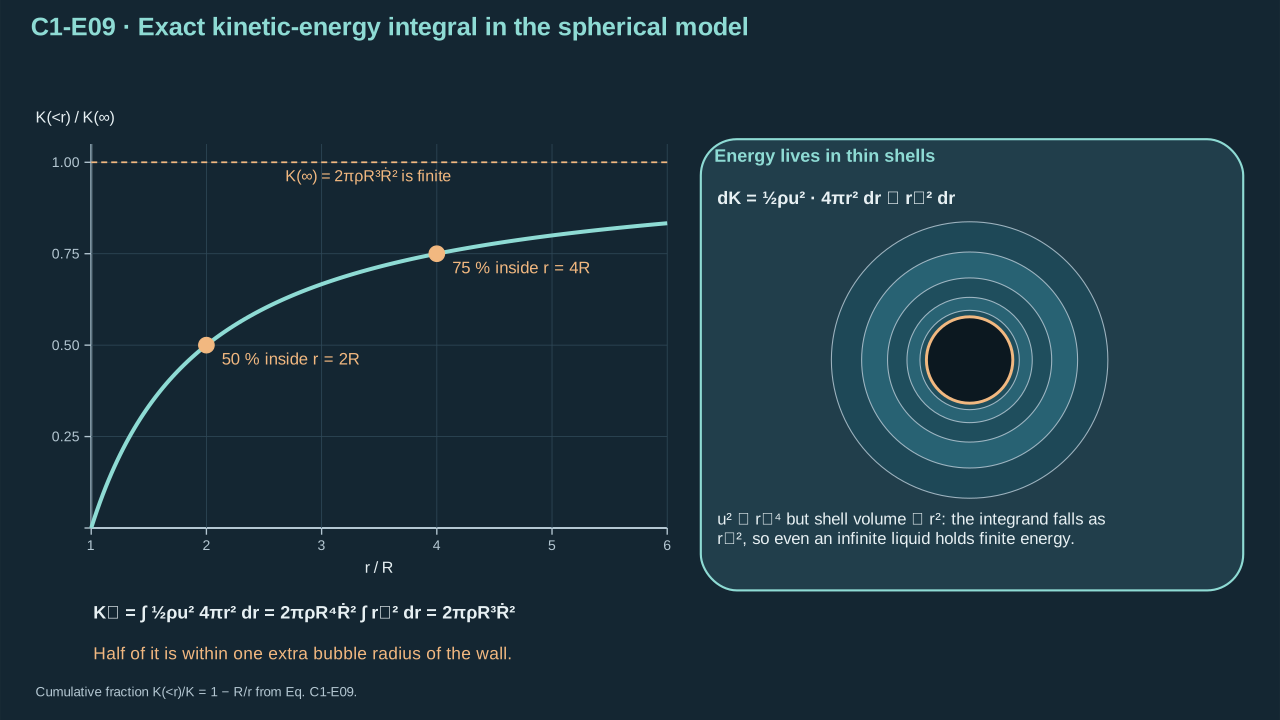
Integrate exterior kinetic energy. Square the velocity in Eq. (C1.3-E02). Multiply by the spherical volume element and integrate. The inverse-square integral converges over the infinite exterior. Carrier liquid beyond the wall supplies the moving inertia.
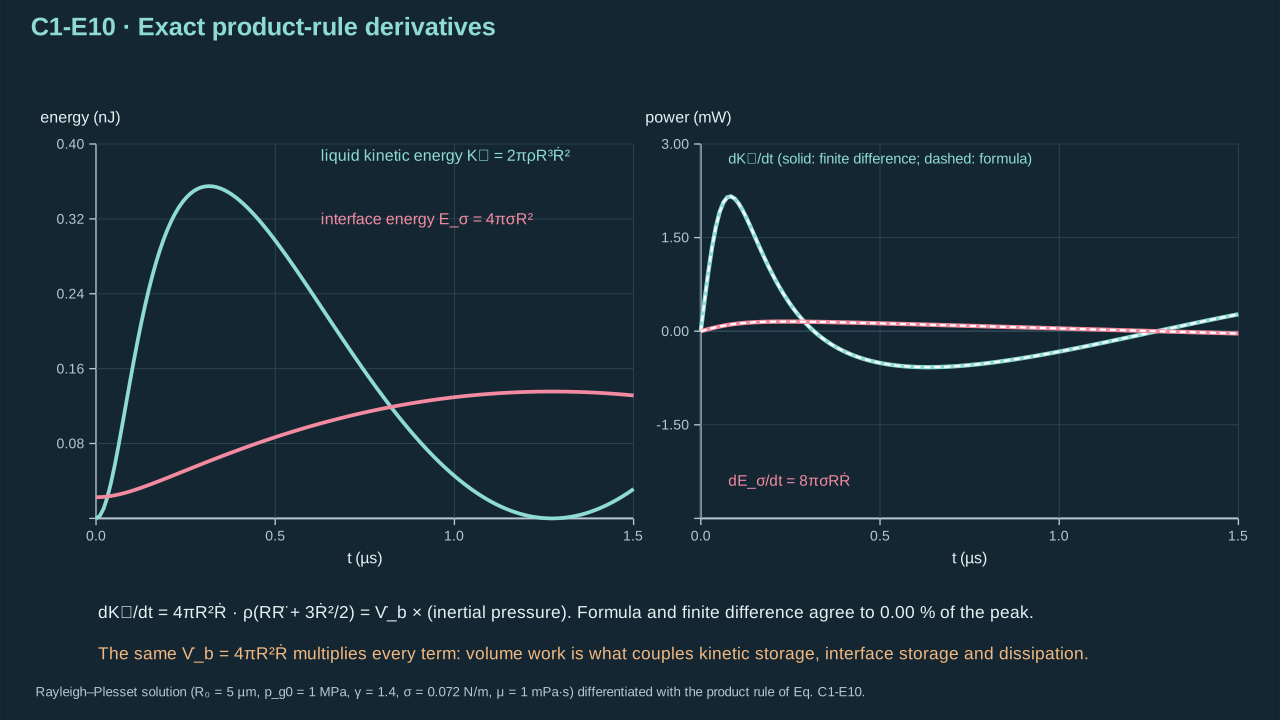
Purpose in this chapter. Differentiate Eq. (C1.4-E09), the surface energy, and cavity volume. Their rates allow the momentum equation to be checked as a power balance.
Differentiate stored energy. Apply the product rule to radius and squared speed. Differentiate cavity volume and interface energy separately. The surface-energy derivative assumes constant surface tension.
Record cavity volume and its rate for the pressure-work calculation.
写出空腔体积及其变化率,用于压力功计算。
Vb=34πR3,V˙b=4πR2R˙,
Record surface energy and its rate at constant surface tension.
写出常表面张力下的表面能及其变化率。
Eσ=4πσR2,dtdEσ=8πσRR˙.
Symbols for Eq. (C1.4-E10).
式(C1.4-E10)的符号定义。
First individual definition第一项单独定义
Second individual definition第二项单独定义
Kl — Carrier kinetic energy (J)
Kl — 载液动能(J)
Eσ — Interfacial energy (J)
Eσ — 界面能(J)
t is time (s)
t 为时间(s)
ρ is carrier density (kg m⁻³)
ρ 为载液密度(kg m⁻³)
R is radius (m)
R 为半径(m)
R˙ — Wall radial velocity (m s⁻¹)
R˙ — 壁面径向速度(m s⁻¹)
R¨ — Wall radial acceleration (m s⁻²)
R¨ — 壁面径向加速度(m s⁻²)
Vb is cavity volume (m³)
Vb 为空腔体积(m³)
V˙b its time derivative (m³ s⁻¹)
V˙b 为其时间导数(m³ s⁻¹)
σ is constant surface tension (N m⁻¹)
σ 为常数表面张力(N m⁻¹)
π is the circle constant (dimensionless)
π 为圆周率(无量纲)
Conventions and conditions. Energy derivatives are powers (W).
约定与条件。 能量的时间导数为功率(W)。
Volume work couples kinetic storage, interface storage and dissipation.
体积功耦合动能储存、界面能储存与耗散。
Check and interpretation. Energy rates have units watts. At a turning point both rates vanish instantaneously, even when acceleration is nonzero. Variable surface tension would add another product-rule term.
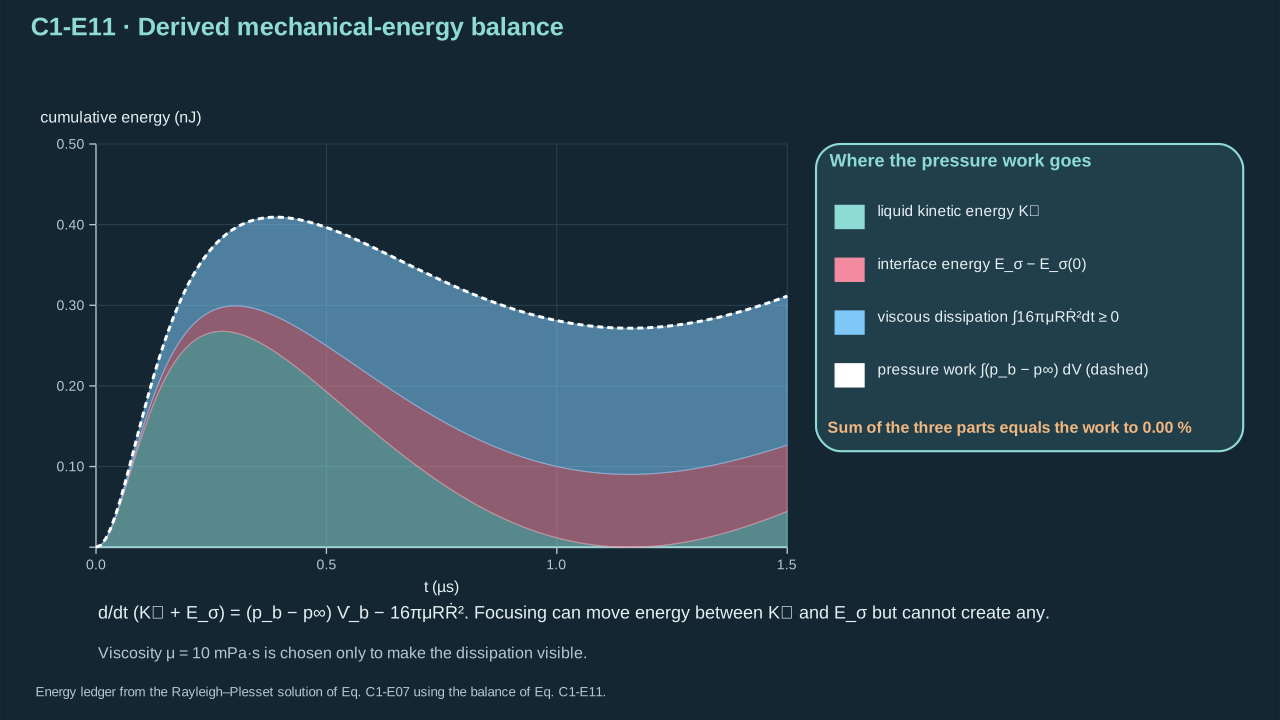
Purpose in this chapter. Combine the motion law in Eq. (C1.3-E07) with Eq. (C1.4-E10). This separates kinetic-energy storage, surface-energy storage, and viscous loss.
Convert momentum balance into power balance. Multiply by cavity volume rate. The inertial term becomes Eq. (C1.4-E10), first row. The capillary term equals minus the surface-energy derivative. Squared speed makes viscous power nonpositive in both motion directions.
Expansion: If R˙>0 and pb>p∞, pressure contributes positive power. This power can increase liquid kinetic energy and surface energy, with some lost to viscosity. Collapse: If R˙<0 and pb<p∞, their product is again positive: the ambient pressure is doing work that can accelerate the inward flow. The surface area shrinks, so stored interfacial energy can also be released. Viscosity always removes mechanical energy, regardless of whether R˙ is positive or negative.
This is the mechanical budget of the spherical cavity and exterior carrier. It does not already account for PFC internal energy, laser absorption, heat transfer, latent heat, noncondensable gas thermodynamics, acoustic radiation or an emitted directional jet. Those require additional balance equations. The equation also does not say that the pressure-work term is always positive.
Conventions and conditions. The nonnegative term is dissipated power (W).
约定与条件。 非负项是耗散功率(W)。
The pressure source supplies mechanical work; focusing cannot create extra energy.
压力源提供机械功;聚焦不能产生额外能量。
Check and interpretation. Expansion against excess internal pressure and collapse under excess external pressure both allow positive work. Dissipation is nonnegative for either velocity sign. Missing: laser absorption, internal energy, latent heat and acoustic radiation in a complete energy budget.
Confinement can redirect liquid and change its energy budget. It may store elastic energy or increase dissipation. Predicting carrier motion requires the thermodynamic source and mechanical receiver. Incident pulse energy alone leaves that budget unresolved.
Step 1.5.1 — Define a solvable ideal-collapse benchmark
步骤 1.5.1——规定可解的理想塌缩基准
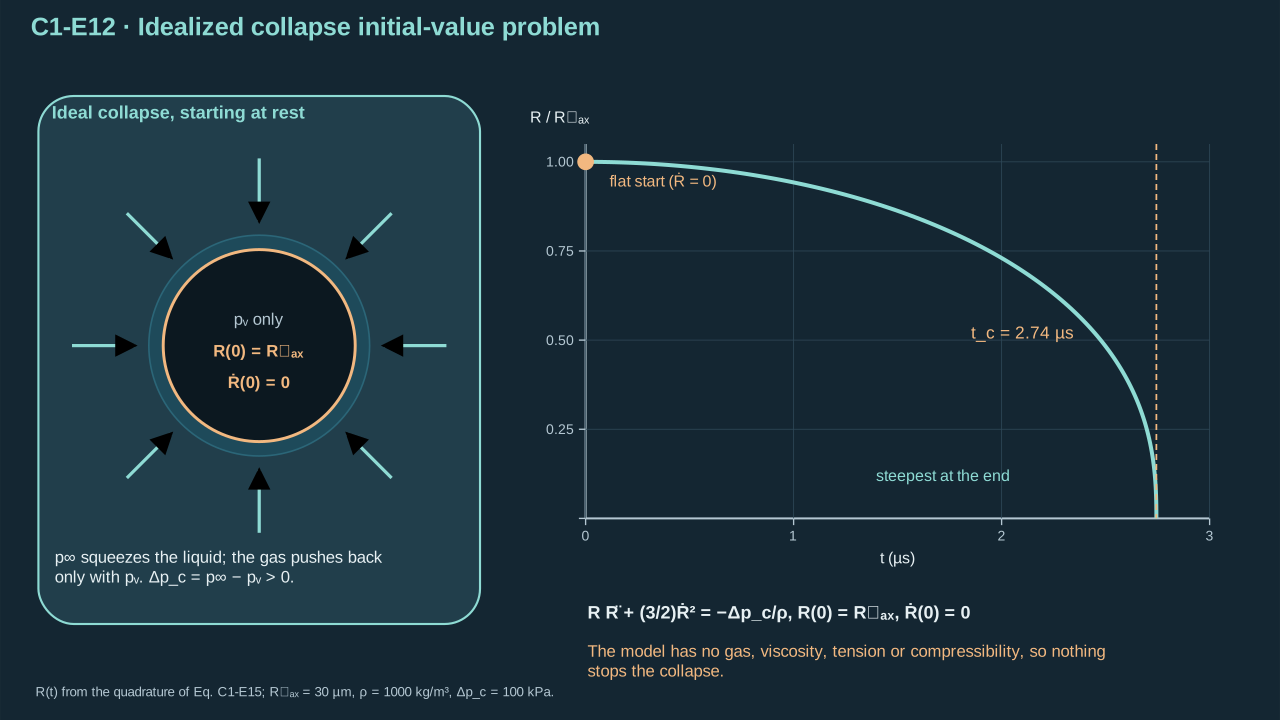
Purpose in this chapter. Reduce Eq. (C1.3-E07) to collapse under a constant positive pressure difference. This restricted control problem supplies the trajectory and time benchmark below.
Specify the ideal collapse problem. Start at maximum radius with zero wall speed. Far-field and vapor pressures are constant with positive collapse difference. Omit tension, viscosity, permanent gas and liquid compressibility. Thermal and phase dynamics are excluded assumptions. Their smallness for PFC remains unestablished. A hot vapor-rich cavity can still expand.
Additional worked steps. The following steps supply details beyond the preserved handoff passage.
补充的完整步骤。 以下步骤补充所保留交接材料之外的细节。
Prescribe constant vapor pressure and omit surface tension and viscosity for this ideal control. Express the pressure difference with the collapse sign.
在这一理想对照中给定恒定蒸气压,并忽略表面张力与黏度。用塌缩符号约定表示压差。
pb=pv,μ=σ=0,pv−p∞=−Δpc,
Insert these restrictions into Rayleigh–Plesset. The pressure forcing is negative.
将这些限制代入 Rayleigh–Plesset 方程。压力驱动力为负。
ρ(RR¨+23R˙2)=−Δpc,
Evaluate the initial state at maximum radius with zero wall speed. The squared-speed term vanishes.
在最大半径、壁面速度为零的初始状态求值。速度平方项消失。
RmaxR¨(0)=−Δpc/ρ,
Divide by the positive maximum radius. Negative initial acceleration starts the inward collapse branch.
除以正的最大半径。负初始加速度使系统进入向内塌缩分支。
R¨(0)=−ρRmaxΔpc<0.
Define a positive collapse-pressure difference.
定义正的塌缩压差。
Δpc=p∞−pv>0
Start from maximum radius with a stationary wall.
从最大半径、壁面静止状态开始。
R(0)=Rmax,R˙(0)=0
The resulting ideal radial equation drives inward collapse.
所得理想径向方程驱动向内塌缩。
RR¨+23R˙2=−ρΔpc
Symbols for Eq. (C1.5-E12).
式(C1.5-E12)的符号定义。
First individual definition第一项单独定义
Second individual definition第二项单独定义
Δpc>0 is constant collapse-driving pressure (Pa)
Δpc>0 为常数塌缩驱动压差(Pa)
p∞ — Constant Far-field absolute pressure (Pa)
p∞ — 恒定的远场绝对压力(Pa)
pv — Stipulated constant vapor pressure (Pa)
pv — 假定恒定蒸气压(Pa)
t=0 is maximum-radius time (s)
t=0 为最大半径时刻(s)
R>0 — Instantaneous cavity radius (m)
R>0 — 瞬时空腔半径(m)
Rmax>0 — Radius at the start of ideal collapse (m)
Rmax>0 — 理想塌缩开始时的半径(m)
R˙ — Wall radial velocity (m s⁻¹)
R˙ — 壁面径向速度(m s⁻¹)
R¨ — Wall radial acceleration (m s⁻²)
R¨ — 壁面径向加速度(m s⁻²)
ρ>0 is carrier density (kg m⁻³)
ρ>0 为载液密度(kg m⁻³)
μ — viscosity, set to zero in this control (Pa s)
μ — 黏度,在此对照中置零(Pa s)
σ — surface tension, set to zero in this control (N m⁻¹)
σ — 表面张力,在此对照中置零(N m⁻¹)
pb — bubble pressure (Pa)
pb — 气泡压力(Pa)
The ideal control begins at rest and excludes the mechanisms that arrest real collapse.
理想对照从静止开始,并排除了阻止实际塌缩的机制。
Check and interpretation. Pressure deficit produces inward acceleration. This hypothetical control omits physical collapse arrest and evolving PFC vapor production.
Step 1.5.2 — Replace time by radius on the collapse branch
步骤 1.5.2——在塌缩分支以半径替代时间
Purpose in this chapter. Transform Eq. (C1.5-E12) into a first-order equation for squared speed. Its integrating factor prepares a trajectory satisfying the maximum-radius initial condition.
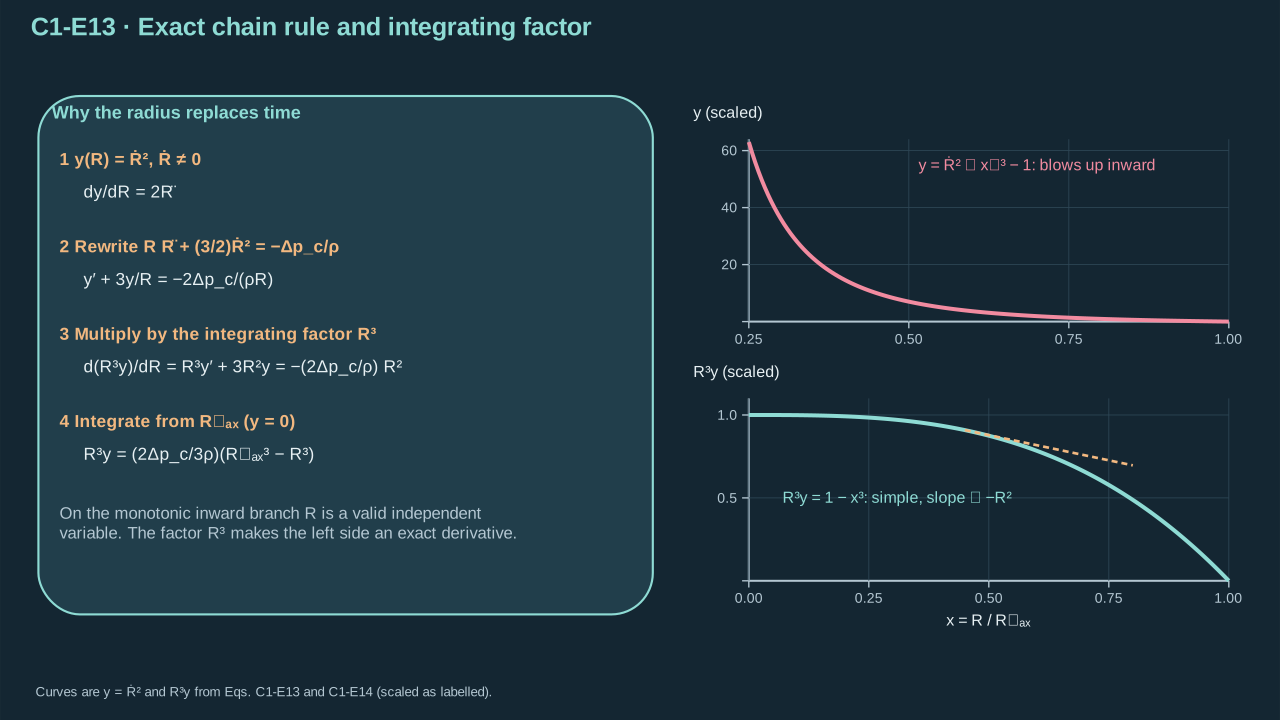
Use radius on the collapse branch. Negative initial acceleration starts decreasing radius. Define squared speed as a radius function. Away from the turning point, apply the chain rule. Cancel the nonzero speed there. Extend the relation continuously to the initial endpoint. Multiply by radius cubed to form an exact derivative.
The formula extends to the starting turning point by continuity. Substituting y and dy/dR into (1) yields
该关系可以通过连续性延拓到初始的速度零点。将 y 和 dy/dR 代入式 (1) 得到:
2RdRdy+23y=−ρΔpc,⟹RdRdy+3y=−ρ2Δpc.(3)
Multiply by R2 and recognize a product derivative:
两侧乘以 R2,利用乘积求导公式:
R3dRdy+3R2y=dRd(R3y)=−ρ2ΔpcR2.(4)
Symbols for Eq. (C1.5-E13).
式(C1.5-E13)的符号定义。
First individual definition第一项单独定义
Second individual definition第二项单独定义
y(R) is squared wall speed (m² s⁻²)
y(R) 为壁面速度平方(m² s⁻²)
R∈(0,Rmax) is decreasing radius (m)
R∈(0,Rmax) 为递减半径(m)
t is time (s)
t 为时间(s)
R˙=0 — Wall radial velocity (m s⁻¹)
R˙=0 — 壁面径向速度(m s⁻¹)
R¨ — Wall radial acceleration (m s⁻²)
R¨ — 壁面径向加速度(m s⁻²)
Δpc is positive pressure difference (Pa)
Δpc 为正压差(Pa)
ρ is carrier density (kg m⁻³)
ρ 为载液密度(kg m⁻³)
y′ — radius derivative dy/dR (m s⁻²)
y′ — 半径导数 dy/dR(m s⁻²)
I — positive integrating factor, I(Rmax)=1 (1)
I — 正积分因子,I(Rmax)=1(1)
I′ — radius derivative dI/dR (m⁻¹)
I′ — 半径导数 dI/dR(m⁻¹)
s — positive dummy radius (m)
s — 正积分哑半径(m)
Rmax — maximum cavity radius (m)
Rmax — 最大空腔半径(m)
ln — natural logarithm with positive dimensionless argument (1)
ln — 自变量为正无量纲数的自然对数(1)
exp — exponential with dimensionless argument (1)
exp — 自变量无量纲的指数函数(1)
Conventions and conditions.d/dR and d/dt are ordinary derivatives on the monotonic branch; Radius powers are the integrating factor, not derivatives.
约定与条件。d/dR 与 d/dt 为单调分支上的普通导数;半径幂构成积分因子,并非导数。
The monotonic collapse branch allows radius to replace time in the first integration.
单调塌缩分支允许在第一次积分中以半径取代时间。
Check and interpretation. Multiplying by the constant maximum-radius cube gives the equivalent integrating factor used below. Every momentum term retains acceleration-per-length-compatible units before integration.
检验与解释。 乘以常数最大半径三次方,即得到下文使用的等价积分因子。积分前各动量项保持一致量纲。
Step 1.5.3 — Recover inward speed and its integration constant
步骤 1.5.3——求向内速度及积分常数
Purpose in this chapter. Integrate Eq. (C1.5-E13) from the stationary maximum-radius state. Select the inward branch before using its reciprocal to calculate collapse time.
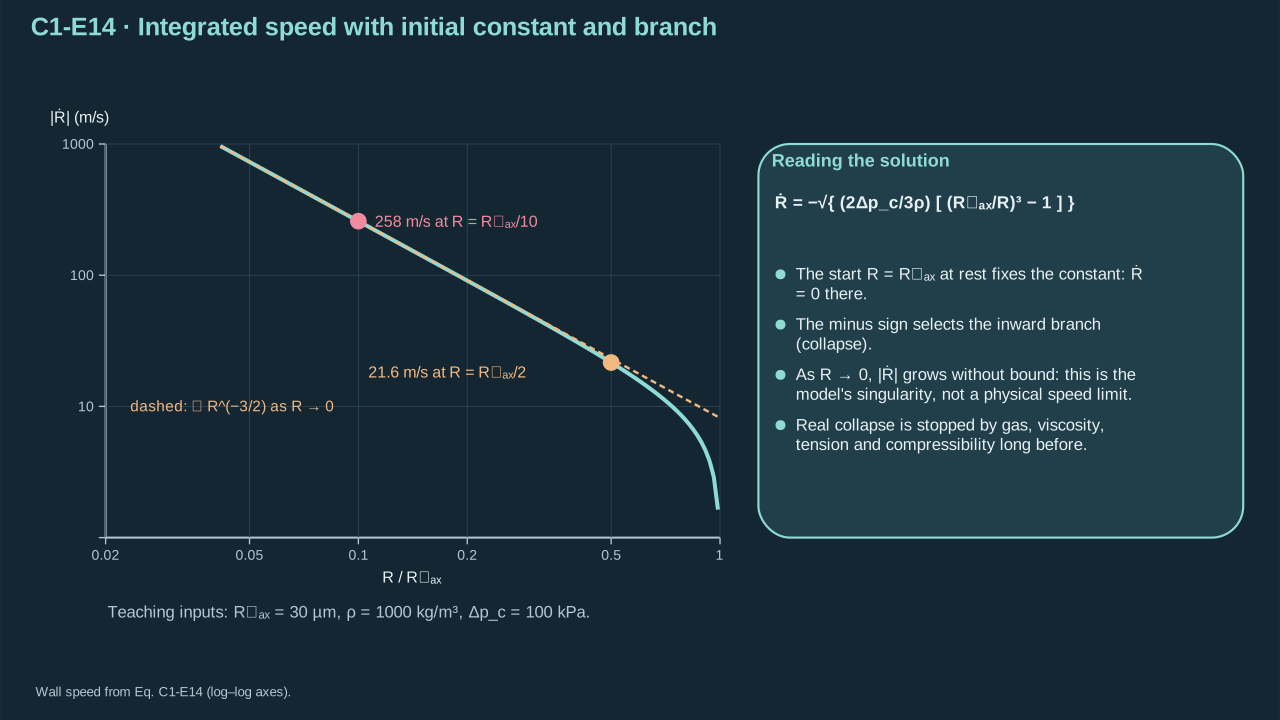
Taking the square root produces two mathematical branches:
开平方后存在两个数学分支:
R˙=±3ρ2Δpc[(RRmax)3−1].(7)
For collapse the radius decreases, so R˙=dR/dt<0; choose the negative branch:
对于塌缩,半径随时间减小,因此 R˙=dR/dt<0,应选取负号:
R˙=−3ρ2Δpc[(RRmax)3−1].(8)
At the initial instant R˙=0, but (1) gives R¨(0)=−Δpc/(ρRmax)<0, so the wall accelerates inward immediately. The expression is an ideal-model wall speed, not an experimentally established jet velocity; its divergence as R→0 signals breakdown of the simplified model.
Conventions and conditions. The square root denotes the nonnegative root; its prefixed minus sign selects collapse.
约定与条件。 根号表示非负平方根;前置负号选择塌缩分支。
The initial condition fixes the integration constant and the inward sign fixes the branch.
初值确定积分常数,向内的符号确定解分支。
Check and interpretation. At maximum radius the speed is zero. For smaller positive radius the squared speed is positive. The speed scale is the square root of pressure divided by density.
Step 1.5.4 — Separate collapse time from geometric scale
步骤 1.5.4——分离塌缩时间与几何尺度
Purpose in this chapter. Integrate the reciprocal speed from Eq. (C1.5-E14). Nondimensionalizing radius isolates the universal integral from radius, density, and pressure scales.
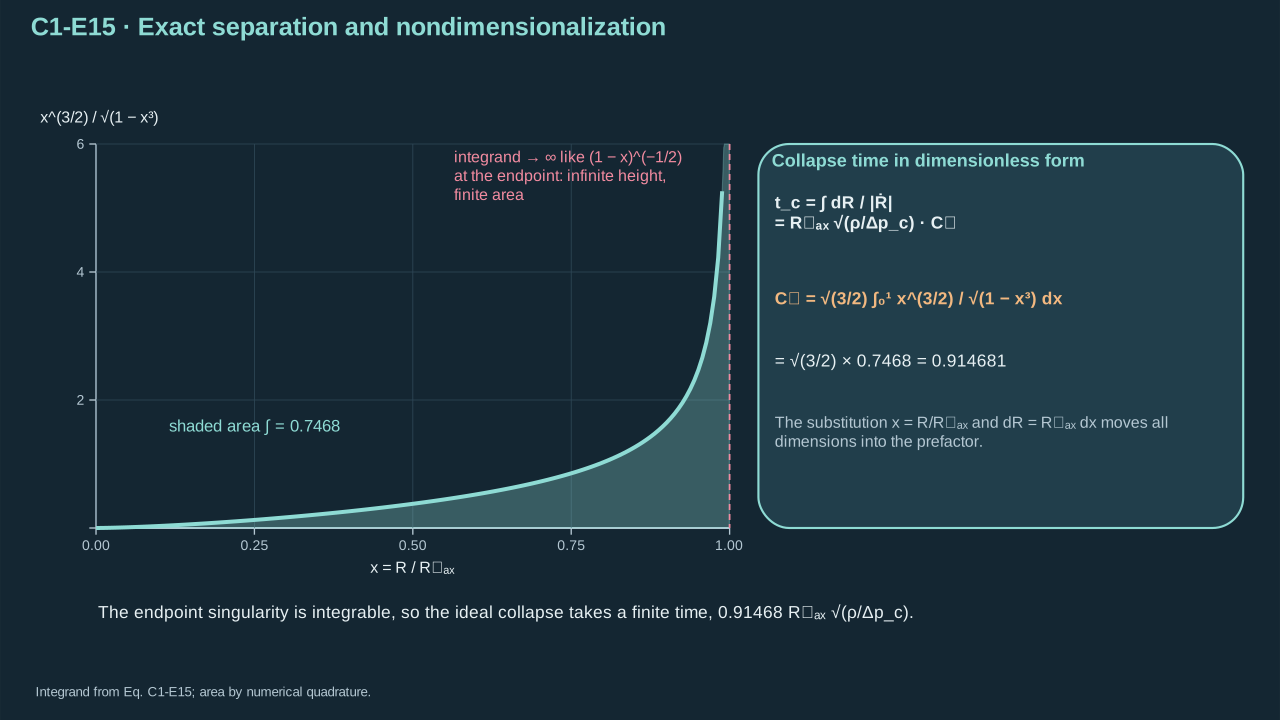
Separate scale from trajectory. Integrate reciprocal inward speed from maximum radius to zero. Normalize radius by its maximum. Every case in this ideal family shares the resulting dimensionless integral. That common integral establishes the time proportionality.
Derivation. For the inward branch, time increases while radius decreases. The negative reciprocal speed reverses the integration bounds. Normalize radius and include its differential. Factor the cubic ratio before taking the positive square root.
Conventions and conditions. definite integrals follow the collapse branch.
约定与条件。 定积分沿塌缩分支进行。
The endpoint singularity is integrable, so the model has a finite collapse time.
端点奇异性可积,因此该模型具有有限塌缩时间。
Check and interpretation. The scale Rmax × sqrt(density/pressure) has units seconds. The integral is improper at its endpoints; its finite value is the formal zero-radius model time.
Step 1.5.5 — Evaluate the Rayleigh time coefficient
步骤 1.5.5——计算瑞利塌缩时间系数
Purpose in this chapter. Evaluate the dimensionless integral in Eq. (C1.5-E15). This establishes the coefficient used in the worked collapse-time calculation.
本章作用。 计算式(C1.5-E15)的无量纲积分。由此确定塌缩时间算例所用的系数。
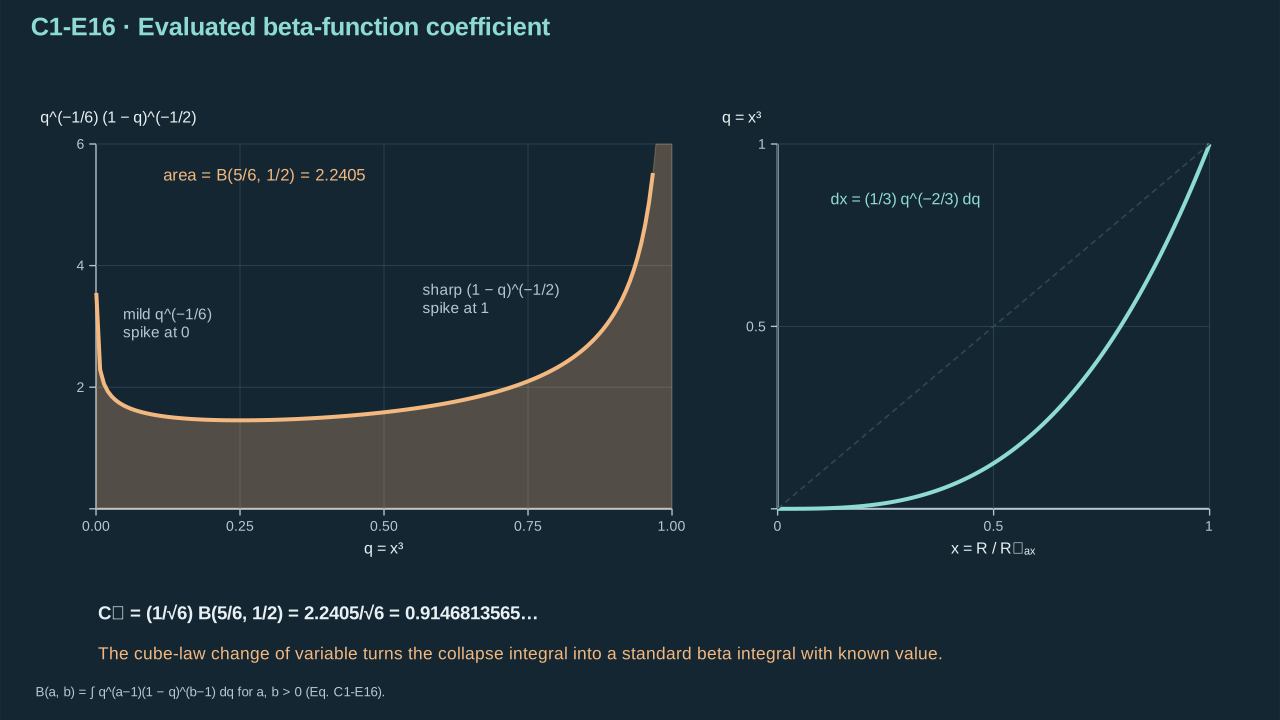
Evaluate the coefficient. Substitute the cube of normalized radius, including its Jacobian. The exponents combine as one half minus two thirds. The result is minus one sixth. Both beta-function arguments are positive, so the integral converges. The coefficient agrees with the published Rayleigh factor. [R1][R3]
Derivation. Cube the normalized radius. Carry both the numerator exponent and Jacobian into the transformed integral. Match each exponent to the beta-function definition. Inspect both endpoints before evaluating the coefficient.
Conventions and conditions. The numeral 6 inside the root is a dimensionless constant; the ellipsis indicates decimal continuation; x,q∈[0,1] and q=x3 define the substitution domain..
The change of variables exposes the beta integral that fixes the numerical coefficient.
换元揭示贝塔积分,从而确定数值系数。
Check and interpretation. Both endpoint powers exceed −1, ensuring integrability. This dimensionless coefficient follows from the trajectory integral. It is independent of material fitting.
检验与解释。 两个端点幂指数均大于 −1,因而可积。此无量纲系数来自轨迹积分,不依赖材料拟合。
Step 1.5.6 — Cross-check the ideal trajectory with pressure work
步骤 1.5.6——用压力功交叉检验理想轨迹
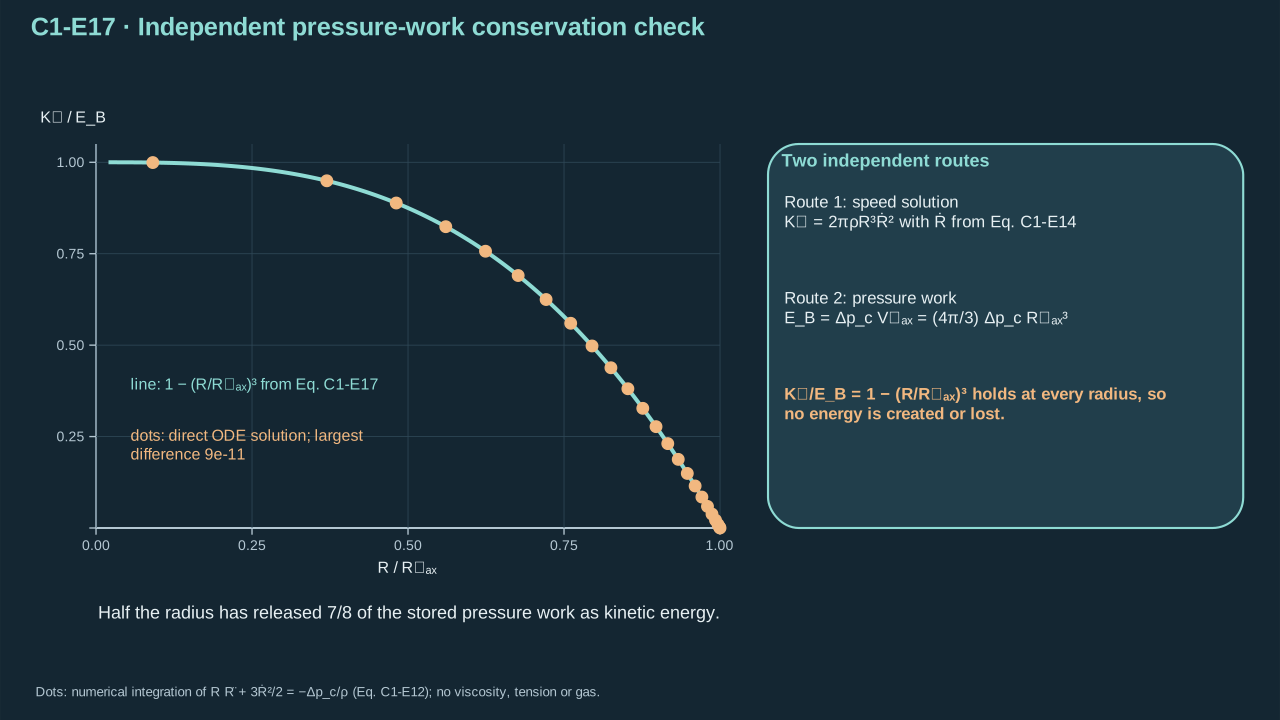
Purpose in this chapter. Insert Eq. (C1.5-E14) into the kinetic energy from Eq. (C1.4-E09). Agreement with pressure work checks the collapse branch and integration constant.
Check pressure work. Insert Eq. (C1.5-E14) into the kinetic-energy integral. The result equals work from the lost cavity volume. Energy vanishes at maximum radius and becomes positive during collapse. This checks the integration constant and sign.
Cancel density and expand the cube of the radius ratio.
约去密度,并展开半径比例的三次方。
Kl(R)=34πΔpcR3[R3Rmax3−1]
Distribute the radius cubed to obtain the difference of cavity volumes.
将半径三次方乘入括号,得到空腔体积之差对应的表达式。
Kl(R)=34πΔpc(Rmax3−R3).
Thus,
因此:
Identify each spherical volume as four thirds pi times its radius cubed.
将每个球体积识别为其半径三次方乘以三分之四圆周率。
Kl(R)=34πΔpc(Rmax3−R3).
The cancellation of ρ is algebraic: liquid density still affects the wall velocity, even though the energy expression at a specified radius no longer explicitly contains it.
ρ 的消去只是代数结果:液体密度仍然影响壁面速度,只是在给定半径下的动能表达式中不再显式出现。
3. Independent check using pressure work
利用压力功独立检验
During collapse, the far-field pressure exceeds cavity pressure by Δpc. The decrease in cavity volume is Vmax−V(R), so the net pressure work released equals
塌缩时远场压力比腔内压力大 Δpc。空腔体积减小 Vmax−V(R),净压力功为:
W=∫RRmaxΔpc4πs2ds=Δpc34π(Rmax3−R3).
Because the ideal Rayleigh-collapse model begins at rest and neglects viscosity, surface tension, compressibility, and other energy reservoirs, all of this net pressure work becomes surrounding-liquid kinetic energy: W=Kl.
Δpc is constant positive pressure difference (Pa)
Δpc 为常数正压差(Pa)
Vmax is maximum cavity volume (m³)
Vmax 为最大空腔体积(m³)
π is the circle constant (dimensionless)
π 为圆周率(无量纲)
Kl/EB is dimensionless and this control has zero viscous and capillary losses
Kl/EB 无量纲,此对照模型的黏性与毛细损失为零
Vb — cavity volume, 4πR3/3 (m³)
Vb — 空腔体积,4πR3/3(m³)
V — dummy volume variable (m³)
V — 积分哑体积变量(m³)
t — time (s)
t — 时间(s)
R˙ — wall speed (m s⁻¹)
R˙ — 壁面速度(m s⁻¹)
The Rayleigh speed solution and pressure-work balance agree exactly.
瑞利速度解与压力功平衡严格一致。
Check and interpretation. Pressure times displaced volume has joule units. Zero initial energy and positive growth during collapse agree with the mechanical power balance. Radial liquid energy does not specify jet energy.
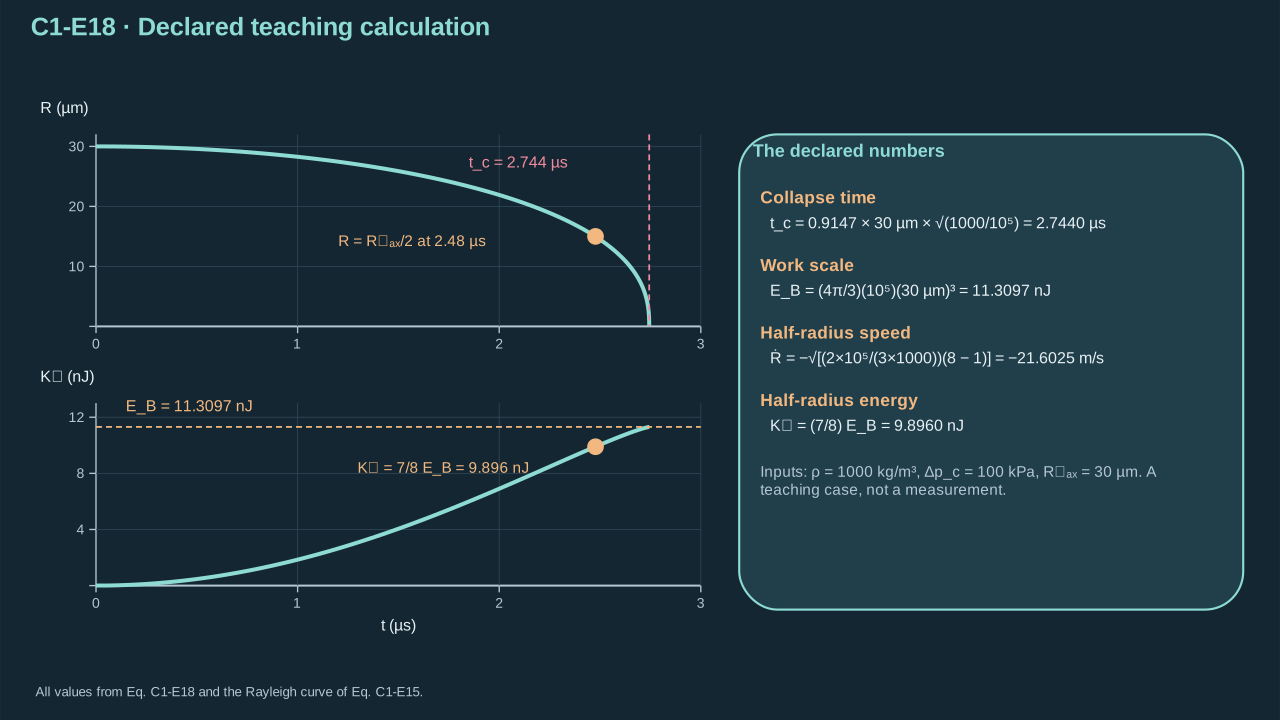
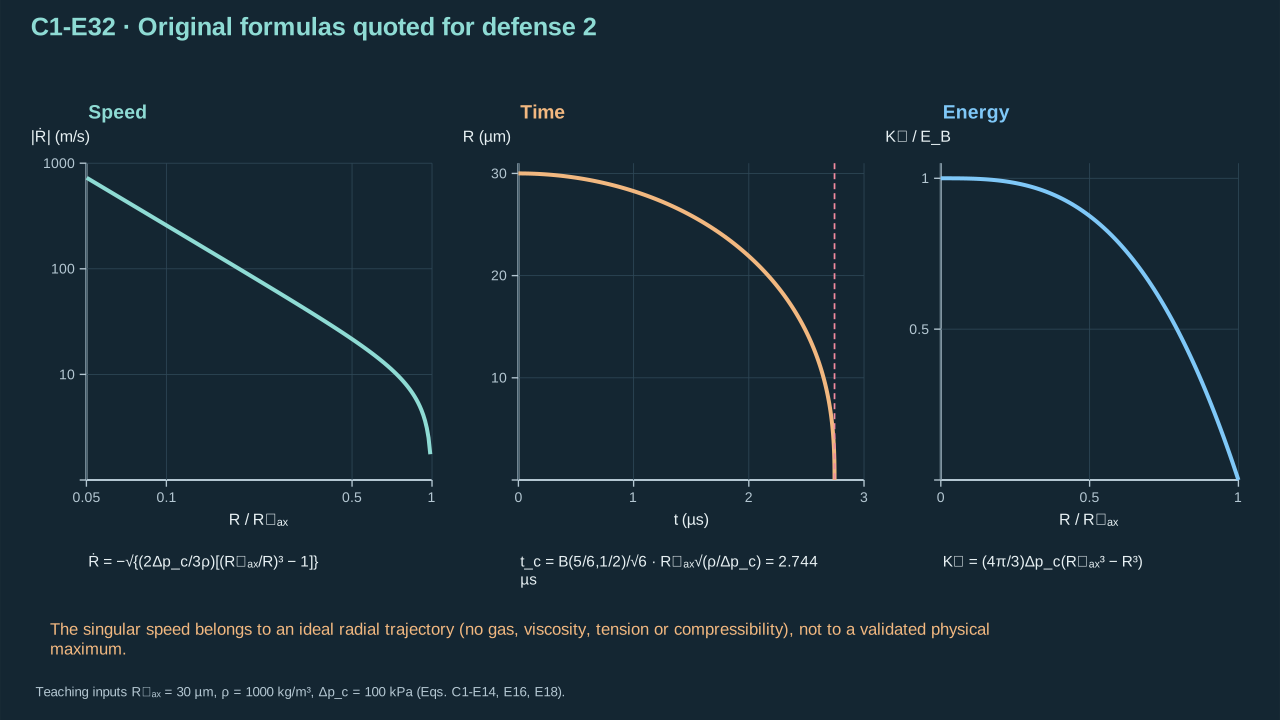
Prescribe maximum radius 30 μm, density 1000 kg m⁻³, and collapse pressure 100 kPa. These teaching inputs are not measured PFC properties. Substitute SI values before converting units. At half radius, the cubic ratio is eight. Subtracting one leaves seven.
规定最大半径 30 μm、密度 1000 kg m⁻³、塌缩压差 100 kPa。这些教学输入并非 PFC 实测物性。先代入 SI 数值,再换算单位。一半半径处的三次方比值为八,减去一得到七。
Step 1.5.7 — Put the ideal benchmark on a numerical scale
步骤 1.5.7——给出理想基准的数值尺度
Purpose in this chapter. Apply Eqs. (C1.5-E14)–(C1.5-E17) to the declared teaching inputs. This translates the benchmark into time, energy, and speed before testing its validity.
Derivation. Convert every teaching input to SI units. Compute the common pressure–density factor and cubic radius before inserting them into time, energy and speed formulas. The half-radius energy fraction follows from the cube of one half.
推导。 将全部教学输入换为 SI 单位。先计算共同压差密度因子及半径三次方,再代入时间、能量和速度公式。半径减半时的能量比例来自二分之一的三次方。
(C1.5-E18) · Declared teaching calculation
(C1.5-E18) · 采用明确给定参数的教学计算
Convert the declared teaching radius and pressure difference to SI units before substitution.
代入之前,先将给定教学半径与压差换算为 SI 单位。
Rmax=30μm=30×10−6m,Δpc=100kPa=105Pa,
Evaluate the density-to-pressure square root. Its units convert a radius into a time scale.
计算密度与压力比的平方根。其单位使半径能够转换为时间尺度。
ρ/Δpc=1000/105=0.1sm−1,
Cube the maximum radius with its SI conversion included.
将已换算为 SI 单位的最大半径取三次方。
Rmax3=27×10−15m3,
Multiply the radius scale, density-pressure factor, and Rayleigh coefficient to obtain collapse time.
Conventions and conditions. s, J, μs and nJ mean seconds, joules, microseconds and nanojoules; the vertical bar specifies half-radius evaluation.
约定与条件。 s、J、μs 与 nJ 分别为秒、焦耳、微秒与纳焦耳;竖线表示在一半半径处取值。
The original numerical control is preserved with its energy and branch checks.
保留原始数值对照,并补充能量与解分支检验。
Check and interpretation. One microsecond is 10⁻⁶ seconds; one nanojoule is 10⁻⁹ joules. The final values below agree with independent quadrature and pressure-work checks. These inputs are illustrative.
Length × √(density/pressure) has units of seconds. Doubling radius doubles collapse time and increases work eightfold. Quadrupling pressure halves time and doubles speed at fixed radius fraction. The dimensionless initial-value problem, and hence its coefficient, stays unchanged. Gas cushioning, varying vapor pressure or confinement can change that problem.
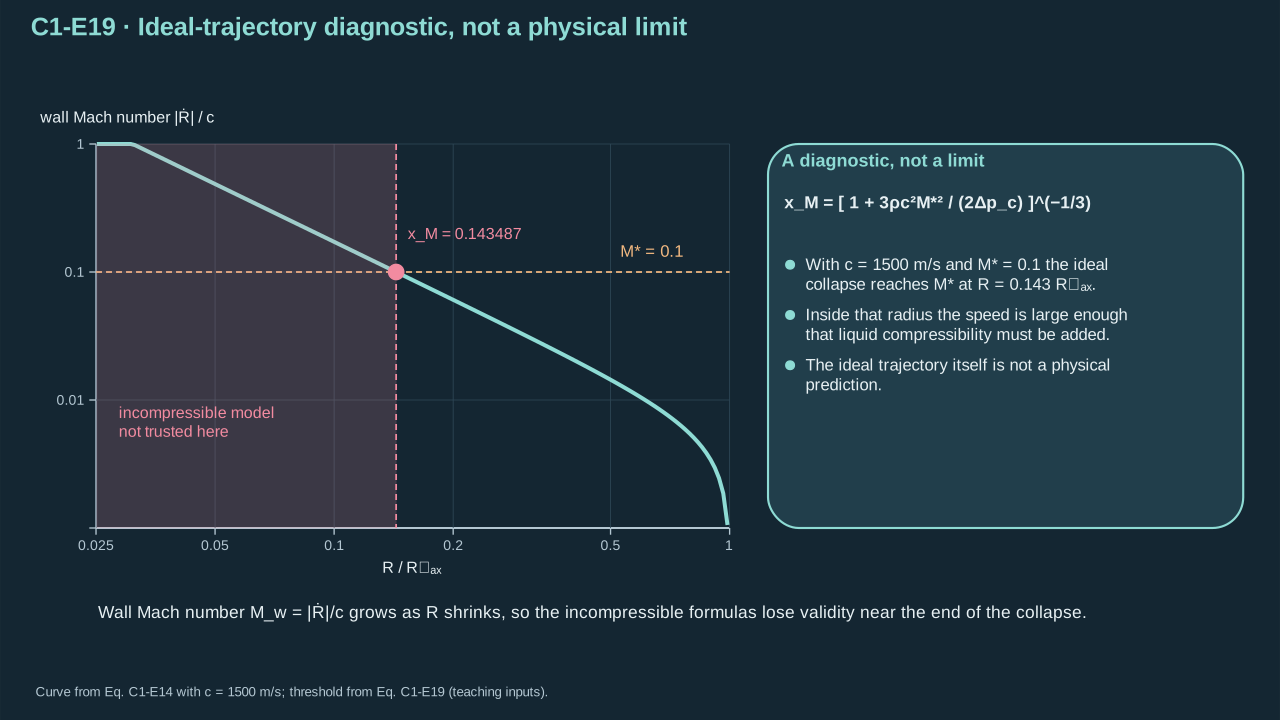
The zero-radius limit gives finite energy and divergent wall speed. Physical maximum speed: Not established. Missing: compressibility, internal pressure, heat and mass transfer, molecular scales and interface distortion. The next equation locates a chosen Mach threshold on the ideal trajectory. It supplies a diagnostic, not a collapse-arrest law.
Step 1.5.8 — Locate where the ideal speed needs further physics
步骤 1.5.8——定位理想速度需要补充物理的位置
Purpose in this chapter. Compare the ideal wall speed with a chosen Mach threshold. This diagnoses the incompressible trajectory without establishing a physical maximum speed.
本章作用。 将理想壁面速度与选定的马赫数阈值比较。这用于诊断不可压缩轨迹,不确立实际最大速度。
Derivation.
推导。
(C1.5-E19) · Ideal-trajectory diagnostic, not a physical limit
(C1.5-E19) · 理想轨迹的诊断指标,而非物理极限
1. Start from the Rayleigh collapse velocity
从 Rayleigh 塌缩速度出发
We previously derived the bubble-wall velocity for ideal spherical collapse:
前面已经推导出理想球形塌缩的壁面速度:
R˙=−3ρ2Δpc[(RRmax)3−1].(1)
Here, Δpc=p∞−pv>0 is the constant collapse-driving pressure difference, ρ is the surrounding liquid density, and Rmax is the initial maximum bubble radius.
This means that within the ideal Rayleigh model, the wall speed reaches 0.1c=150m/s when the bubble radius decreases to about 14.35% of its initial maximum value. The threshold radius is RM=0.1435Rmax.
The ideal Rayleigh model assumes incompressible liquid. As R→0, equation (1) predicts ∣R˙∣→∞. This divergence is a mathematical consequence of the idealizations, not a physically attainable speed.
Choosing M∗=0.1 is a conservative diagnostic convention for identifying when liquid compressibility may warrant closer examination. It is not a universal threshold at which incompressible theory suddenly becomes invalid.
Within the ideal trajectory, R<RM corresponds to Mw>M∗. However, a real cavity may be affected by vapor condensation, permanent gas, acoustic radiation, shocks, and other phenomena before reaching this radius.
M∗>0 is a selected diagnostic Mach value (dimensionless)
M∗>0 为选择的诊断马赫值(无量纲)
xM=RM/Rmax is the radius fraction when Mw=M∗ (dimensionless)
xM=RM/Rmax 为 Mw=M∗ 时的半径比例(无量纲)
RM — Cavity radius at the selected Mach value (m)
RM — 选定马赫数处的空腔半径(m)
Rmax — Radius at the start of ideal collapse (m)
Rmax — 理想塌缩开始时的半径(m)
ρ is carrier density (kg m⁻³)
ρ 为载液密度(kg m⁻³)
Δpc is positive collapse pressure (Pa)
Δpc 为正塌缩压差(Pa)
x — normalized radius, R/Rmax (1)
x — 无量纲半径,R/Rmax(1)
R — current cavity radius (m)
R — 当前空腔半径(m)
Conventions and conditions. absolute bars denote magnitude; The number uses the previous teaching density and pressure; Teaching inputs use the preceding density and pressure, with c=1500 m s⁻¹ and chosen M∗=0.1.
约定与条件。 绝对值符号表示大小;数值使用前述教学密度与压差;教学输入采用前述密度和压差,并取 c=1500 m s⁻¹、选定 M∗=0.1。
A Mach diagnostic exposes the shrinking validity range of incompressible collapse.
马赫数诊断揭示不可压缩塌缩模型的适用范围不断缩小。
Check and interpretation. The bracket is dimensionless and exceeds one, so the diagnostic radius lies below maximum radius. As threshold tends to zero, its radius approaches the starting radius. Singular zero radius remains outside physical validity.
Step 1.6.1 — Summarize a pressure history as pressure impulse
步骤 1.6.1——用压力冲量概括压力历程
Purpose in this chapter. Move from spherical radius dynamics to spatial liquid response. Define a local time-integrated pressure field whose gradient enters the next momentum calculation.
本章作用。 从球形半径动力学转向空间液体响应。定义局部压力时间积分场,其梯度将进入下一步动量计算。
Define pressure impulse. Integrate local pressure relative to a spatially uniform reference over time. Pressure impulse has units Pa s. Its spatial gradient drives liquid velocity change. Acoustic crossing time has units s. The cited short-event model motivates the following integration and approximation. [R2]
定义压力冲量。 对局部压力相对于空间均匀参考值作时间积分。压力冲量单位为 Pa s,其空间梯度驱动液体速度变化。声传播时间单位为 s。所引短事件模型提供以下积分与近似的依据。 [R2]
Derivation.
推导。
(C1.6-E20) · Definition of local pressure impulse
(C1.6-E20) · 局部压力冲量的定义
1. What does C1.6-E20 integrate?
C1.6-E20 对什么积分?
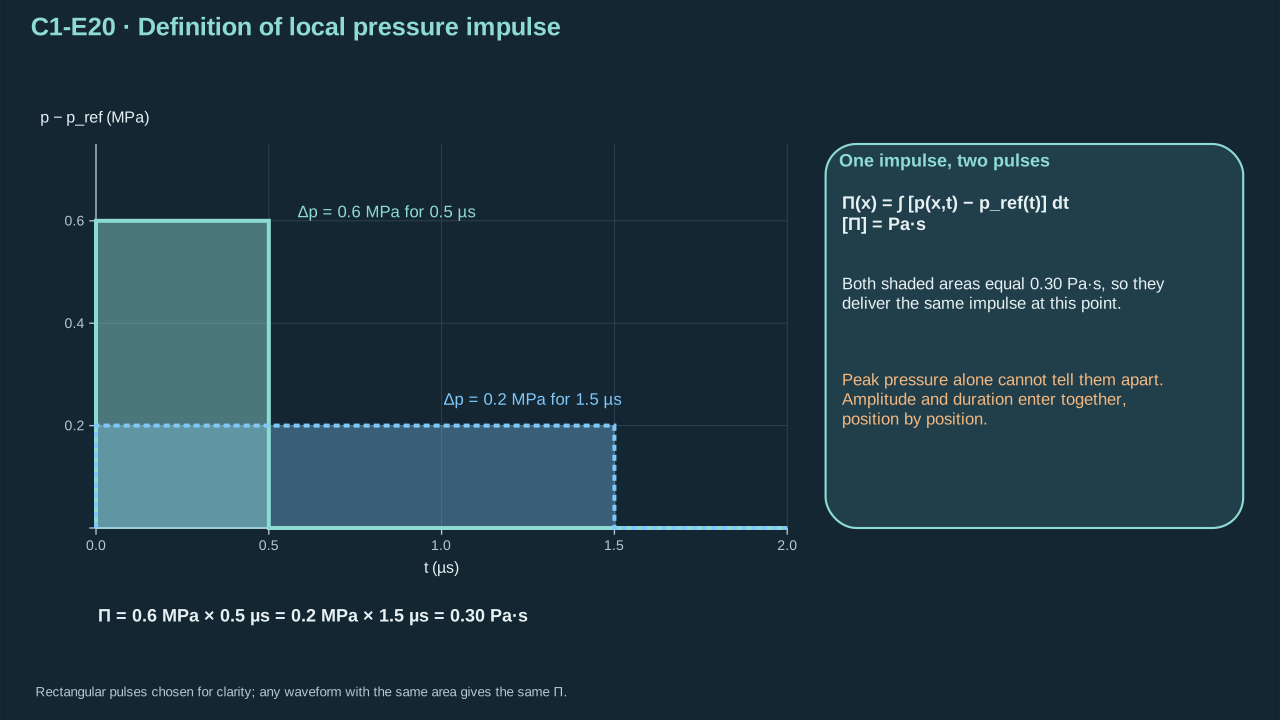
At one fixed liquid position, integrate pressure excess over the stated event interval. This defines pressure impulse.
在固定液体位置,对给定事件区间内的超压作时间积分。由此定义压力冲量。
Π(x)=∫t0t1[p(x,t)−pref(t)]dt
Here, x is a fixed Eulerian observation point, t is the integration variable, and [t0,t1] is the chosen pressure-event interval. pref is a spatially uniform reference pressure, possibly varying with time. The result Π(x) is a field over the liquid domain and has units Pa·s.
Choose a fixed point A in the liquid. Plot the local excess-pressure history against time; the signed area under the curve over the selected interval is Π(xA). Repeat at other points to reconstruct the spatial field. There is no volume integral or surface integral in C1.6-E20.
A fixed Eulerian location is not an individual fluid parcel. The formula assumes that this location belongs to the liquid domain throughout the selected time interval. If the moving phase boundary crosses it, the integration domain or formulation must be reconsidered.
For rectangular excess-pressure pulses, Π=Δpτ. An illustrative 2 MPa pulse lasting 1 μs and a 1 MPa pulse lasting 2 μs both give 2 Pa·s. They have different peak pressures but equal time-integrated pressure at that location.
Equal impulse at a single point does not ensure equal velocity fields; the spatial impulse distribution, boundaries, compressibility, and the event regime also matter.
For an incompressible Newtonian liquid of constant density,
对于密度恒定的不可压缩牛顿流体:
ρ[∂t∂u+(u⋅∇)u]=−∇p+μ∇2u.
Time integration at a fixed position, with ν=μ/ρ, yields the equation appearing in C1.6-E21:
在固定空间位置对时间积分,并令 ν=μ/ρ,得到 C1.6-E21:
Δu=−ρ∇Π−∫t0t1(u⋅∇)udt+ν∫t0t1∇2udt.
The spatially uniform reference pressure drops out when taking the gradient. If the integrated convective and viscous terms are negligible relative to pressure forcing, the reduced equation is
由于参考压力在空间中均匀,其梯度为零。如果积分后的对流项和黏性项相对于压力驱动可忽略,得到:
Δu≃−ρ1∇Π.
Thus the spatial gradient of pressure impulse—not merely the local impulse magnitude—determines the leading-order velocity increment and direction.
因此,在该近似下,决定速度增量及其方向的是压力冲量的空间梯度,而非某一点的冲量大小本身。
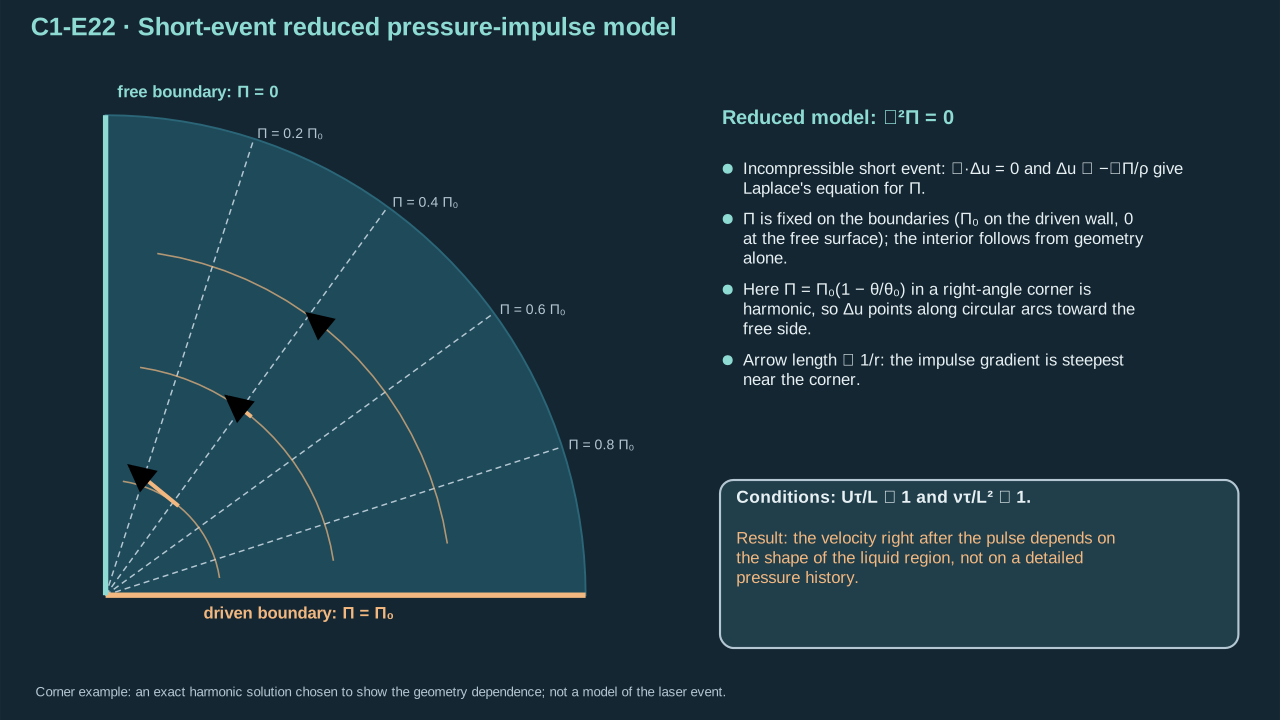
For the incompressible, fixed-domain reduced problem, taking the divergence of this relation yields ∇2Π=0. This Laplace equation needs boundary conditions on the cavity, walls, and outlets. A spatially uniform addition to Π changes no velocity because its gradient is zero.
The local pressure impulseΠ(x) has units Pa·s = N·s/m². It is a time-integrated pressure at a point. To obtain a resultant force impulse on a fixed surface S, one must also integrate pressure traction over that surface:
局部压力冲量Π(x) 的单位为 Pa·s = N·s/m²,表示某一点的压力时间积分。要得到固定表面 S 上的合力学冲量,还需要对该表面上的压力牵引做面积分:
Jp=−∫t0t1∫S[p(x,t)−pref(t)]ndAdt
where n is the chosen outward normal of the receiving fluid/control surface; the sign depends on the traction convention. For a fixed surface this can be written Jp=−∫SΠ(x)ndA. Its units are N·s (kg·m/s). For a moving or deforming wall, the instantaneous area and normal change; viscoustraction and momentum flux may also be needed.
其中 n 是按约定选取的表面外法向,符号取决于牵引方向约定。对于固定表面,可写为 Jp=−∫SΠ(x)ndA。其单位为 N·s(kg·m/s)。若壁面运动或变形,瞬时表面积和法向会发生变化;还可能需要计入黏性牵引和动量通量。
In the special case of a planar fixed patch of area A with uniform normal pressure impulse, ∣Jp∣=AΠ when Π≥0. This special case must not be applied directly to a changing spherical cavity interface.
只有对于面积为 A 的固定平面、且法向压力冲量均匀时,若 Π≥0,才可写成 ∣Jp∣=AΠ。不能将这一特例直接用于不断变化的球形空腔界面。
Symbols for Eq. (C1.6-E20).
式(C1.6-E20)的符号定义。
First individual definition第一项单独定义
Second individual definition第二项单独定义
x is fixed liquid position (m)
x 为固定液体位置(m)
Π is pressure impulse (Pa s)
Π 为压力冲量(Pa s)
p is local pressure (Pa)
p 为局部压力(Pa)
pref a spatially uniform reference (Pa)
pref 为空间均匀参考压力(Pa)
t is time (s)
t 为时间(s)
t0 — Event start time (s)
t0 — 事件开始时刻(s)
t1 — Event end time (s)
t1 — 事件结束时刻(s)
τ is event duration (s)
τ 为持续时间(s)
q — gauge pressure (Pa)
q — 表压(Pa)
N — positive integer subdivision count (1)
N — 正整数分段数(1)
k — time-sample index (1)
k — 时间采样指标(1)
tk — sample time (s)
tk — 采样时刻(s)
Δt — time-step width (s)
Δt — 时间段宽度(s)
Jp — gauge-pressure mechanical impulse on the liquid control volume (N s)
Jp — 作用于液体控制体的表压机械冲量(N s)
S(t) — liquid control-volume surface (m²)
S(t) — 液体控制体表面(m²)
n — outward unit normal to the control surface (1)
n — 控制表面向外单位法向(1)
dA — area element (m²)
dA — 面积元(m²)
ρ — constant liquid density (kg m⁻³)
ρ — 恒定液体密度(kg m⁻³)
u — liquid velocity field (m s⁻¹)
u — 液体速度场(m s⁻¹)
μ — dynamic viscosity (Pa s)
μ — 动力黏度(Pa s)
ν — kinematic viscosity (m² s⁻¹)
ν — 运动黏度(m² s⁻¹)
Δu — fixed-position velocity increment (m s⁻¹)
Δu — 固定位置速度增量(m s⁻¹)
S — fixed receiving surface (m²)
S — 固定受载表面(m²)
A — fixed planar patch area (m²)
A — 固定平面面积(m²)
∇ — spatial gradient (m⁻¹)
∇ — 空间梯度(m⁻¹)
∇2 — vector Laplacian (m⁻²)
∇2 — 矢量拉普拉斯算子(m⁻²)
Conventions and conditions. Square brackets on Π denote units, not endpoint evaluation; The integral is at fixed position in a liquid domain whose displacement will be assessed below; Brackets denote units; fixed-surface reduction requires fixed orientation and all sampled points remaining liquid.
Impulse combines duration and amplitude at each liquid position.
压力冲量在每个液体位置组合压力幅值与持续时间。
Check and interpretation. A constant reference shifts the local pressure integral without changing its spatial gradient. Absolute contact loads require the actual exterior pressure and viscoustraction. A point crossed by an interface needs a moving-domain formulation.
Step 1.6.2 — Convert pressure history into liquid velocity change
步骤 1.6.2——将压力历程转为液体速度变化
Purpose in this chapter. Use the pressure impulse defined in Eq. (C1.6-E20). Integrating momentum separates pressure, convective, and viscous contributions to velocity change. This exact model identity is the starting point for Eq. (C1.6-E22).
For an incompressible Newtonian liquid with constant density ρ, dynamic viscosityμ, and no body forces, the momentum equation is
对于密度 ρ、动力黏度μ 均为常数、且忽略体积力的不可压缩牛顿流体,动量方程为:
ρ[∂t∂u+(u⋅∇)u]=−∇p+μ∇2u(1)
Here, u(x,t) is the velocity field, p(x,t) is pressure, ∇p is the pressure gradient, and ∇2u is the vector Laplacian of velocity. The notation (u⋅∇)u denotes convective acceleration.
Notice that there are four terms. We have not discarded any of them.
注意,这里一共有四项,我们没有忽略其中任何一项。
Term 1: Local acceleration
第一项:局部加速度
Because x is fixed, the fundamental theorem of calculus gives
因为 x 保持固定,根据微积分基本定理:
∫t0t1∂t∂u(x,t)dt=u(x,t1)−u(x,t0)
Define this endpoint difference as the fixed-position velocity increment.
将该端点差定义为固定位置的速度增量。
∫t0t1∂t∂u(x,t)dt=Δu.(4)
This is the velocity change at the same spatial location, not the displacement of a liquid particle.
这是同一空间位置上的速度变化,而不是液体质点的位移。
Term 2: Pressure gradient
第二项:压力梯度
For a sufficiently smooth pressure field, spatial differentiation and time integration commute:
对于足够光滑的压力场,空间求导与时间积分可以交换次序:
∫t0t1∇p(x,t)dt=∇[∫t0t1p(x,t)dt].(5)
Recall the definition of pressure impulse:
回忆压力冲量的定义:
Π(x)=∫t0t1[p(x,t)−pref(t)]dt.
Because pref(t) is spatially uniform, its spatial gradient is zero. Therefore,
由于 pref(t) 在空间中均匀,其空间梯度为零,因此:
∇Π=∇∫t0t1p(x,t)dt−=0∇∫t0t1pref(t)dt
The spatially uniform reference contributes zero gradient; commute the remaining gradient and integral.
空间均匀参考压强的梯度为零;交换剩余梯度与积分的次序。
∇Π=∫t0t1∇pdt.(6)
Consequently, the pressure term in equation (3) becomes
因此,式 (3) 中的压力项就变成:
−ρ1∫t0t1∇pdt=−ρ∇Π(7)
This is the crucial mathematical step connecting pressure impulse to the momentum equation.
这就是将压力冲量与动量方程联系起来的关键数学步骤。
Terms 3 and 4: Convection and viscosity
第三、四项:对流与黏性
The remaining integrals are retained in their original forms:
剩余两项的积分保留原来的形式:
−∫t0t1(u⋅∇)udtandν∫t0t1∇2udt.
Unlike the local time derivative, these terms generally cannot be reduced to simple differences between their values at t0 and t1. Evaluating them requires the velocity field throughout the integration interval.
This is exactly C1.6-E21. It is simply the time-integrated Navier–Stokes equation, with the pressure integral rewritten using the definition of pressure impulse.
It is exact within the stated incompressible, constant-property model, provided the fixed observation point remains in the liquid domain over the integration interval. We have not yet made the short-event approximation.
Conventions and conditions. the dot is a true vector contraction in convective acceleration, not an equation separator.
约定与条件。 圆点是对流加速度中的真正矢量缩并,并非公式分隔符。
The short-event approximation must justify removing convective and viscous impulses.
短事件近似必须说明为何可以删除对流与黏性冲量。
Check and interpretation. The convective and viscous terms remain integrals because their fields evolve. Each integrated term has units velocity. Time-dependent bounds that depend on position require additional gradient terms.
Step 1.6.3 — Decide when pressure impulse dominates the event
步骤 1.6.3——判断事件何时由压力冲量主导
Purpose in this chapter. Estimate the convective and viscous terms retained in Eq. (C1.6-E21). Under the stated short-event conditions, the reduced model links incompressibility to a pressure-impulse boundary problem.
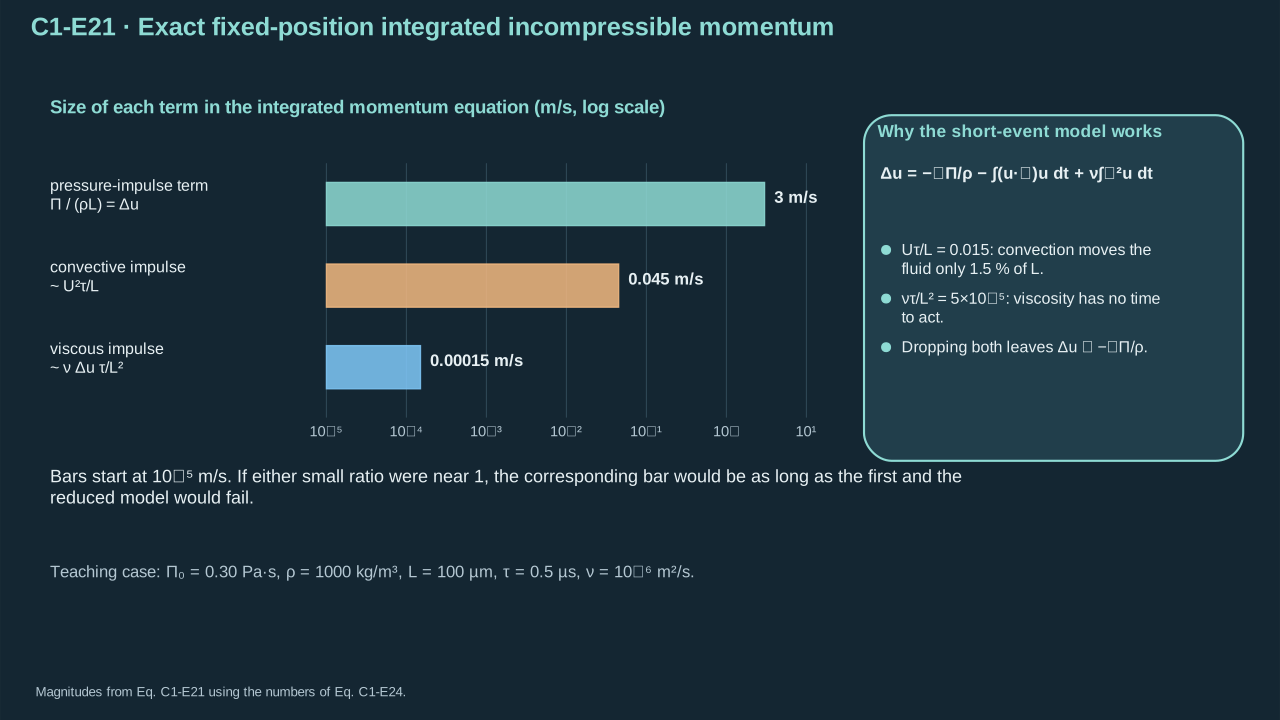
Bound the omitted scales. Choose representative liquid speed and variation length. Convective impulse scales as speed × duration/length. Viscous impulse scales as kinematic viscosity × duration/length². Small interface displacement permits fixed boundary geometry. These scale diagnostics provide no guaranteed singular-boundary-layer error bound. Under these conditions, subtract incompressible velocities and take the divergence.
(C1.6-E22) · Short-event reduced pressure-impulse model
(C1.6-E22) · 短时事件的简化压力冲量模型
4. Where does the next approximation come from?
下一步的近似从哪里来?
C1.6-E22 is a separate approximation. If the event lasts τ=t1−t0, the flow varies over a spatial scale L, and characteristic speed is U, then the convective and viscous terms are small relative to a characteristic velocity change when the corresponding ratios are small:
Provided the relevant velocity-change scaling and boundary conditions support these omissions, C1.6-E21 reduces to
在速度变化的尺度估计与边界条件也支持忽略这两项时,C1.6-E21 才简化为:
Δu≃−ρ∇Π(C1.6-E22)
The two equations must not be conflated: C1.6-E21 retains all three acceleration mechanisms and is exact under the stated model; C1.6-E22 neglects two of them and requires additional assumptions.
Additional worked steps. The following steps supply details beyond the preserved handoff passage.
补充的完整步骤。 以下步骤补充所保留交接材料之外的细节。
Estimate convective acceleration by squared characteristic speed divided by variation length. Integrating over event duration gives its velocity-change scale.
用特征速度平方除以变化长度估计对流加速度。再乘以事件持续时间,得到其速度变化尺度。
∫t0t1(u⋅∇)udt∼U2τ/L,(U2τ/L)/U=Uτ/L,
Estimate the viscous Laplacian using inverse squared variation length. Compare the resulting viscous impulse with characteristic speed.
用变化长度平方的倒数估计黏性拉普拉斯项。将所得黏性冲量与特征速度比较。
ν∫t0t1∇2udt∼νUτ/L2,(νUτ/L2)/U=ντ/L2,
Subtract the divergence-free velocities at the two fixed event endpoints. Their velocity increment remains divergence-free.
将两个固定事件端点的无散速度相减。所得速度增量仍无散。
∇⋅Δu=∇⋅u(t1)−∇⋅u(t0)=0−0=0,
Take the divergence of the reduced pressure-impulse relation. With constant density, incompressibility gives Laplace's equation.
对约化压力冲量关系取散度。密度恒定时,不可压缩条件给出拉普拉斯方程。
0=−∇⋅∇Π/ρ=−∇2Π/ρ.
Require small convective impulse on the chosen velocity scale.
要求在所选速度尺度下,对流冲量足够小。
LUτ≪1
Require small viscous impulse on that same scale.
要求在同一尺度下,黏性冲量足够小。
L2ντ≪1
Under the stated additional assumptions, retain the pressure contribution as the leading velocity change.
在已声明的附加假设下,保留压力贡献作为主导速度变化。
Δu≃−ρ∇Π
Apply incompressibility to this reduced relation to obtain the pressure-impulse boundary equation.
对该约化关系应用不可压缩条件,得到压力冲量边值方程。
0=∇⋅Δu≃−ρ∇2Π⟹∇2Π=0
Symbols for Eq. (C1.6-E22).
式(C1.6-E22)的符号定义。
First individual definition第一项单独定义
Second individual definition第二项单独定义
U>0 is a characteristic liquid speed (m s⁻¹)
U>0 为特征液体速度(m s⁻¹)
τ is impulse duration (s)
τ 为冲量持续时间(s)
L>0 is liquid variation length (m)
L>0 为液体变化长度(m)
ν is kinematic viscosity (m² s⁻¹)
ν 为运动黏度(m² s⁻¹)
Δu is velocity change (m s⁻¹)
Δu 为速度变化(m s⁻¹)
Π is pressure impulse (Pa s)
Π 为压力冲量(Pa s)
ρ is density (kg m⁻³)
ρ 为密度(kg m⁻³)
t0 — fixed event start time (s)
t0 — 固定事件起始时刻(s)
t1 — fixed event end time (s)
t1 — 固定事件终止时刻(s)
t — time (s)
t — 时间(s)
u — liquid velocity (m s⁻¹)
u — 液体速度(m s⁻¹)
∇ — spatial gradient operator (m⁻¹)
∇ — 空间梯度算子(m⁻¹)
∇⋅ — spatial divergence operator (m⁻¹)
∇⋅ — 空间散度算子(m⁻¹)
∇2 — spatial Laplacian operator (m⁻²)
∇2 — 空间拉普拉斯算子(m⁻²)
Conventions and conditions.∇⋅ denotes divergence and ∇2 Laplacian; ≪ means asymptotically small, and ≃ marks the reduced approximation; The last Laplace equation belongs to that reduced model; ∼ denotes a scale estimate, rather than an equality or rigorous error bound.
The velocity depends on a spatial impulse gradient constrained by boundary geometry.
速度取决于受边界几何约束的空间压力冲量梯度。
Check and interpretation. If the actual increment is much smaller than the chosen speed, these ratios need not bound its relative error. A fixed wall gives zero normal impulse derivative when normal velocity is unchanged. Driven and outlet boundaries supply their impulse values.
A fixed impermeable wall requires zero normal velocity change. Its normal impulse derivative therefore vanishes. A driven cavity prescribes impulse or pressure history. A communicating outlet supplies its pressure reference. A spatially uniform impulse addition has zero gradient and changes no velocity. Pulse duration and boundary geometry can change the response at fixed peak pressure.
Step 1.6.4 — Show how a boundary selects the liquid-motion direction
步骤 1.6.4——说明边界如何选择液体运动方向
Purpose in this chapter. Solve the reduced model from Eq. (C1.6-E22) for a straight column. Inlet and outlet impulses select a gradient and therefore an axial velocity increment.
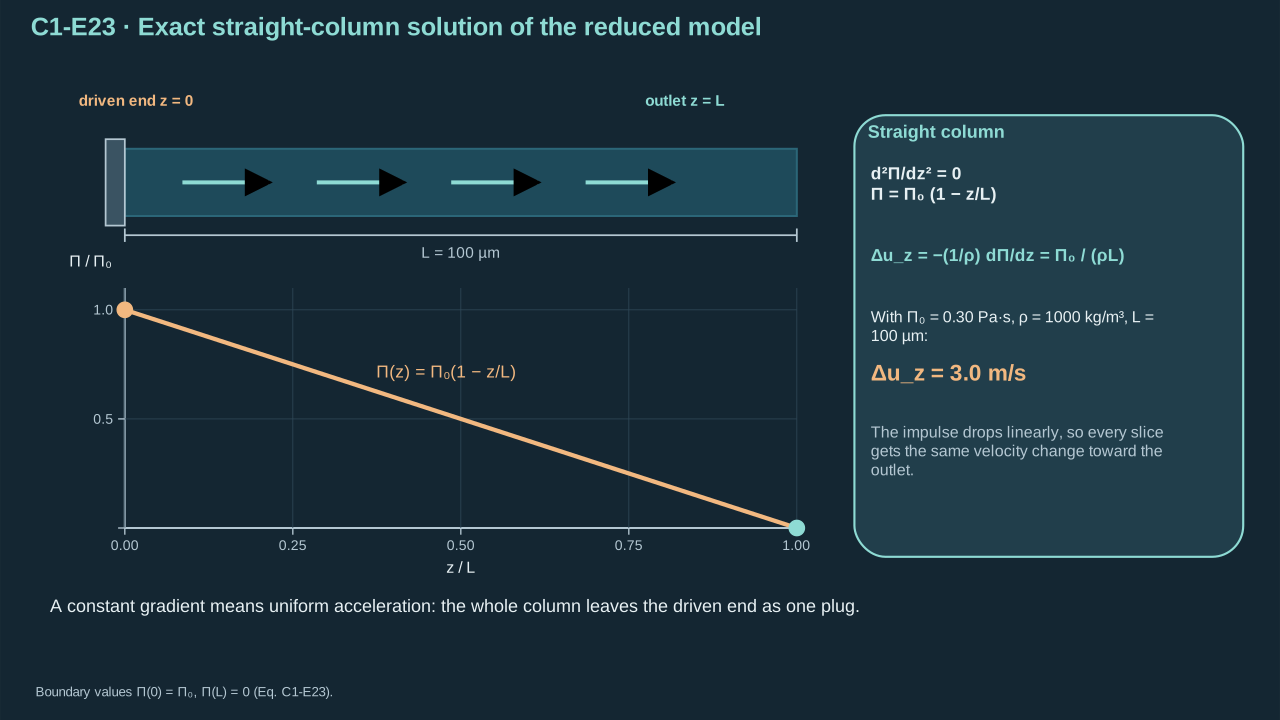
Solve a straight-column benchmark. Start with a stationary uniform column along the positive axis. Area is constant and side walls are fixed. Prescribe positive inlet impulse and zero outlet impulse. Integrate the one-dimensional Laplace equation twice. Apply both endpoint values to obtain its gradient.
(C1.6-E23) · Exact straight-column solution of the reduced model
(C1.6-E23) · 简化模型中直液柱的精确解
5. Apply C1.6-E23 to a straight liquid column
将 C1.6-E23 应用于直液柱
Let z∈[0,L], with a driven inlet at z=0 and an outlet at z=L. Define Π(0)=Π0 and Π(L)=0. The one-dimensional Laplace equation in the short-event reduced model is
When the short-event approximation applies, the resulting axial velocity increment is
当短时事件近似成立时,得到的轴向速度增量为:
Δuz≃−ρ1dzdΠ=ρL1∫t0t1f(t)dt.
This makes the operations distinct: integrate pressure over time to obtain Π; differentiate Π in space to obtain the leading-order velocity change.
这使两个操作的作用清晰区分:先对压力进行时间积分得到 Π,再对 Π 作空间求导得到一阶速度变化。
Additional worked steps. The following steps supply details beyond the preserved handoff passage.
补充的完整步骤。 以下步骤补充所保留交接材料之外的细节。
Integrate the one-dimensional Laplace equation once. Its pressure-impulse gradient is constant.
对一维拉普拉斯方程积分一次。压力冲量梯度为常数。
d2Π/dz2=0⇒dΠ/dz=A1,
Integrate that constant gradient from the inlet to an arbitrary column position.
从入口至任意液柱位置积分该常梯度。
Π(z)−Π(0)=∫0zA1ds=A1z,
Apply the prescribed inlet pressure impulse to determine the additive constant.
应用给定入口压力冲量,确定加法积分常数。
Π(0)=Π0⇒A0=Π0,
Apply zero outlet impulse. This determines the gradient and its negative sign.
应用出口冲量为零的条件。由此确定梯度及其负号。
0=Π(L)=A1L+Π0⇒A1=−Π0/L,
Insert the gradient into the reduced momentum relation. The resulting axial velocity increment is positive toward the outlet.
将该梯度代入约化动量关系。所得轴向速度增量为正,指向出口。
Δuz=−(−Π0/L)/ρ=Π0/(ρL).
The first integration makes pressure impulse linear in column position.
第一次积分使压力冲量成为液柱位置的线性函数。
dz2d2Π=0⟹Π=A1z+A0,
The two endpoint values determine its two integration constants.
两个端点值确定两个积分常数。
Π(0)=Π0,Π(L)=0⟹A0=Π0,A1=−LΠ0,
Insert the resulting gradient into the axial velocity increment.
将所得梯度代入轴向速度增量。
Π(z)=Π0(1−Lz),Δuz=−ρ1dzdΠ=ρLΠ0.
Symbols for Eq. (C1.6-E23).
式(C1.6-E23)的符号定义。
First individual definition第一项单独定义
Second individual definition第二项单独定义
z∈[0,L] is axial position (m)
z∈[0,L] 为轴向位置(m)
L>0 column length (m)
L>0 为液柱长度(m)
Π(z) — Local column pressure impulse (Pa s)
Π(z) — 液柱局部压力冲量(Pa s)
Π0>0 — Driven-end pressure impulse (Pa s)
Π0>0 — 驱动端压力冲量(Pa s)
A0 is an integration constant (Pa s)
A0 为积分常数(Pa s)
A1 a gradient constant (Pa s m⁻¹)
A1 为梯度常数(Pa s m⁻¹)
ρ>0 is carrier density (kg m⁻³)
ρ>0 为载液密度(kg m⁻³)
Δuz is positive axial speed change (m s⁻¹)
Δuz 为正轴向速度变化(m s⁻¹)
s — dummy axial integration coordinate (m)
s — 轴向积分哑坐标(m)
f(t) — prescribed pressure-excess waveform (Pa)
f(t) — 给定超压波形(Pa)
t0 — event start time (s)
t0 — 事件开始时间(s)
t1 — event end time (s)
t1 — 事件结束时间(s)
Conventions and conditions.d/dz is an axial derivative; Subscript z labels the component and 0 the driven endpoint; The uniform-speed column is an inviscid core benchmark; no-slip wall layers are omitted.
约定与条件。d/dz 为轴向导数;下标 z 表示分量,0 表示受驱动端点;匀速液柱是无黏核心流基准;省略无滑移壁面层。
A linear spatial impulse drop accelerates liquid toward the outlet.
线性的空间冲量下降使液体向出口加速。
Check and interpretation. At inlet and outlet the solution reproduces both prescribed values. Impulse divided by density and length has units m s⁻¹. Equal pressure peaks with different durations produce different speed increments.
检验与解释。 解在入口和出口恢复两个给定值。冲量除以密度及长度的单位为 m s⁻¹。相同压力峰值、不同持续时间会产生不同速度增量。
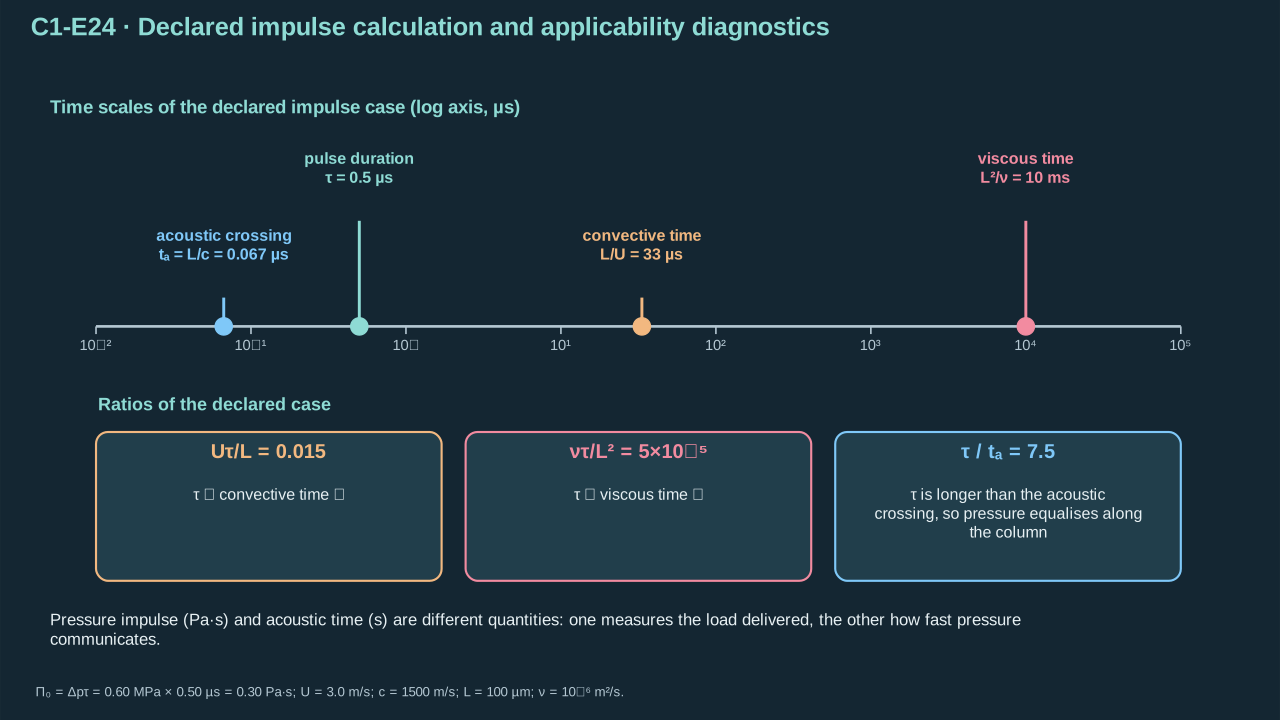
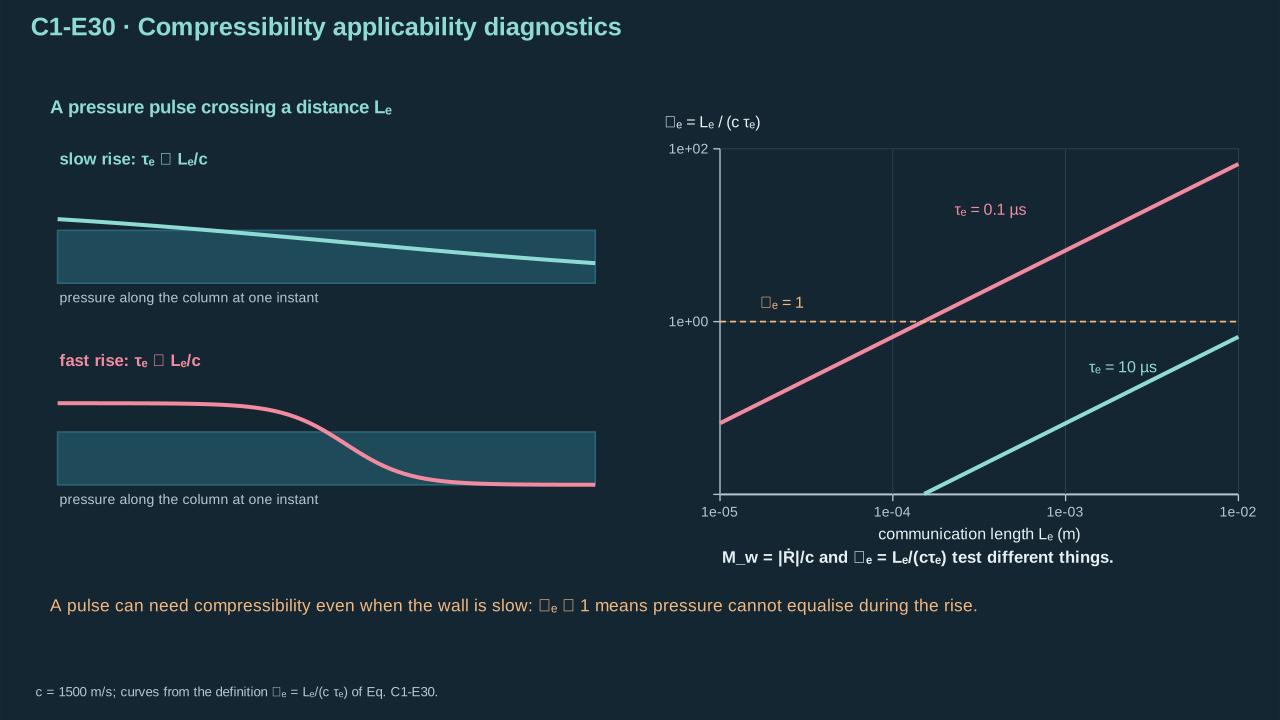
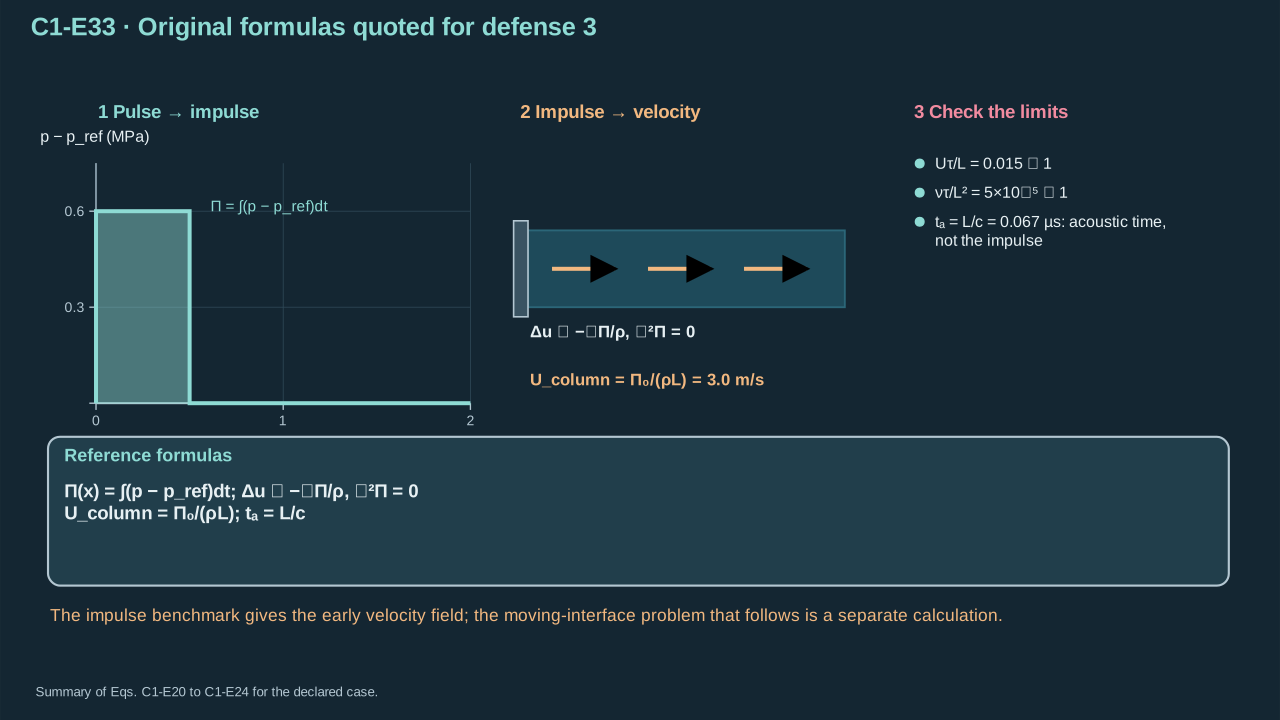
Prescribe 0.60 MPa for 0.50 μs across a 100 μm column. Use the earlier density, viscosity 0.001 Pa s, and sound speed 1500 m s⁻¹. The velocity change is 3.0 m s⁻¹. Crossing time is shorter than the pulse. Uniform pressure and final jet speed remain unestablished. The solved column has an end-to-end pressure gradient.
在 100 μm 液柱两端施加 0.60 MPa 压差,持续 0.50 μs。采用前述密度、黏度 0.001 Pa s 和声速 1500 m s⁻¹。速度变化为 3.0 m s⁻¹。传播时间短于脉冲时长。均匀压力及最终射流速率尚未确立。已解液柱具有端到端压力梯度。
Step 1.6.5 — Check the scale and assumptions of the column result
步骤 1.6.5——检验液柱结果的尺度与假设
Purpose in this chapter. Apply Eq. (C1.6-E23) to a declared pressure pulse. Calculate velocity change and compare acoustic, convective, and viscous scales before interpreting that result.
(C1.6-E24) · Declared impulse calculation and applicability diagnostics
(C1.6-E24) · 采用给定参数的冲量计算与适用性诊断
For the course's illustrative pressure difference Δp=0.60MPa lasting τ=0.50μs, Π0=Δpτ=0.30Pas. With ρ=1000kg/m3 and L=100μm, the velocity increment is Δuz=3.0m/s.
This example distinguishes the two operations: the integral ∫dt produces Π(z), while the spatial derivative dΠ/dz determines the direction and strength of acceleration. It is a straight-column benchmark, not a prediction of the ultimate cavitation jet velocity.
This reduced pressure-impulse model assumes small integrated convection and viscosity relative to the pressure forcing, sufficiently small interface displacement for fixed-geometry approximations, and a compatible incompressible pressure field. It does not automatically describe fast compressible shocks, strongly moving interfaces, or an actual jet without a spatially resolved geometry and boundary conditions. In the course example the acoustic crossing timeL/c is about 0.0667 μs, shorter than the 0.50 μs pulse; “short-event” here concerns the neglected inertial-advection and viscous effects, not a claim that the pulse is shorter than the acoustic time.
Additional worked steps. The following steps supply details beyond the preserved handoff passage.
补充的完整步骤。 以下步骤补充所保留交接材料之外的细节。
Convert the teaching pressure, pulse duration, and column length to SI units.
将教学压力、脉冲持续时间及液柱长度换算为 SI 单位。
Δp=6.0×10⁵Pa,τ=5.0×10⁻⁷s,L=10−4m,
Integrate the constant pressure pulse by multiplying its amplitude and duration.
将恒压脉冲的幅值与持续时间相乘,得到其时间积分。
Π0=(6.0×10⁵)(5.0×10⁻⁷)=0.30Pas,
Calculate density times column length, then divide pressure impulse by this factor to obtain velocity change.
计算密度与液柱长度的乘积,再用压力冲量除以该因子,得到速度变化。
ρL=1000(10−4)=0.1kgm−2,U=0.30/0.1=3.0ms−1,
Evaluate displacement relative to variation length using characteristic speed and event duration.
利用特征速度与事件持续时间,计算位移相对于变化长度的比例。
Uτ/L=3(5×10−7)/10−4=0.015,
Evaluate the viscous impulse ratio using kinematic viscosity and squared variation length.
利用运动黏度与变化长度平方,计算黏性冲量比值。
ντ/L2=(10−6)(5×10−7)/10−8=5×10−5,
Calculate one-way acoustic travel time and compare it with the pressure-pulse duration.
计算单程声传播时间,并将其与压力脉冲持续时间比较。
ta=10−4/1500=6.66667×10−8s,τ/ta=7.5.
Collect the pressure-pulse time integral.
汇总压力脉冲的时间积分。
Π0=Δpτ=(0.60×10⁶)(0.50×10⁻⁶)Pas=0.30Pas,
Record the predicted column velocity change and acoustic travel time.
写出所预测的液柱速度变化与声传播时间。
U=ρLΠ0=3.0ms−1,ta=cL=0.066667μs,
Compare the convective, viscous, and acoustic ratios before using the reduced model.
使用约化模型之前,比较对流、黏性与声学比值。
LUτ=0.015,L2ντ=5.0×10⁻⁵,taτ=7.5.
Symbols for Eq. (C1.6-E24).
式(C1.6-E24)的符号定义。
First individual definition第一项单独定义
Second individual definition第二项单独定义
Π0 is driven-end impulse (Pa s)
Π0 为受驱动端冲量(Pa s)
Δp is constant applied column pressure difference (Pa)
Δp 为施加的常数液柱压差(Pa)
τ is pulse duration (s)
τ 为脉冲持续时间(s)
U is column speed increment (m s⁻¹)
U 为液柱速度增量(m s⁻¹)
ρ=1000 kg m⁻³ is density
ρ=1000 kg m⁻³ 为密度
L=100×10−6 m is length
L=100×10−6 m 为长度
c=1500 m s⁻¹ is sound speed
c=1500 m s⁻¹ 为声速
ta is acoustic crossing time (s)
ta 为声传播时间(s)
ν=μ/ρ=10−6 m² s⁻¹ with μ=0.001 Pa s
ν=μ/ρ=10−6 m² s⁻¹,且 μ=0.001 Pa s
μ — Carrier dynamic viscosity (Pa s)
μ — 载液动力黏度(Pa s)
Conventions and conditions. The three ratios are dimensionless; μs means microseconds.
约定与条件。 三个比值均无量纲;μs 表示微秒。
Pressure impulse and acoustic time have distinct definitions, dimensions and roles.
压力冲量与声传播时间具有不同的定义、量纲与作用。
Check and interpretation. The rectangular discontinuity has zero ideal rise time, so its fronts require acoustic treatment. The integrated column result is a reduced impulse benchmark. A real pulse needs a measured or prescribed finite rise time and the separate communication test below.
Directional motion requires asymmetry. A sphere in uniform infinite liquid has no preferred direction. Outlets, menisci, walls, neighbors or uneven heating break that symmetry. Stand-off is center-to-boundary distance divided by maximum radius. Equal stand-off still permits different curvature and material response. Collapse near a rigid plane commonly directs a jet toward it. Deformable boundaries can change or split that response. [R3][R12]
Step 1.6.6 — Explain why a spherical cavity cannot choose a jet direction
步骤 1.6.6——说明球形空腔为何不能选择射流方向
Purpose in this chapter. Contrast spherical symmetry with the directed column in Eq. (C1.6-E23). This identifies the geometric information missing from a radius-only model and motivates Section 1.7.
Derivation.Stand-off compares a center-to-boundary distance with maximum bubble radius. It is a geometric descriptor. To prove directional cancellation for the unbounded sphere, write each radial unit-vector component and integrate over all solid angles. The azimuthal sine and cosine integrate to zero; the axial component cancels between hemispheres.
(C1.6-E25) · Geometry definition and exact symmetry identity
(C1.6-E25) · 几何定义与精确的对称性恒等式
Write the radial unit vector in Cartesian components and the solid-angle integration measure.
用笛卡尔分量表示径向单位矢量,并写出立体角积分测度。
er=(sinθcosψ,sinθsinψ,cosθ),dΩ=sinθdθdψ,
Integrate the azimuthal cosine factor. This cancels the first Cartesian component over a complete revolution.
积分方位角余弦因子。第一笛卡尔分量在完整一周内相互抵消。
∫02πcosψdψ=[sinψ]02π=0,
Integrate the azimuthal sine factor. This cancels the second Cartesian component.
积分方位角正弦因子。第二笛卡尔分量因此抵消。
∫02πsinψdψ=[−cosψ]02π=0,
Integrate the polar factor for the third component. Its two endpoint contributions are equal.
积分第三分量的极角因子。其两个端点的贡献相等。
∫0πcosθsinθdθ=[21sin2θ]0π=0,
Collect the three zero components. An exactly spherical configuration has no preferred vector direction.
合并三个零分量。严格球形构型没有优先的矢量方向。
∫S2erdΩ=(0,0,0).
Define stand-off using center-to-boundary distance divided by maximum radius.
用中心至边界距离除以最大半径,定义相对壁距。
γ=Rmaxh
The zero angular vector integral records the absence of a preferred direction under exact spherical symmetry.
角向矢量积分为零,表明严格球对称时没有优先方向。
∫S2erdΩ=0
Symbols for Eq. (C1.6-E25).
式(C1.6-E25)的符号定义。
First individual definition第一项单独定义
Second individual definition第二项单独定义
γ is dimensionless stand-off
γ 为无量纲离壁比
h is bubble-center-to-boundary distance (m)
h 为气泡中心到边界的距离(m)
Rmax is maximum radius (m)
Rmax 为最大半径(m)
S2 denotes all directions on the unit sphere (—)
S2 表示单位球面上的全部方向(—)
er is the outward radial unit vector (dimensionless)
er 为向外径向单位矢量(无量纲)
dΩ is the dimensionless solid-angle measure
dΩ 为无量纲立体角测度
0 is the zero vector (dimensionless)
0 为零矢量(无量纲)
θ — polar angle, 0≤θ≤π (1)
θ — 极角,0≤θ≤π(1)
ψ — azimuthal angle, 0≤ψ≤2π (1)
ψ — 方位角,0≤ψ≤2π(1)
Conventions and conditions. The angular identity expresses directional cancellation under perfect spherical symmetry; it is not a boundary-jet prediction; Angles are dimensionless radians; tuple entries are Cartesian vector components.
Stand-off locates a boundary; perfect spherical symmetry selects no outgoing direction.
离壁比定位边界;完全球对称不能选出向外喷射方向。
Check and interpretation. The cancellation concerns perfect symmetry. Actual boundaries change the spatial pressure and velocity problem. Stand-off alone cannot determine the response of different boundary materials or curvatures.
Step 1.7.1 — Replace the radius model with spatial liquid equations
步骤 1.7.1——用空间液体方程替代纯半径模型
Purpose in this chapter. Retain the mass and momentum laws across the actual liquid domain. These equations provide the spatial dynamics needed when boundaries and interface shape determine the jet.
Specify the spatial jet problem. Prescribe initial interface shape and carrier velocity. Define solid boundaries, outlet, contact-line behavior and pressure closure. The following equations conserve mass and momentum for constant-property incompressible Newtonian liquid. Gravity is omitted. Solve them with the interface and boundary conditions below. A fitted radius history leaves these spatial conditions unresolved.
(C1.7-E26) · Bulk conservation and Newtonian constitutive assumption
(C1.7-E26) · 体相守恒律与牛顿流体本构假设
1. Start from the Navier–Stokes equation
从 Navier–Stokes 方程出发
For an incompressible Newtonian liquid with constant density ρ, dynamic viscosityμ, and no body forces, the momentum equation is
对于密度 ρ、动力黏度μ 均为常数、且忽略体积力的不可压缩牛顿流体,动量方程为:
ρ[∂t∂u+(u⋅∇)u]=−∇p+μ∇2u(1)
Here, u(x,t) is the velocity field, p(x,t) is pressure, ∇p is the pressure gradient, and ∇2u is the vector Laplacian of velocity. The notation (u⋅∇)u denotes convective acceleration.
Divide both sides by ρ, and define the kinematic viscosityν=μ/ρ:
两侧除以 ρ,并定义运动黏度ν=μ/ρ:
∂t∂u=−ρ∇p−(u⋅∇)u+ν∇2u(2)
This equation states that the local velocity changes because of pressure gradients, convective transport, and viscous effects.
这个方程表示:局部速度的变化由压力梯度、对流输运以及黏性作用共同决定。
Additional worked steps. The following steps supply details beyond the preserved handoff passage.
补充的完整步骤。 以下步骤补充所保留交接材料之外的细节。
Begin with mass conservation before imposing constant density. Constant density reduces it to zero velocity divergence.
先写质量守恒,再施加常密度条件。常密度使其约化为速度散度为零。
∂tρ+∇⋅(ρu)=0ρconstant∇⋅u=0,
Adopt the Newtonian stress law with constant viscosity. It separates pressure and symmetric velocity-gradient stresses.
采用常黏度牛顿应力定律。该定律区分压力应力与对称速度梯度应力。
T=−pI+μ[∇u+(∇u)T],
Apply momentum conservation without body force. Stress divergence produces material acceleration.
在无体积力时应用动量守恒。应力散度产生物质加速度。
ρDu/Dt=∇⋅T,
Take the divergence of Newtonian stress. Constant viscosity and incompressibility remove the gradient-of-divergence contribution.
对牛顿应力取散度。常黏度与不可压缩条件消去散度梯度项。
∇⋅T=−∇p+μ[∇2u+∇(∇⋅u)]=−∇p+μ∇2u,
Expand material acceleration into the local time derivative and convective acceleration.
将物质加速度展开为局部时间导数与对流加速度。
Du/Dt=∂tu+(u⋅∇)u.
State the constant-density mass-conservation condition.
写出常密度质量守恒条件。
∇⋅u=0
Combine material acceleration and Newtonian stress divergence to obtain the spatial liquid momentum equation.
结合物质加速度与牛顿应力散度,得到空间液体动量方程。
ρ(∂t∂u+(u⋅∇)u)=−∇p+μ∇2u
Symbols for Eq. (C1.7-E26).
式(C1.7-E26)的符号定义。
First individual definition第一项单独定义
Second individual definition第二项单独定义
u(x,t) is liquid velocity (m s⁻¹)
u(x,t) 为液体速度(m s⁻¹)
x is spatial position (m)
x 为空间位置(m)
t is time (s)
t 为时间(s)
ρ is constant carrier density (kg m⁻³)
ρ 为常数载液密度(kg m⁻³)
p is liquid pressure (Pa)
p 为液体压力(Pa)
μ is constant viscosity (Pa s)
μ 为常数黏度(Pa s)
T — Cauchy stress tensor (Pa)
T — 柯西应力张量(Pa)
I — identity tensor (1)
I — 单位张量(1)
D/Dt — material time derivative (s⁻¹)
D/Dt — 物质时间导数(s⁻¹)
∂t — time derivative at fixed position (s⁻¹)
∂t — 固定位置的时间导数(s⁻¹)
∇ — spatial gradient operator (m⁻¹)
∇ — 空间梯度算子(m⁻¹)
∇⋅ — spatial divergence operator (m⁻¹)
∇⋅ — 空间散度算子(m⁻¹)
∇2 — spatial Laplacian operator (m⁻²)
∇2 — 空间拉普拉斯算子(m⁻²)
Conventions and conditions.∇⋅,∇,∇2 denote divergence, gradient and vector Laplacian; ∂t is the fixed-position derivative; The dot in convection is vector contraction; The momentum equation has force-per-volume units (N m⁻³); Superscript T denotes transpose; body forces are omitted; the density derivative is displayed before imposing constant density.
约定与条件。∇⋅,∇,∇2 分别为散度、梯度与矢量拉普拉斯;∂t 为固定位置导数;对流中的圆点为矢量缩并;动量方程各项单位为单位体积力(N m⁻³);上标 T 表示转置;忽略体力;密度导数写在施加常密度条件之前。
Bulk momentum and volume conservation supply the spatial field needed for jet formation.
体内动量与体积守恒给出射流形成所需的空间场。
Check and interpretation. Stress divergence and inertia both have units N m⁻³. Supply a divergence-free initial velocity, compatible interface shape, wall velocities, outlet data and contact-line law. A radius history cannot replace these fields.
检验与解释。 应力散度和惯性项单位均为 N m⁻³。需要给定无散初始速度、相容初始界面、壁面速度、出口数据及接触线规律。半径历程不能代替这些空间场。
Step 1.7.2 — Close the spatial model at its moving interface
步骤 1.7.2——在运动界面闭合空间模型
Purpose in this chapter. Add interface motion and traction conditions to Eq. (C1.7-E26). Their orientation and stress signs must recover the spherical jump in Eq. (C1.3-E06).
Set interface orientation and stress. The normal points from liquid into gas. An inner spherical cavity therefore has negative curvature. An outer liquid droplet has positive curvature. This reproduces Eq. (C1.3-E06). A clean interface with negligible gas viscosity has zero tangential viscoustraction. At zero liquid viscosity, that condition adds no strain-rate constraint. Without phase transfer, interface and liquid normal velocities match.
(C1.7-E27) · Kinematic condition and clean-interface traction
(C1.7-E27) · 运动学条件与洁净界面牵引
3. Kinematic condition: advance interface position
运动学条件:推进界面位置
With zero mass transfer across the interface, the physically required statement is equality of normal velocities,
如果界面没有相变质量通量,物理上必须满足法向速度相等:
(dtdX−u)⋅n=0.
If we deliberately follow material interface markers, we can choose the stronger parametrization used in C1.7-E28:
如果选择追踪界面上的物质标记点,就可以采用 C1.7-E28 的较强参数化形式:
dtdX=u(X,t)=∇ϕ(X,t).
The normal component determines the physical interface shape; tangential marker motion depends on parametrization. This equation tells us where the interface moves, not how its velocity potential evolves.
Additional worked steps. The following steps supply details beyond the preserved handoff passage.
补充的完整步骤。 以下步骤补充所保留交接材料之外的细节。
Represent the interface by a smooth level set increasing into gas. Its gradient defines the normal, and its time change defines normal interface speed.
用向气体侧增大的光滑水平集表示界面。其梯度确定法向,其时间变化确定界面法向速度。
F(x,t)=0,n=∇F/∣∇F∣,Vn=−∂tF/∣∇F∣,
For an interface transported by liquid without phase slip, impose zero material change of the level set.
对于由液体输运且没有相变滑移的界面,令水平集的物质变化为零。
∂tF+u⋅∇F=0⇒Vn=u⋅n,
Apply the clean-interface traction jump using the liquid-to-gas normal and signed curvature.
采用液体指向气体的法向与带符号曲率,应用清洁界面牵引跃变关系。
(Tg−Tl)n=σκn,
Insert gas pressure stress and liquid Newtonian stress into the traction jump.
将气体压力应力与液体牛顿应力代入牵引跃变关系。
(Tg−Tl)n=[(pl−pb)I−2μD]n,
Use unit normal magnitude and orthogonality of normal and tangent before taking projections.
在作投影之前,使用单位法向的模长条件及法向与切向的正交性。
n⋅n=1,s⋅n=0,
Project the traction jump onto the normal. This gives the normal pressure and viscous-stress balance.
将牵引跃变投影至法向。由此得到法向压力与黏性应力平衡。
pl−pb−2μn⋅Dn=σκ,
Project onto a tangent. Constant surface tension and negligible gas viscous stress give zero tangential liquid traction.
投影至切向。常表面张力及可忽略的气相黏性应力给出零液体切向牵引。
−2μs⋅Dn=0.
Define symmetric strain rate and signed curvature using the adopted normal orientation.
根据所采用的法向方向,定义对称应变率与带符号曲率。
D=21(∇u+(∇u)T),κ=∇s⋅n,
Collect interface kinematics and normal pressure balance.
汇总界面运动学与法向压力平衡。
Vn=u⋅n,pl=pb+σκ+2μn⋅Dn,
Collect tangential traction and the inner-sphere curvature sign.
汇总切向牵引条件及内球面曲率符号。
2μs⋅Dn=0,κsphere=−R2.
Symbols for Eq. (C1.7-E27).
式(C1.7-E27)的符号定义。
First individual definition第一项单独定义
Second individual definition第二项单独定义
D is symmetric liquid strain-rate tensor (s⁻¹)
D 为液体对称应变率张量(s⁻¹)
u is velocity (m s⁻¹)
u 为速度(m s⁻¹)
n is the unit normal from liquid into gas (dimensionless)
n 为从液体指向气体的单位法向(无量纲)
κ is signed curvature (m⁻¹)
κ 为带符号曲率(m⁻¹)
Vn is interface normal speed (m s⁻¹)
Vn 为界面法向速度(m s⁻¹)
pl — Adjacent-liquid absolute pressure (Pa)
pl — 邻近液体绝对压力(Pa)
pb — Uniform bubble absolute pressure (Pa)
pb — 均匀气泡绝对压力(Pa)
σ is surface tension (N m⁻¹)
σ 为表面张力(N m⁻¹)
μ is viscosity (Pa s)
μ 为黏度(Pa s)
s is any unit tangent (dimensionless)
s 为任意单位切向(无量纲)
R is spherical cavity radius (m)
R 为球形空腔半径(m)
F — smooth dimensionless level set increasing into gas (1)
F — 向气体侧增加的光滑无量纲水平集(1)
x — position (m)
x — 位置(m)
t — time (s)
t — 时间(s)
Tg — gas stress, −pbI (Pa)
Tg — 气体应力,−pbI(Pa)
Tl — liquid stress, −plI+2μD (Pa)
Tl — 液体应力,−plI+2μD(Pa)
I — identity tensor (1)
I — 单位张量(1)
∇ — spatial gradient operator (m⁻¹)
∇ — 空间梯度算子(m⁻¹)
∇s⋅ — surface divergence operator (m⁻¹)
∇s⋅ — 表面散度算子(m⁻¹)
∂t — time derivative at fixed position (s⁻¹)
∂t — 固定位置的时间导数(s⁻¹)
X — material interface marker position (m)
X — 界面物质标记点位置(m)
ϕ — velocity potential (m² s⁻¹)
ϕ — 速度势(m² s⁻¹)
Conventions and conditions.∇u is its spatial gradient, with superscript T denoting transpose; ∇s⋅ is surface divergence; Dots denote tensor/vector contractions; The level-set gradient is nonzero on the interface.
约定与条件。∇u 为其空间梯度,上标 T 表示转置;∇s⋅ 为表面散度;圆点表示张量或矢量缩并;水平集在界面上的梯度非零。
Interface normals, signed curvature and material motion must use one consistent convention.
界面法向、带符号曲率与物质运动必须采用一致约定。
Check and interpretation. The interface condition matches normal velocity; tangential node motion is a parametrization choice. It imposes no solid-wall no-slip condition on an inviscid free surface. Phase transfer needs a mass-flux condition instead.
Set zero liquid velocity at a stationary viscous wall. Couple liquid velocity and stress to a moving film. Supply external pressure and stress at the outlet or meniscus. Close the contact line with a pinned or moving-angle law. Chapter 4 supplies payload and release mechanics. Appreciable phase transfer replaces equal normal velocities with Chapter 2’s mass-flux balance.
Step 1.7.3 — Construct a conditional pre-impact interface solver
步骤 1.7.3——构造有条件的撞击前界面求解模型
Purpose in this chapter. Reduce Eqs. (C1.7-E26) and (C1.7-E27) under the stated inviscid potential-flow assumptions. The resulting system evolves interface shape and can resolve directional pre-impact motion.
Derive the potential-flow reduction. Assume inviscid, initially irrotational flow away from shocks and unresolved wall layers. The potential satisfies Laplace’s equation. Without phase slip, interface nodes follow liquid velocity. Convert the Eulerian Bernoulli derivative to the material derivative. Add velocity dotted with the potential gradient. This closes a spatial pre-impact model under the stated assumptions. Boundary-integralmicrojet models use this reduction. [R4]
Core answer (English). C1.7-E28 is a conditional potential-flow closure for a moving gas–liquid interface, not a complete laser-to-PFC-jet model. The bulk Laplace equation supplies the velocity field; the kinematic condition updates interface geometry; the dynamic condition updates interface potential. The material-derivative expression is a rewrite, not another independent equation. All initial data, non-interface boundary conditions and the bubble-pressure history must still be given or modeled.
In the spherical Rayleigh–Plesset model, the unknown shape is only the radius R(t). In the nonspherical jet problem, let Ω(t) be the liquid domain, Γ(t) its moving gas–liquid interface and X(α,t) the position of an interface marker (the parameter α labels that marker). We seek φ(x,t) in the liquid and Γ(t) over time. The velocity is then u=∇φ. Pressure at the interface is obtained from stress balance. Bubble pressure p_b(t) is an additional required source input or thermodynamic unknown.
Assume the carrier is incompressible, inviscid and irrotational, away from shocks and boundary layers. Irrotationality permits u=∇φ. Incompressibility requires ∇·u=0. Substitution yields
At any fixed time, Laplace's equation determines the potential only after the domain and appropriate boundary data are specified. It cannot advance the interface by itself.
3. Kinematic condition: advance interface position
运动学条件:推进界面位置
With zero mass transfer across the interface, the physically required statement is equality of normal velocities,
如果界面没有相变质量通量,物理上必须满足法向速度相等:
(dtdX−u)⋅n=0.
If we deliberately follow material interface markers, we can choose the stronger parametrization used in C1.7-E28:
如果选择追踪界面上的物质标记点,就可以采用 C1.7-E28 的较强参数化形式:
dtdX=u(X,t)=∇ϕ(X,t).
The normal component determines the physical interface shape; tangential marker motion depends on parametrization. This equation tells us where the interface moves, not how its velocity potential evolves.
4. Dynamic condition: derive it instead of assuming it
动力学条件:从基本方程推导
Begin with the inviscid Euler momentum equation with constant density and no body forces:
从密度恒定、无体积力的无黏 Euler 动量方程出发:
∂t∂u+(u⋅∇)u=−ρ∇p.
For u=∇φ, the flow is irrotational. Consequently
对于 u=∇φ 的无旋流动,有:
∂t∂u=∇(∂t∂ϕ),(u⋅∇)u=∇(21∣u∣2).
Substitute and factor the gradient:
将其代入并提取梯度:
∇(∂t∂ϕ+21∣u∣2+ρp)=0.
The quantity in parentheses is constant in space but may depend on time, say C(t). With the reference gauge φ→0, u→0, and p→p∞(t) at infinity, C(t)=p∞(t)/ρ. Thus unsteady Bernoulli is
At a clean inviscid gas–liquid interface, the normal-stress jump reduces to the signed Young–Laplace relation
在洁净、无黏的气液界面处,法向应力跳跃关系简化为带符号的 Young–Laplace 关系:
pl=pb+σκ,κ=∇s⋅n.
The course defines n from liquid to gas. For an interior spherical cavity this makes κ=-2/R, so p_l=p_b-2σ/R, consistent with the earlier spherical model. Evaluate Bernoulli on the liquid side of Γ and substitute p=p_l:
课程定义 n 从液体指向气体。对于液体内部的球形空腔,这使得 κ=-2/R,因此 p_l=p_b-2σ/R,与前面的球对称模型一致。在 Γ 的液体侧使用 Bernoulli 方程,再代入 p=p_l:
∂t∂ϕ+21∣u∣2+ρpb+σκ=ρp∞.
Rearranging gives the displayed Eulerian dynamic boundary condition:
整理后就得到截图里的欧拉形式动力学边界条件:
∂t∂ϕΓ=ρp∞−pb−σκ−21∣u∣2.
This is the missing derivation: Euler momentum → unsteady Bernoulli → interface normal-stress balance → dynamic interface condition.
The preceding ∂φ/∂t is an Eulerian derivative at fixed spatial position, evaluated on the interface. The last line instead differentiates φ(X(t),t)while following the moving material marker. Apply the multivariable chain rule:
For material interface markers, dX/dt=u, and since ∇φ=u, their dot product is |u|²:
由于界面物质点满足 dX/dt=u,且 ∇φ=u,点积等于 |u|²:
DtDϕ=∂t∂ϕ+∣u∣2=ρp∞−pb−σκ−21∣u∣2+∣u∣2.
Therefore,
因此:
Combine the negative half and positive whole squared-speed contributions.
合并负二分之一与正一倍的速度平方项。
DtDϕ=ρp∞−pb−σκ+21∣u∣2(X∈Γ).
The sign changes only because of the additional advection term. This is not an independent fifth physical law; it is the same dynamic boundary condition expressed on a moving marker.
For prescribedp_b(t), material parameters, complete initial interface shape and surface potential, and consistent boundary conditions at walls, outlets, far field and contact lines, the mathematical potential-flow problem can be advanced through a coupled loop:
Given the current Γ(t) and surface potentialφ|Γ, solve ∇²φ=0 in the current liquid geometry with all remaining boundary conditions.
已知当前 Γ(t) 和界面速度势φ|Γ,结合其余边界条件,在当前液体几何内求解 ∇²φ=0。
Compute u=∇φ at the interface and curvature κ from its geometry.
求得界面速度 u=∇φ,并从界面几何计算曲率 κ。
Use the kinematic condition to advance X.
用运动学条件更新界面位置 X。
Use the material dynamic condition to advance the interface potentialφ|Γ.
用物质形式的动力学条件更新界面速度势φ|Γ。
Update the geometry and repeat until the model's assumptions cease to apply.
更新几何并重复,直到模型假设不再适用。
In this sense, there is one bulk elliptic problem and two evolving surface quantities (X and φ|Γ), with one kinematic and one dynamic evolution equation. The interior pressure can be reconstructed from Bernoulli; it is not an additional independent bulk evolution variable in this reduction.
Not yet closed for a real PFCjet: If p_b(t) is unknown, Chapter 2 must supply thermodynamics, heat transfer and finite phase inventory. If there is substantial evaporation/condensation, dX/dt=u is no longer the appropriate full interfacial kinematic law; a mass-flux jump condition is needed. If the geometry lacks outlet/contact-line conditions, the spatial problem is underdetermined. Strong compressibility, shocks, interface penetration and topology change also exceed the present potential-flow assumptions.
Conventions and conditions.∇ and ∇2 are spatial gradient and Laplacian; D/Dt is the material derivative; ∣u∣ is speed and the dot a vector contraction; The potential gauge is fixed at infinity; Interface markers X(t) follow liquid particles; Dϕ/Dt has units m² s⁻²; assume single-valued potential and a smooth pre-impact interface.
The interface shape evolves jointly with potential; changing geometry creates focusing.
界面形状与速度势共同演化,几何变化产生聚焦。
Check and interpretation. Solve-and-advance loop: prescribe initial interface and potential; evaluate pressure input and curvature; solve the harmonic field with interface potential and impermeable-wall normal data; recover velocity; advance interface positions and interface potential; repeat. An outlet supplies its pressure or compatible potential condition. Far-field gauge fixes the additive freedom. Material and Eulerian dynamic conditions are alternative forms. Missing: physical PFC pressure history, phase transfer, contact-line law where applicable, and treatment of topology changes.
Check the spherical limit of Eq. (C1.7-E28). Wall potential is minus radius × wall speed. Curvature is minus two/radius. Differentiate the wall potential and rearrange the squared-speed term. This recovers inviscid Rayleigh–Plesset. Interface penetration then changes topology. Post-penetration flow requires a new domain and pressure-transmission model.
Step 1.7.4 — Recover the radial model as a consistency check
步骤 1.7.4——恢复径向模型以检验一致性
Purpose in this chapter. Apply Eq. (C1.7-E28) to a sphere. Recovering the inviscid form of Eq. (C1.3-E07) checks the moving-interface signs and derivative convention.
(C1.7-E29) · Exact spherical recovery of the potential closure
(C1.7-E29) · 势流闭合关系对球形模型的精确恢复
7. Spherical consistency check
球对称极限校验
The interface potential from C1.3-E03 is φΓ=-RṘ. Along the moving boundary,
根据 C1.3-E03,球形界面速度势为 φΓ=-RṘ。沿运动界面求导:
DtDϕΓ=dtd(−RR˙)=−R˙2−RR¨.
Insert κ=-2/R, |u|²=Ṙ² into the dynamic condition:
代入 κ=-2/R、|u|²=Ṙ²:
−R˙2−RR¨=ρp∞−pb+2σ/R+21R˙2.
Rearranging gives the inviscid Rayleigh–Plesset equation:
整理后得到无黏 Rayleigh–Plesset 方程:
ρ(RR¨+23R˙2)=pb−p∞−R2σ.
This shows the mathematical compatibility of C1.7-E28 with the earlier spherical equations, not experimental validation of nonspherical PFCjetting.
这表明 C1.7-E28 与前面的球对称方程在数学上相容,并不构成非球对称 PFC射流的实验验证。
Symbols for Eq. (C1.7-E29).
式(C1.7-E29)的符号定义。
First individual definition第一项单独定义
Second individual definition第二项单独定义
ϕΓ is the velocity potential evaluated on the spherical interface (m² s⁻¹), with subscript Γ the interface label
ϕΓ 为球形界面处速度势(m² s⁻¹),下标 Γ 标识界面
R>0 is radius (m)
R>0 为半径(m)
R˙ — Wall radial velocity (m s⁻¹)
R˙ — 壁面径向速度(m s⁻¹)
R¨ — Wall radial acceleration (m s⁻²)
R¨ — 壁面径向加速度(m s⁻²)
κ is signed liquid-to-gas curvature (m⁻¹)
κ 为液体指向气体约定下的带符号曲率(m⁻¹)
p∞ — Far-field absolute pressure (Pa)
p∞ — 远场绝对压力(Pa)
pb — Uniform bubble absolute pressure (Pa)
pb — 均匀气泡绝对压力(Pa)
σ is surface tension (N m⁻¹)
σ 为表面张力(N m⁻¹)
ρ is carrier density (kg m⁻³)
ρ 为载液密度(kg m⁻³)
Γ — Moving liquid–gas interface (—)
Γ — 运动液—气界面(—)
t — time (s)
t — 时间(s)
Conventions and conditions. The potential is differentiated along the wall; viscosity is zero in this check; d/dt follows the spherical interface.
约定与条件。速度势沿壁面求导;此检验中黏度为零;d/dt 跟随球形界面。
The spatial potential formulation returns the spherical model under spherical geometry.
空间势流表述在球形几何下恢复球形模型。
Check and interpretation. This recovers the inviscid radial balance with the same capillary sign. The viscous term cannot emerge from an inviscid potential boundary condition. At static equilibrium the Laplace overpressure is recovered.
Step 1.7.5 — Check whether incompressibility is adequate for the event
步骤 1.7.5——检验事件是否适用不可压缩近似
Purpose in this chapter. Compare wall speed and event duration with acoustic scales. These separate diagnostics delimit both the pressure-impulse reduction and the incompressible interface model.
Question A — motion magnitude: Is the cavity wall moving slowly compared with the speed of sound in the surrounding liquid? We define the wall Mach number from a measured or computed wall-speed history, not from the laser pulse intensity:
Question B — pressure communication: Can a change in pressure propagate across the relevant liquid region before the imposed loading changes appreciably? This comparison involves an acoustic travel time and a load variation time; it does not follow from the wall Mach number.
2. Derive the propagation time from compressible conservation
从可压缩守恒方程解释传播时间
For a small acoustic disturbance in an initially resting, homogeneous, inviscid, barotropic liquid, write density ρ=ρ0+ρ′, pressure p=p0+p′, and velocity u′. Linearized mass conservation is
Define the small-disturbance sound speed by the barotropic relation p′=c2ρ′. Differentiate equation (1) in time and take the divergence of equation (2):
用小扰动声速对应的本构关系 p′=c2ρ′。对式 (1) 求时间导数,并对式 (2) 求散度:
∂t2∂2ρ′+ρ0∇⋅∂t∂u′=0,ρ0∇⋅∂t∂u′=−∇2p′.(3)
Substitution produces ∂t2ρ′−∇2p′=0. For constant c, using ρ′=p′/c2 gives the acoustic wave equation:
代入得到 ∂t2ρ′−∇2p′=0。声速为常数时,使用 ρ′=p′/c2,得到声波方程:
∂t2∂2p′=c2∇2p′.(4)
The disturbance propagates at speed c under these assumptions. Over an appropriately selected communication distance Le, the one-way acoustic crossing time is
在上述假设下,扰动以声速 c 传播。对于选定的压力通信距离 Le,单程声穿越时间为:
ta=cLe.(5)
This is a propagation scale, not a precise delay for every reflected or multidimensional wave pattern. Boundaries, geometry and variable sound speed may change the relevant communication path.
它是传播时间尺度,不是每个反射或多维波形的精确延迟。边界、几何与变声速可能改变真实的通信路径。
3. Define the communication ratio and derive its meaning
定义通信比并说明物理意义
Let τe be the characteristic time over which the relevant load changes, such as its rise time, pressure-reversal time or a specified high-gradient transient. Then
令 τe 为相关载荷发生显著变化的特征时间,例如压力上升时间、反向时间或指定的急剧变化瞬态,则:
Ce=τeta=cτeLe.(6)
If Ce≪1, acoustic communication is fast compared with the imposed change, so the instantaneous-pressure-equilibration idea is more plausible. If Ce≳1, the pressure changes before information can cross the region: propagation delay, wave reflection and compressibility may be essential. There is no universal sharp threshold or guaranteed numerical error bound at a particular value of Ce.
4. Numerical test: same wall speed, different pressure rise
数值检验:相同壁面速度,不同压力上升时间
Choose an illustrative, not experimentally calibrated, communication distance Le=100μm=10−4m, carrier sound speed c=1500m/s, and a wall velocity magnitude ∣R˙∣=15m/s. The speed criterion is
For a different slowly rising load τe=1μs=1000ns:
对于另一种缓慢上升的载荷 τe=1μs=1000ns:
Ce,slow=100066.667=0.06667.(9)
Both scenarios have the same assumed Mw=0.01, but the first does not support an instantaneous-pressure-field approximation during the rise, whereas the second is more favorable. Neither number independently proves a quantitative solution-error bound.
Section 1.6 uses a nominal 0.50μspressure-impulse interval over a 100μm column. Using that duration gives ta/τ=66.667/500=0.1333. But this ratio is not necessarily the relevant Ce: if the actual pressure rise takes only 10ns, its communication ratio remains 6.667 during that rise. The lesson must state or measure the loading waveform before claiming a pressure-communication screen has passed.
The section's U=3m/s is a liquid-column speed increment, not necessarily the bubble-wall speed. It gives a different liquid-speed Mach scale U/c=0.002; it cannot silently be substituted for Mw unless that velocity is genuinely the wall velocity.
6. Can the short-impulse approximation and rapid communication coexist?
短时冲量近似与快速通信能否同时满足?
The reduced impulse model neglects convection when Uτ/L≪1, and needs fast pressure communication when L/(cτe)≪1. If the relevant event variation time is on the order of the pulse duration τe∼τ, both can hold when the time hierarchy is
This requires U≪c, but the latter alone does not guarantee that a particular selected τ lies between the two times. A separate viscous-diffusion check ντ/L2≪1 is needed for the reduced bulk description, and does not substitute for wall-boundary-layer analysis.
Actual liquid region and pressure-communication path Le
真实液体区域与通信路径 Le
Material state
材料状态
c, how obtained, pressure/temperature dependence
声速 c、其来源和压力/温度依赖
Motion
运动
R˙(t) and event-window Mw,max
速度历程与事件内最大壁面马赫数
Loading
载荷
Actual rise/change time τe, not merely pulse width
实际上升/变化时间,非仅脉宽
Communication
通信
ta=Le/c, Ce=ta/τe
声穿越时间及通信比
Conclusion
结论
Supported approximation, uncertainties, missing geometry or waveform, compressible comparison if needed
支持的近似、不确定性、缺失波形及必要时的可压缩求解对照
Defensible claim: These are practical applicability diagnostics, not physical hard limits, proof of incompressibility, or independent validation of a cavitationjet.
Ce a pressure-communication ratio (both dimensionless)
Ce 为压力通信比(两者均无量纲)
R˙ is wall speed (m s⁻¹)
R˙ 为壁面速度(m s⁻¹)
c>0 is carrier sound speed (m s⁻¹)
c>0 为载液声速(m s⁻¹)
Le>0 is the distance across which loading must communicate (m)
Le>0 为载荷必须传播的距离(m)
τe>0 is the event's relevant rise or change time (s)
τe>0 为事件相关的上升或变化时间(s)
ρ0 — positive uniform background density (kg m⁻³)
ρ0 — 均匀背景正密度(kg m⁻³)
ρ′ — small acoustic density perturbation (kg m⁻³)
ρ′ — 小幅声学密度扰动(kg m⁻³)
p′ — small acoustic pressure perturbation (Pa)
p′ — 小幅声学压力扰动(Pa)
u′ — small acoustic velocity perturbation (m s⁻¹)
u′ — 小幅声学速度扰动(m s⁻¹)
∇⋅ — spatial divergence operator (m⁻¹)
∇⋅ — 空间散度算子(m⁻¹)
∇2 — spatial Laplacian operator (m⁻²)
∇2 — 空间拉普拉斯算子(m⁻²)
∂t — time derivative at fixed position (s⁻¹)
∂t — 固定位置的时间导数(s⁻¹)
t — time (s)
t — 时间(s)
ta — one-way acoustic travel time (s)
ta — 单程声传播时间(s)
ρ — total liquid density (kg m⁻³)
ρ — 总液体密度(kg m⁻³)
p — total liquid pressure (Pa)
p — 总液体压强(Pa)
p0 — uniform background pressure (Pa)
p0 — 均匀背景压强(Pa)
Mw,max — maximum wall Mach number in the stated event window (1)
Mw,max — 给定事件区间内的最大壁面马赫数(1)
t0 — event-window start (s)
t0 — 事件区间起点(s)
t1 — event-window end (s)
t1 — 事件区间终点(s)
U — characteristic liquid speed; distinct from wall speed (m s⁻¹)
U — 特征液体速度;与壁速有区别(m s⁻¹)
L — liquid-column length or chosen flow scale (m)
L — 液柱长度或选定流动尺度(m)
τ — pressure-impulse integration duration (s)
τ — 压力冲量积分时长(s)
ν — kinematic viscosity (m² s⁻¹)
ν — 运动黏度(m² s⁻¹)
Conventions and conditions.∣∣ denotes magnitude; subscript e labels the selected event scale; Primes denote small acoustic perturbations; ns is 10⁻⁹ s; linearization assumes inviscid barotropic liquid and constant c.
约定与条件。∣∣ 表示大小;下标 e 标识选定事件尺度;撇号标记小幅声学扰动;ns 为 10⁻⁹ s;线性化假设液体无黏、正压且声速恒定。
A pressure pulse can require compressibility even while the bulk wall speed is modest.
即使总体壁面速率不高,压力脉冲仍可能要求考虑可压缩性。
Check and interpretation. Operational test: record geometry, pressure observer, sound-speed source and uncertainty; identify the pressure variation time; sample wall speed with adequate temporal resolution; compute both ratios over the event. The rapid example fails pressure communication despite small Mach number. The slow example supports that approximation. These illustrative inputs are unmeasured. Thresholds are diagnostics, without certified error bounds. The impulse model also needs small displacement, advection and viscous corrections.
Small wall Mach number and communication ratio test different incompressible assumptions. Jet survival, arriving mass, footprint and receiver response need further models. Chapter 3 defines finite-mass, finite-time jet observables. Chapter 4 connects those loads to release. Here, compressibility enters through rapid transmission and arrest.
Results and remaining inputs. The radial momentum, energy, collapse-time and column-impulse calculations are derived above. The spatial jet model includes oriented interface conditions. PFCjet prediction still requires thermodynamic pressure history and actual geometry. It also requires the evolving spatial solution.
Answer each question in your own words. Explain the governing equations and their assumptions. The reference answers support comparison after your attempt. Mastery requires a demonstrated explanation. Saving a response does not establish understanding.
Question 1 — What connects cavity motion to an external transfer jet?
问题 1——哪些力学环节将空腔运动连接至外部转印射流?
Explain the mechanism, assumptions, and limits in your own words.
用自己的话解释机制、假设与限制。
Reference answer and mastery criteria参考答案与掌握标准
Step 1.8.1 — Connect bubble pressure to the transfer-jet explanation
步骤 1.8.1——将气泡压力连接至转印射流解释
Purpose in this chapter. Combine the radial balance and pressure composition from Section 1.3. Use them to explain the source of liquid motion, then identify the boundary information required for an external jet.
Derivation. Reconstruct the causal chain before answering. Subtract far-field pressure from the normal traction law, equate it to radial inertia, then solve for acceleration. The mixture statement identifies the missing source input. Follow the full Euler-to-Bernoulli derivation in C1.3-E05 and energy conversion in C1.4-E11. For a directional outlet, replace the scalar radial solution with C1.7-E26–C1.7-E28 and the actual boundaries.
(C1.8-E31) · Original formulas quoted for defense 1
(C1.8-E31) · 答辩问题 1 引用的原始公式
Use the spherical interface stress balance to express liquid-side pressure in terms of bubble pressure.
利用球形界面应力平衡,以气泡压力表示液体侧压力。
pl−p∞=pb−p∞−2σ/R−4μR˙/R,
Use Bernoulli to express that same liquid pressure through wall inertia.
利用伯努利关系,通过壁面惯性表示同一液体压力。
pl−p∞=ρRR¨+23ρR˙2,
Equate these two pressure expressions and isolate the acceleration contribution.
令这两个压力表达式相等,并分离加速度贡献。
ρRR¨=pb−p∞−2σ/R−4μR˙/R−23ρR˙2,
Divide by positive liquid density and cavity radius. This gives acceleration for the stated pressure input.
除以正的液体密度与空腔半径。由此得到给定压力输入下的加速度。
R¨=ρRpb−p∞−2σ/R−4μR˙/R−23ρR˙2.
Collect the radial motion law for the pressure-to-liquid-motion explanation.
为压力驱动液体运动的解释汇总径向运动规律。
ρ(RR¨+23R˙2)=pb−p∞−R2σ−R4μR˙
Identify the vapor and permanent-gas inputs still needed to prescribe bubble pressure.
明确给定气泡压力仍需的蒸气与非凝结气体输入。
pb=pv,PFC+pv,w+pg
Symbols for Eq. (C1.8-E31).
式(C1.8-E31)的符号定义。
First individual definition第一项单独定义
Second individual definition第二项单独定义
ρ is carrier density (kg m⁻³)
ρ 为载液密度(kg m⁻³)
R>0 is cavity radius (m)
R>0 为空腔半径(m)
R˙ — Wall radial velocity (m s⁻¹)
R˙ — 壁面径向速度(m s⁻¹)
R¨ — Wall radial acceleration (m s⁻²)
R¨ — 壁面径向加速度(m s⁻²)
pb — Uniform bubble absolute pressure (Pa)
pb — 均匀气泡绝对压力(Pa)
p∞ — Far-field absolute pressure (Pa)
p∞ — 远场绝对压力(Pa)
σ is surface tension (N m⁻¹)
σ 为表面张力(N m⁻¹)
μ is viscosity (Pa s)
μ 为黏度(Pa s)
pv,PFC — PFC-vapor partial pressure (Pa)
pv,PFC — PFC 蒸气分压(Pa)
pv,w — Water-vapor partial pressure (Pa)
pv,w — 水蒸气分压(Pa)
pg — Noncondensable-gas partial pressure (Pa)
pg — 非凝结气体分压(Pa)
pl — liquid-side wall pressure (Pa)
pl — 壁面液体侧压力(Pa)
Conventions and conditions. The equations are the spherical mechanical balance and the pressure-composition closure target.
约定与条件。 两式分别为球形力学平衡与需要闭合的压力组成。
The source pressure moves carrier liquid; geometry determines whether that motion is a useful jet.
源压力使载液运动;几何决定这种运动能否成为有用射流。
Check and interpretation. Falsification question: does the measured or prescribed pressure history satisfy the stated momentum balance within its regime? An emitted jet further needs direction, finite moving mass and an evolving interface. Transfer success needs a receiver load and fracture evidence.
Identify PFC inventory, absorber, cavity and force path first. Absorption and phase change must supply the pressure history. Low boiling point leaves that history unresolved. The spherical balance gives acceleration of the surrounding carrier. Capillarity resists expansion and assists collapse. Viscosity dissipates energy in both directions. Keep the liquid inclusion distinct from the cavity.
An external jet needs directing geometry, coherent moving liquid and a receiver. Internal collapse jets, sealed inflation and stretched bridges have different event sequences. Track cavity shape, emitted liquid and film motion together. Chapter 2 supplies thermal closure. Chapters 3 and 4 address arrival, fracture and intact placement.
Distinguishes PFC liquid inventory, cavity contents and accelerated carrier, and states that the pressure history needs thermal/phase closure.
区分 PFC 液体库存、空腔内容物与被加速载液,并说明压力历程需要热与相变闭合。
Explains why a radial balance cannot select a jet direction; identifies a concrete asymmetric boundary or outlet.
解释径向平衡为何不能选定射流方向,并指出具体非对称边界或出口。
Distinguishes external ejection, re-entrant penetration, sealed inflation and liquid bridging using observable event order.
利用可观测事件顺序区分外部喷射、再入穿透、密闭膨胀与液桥。
Does not infer successful fracture or intact placement from cavity size or visible release alone.
不单凭空腔尺寸或可见释放推断成功断裂或完整落位。
Question 2 — Explain the Rayleigh coefficient and its speed singularity.
问题 2——解释瑞利系数及其速度奇异性的物理范围。
Explain the mechanism, assumptions, and limits in your own words.
用自己的话解释机制、假设与限制。
Reference answer and mastery criteria参考答案与掌握标准
Step 1.8.2 — Reconstruct the collapse benchmark and its limits
步骤 1.8.2——重建塌缩基准及其限制
Purpose in this chapter. Combine the trajectory, collapse-time coefficient, and energy check from Section 1.5. Explain their shared assumptions before discussing the ideal speed singularity.
Derivation. Reproduce the collapse chain rather than memorize its coefficient. Use squared speed and the integrating factor from C1.5-E13. Apply the initial condition as in C1.5-E14. Integrate reciprocal inward speed as in C1.5-E15–C1.5-E16. Obtain energy independently from pressure work in C1.5-E17. Check the chosen Mach cutoff using C1.5-E19 before interpreting the singular trajectory.
(C1.8-E32) · Original formulas quoted for defense 2
(C1.8-E32) · 答辩问题 2 引用的原始公式
Introduce squared speed and multiply the ideal radial equation by its integrating factor.
引入速度平方,并将理想径向方程乘以积分因子。
y=R˙2,dRd(R3y)=−2ΔpcR2/ρ,
Integrate from the stationary maximum-radius state. Its initial squared speed is zero.
从最大半径处的静止状态开始积分。其初始速度平方为零。
R3y−0=−3ρ2Δpc(R3−Rmax3),
Choose inward speed, separate time and radius, and normalize the collapse-time integral.
选择向内速度,分离时间与半径,并将塌缩时间积分无量纲化。
R˙=−y,tc=Rmax2Δpc3ρ∫011−x3x3/2dx,
Independently integrate pressure work over cavity volume. This checks the trajectory's energy and integration constant.
独立地对空腔体积积分压力功。这检验轨迹的能量与积分常数。
Kl=∫VmaxVb−ΔpcdV=Δpc(Vmax−Vb).
State the inward branch of the ideal collapse trajectory.
写出理想塌缩轨迹的向内分支。
R˙=−3ρ2Δpc[(RRmax)3−1]
State its collapse time with the evaluated beta-function coefficient.
用已求得的贝塔函数系数写出其塌缩时间。
tc=6B(5/6,1/2)RmaxΔpcρ
State the independently checked exterior kinetic energy.
写出经独立压力功方法检验的外域动能。
Kl=34πΔpc(Rmax3−R3)
Symbols for Eq. (C1.8-E32).
式(C1.8-E32)的符号定义。
First individual definition第一项单独定义
Second individual definition第二项单独定义
R˙≤0 is inward wall velocity (m s⁻¹)
R˙≤0 为向内壁面速度(m s⁻¹)
R∈(0,Rmax] — Instantaneous cavity radius (m)
R∈(0,Rmax] — 瞬时空腔半径(m)
Rmax — Radius at the start of ideal collapse (m)
Rmax — 理想塌缩开始时的半径(m)
Δpc>0 is constant collapse pressure (Pa)
Δpc>0 为常数塌缩压差(Pa)
ρ is carrier density (kg m⁻³)
ρ 为载液密度(kg m⁻³)
tc is ideal collapse time (s)
tc 为理想塌缩时间(s)
B is the dimensionless beta function defined in Eq
B 为式(C1.5-E17)定义的无量纲贝塔函数
Kl is carrier kinetic energy (J)
Kl 为载液动能(J)
π is the circle constant (dimensionless)
π 为圆周率(无量纲)
y — squared wall speed (m² s⁻²)
y — 壁面速度平方(m² s⁻²)
x — normalized radius, R/Rmax (1)
x — 无量纲半径,R/Rmax(1)
Vb — cavity volume, 4πR3/3 (m³)
Vb — 空腔体积,4πR3/3(m³)
Vmax — maximum volume, 4πRmax3/3 (m³)
Vmax — 最大体积,4πRmax3/3(m³)
V — dummy volume variable (m³)
V — 积分哑体积变量(m³)
Conventions and conditions. (C1.5-E17); The initial cavity is at rest, with no gas, viscosity, capillarity or compressibility.
约定与条件。 初始空腔静止,并忽略非凝结气体、黏性、毛细及可压缩性。
The singular velocity belongs to an ideal radial trajectory, not a validated physical maximum.
奇异速度属于理想径向轨迹,而非经过验证的实际最大值。
Check and interpretation. Falsification question: do gas pressure, capillarity, viscosity, compressibility or deformation cease to be negligible before the radius of interest? Finite pressure work remains compatible with unbounded ideal speed because the effective radial inertia vanishes. Physical maximum: Not established.
The coefficient integrates the common dimensionless collapse trajectory. Squared speed gives a first-order radial equation. Its integrating factor is radius cubed. Zero initial speed fixes the constant; the negative root selects collapse. Integrating reciprocal speed yields the beta function and 0.9146813565. Quadrupling pressure halves time under the same assumptions.
The 30 μm control gives 2.744 μs and 11.31 nJ. Half-radius inward speed is 21.60 m s⁻¹. These are spherical pressure–inertia results. PFC activation and emitted jet speed remain unestablished. Finite work coexists with divergent speed because inertia scales with radius cubed. Gas, vapor pressure, compressibility, transport and distortion can arrest that ideal trajectory. A finite-mass maximum needs geometry and observation scales.
Connects the coefficient to the nondimensional radius integral, including the initial condition and collapse branch.
把系数联系到无量纲半径积分,并说明初始条件与塌缩分支。
Explains the pressure and radius scaling and gives a consistent numerical or proportionality example.
解释压差与半径的尺度关系,并给出一致的数值或比例例子。
Reconciles finite pressure work with the shrinking inertia scale, then identifies concrete neglected arrest mechanisms.
用不断缩小的惯性尺度解释有限压力功,再指出具体被忽略的终止机制。
Distinguishes radial wall velocity from a directional jet and refuses a universal maximum without defined geometry, mass and observation scale.
区分径向壁面速度与定向射流,且在几何、质量和观测尺度未定义时不声称通用最大值。
Question 3 — Which spatial and temporal inputs determine a transfer jet?
问题 3——哪些空间及时间输入决定转印射流?
Explain the mechanism, assumptions, and limits in your own words.
用自己的话解释机制、假设与限制。
Reference answer and mastery criteria参考答案与掌握标准
Step 1.8.3 — Connect pressure history, geometry, and response time
步骤 1.8.3——贯通压力历程、几何与响应时间
Purpose in this chapter. Combine Sections 1.6 and 1.7. Distinguish the exact momentum integral, its reduced column benchmark, and the additional spatial and acoustic inputs needed for a transfer-jet prediction.
Derivation. Start with the exact time-integrated momentum in C1.6-E21. Apply C1.6-E22 conditions before discarding residual integrals. Use C1.6-E23 endpoint data to solve the spatial impulse field. C1.7-E30 separately tests communication using rise time. These steps determine an initial velocity increment; subsequent jet shape requires the moving-interface solve.
(C1.8-E33) · Original formulas quoted for defense 3
(C1.8-E33) · 答辩问题 3 引用的原始公式
Begin with the exact fixed-position integrated momentum relation. Retain convective and viscous impulses.
从精确的固定位置积分动量关系出发。保留对流与黏性冲量。
Δu=−∇Π/ρ−∫t0t1(u⋅∇)udt+ν∫t0t1∇2udt,
Under the stated scale and geometry conditions, neglect those two contributions relative to the leading velocity change.
在已声明的尺度与几何条件下,相对于主导速度变化忽略这两项贡献。
Uτ/L≪1,ντ/L2≪1⇒Δu≃−∇Π/ρ,
Apply incompressibility to the reduced velocity increment. Pressure impulse then satisfies Laplace's equation.
对约化速度增量应用不可压缩条件。压力冲量因此满足拉普拉斯方程。
∇⋅Δu=0⇒∇2Π=0,
Apply the inlet and outlet impulse values to the straight-column solution.
将入口与出口冲量值应用于直液柱解。
Π(0)=Π0,Π(L)=0⇒Π(z)=Π0(1−z/L),
Differentiate the resulting pressure-impulse profile and divide its negative gradient by density.
对所得压力冲量分布求导,再将其负梯度除以密度。
Δuz=−ρ1dzdΠ=ρLΠ0.
Begin with the fixed-position pressure-impulse definition.
从固定位置的压力冲量定义出发。
Π(x)=∫t0t1(p−pref)dt
State the leading velocity-change relation and its incompressible boundary equation under the required approximations.
在所需近似下,写出主导速度变化关系及其不可压缩边值方程。
Δu≃−ρ∇Π,∇2Π=0
Connect the column velocity scale to the pressure-impulse boundary values, and check the acoustic response time.
将液柱速度尺度连接至压力冲量边界值,并检验声学响应时间。
Ucolumn=ρLΠ0,ta=cL
Symbols for Eq. (C1.8-E33).
式(C1.8-E33)的符号定义。
First individual definition第一项单独定义
Second individual definition第二项单独定义
Π is local pressure impulse (Pa s)
Π 为局部压力冲量(Pa s)
x is fixed position (m)
x 为固定位置(m)
t — Elapsed time (s)
t — 经过时间(s)
t0 — Event start time (s)
t0 — 事件开始时刻(s)
t1 — Event end time (s)
t1 — 事件结束时刻(s)
p — Liquid pressure field (Pa)
p — 液体压力场(Pa)
pref — Spatially uniform reference pressure (Pa)
pref — 空间均匀参考压力(Pa)
Δu is liquid speed change (m s⁻¹)
Δu 为液体速度变化(m s⁻¹)
ρ is carrier density (kg m⁻³)
ρ 为载液密度(kg m⁻³)
Ucolumn is the ideal straight-column speed increment (m s⁻¹)
Ucolumn 为理想直液柱速度增量(m s⁻¹)
Π0 is driven-end impulse (Pa s)
Π0 为受驱动端冲量(Pa s)
L is column length (m)
L 为液柱长度(m)
ta is crossing time (s)
ta 为传播时间(s)
c is sound speed (m s⁻¹)
c 为声速(m s⁻¹)
u — liquid velocity (m s⁻¹)
u — 液体速度(m s⁻¹)
ν — kinematic viscosity (m² s⁻¹)
ν — 运动黏度(m² s⁻¹)
U — characteristic speed (m s⁻¹)
U — 特征速度(m s⁻¹)
τ — event duration, t1−t0 (s)
τ — 事件时长,t1−t0(s)
z — column coordinate, 0≤z≤L (m)
z — 液柱坐标,0≤z≤L(m)
Δuz — axial speed increment (m s⁻¹)
Δuz — 轴向速度增量(m s⁻¹)
∇ — spatial gradient operator (m⁻¹)
∇ — 空间梯度算子(m⁻¹)
∇2 — spatial Laplacian operator (m⁻²)
∇2 — 空间拉普拉斯算子(m⁻²)
∇⋅ — spatial divergence operator (m⁻¹)
∇⋅ — 空间散度算子(m⁻¹)
Conventions and conditions.∇,∇2 denote spatial gradient and Laplacian; The reduced momentum formula needs a frozen geometry and small omitted impulses; ≪ denotes an asymptotic smallness condition.
The impulse benchmark gives an early velocity field, followed by a moving-interface problem.
冲量基准给出早期速度场,之后还需解运动界面问题。
Check and interpretation. Falsification question: does the observer stay liquid, and are geometry motion, residual impulses and acoustic rise effects small? Report location, duration, geometry and reference pressure with every impulse. Equal scalar peaks cannot determine the spatial gradient.
Specify driven boundary, outlet, meniscus and receiver geometry. Integrate pressure over time at every location. Equal peaks can have different durations and impulses. Equal scalar impulses can produce different spatial gradients. The gradient sets early velocity. Boundary conditions determine that gradient. A uniform impulse addition causes no acceleration.
The column gives 0.30 Pa s and 3.0 m s⁻¹. Its separate crossing time is 0.0667 μs. The total duration spans 7.5 acoustic crossings. Its ideal rectangular fronts have zero rise time. Communication at those fronts requires an acoustic model. A finite physical rise time needs the separate C1.7-E30 test. Uniform pressure remains unestablished. Check displacement, convection and viscosity. Then evolve the interface with pressure, stress and contact-line conditions. Focusing follows from that spatial evolution and thermodynamic pressure history. Rapid changes or impact can require compressibility at low bulk speed.
液柱给出 0.30 Pa s 与 3.0 m s⁻¹,传播时间另为 0.0667 μs。总时长包含 7.5 次声穿越。理想矩形波前上升时间为零,波前通信需要声学模型。实际有限上升时间需单独应用 C1.7-E30 检验。均匀压力仍未确立。先检查位移、对流及黏性,再结合压力、应力和接触线条件演化界面。聚焦取决于空间演化及热力学压力历程。快速变化或撞击时,即使总体速率低也可能需要可压缩性。
Review criteria
审阅标准
Distinguishes pressure (Pa), pressure impulse (Pa s), momentum (N s) and crossing time (s), without equating their units.
区分压力(Pa)、压力冲量(Pa s)、动量(N s)与传播时间(s),不混淆其单位。
Uses the spatial impulse gradient and actual boundary conditions to explain the initial velocity; a scalar peak is insufficient.
利用空间冲量梯度与实际边界条件解释初始速度,说明单一峰值不足。
Explains what the ideal column predicts and what its small-displacement and residual-impulse diagnostics do not guarantee.
解释理想液柱预测的内容,以及小位移与残余冲量诊断不能保证的内容。
Identifies the subsequent moving-interface, pressure, phase-transfer and compressibility information needed for a physical jet.
指出实际射流还需要后续运动界面、压力、相变传质与可压缩性信息。
Submit your three answers
提交三个回答
Answer in your own words, in either language. Paste your answers into the teaching chat. Review covers reasoning, assumptions, and limits. All three accepted answers establish chapter mastery.