Historical lesson/review. Use the complete textbook course for the current study order. Former Chapters 4 and 5 are now Appendixes A and B.
历史课程/复习材料。当前学习顺序请使用完整教材课程。原第四、五章现为附录 A、B。
Now suppose a bubble already exists. Assume its motion is spherical, the surrounding liquid is incompressible, and no mass crosses the bubble interface. Write its radius as R(t). A dot above R means a time derivative: Ṙ is signed wall velocity (positive outward), and R̈ is wall acceleration.
现在假设气泡已经存在。设气泡保持球形、周围液体不可压缩,并且没有质量穿过气泡界面。将气泡半径记为 R(t)。R 上方的点表示对时间求导:Ṙ 是带符号的壁面速度(向外为正),R̈ 是壁面加速度。
Count the volume crossing each sphere
计算穿过每个球面的体积流量
At the bubble wall, surface area multiplied by wall speed gives the volume flow rate. At any surrounding radius r > R, the area is larger but the same volume per second must cross it. Otherwise liquid would accumulate or disappear between the two spheres.
在气泡壁面,球面面积乘以壁面速度就是体积流率。在外侧任意半径 r > R 处,球面面积更大,但每秒穿过的液体体积必须相同。否则,液体就会在两个球面之间凭空积累或消失。
4πR²Ṙ = 4πr²u(r,t)
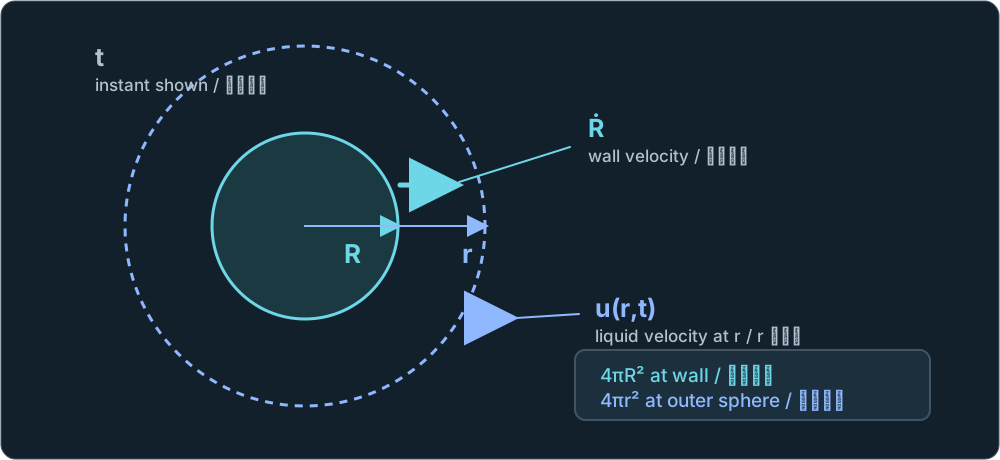
At the wall R, area 4πR² moves at Ṙ. At outer radius r, area 4πr² carries liquid at u(r,t), at the same instant t.
在壁面 R 处,面积 4πR² 以 Ṙ 运动;在外侧半径 r 处,面积 4πr² 的液体速度为 u(r,t),两者对应同一时刻 t。
u(r,t) = (R/r)²Ṙ
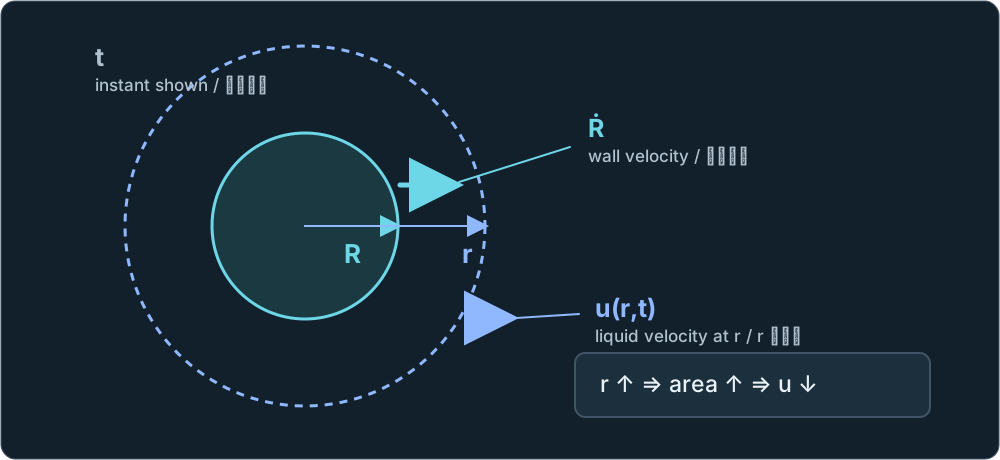
The wall speed Ṙ and outer liquid speed u(r,t) are attached to their concentric surfaces; greater r means lower radial speed.
壁面速度 Ṙ 与外侧液体速度 u(r,t) 分别标在对应球面;r 越大,径向速度越低。
Here u(r,t) is radial liquid velocity. At r = 2R, the spherical area is four times the wall area, so the liquid speed is one quarter of the wall speed. At r = 3R, it is one ninth. During collapse, Ṙ and u are negative: the same formula describes inward flow.
其中 u(r,t) 是液体的径向速度。在 r = 2R 处,球面面积是壁面面积的四倍,因此液体速度是壁面速度的四分之一;在 r = 3R 处则是九分之一。塌缩时,Ṙ 与 u 为负值:同一公式描述向内流动。
The arrows are schematic. The factor of four comes from the area of a sphere increasing with the square of its radius.
箭头仅为示意。速度变为四分之一,是因为球面面积随半径的平方增大。
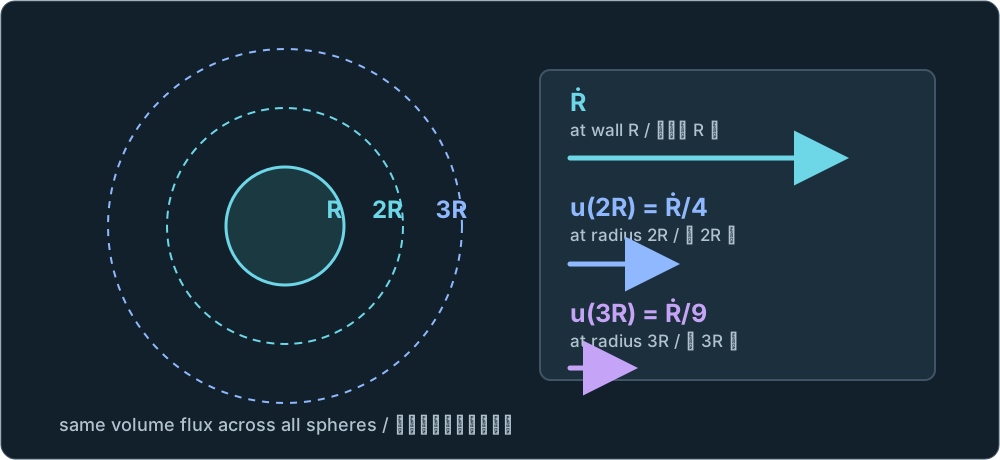
The worked locations 2R and 3R are marked on the liquid spheres, with their velocity ratios beside them.
例题中的 2R 和 3R 标在对应的液体球面上,旁边给出了各处的速度比例。
This inverse-square law is for radial liquid velocity in the stated spherical, incompressible flow. A nearby wall changes the flow geometry; evaporation or condensation changes the interface mass balance. We will use this velocity field to derive the liquid inertia in the next lesson.
这个平方反比规律描述的是上述球对称、不可压缩流动中的液体径向速度。邻近固壁会改变流动几何;蒸发或凝结会改变界面的质量平衡。下一课将用这一速度场推导液体惯性项。
One check
一道检查题
A spherical bubble wall moves outward at 8 m/s. Under this model, what are the speed and direction of the liquid at r = 2R, and why?
一个球形气泡的壁面以 8 m/s 向外运动。在本课模型下,r = 2R 处液体的速度大小和方向是什么?为什么?