Historical lesson/review. Use the complete textbook course for the current study order. Former Chapters 4 and 5 are now Appendixes A and B.
历史课程/复习材料。当前学习顺序请使用完整教材课程。原第四、五章现为附录 A、B。
Our first two lessons began with a bubble already present. That is a different question from inception: where does the initial cavity come from? Even if vapor is favored by the local pressure, creating a new liquid–vapor surface costs energy.
前两课都从已有气泡出发。空化初生讨论的是另一个问题:最初的空腔从何而来?即使局部压力有利于蒸气存在,新建液–汽界面仍需要能量。
The small-embryo barrier
微小胚核的能垒
Consider an idealized spherical vapor embryo of radius r in a clean, isothermal liquid. Define the positive vapor-pressure advantage Δp using the equilibrium vapor pressure pv(T) and surrounding liquid pressure p∞. Classical nucleation theory then gives the reversible work of formation.
考虑洁净、等温液体中一个半径为 r 的理想化球形蒸气胚核。用平衡蒸气压 pv(T) 和周围液体压力 p∞ 定义正的蒸气压优势 Δp。经典成核理论据此给出可逆形成功。
Δp = pv(T) − p∞ > 0
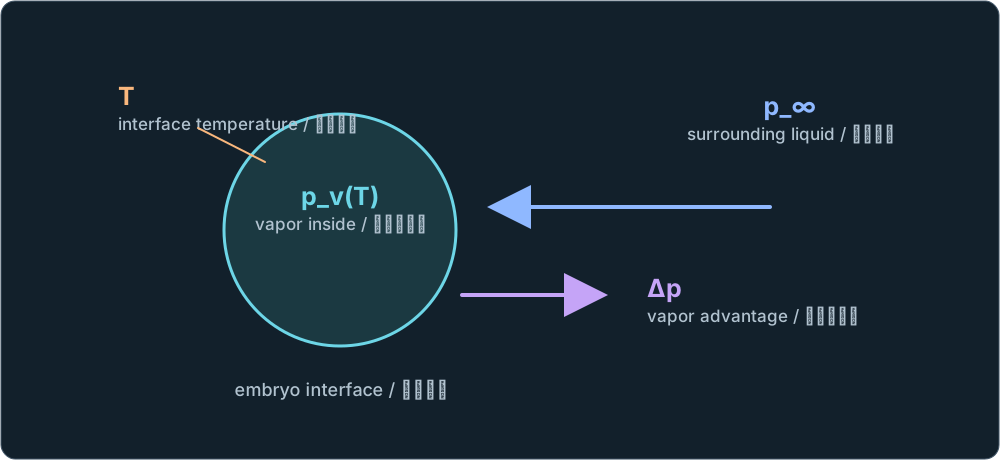
The embryo contains vapor at p_v(T); the surrounding liquid is at p_∞. The pressure advantage Δp spans the interface.
胚核内部蒸气压为 p_v(T),周围液体压力为 p_∞;压差优势 Δp 跨越界面。
ΔG(r) = 4πσr² − (4π/3)Δp r³.
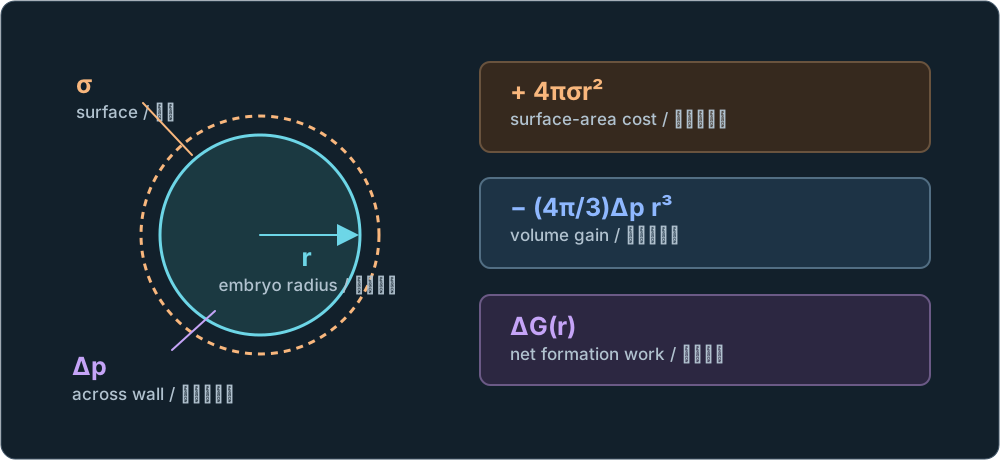
Radius r sets embryo area and volume. σ acts at its surface, Δp across it, and the surface cost minus volume gain gives ΔG(r).
半径 r 决定胚核面积与体积;σ 作用于表面,Δp 跨越界面,表面能代价减去体积能收益得到 ΔG(r)。
The first term is the surface cost and grows as r². The second is the pressure-volume gain and grows as r³. The surface cost dominates a very small embryo; the volume gain can dominate once it becomes large enough.
第一项是表面能代价,随 r² 增长;第二项是压差带来的体积能收益,随 r³ 增长。胚核很小时,表面能代价占主导;胚核足够大时,体积能收益可以占主导。
Qualitative energy landscape for the idealized model. A pre-existing interface or a solid nucleation site changes the pathway and the barrier.
理想化模型的定性能量图景。已有界面或固体成核位点会改变成核路径与能垒。
r* = 2σ/Δp
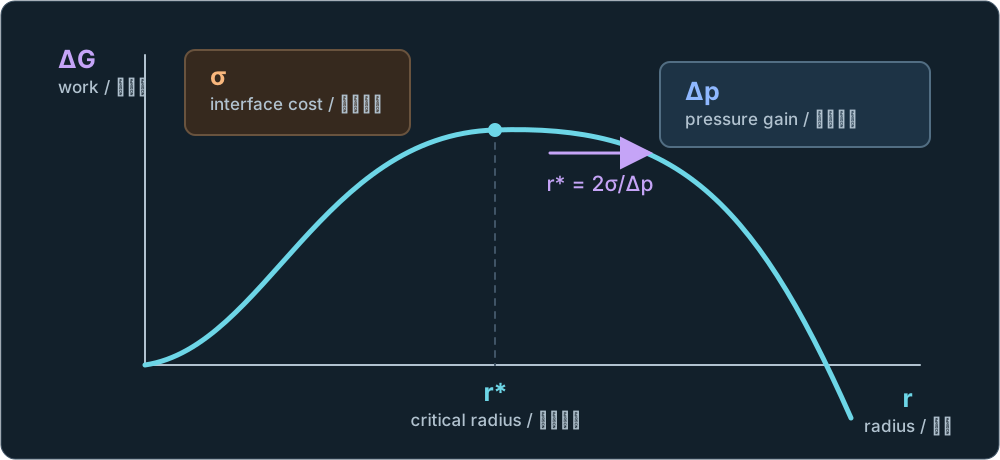
The formation-work curve peaks at r*. The diagram locates ΔG, r, surface tension σ, and pressure advantage Δp.
形成功曲线在 r* 处达到峰值;图中标出了 ΔG、r、表面张力 σ 与压差优势 Δp。
This is the critical radius at the top of the barrier. In this model, an embryo smaller than r* tends to shrink; one larger than r* can grow if the favorable conditions persist. Lowering the surrounding pressure increases Δp and makes r* smaller.
这是能垒顶点处的临界半径。在该模型中,小于 r* 的胚核倾向于缩小;大于 r* 的胚核在有利条件持续时可以生长。降低周围液体压力会增大 Δp,从而减小 r*。
A trapped gas pocket already has an interface, while a particle or wall defect can provide an easier formation path. These cases do not simply use a smaller barrier in the same clean-liquid embryo formula. A very clean sample can still nucleate stochastically; the probability depends on pressure history, observation time, and volume. The equation above is an idealized energy picture, not a universal threshold for a shelled nanodroplet or a laser experiment.
被困气穴本身已有界面,而颗粒或壁面缺陷可能提供更容易的成核路径。这些情形不能简单地用同一个洁净液体胚核公式,只把能垒调低。非常洁净的样品仍可能随机成核;其概率取决于压力历程、观测时间和体积。上式是一幅理想化的能量图景,并非带壳纳米液滴或激光实验的普适阈值。
To see why one empty trial is inconclusive, imagine a constant nucleation rate J per unit volume per unit time in an observation volume V for duration t. An idealized independent-event model gives the probability of at least one event below.
要理解为什么一次未观察到事件的试验不能得出定论,设观测体积为 V、持续时间为 t,单位体积、单位时间的成核率恒为 J。理想化的独立事件模型给出如下至少发生一次事件的概率。
P(≥1) = 1 − exp(−JVt)
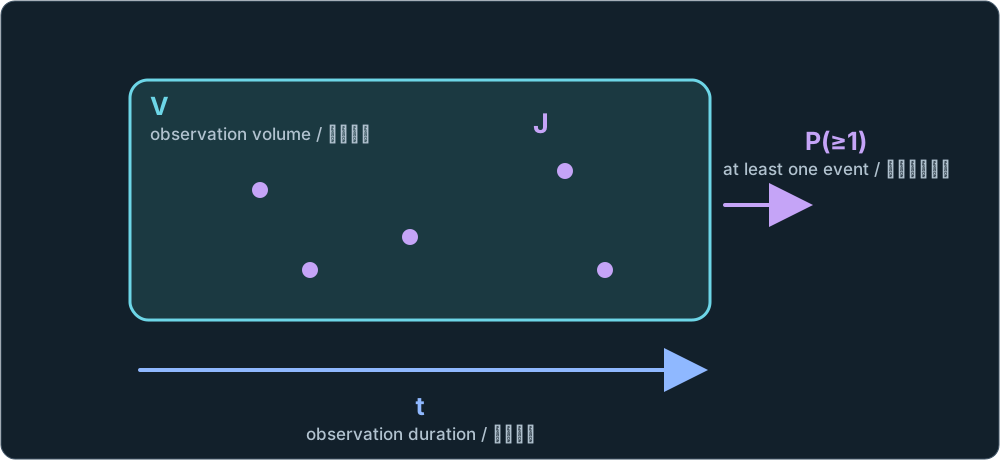
The rate J acts throughout observation volume V during time t; P(≥1) is the chance of one or more events.
成核率 J 在观测体积 V 内、时间 t 中起作用;P(≥1) 是至少发生一次事件的概率。
When J > 0, a finite pulse can still produce zero events. Repeating the experiment estimates an event frequency; a single non-event cannot distinguish a small probability from impossibility.
即使 J > 0,有限时长的脉冲仍可能没有事件。重复实验可以估计事件发生频率;单次未发生事件无法区分低概率与不可能。
One check
一道检查题
Twenty fresh clean samples receive identical short pressure pulses; two show cavitation. What does this say about the claim that the other eighteen were incapable of cavitating under that pulse?
二十份新的洁净样品受到相同的短时压力脉冲,其中两份出现空化。这对“另外十八份样品在该脉冲下不可能发生空化”的说法意味着什么?