Core route · step 17/21 · source T01

主路线 · 第 17/21 步 · 来源 T01

Optical deposition

光能沉积

Source: supplied project-theory book, Stage 1. The complete bilingual chapter follows, with its derivations and qualifications. Textbook source (Markdown) · Original Markdown.

来源:所给项目理论教材阶段 1。下方完整收录双语章节及推导和限定。教材原文(Markdown) · 原始 Markdown。

Keep the source’s evidence states: optical normalization is an accounting check; activation is uncalibrated; R(t) is prescribed; near-wall loading and cohesive release remain conditional.

保留来源证据状态:光学归一化属于核算检查;激活尚未标定;R(t) 为规定输入;近壁加载及黏聚释放仍有条件。

Reader’s orientation

阅读导引

Scope. This English–Chinese edition translates the preceding explanation. It distinguishes the five-stage framework and screening results in the supplied PDF [S1] from the intermediate explanatory derivations. Equations are shared by both languages. Citations use the original source-page numbers; the five original pages are reproduced unchanged in Appendix A.

范围。 本英汉双语版翻译前文的逐步讲解,并区分所提供 PDF [S1] 中的五阶段框架与筛查结果,以及为讲解而补充的中间推导。两种语言共用公式。引文使用原始材料页码,五页原文在附录 A 中原样收录。

For a mechanics graduate, the most useful starting point is to regard a bubble as a moving internal boundary. Its radius is a displacement coordinate, its internal pressure provides a driving force, and the surrounding liquid supplies inertia and viscous resistance.

对于具有力学背景的毕业生,最有用的切入点是把气泡看作一个运动的内部边界。它的半径是一个位移坐标,内部压力提供驱动力,而周围液体提供惯性与黏性阻力。

The difficulty is connecting that familiar mechanics to two additional questions: how the bubble becomes activated, and how its motion causes an interface to separate.

难点在于把这些熟悉的力学概念与另外两个问题连接起来:气泡如何被激活,以及气泡运动如何导致界面分离。

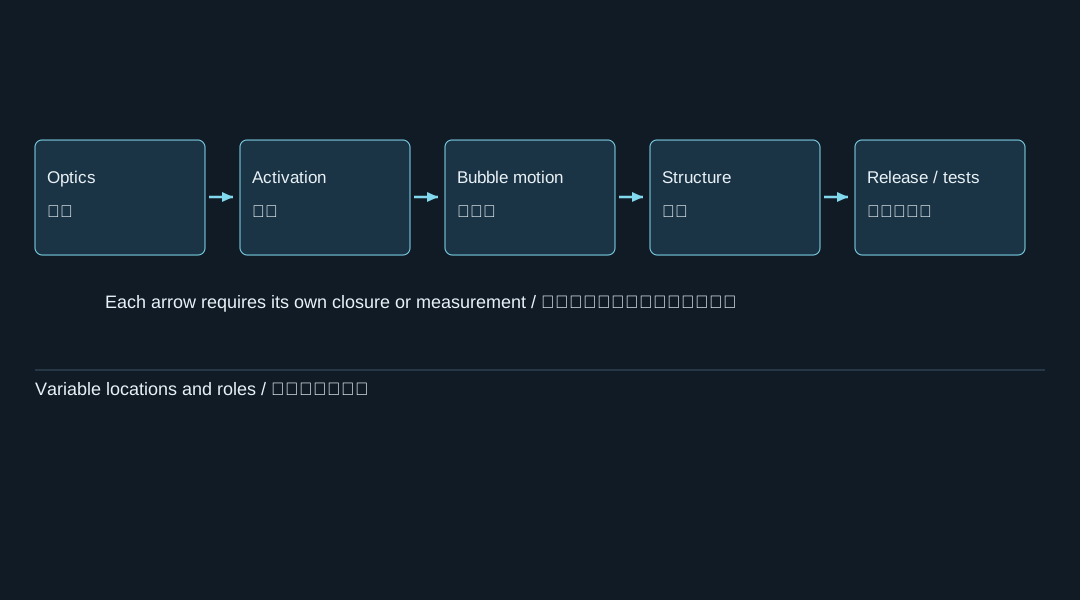
The source organizes this into five stages:

原始材料将这一过程组织为五个阶段:

Optical energy deposition / 光能沉积↓Activation probability / 激活概率↓Bubble motion and pressure / 气泡运动与压力↓Structural response and release / 结构响应与释放↓Sensitivity and measurements / 敏感性与测量\begin{gathered} \text{Optical energy deposition / 光能沉积}\\ \downarrow\\ \text{Activation probability / 激活概率}\\ \downarrow\\ \text{Bubble motion and pressure / 气泡运动与压力}\\ \downarrow\\ \text{Structural response and release / 结构响应与释放}\\ \downarrow\\ \text{Sensitivity and measurements / 敏感性与测量} \end{gathered}
Reader’s orientation / 阅读导引;

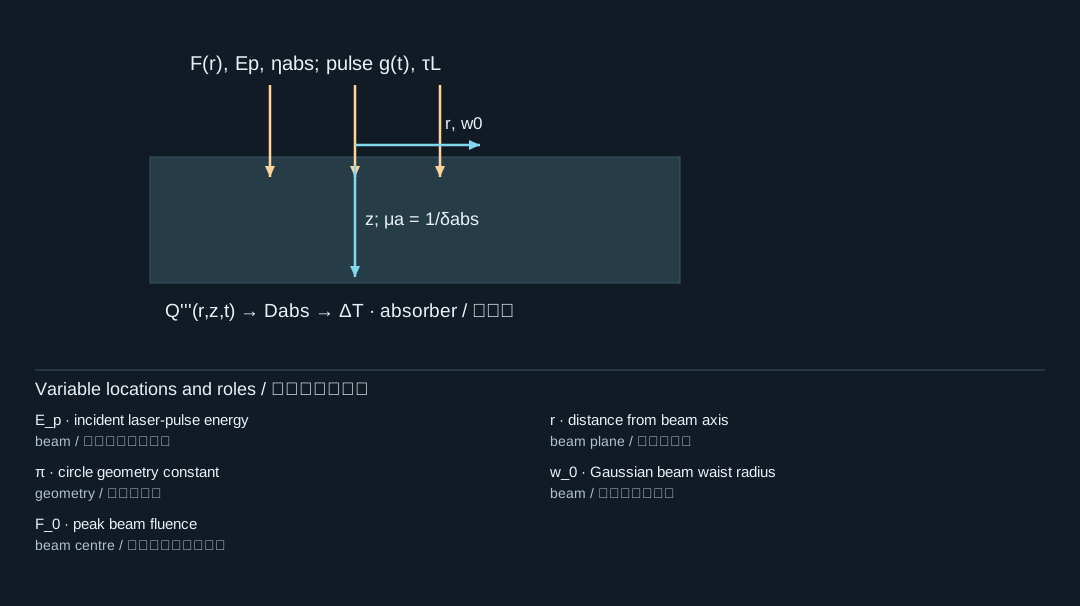
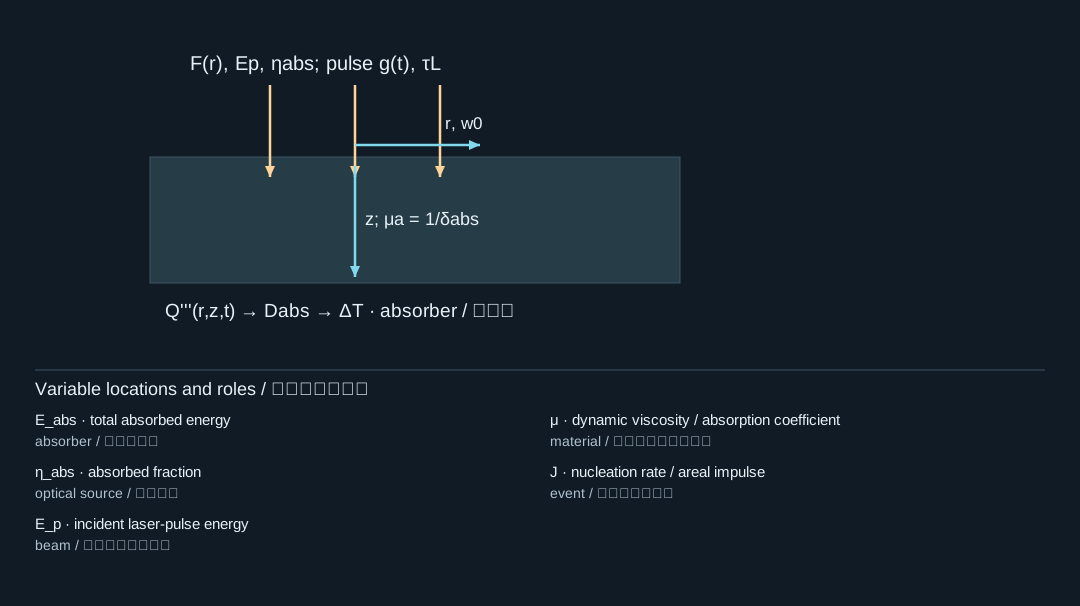
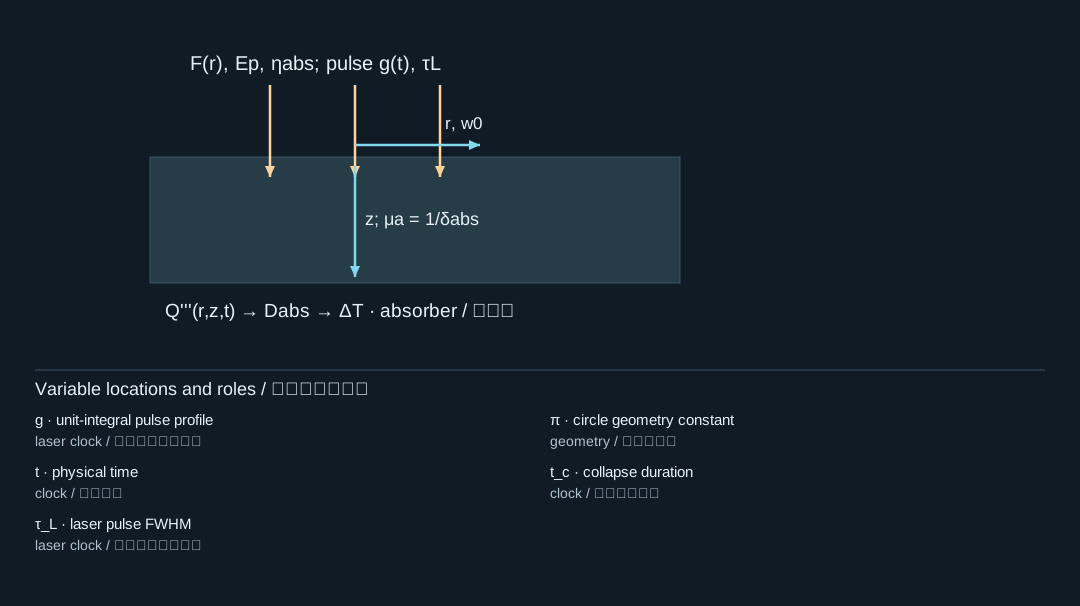
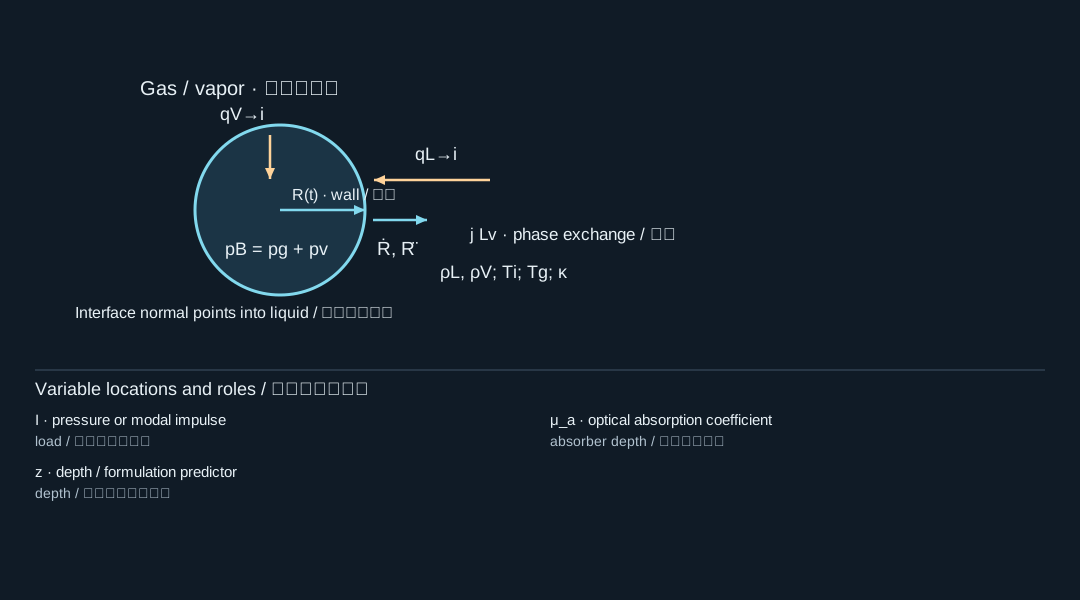
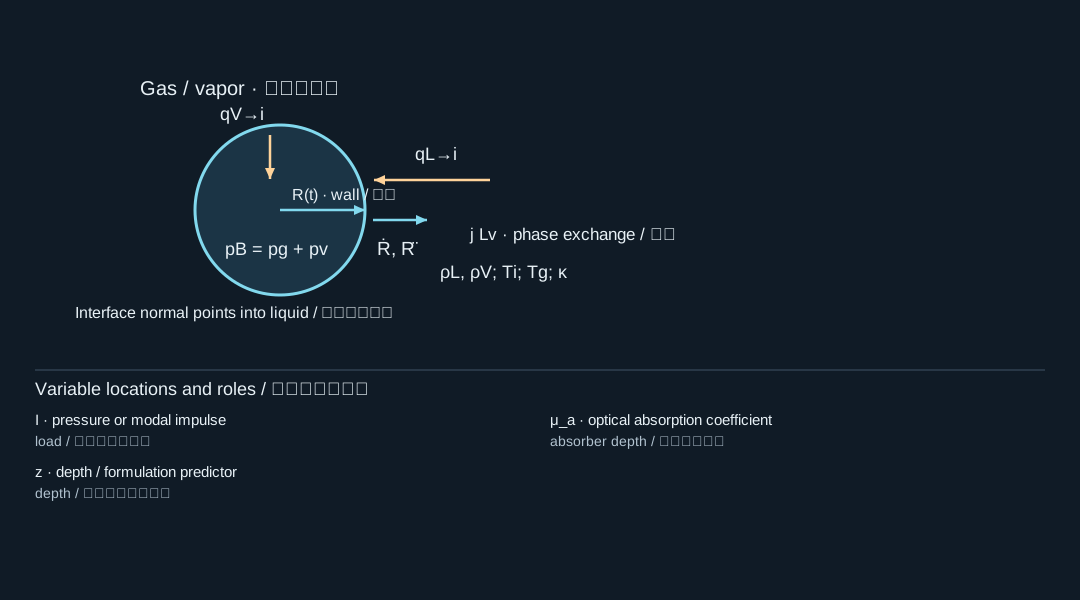
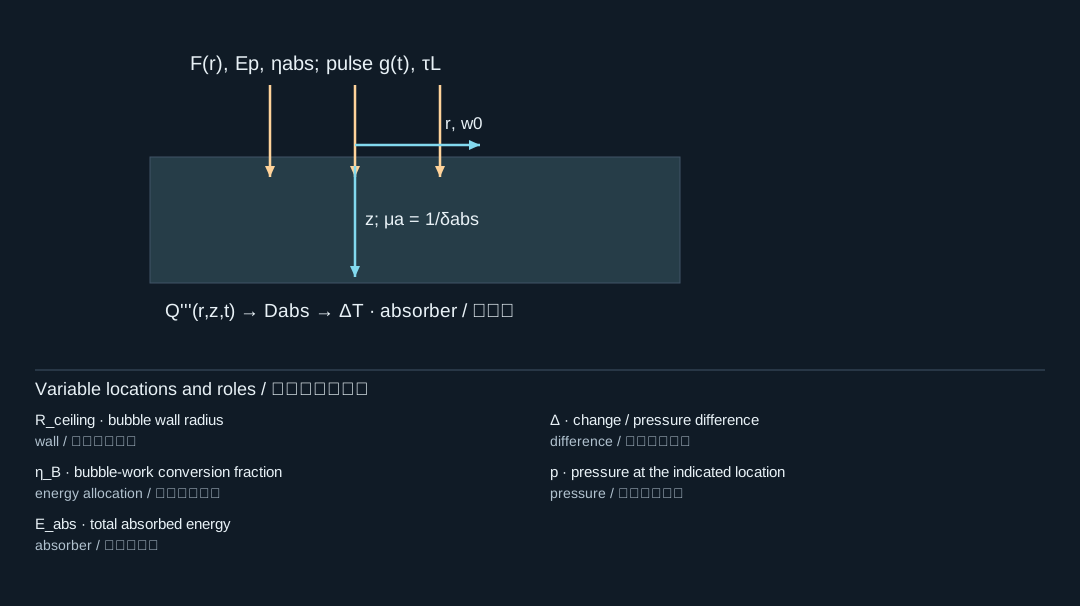
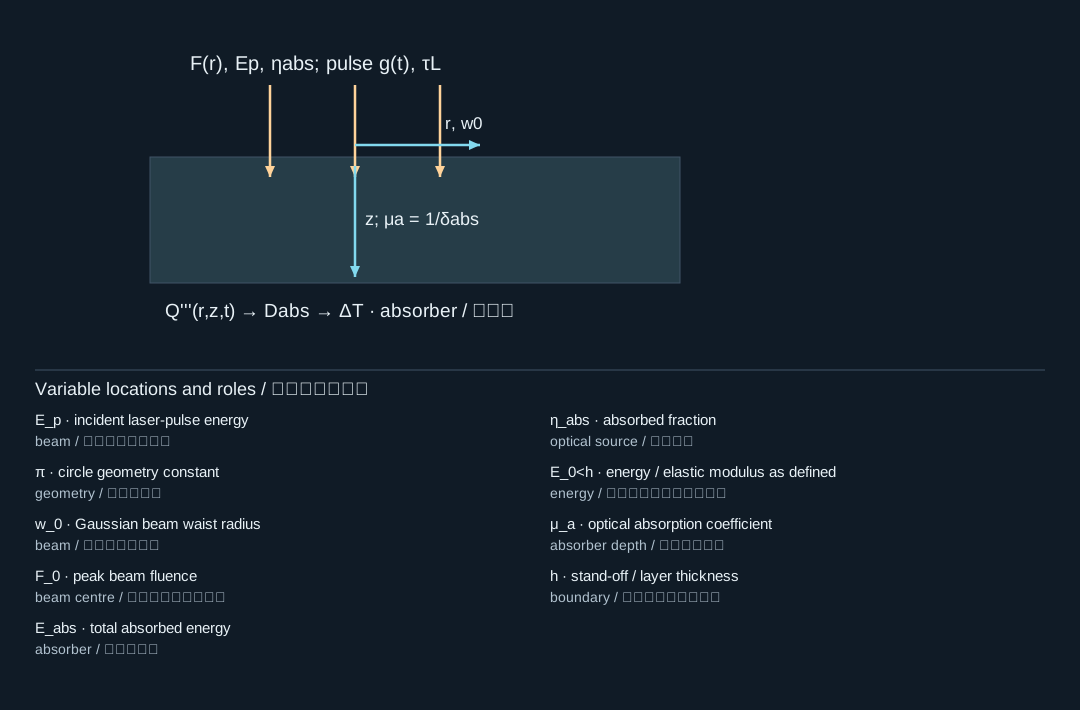
The diagram locates the physical system; its key lists the symbols in the formula. Read the definition in the surrounding derivation when a letter has different roles.

图示标出物理体系,图例列出公式中的符号。若某字母有多种作用,应以邻近推导中的定义为准。

A central distinction in the source is that these stages are not equally established: the optical source is energy-normalized, the activation law is uncalibrated, the bubble trajectory is prescribed, and interface release remains unresolved. We must retain those distinctions while deriving the mathematics. [S1, pp. 1–4]

原始材料中的一个核心区分是:这些阶段的确立程度并不相同。光学源已经过能量归一化;激活规律尚未标定;气泡轨迹是人为规定的;界面释放仍未解决。在进行数学推导时,必须始终保留这些区分。[S1,第1–4页]

Reader’s orientation1. Optical deposition1.1 From beam fluence to total pulse energy1.2 From pulse energy to a time-dependent source1.3 From surface intensity to volumetric heating1.4 Local dose, peak rate, and temperature rise1.5 Why enough energy does not guarantee a bubble

1. Optical deposition

光能沉积

Where does the laser energy go? Corresponding to Theory 01, source page 1.

激光能量去了哪里?对应 Theory 01,原始材料第1页。

The first task is not yet to predict cavitation. It is to construct a heating field whose integral equals the intended absorbed energy.

第一项任务还不是预测空化,而是构造一个热源场,使其积分等于设定的吸收能量。

1.1 From beam fluence to total pulse energy

从光束能量面密度到脉冲总能量

Fluence is the laser energy delivered per unit area during one pulse:

能量面密度(fluence)是单个脉冲期间单位面积接收到的激光能量:
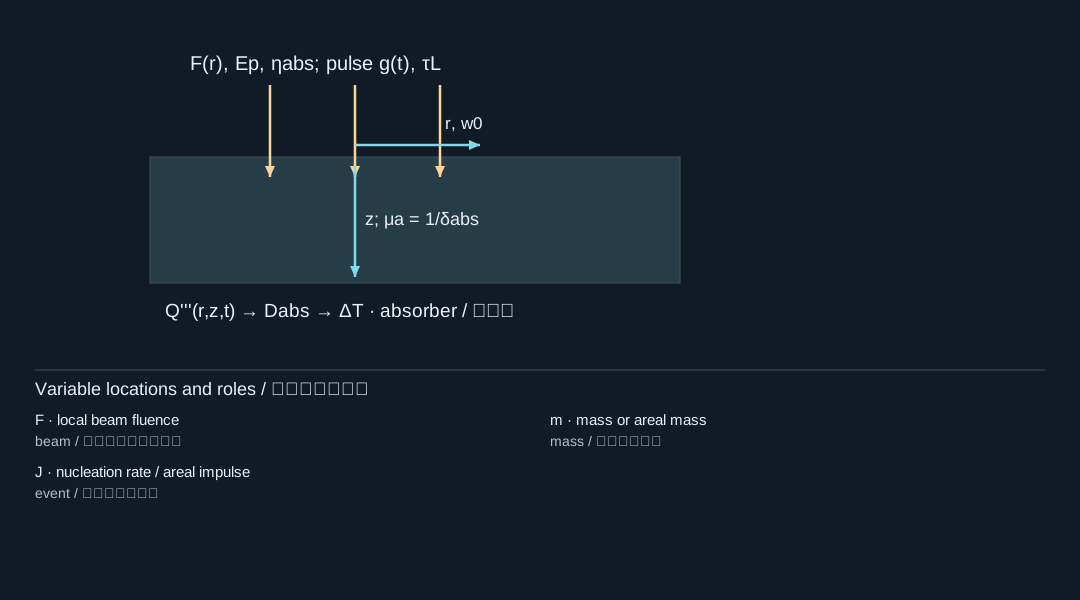
[F]=J m−2.[F]=\mathrm{J\,m^{-2}}.
1.1 From beam fluence to total pulse energy / 从光束能量面密度到脉冲总能量; F: local beam fluence; J: nucleation rate / areal impulse; m: mass or areal mass

The diagram locates the physical system; its key lists the symbols in the formula. Read the definition in the surrounding derivation when a letter has different roles.

图示标出物理体系,图例列出公式中的符号。若某字母有多种作用,应以邻近推导中的定义为准。

It is different from intensity, which is power per unit area:

它不同于光强,后者是单位面积上的功率:
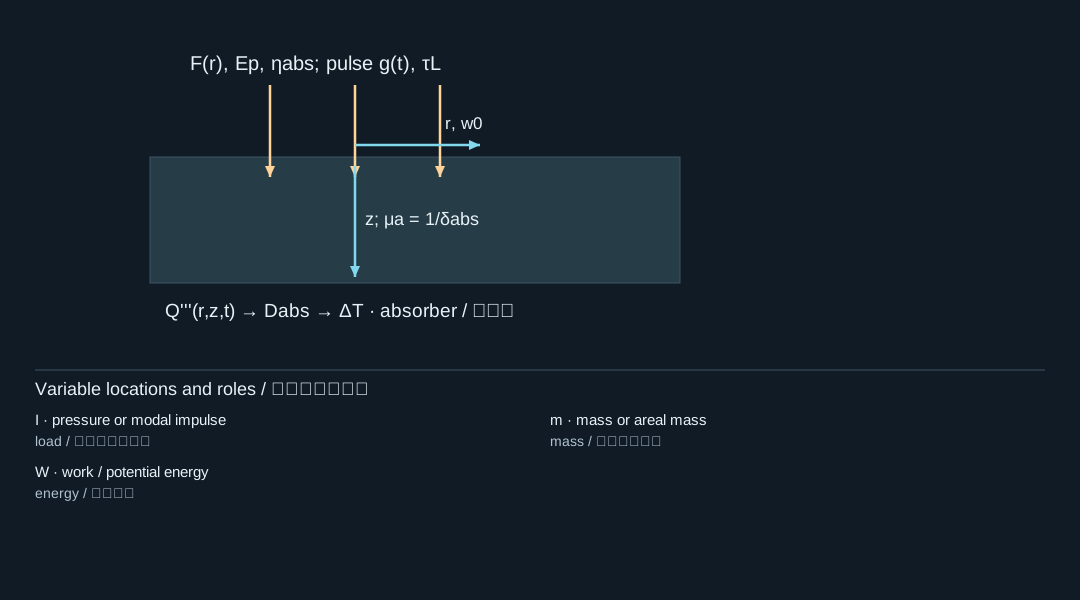
[I]=W m−2.[I]=\mathrm{W\,m^{-2}}.
1.1 From beam fluence to total pulse energy / 从光束能量面密度到脉冲总能量; I: pressure or modal impulse; W: work / potential energy; m: mass or areal mass

The diagram locates the physical system; its key lists the symbols in the formula. Read the definition in the surrounding derivation when a letter has different roles.

图示标出物理体系,图例列出公式中的符号。若某字母有多种作用,应以邻近推导中的定义为准。

The source assumes an axisymmetric Gaussian fluence profile,

原始材料假设能量面密度具有轴对称高斯分布:
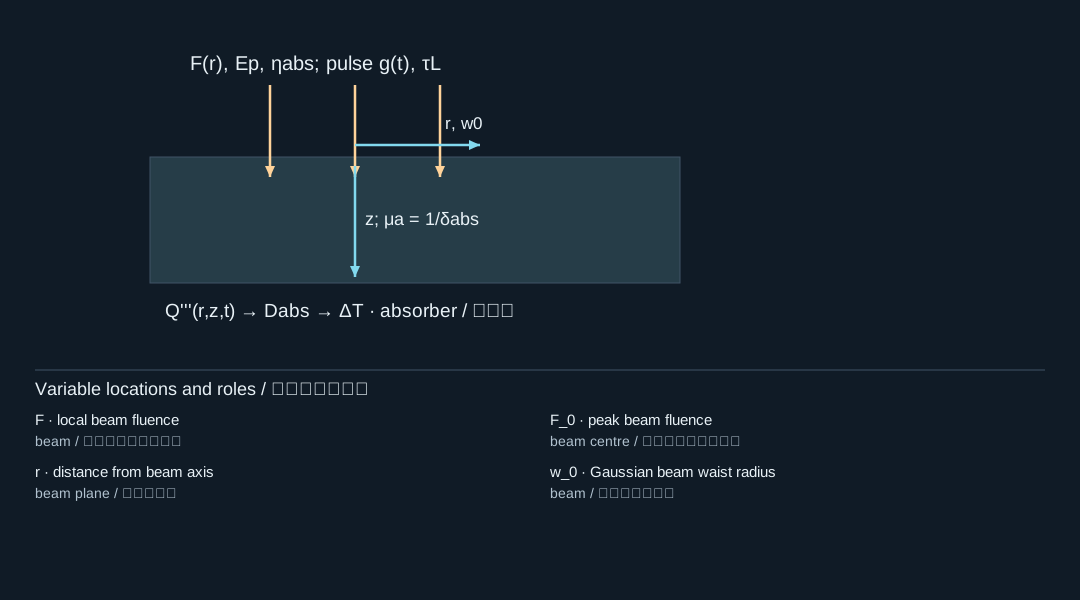
F(r)=F0exp⁡(−2r2w02),F(r)=F_0\exp\left(-\frac{2r^2}{w_0^2}\right),
1.1 From beam fluence to total pulse energy / 从光束能量面密度到脉冲总能量; F: local beam fluence; r: distance from beam axis; F_0: peak beam fluence; w_0: Gaussian beam waist radius

The diagram locates the physical system; its key lists the symbols in the formula. Read the definition in the surrounding derivation when a letter has different roles.

图示标出物理体系,图例列出公式中的符号。若某字母有多种作用,应以邻近推导中的定义为准。

where F0F_0 is the on-axis fluence and w0w_0 is the radius at which the fluence has fallen to F0e−2F_0e^{-2}. The total pulse energy is the area integral. An annular element has area dA=2πr drdA=2\pi r\,dr, so

其中,F0F_0 是轴线上能量面密度,w0w_0 是能量面密度下降至 F0e−2F_0e^{-2} 时的半径。脉冲总能量由面积积分得到。环形微元的面积为 dA=2πr drdA=2\pi r\,dr,因此

Ep=2πF0∫0∞rexp⁡(−2r2w02) dr.E_p=2\pi F_0\int_0^\infty r\exp\left(-\frac{2r^2}{w_0^2}\right)\,dr.
1.1 From beam fluence to total pulse energy / 从光束能量面密度到脉冲总能量; E_p: incident laser-pulse energy; π: circle geometry constant; F_0: peak beam fluence; r: distance from beam axis; w_0: Gaussian beam waist radius

The diagram locates the physical system; its key lists the symbols in the formula. Read the definition in the surrounding derivation when a letter has different roles.

图示标出物理体系,图例列出公式中的符号。若某字母有多种作用,应以邻近推导中的定义为准。

Set

令
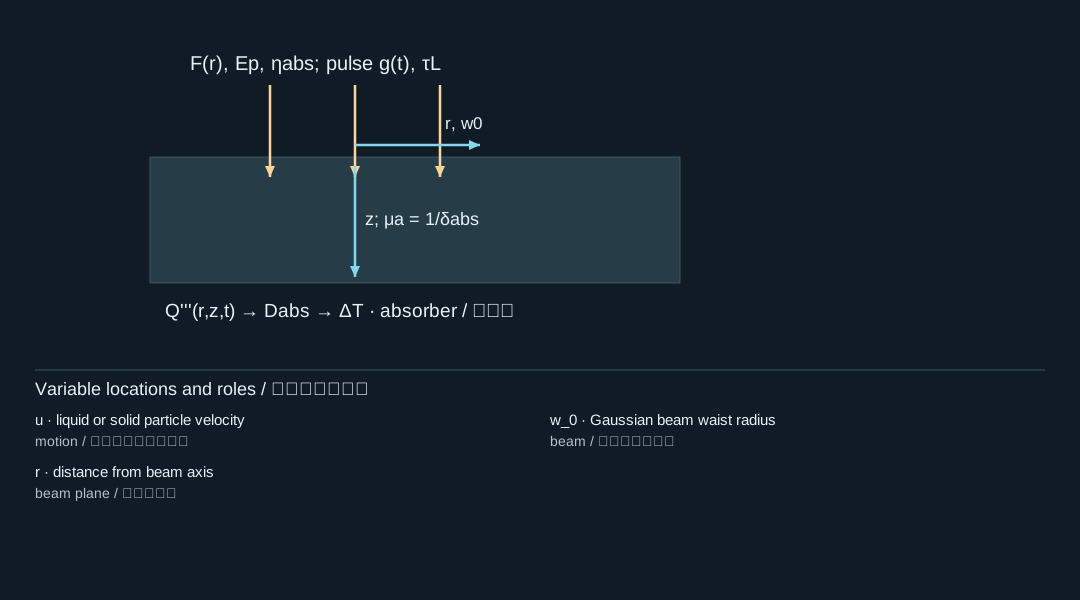
u=2r2w02,r dr=w024 du.u=\frac{2r^2}{w_0^2},\qquad r\,dr=\frac{w_0^2}{4}\,du.
1.1 From beam fluence to total pulse energy / 从光束能量面密度到脉冲总能量; u: liquid or solid particle velocity; r: distance from beam axis; w_0: Gaussian beam waist radius

The diagram locates the physical system; its key lists the symbols in the formula. Read the definition in the surrounding derivation when a letter has different roles.

图示标出物理体系,图例列出公式中的符号。若某字母有多种作用,应以邻近推导中的定义为准。

Then

于是
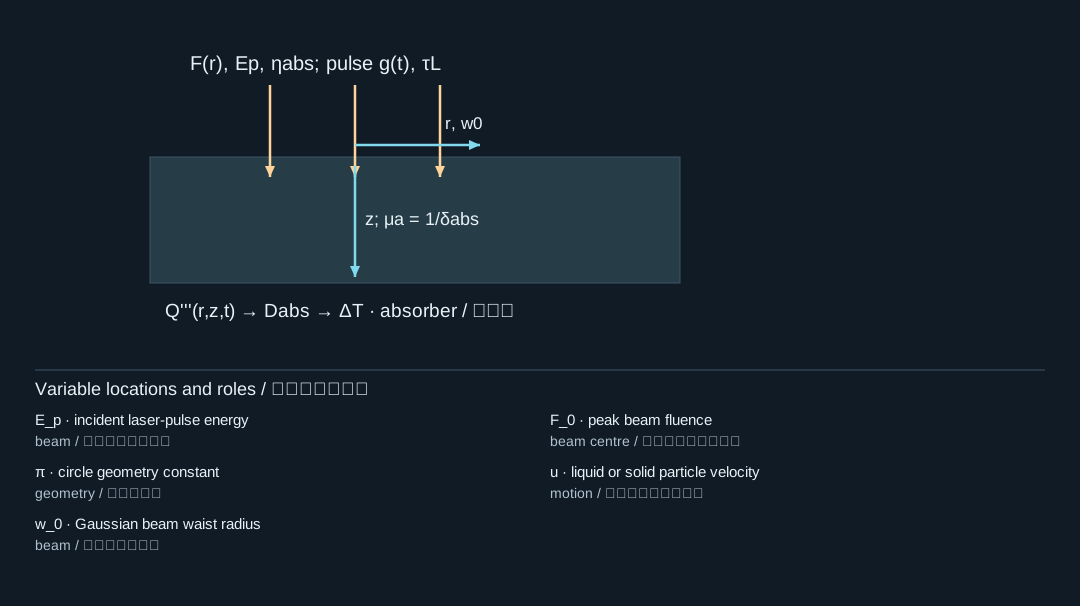
Ep=πw02F02∫0∞e−u du,E_p=\frac{\pi w_0^2F_0}{2}\int_0^\infty e^{-u}\,du,
1.1 From beam fluence to total pulse energy / 从光束能量面密度到脉冲总能量; E_p: incident laser-pulse energy; π: circle geometry constant; w_0: Gaussian beam waist radius; F_0: peak beam fluence; u: liquid or solid particle velocity

The diagram locates the physical system; its key lists the symbols in the formula. Read the definition in the surrounding derivation when a letter has different roles.

图示标出物理体系,图例列出公式中的符号。若某字母有多种作用,应以邻近推导中的定义为准。

which gives

得到
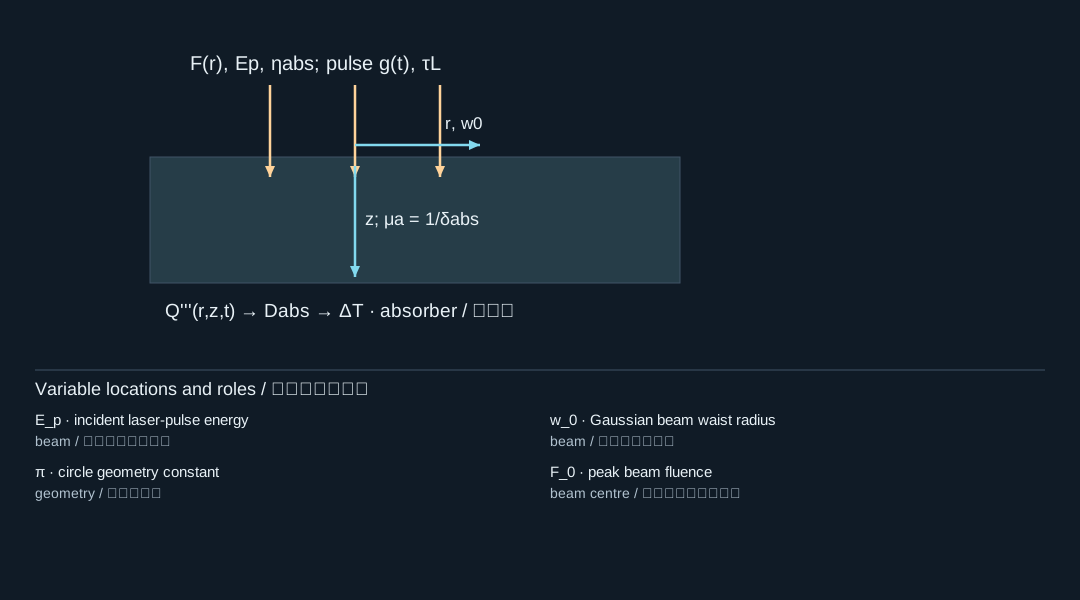
Ep=πw02F02.\boxed{E_p=\frac{\pi w_0^2F_0}{2}}.
1.1 From beam fluence to total pulse energy / 从光束能量面密度到脉冲总能量; E_p: incident laser-pulse energy; π: circle geometry constant; w_0: Gaussian beam waist radius; F_0: peak beam fluence

The diagram locates the physical system; its key lists the symbols in the formula. Read the definition in the surrounding derivation when a letter has different roles.

图示标出物理体系,图例列出公式中的符号。若某字母有多种作用,应以邻近推导中的定义为准。

This explains the factor 1/21/2: the beam is Gaussian, not a uniformly illuminated disk. This is the spatial normalization used in the source. [S1, p. 1]

这就解释了系数 1/21/2 的来源:光束是高斯分布,而不是均匀照明的圆盘。这正是原始材料采用的空间归一化关系。[S1,第1页]

For the reference inputs,

代入参考输入:
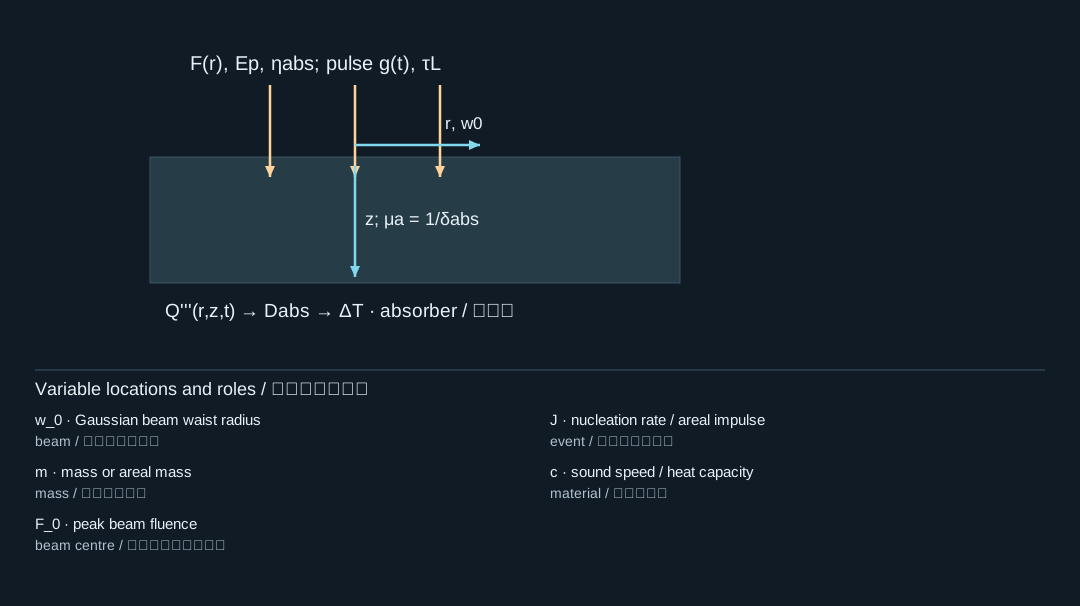
w0=25×10−6 m,F0=0.10 J cm−2=1000 J m−2,w_0=25\times10^{-6}\ \mathrm m,\qquad F_0=0.10\ \mathrm{J\,cm^{-2}}=1000\ \mathrm{J\,m^{-2}},
1.1 From beam fluence to total pulse energy / 从光束能量面密度到脉冲总能量; w_0: Gaussian beam waist radius; m: mass or areal mass; F_0: peak beam fluence; J: nucleation rate / areal impulse; c: sound speed / heat capacity

The diagram locates the physical system; its key lists the symbols in the formula. Read the definition in the surrounding derivation when a letter has different roles.

图示标出物理体系,图例列出公式中的符号。若某字母有多种作用,应以邻近推导中的定义为准。

we obtain

可得
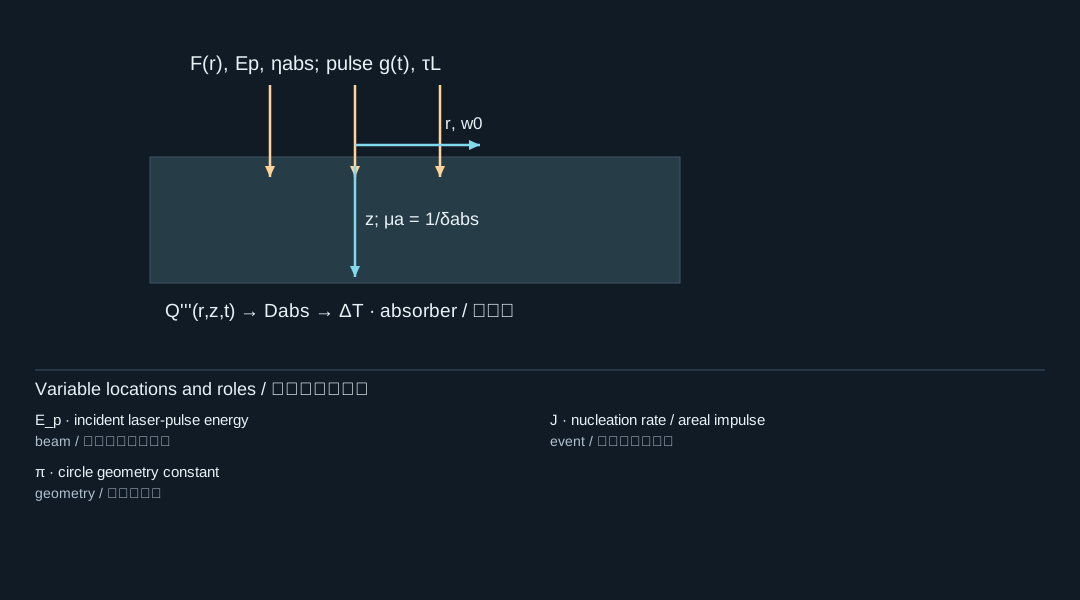
Ep=π(25×10−6)2(1000)2=9.8175×10⁻⁷ J.E_p=\frac{\pi(25\times10^{-6})^2(1000)}{2}=9.8175\times10^{-7}\ \mathrm J.
1.1 From beam fluence to total pulse energy / 从光束能量面密度到脉冲总能量; E_p: incident laser-pulse energy; π: circle geometry constant; J: nucleation rate / areal impulse

The diagram locates the physical system; its key lists the symbols in the formula. Read the definition in the surrounding derivation when a letter has different roles.

图示标出物理体系,图例列出公式中的符号。若某字母有多种作用,应以邻近推导中的定义为准。

Thus,

因此
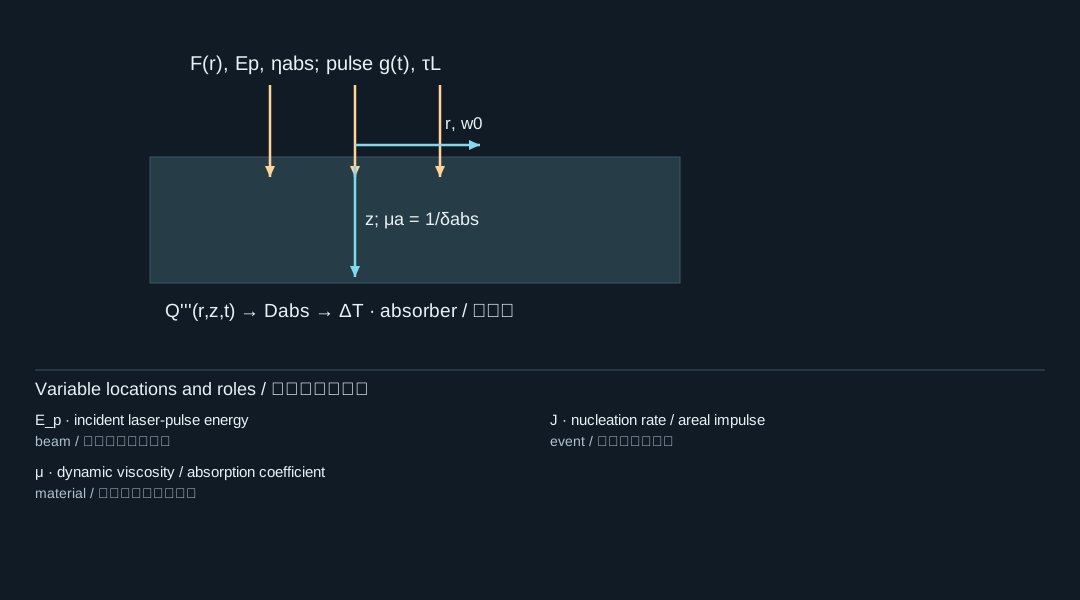
Ep=0.98175 μJ.\boxed{E_p=0.98175\ \mu\mathrm J}.
1.1 From beam fluence to total pulse energy / 从光束能量面密度到脉冲总能量; E_p: incident laser-pulse energy; μ: dynamic viscosity / absorption coefficient; J: nucleation rate / areal impulse

The diagram locates the physical system; its key lists the symbols in the formula. Read the definition in the surrounding derivation when a letter has different roles.

图示标出物理体系,图例列出公式中的符号。若某字母有多种作用,应以邻近推导中的定义为准。

With the assumed absorbed fraction ηabs=0.30\eta_{\mathrm{abs}}=0.30,

采用假设的吸收比例 ηabs=0.30\eta_{\mathrm{abs}}=0.30,得到

Eabs=ηabsEp=0.29452 μJ.\boxed{E_{\mathrm{abs}}=\eta_{\mathrm{abs}}E_p=0.29452\ \mu\mathrm J}.
1.1 From beam fluence to total pulse energy / 从光束能量面密度到脉冲总能量; E_abs: total absorbed energy; η_abs: absorbed fraction; E_p: incident laser-pulse energy; μ: dynamic viscosity / absorption coefficient; J: nucleation rate / areal impulse

The diagram locates the physical system; its key lists the symbols in the formula. Read the definition in the surrounding derivation when a letter has different roles.

图示标出物理体系,图例列出公式中的符号。若某字母有多种作用,应以邻近推导中的定义为准。

These reproduce the reference energy values in the document. They are scenario calculations, not a measured cavitation threshold. [S1, p. 5]

这些结果复现了原始材料中的参考能量值。它们属于情景计算结果,并非实测空化阈值。[S1,第5页]

1.2 From pulse energy to a time-dependent source

从脉冲能量到时变热源

We now distribute that energy over time. Write

现在将这部分能量沿时间分配,写成
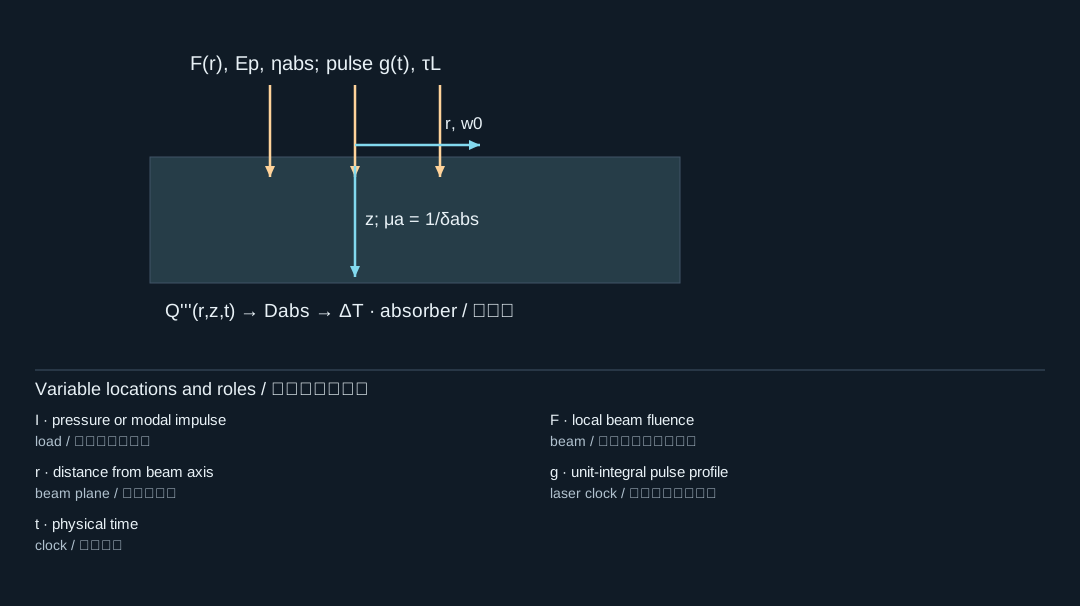
I(r,t)=F(r)g(t),I(r,t)=F(r)g(t),
1.2 From pulse energy to a time-dependent source / 从脉冲能量到时变热源; I: pressure or modal impulse; r: distance from beam axis; t: physical time; F: local beam fluence; g: unit-integral pulse profile

The diagram locates the physical system; its key lists the symbols in the formula. Read the definition in the surrounding derivation when a letter has different roles.

图示标出物理体系,图例列出公式中的符号。若某字母有多种作用,应以邻近推导中的定义为准。

and require

并要求
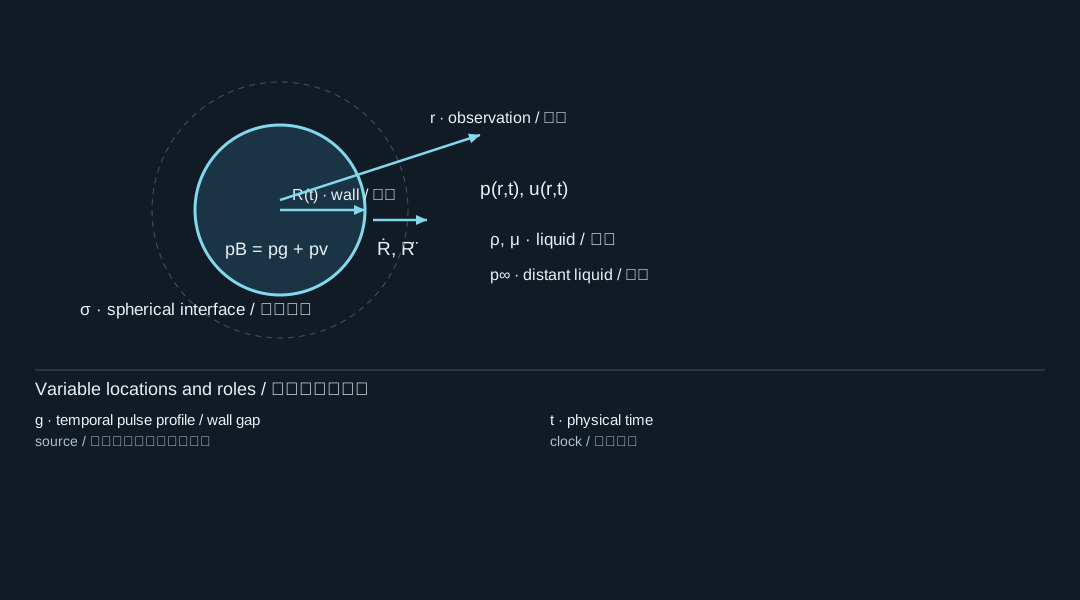
∫−∞∞g(t) dt=1.\int_{-\infty}^{\infty}g(t)\,dt=1.
1.2 From pulse energy to a time-dependent source / 从脉冲能量到时变热源; g: temporal pulse profile / wall gap; t: physical time

The diagram locates the physical system; its key lists the symbols in the formula. Read the definition in the surrounding derivation when a letter has different roles.

图示标出物理体系,图例列出公式中的符号。若某字母有多种作用,应以邻近推导中的定义为准。

This ensures that integrating intensity over the pulse recovers fluence:

这样就保证了对整个脉冲的光强进行时间积分,可以恢复能量面密度:
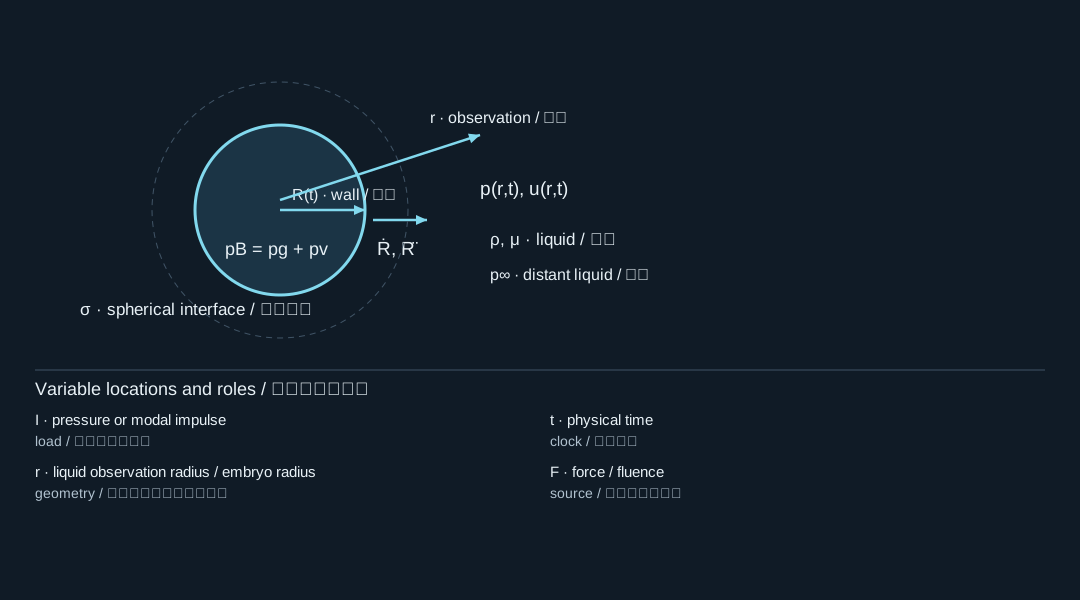
∫−∞∞I(r,t) dt=F(r).\int_{-\infty}^{\infty}I(r,t)\,dt=F(r).
1.2 From pulse energy to a time-dependent source / 从脉冲能量到时变热源; I: pressure or modal impulse; r: liquid observation radius / embryo radius; t: physical time; F: force / fluence

The diagram locates the physical system; its key lists the symbols in the formula. Read the definition in the surrounding derivation when a letter has different roles.

图示标出物理体系,图例列出公式中的符号。若某字母有多种作用,应以邻近推导中的定义为准。

For a Gaussian pulse with full width at half maximum τL\tau_L, the normalized function shown in the slide is

对于半高全宽为 τL\tau_L 的高斯脉冲,原始页面给出的归一化函数为

g(t)=1τL4ln⁡2πexp⁡[−4ln⁡2(t−tcτL)2].\boxed{g(t)=\frac{1}{\tau_L}\sqrt{\frac{4\ln2}{\pi}}\exp\left[-4\ln2\left(\frac{t-t_c}{\tau_L}\right)^2\right]}.
1.2 From pulse energy to a time-dependent source / 从脉冲能量到时变热源; g: unit-integral pulse profile; t: physical time; τ_L: laser pulse FWHM; π: circle geometry constant; t_c: collapse duration

The diagram locates the physical system; its key lists the symbols in the formula. Read the definition in the surrounding derivation when a letter has different roles.

图示标出物理体系,图例列出公式中的符号。若某字母有多种作用,应以邻近推导中的定义为准。

Why this expression? At t=tc±τL/2t=t_c\pm\tau_L/2, the exponential becomes e−ln⁡2=1/2e^{-\ln2}=1/2, establishing the specified full width. The prefactor follows from the Gaussian integral and makes the total integral unity.

为什么是这个表达式?在 t=tc±τL/2t=t_c\pm\tau_L/2 时,指数项变为 e−ln⁡2=1/2e^{-\ln2}=1/2,因此满足指定的半高全宽。前面的系数由高斯积分得到,使总积分等于1。

Notice that

注意
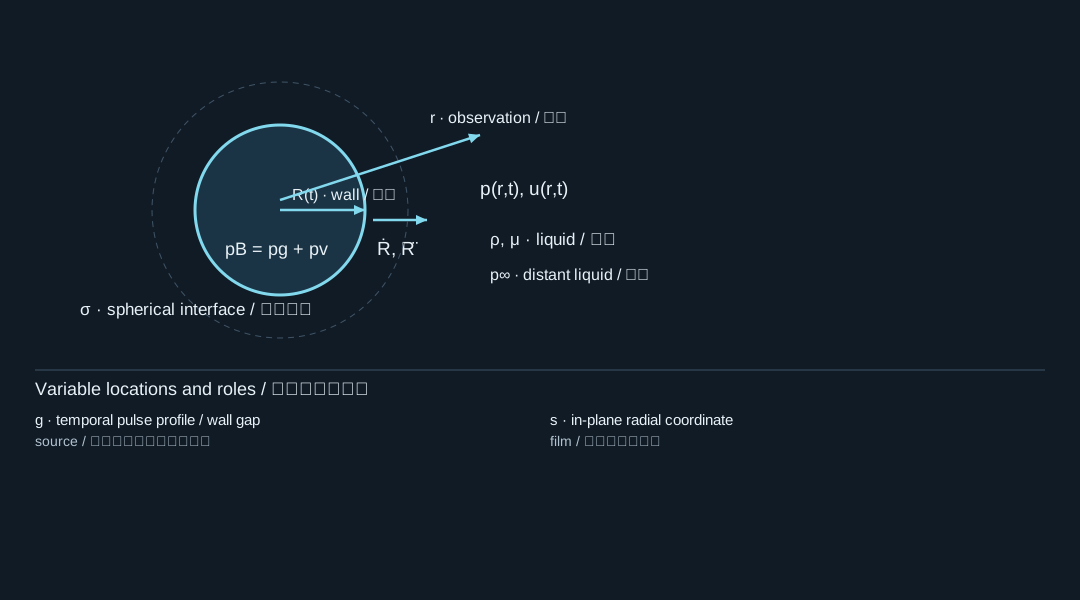
[g]=s−1.[g]=\mathrm{s^{-1}}.
1.2 From pulse energy to a time-dependent source / 从脉冲能量到时变热源; g: temporal pulse profile / wall gap; s: in-plane radial coordinate

The diagram locates the physical system; its key lists the symbols in the formula. Read the definition in the surrounding derivation when a letter has different roles.

图示标出物理体系,图例列出公式中的符号。若某字母有多种作用,应以邻近推导中的定义为准。

Therefore FgFg has units of intensity rather than energy density.

因此,FgFg 的单位是光强的单位,而不是能量密度的单位。

1.3 From surface intensity to volumetric heating

从表面光强到体积热源

Let zz measure depth into the absorbing material. The Beer–Lambert assumption is

以 zz 表示进入吸收材料内部的深度。Beer–Lambert 假设为

∂I∂z=−μaI,\frac{\partial I}{\partial z}=-\mu_a I,
1.3 From surface intensity to volumetric heating / 从表面光强到体积热源; I: pressure or modal impulse; z: depth / formulation predictor; μ_a: optical absorption coefficient

The diagram locates the physical system; its key lists the symbols in the formula. Read the definition in the surrounding derivation when a letter has different roles.

图示标出物理体系,图例列出公式中的符号。若某字母有多种作用,应以邻近推导中的定义为准。

where μa\mu_a is an absorption coefficient with units m−1\mathrm{m^{-1}}. Solving gives

其中,μa\mu_a 是吸收系数,单位为 m−1\mathrm{m^{-1}}。求解可得

I(z)=I(0)e−μaz.I(z)=I(0)e^{-\mu_a z}.
1.3 From surface intensity to volumetric heating / 从表面光强到体积热源; I: pressure or modal impulse; z: depth / formulation predictor; μ_a: optical absorption coefficient

The diagram locates the physical system; its key lists the symbols in the formula. Read the definition in the surrounding derivation when a letter has different roles.

图示标出物理体系,图例列出公式中的符号。若某字母有多种作用,应以邻近推导中的定义为准。

The optical power removed from the beam per unit volume is

单位体积内从光束中吸收的光功率为
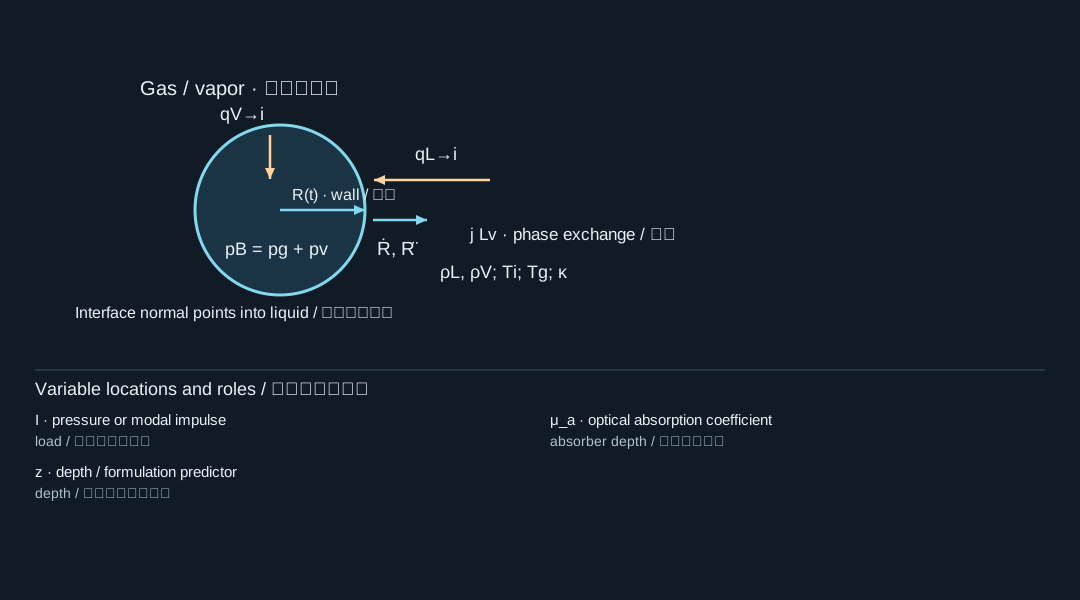
−∂I∂z=μaI(0)e−μaz.-\frac{\partial I}{\partial z}=\mu_a I(0)e^{-\mu_a z}.
1.3 From surface intensity to volumetric heating / 从表面光强到体积热源; I: pressure or modal impulse; z: depth / formulation predictor; μ_a: optical absorption coefficient

The diagram locates the physical system; its key lists the symbols in the formula. Read the definition in the surrounding derivation when a letter has different roles.

图示标出物理体系,图例列出公式中的符号。若某字母有多种作用,应以邻近推导中的定义为准。

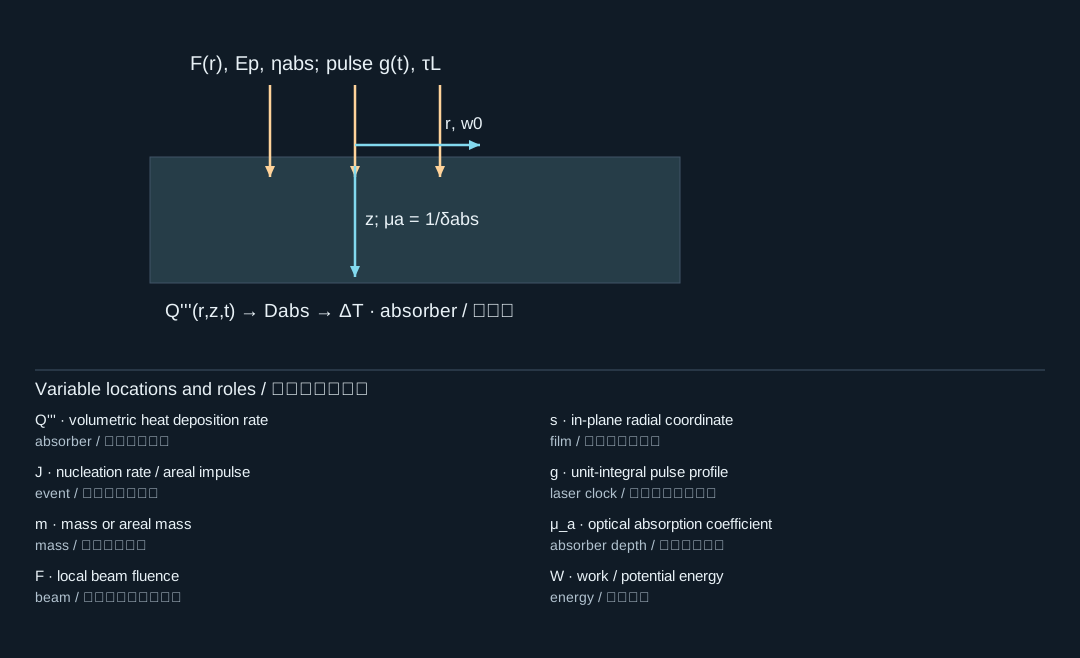
Combining spatial, temporal, and depth dependence produces the source’s heating field:

将空间分布、时间分布和深度衰减结合起来,得到原始材料采用的热源场:
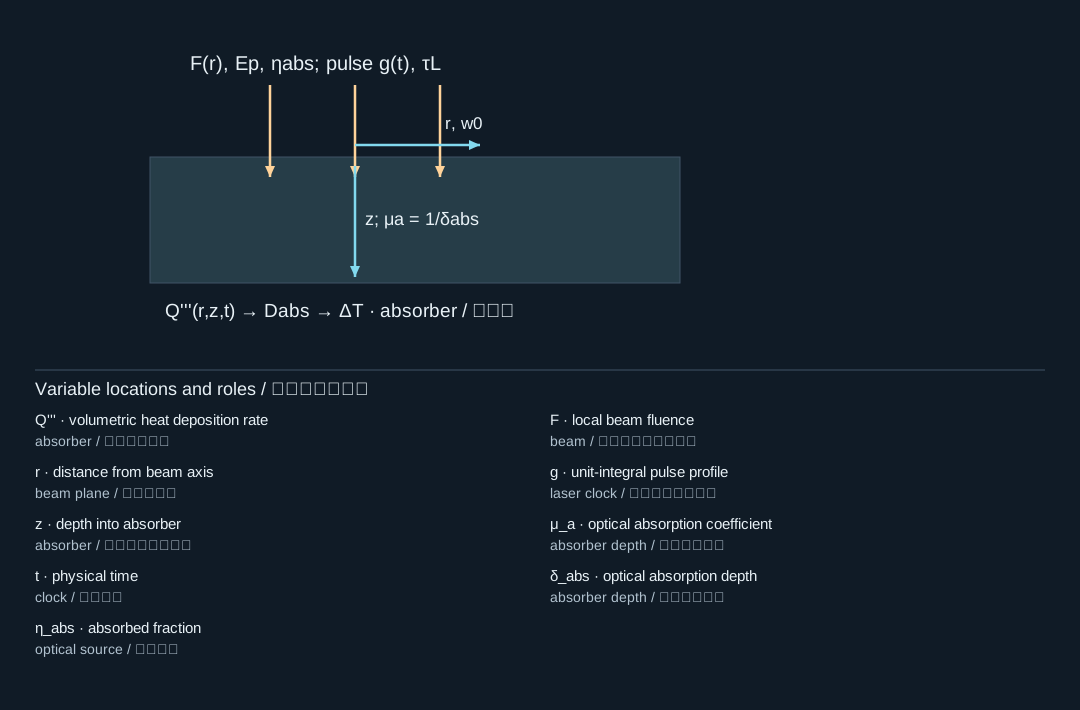
Q′′′(r,z,t)=ηabsF(r)g(t)μae−μaz,μa=1δabs.\boxed{Q'''(r,z,t)=\eta_{\mathrm{abs}}F(r)g(t)\mu_a e^{-\mu_a z}},\qquad \mu_a=\frac{1}{\delta_{\mathrm{abs}}}.
1.3 From surface intensity to volumetric heating / 从表面光强到体积热源; Q''': volumetric heat deposition rate; r: distance from beam axis; z: depth into absorber; t: physical time; η_abs: absorbed fraction; F: local beam fluence; g: unit-integral pulse profile; μ_a: optical absorption coefficient; δ_abs: optical absorption depth

The diagram locates the physical system; its key lists the symbols in the formula. Read the definition in the surrounding derivation when a letter has different roles.

图示标出物理体系,图例列出公式中的符号。若某字母有多种作用,应以邻近推导中的定义为准。

Here Q′′′Q''' is volumetric heating power:

这里的 Q′′′Q''' 是单位体积发热功率:

[Q′′′]=J m−2⏟Fs−1⏟gm−1⏟μa=W m−3.[Q''']=\underbrace{\mathrm{J\,m^{-2}}}_{F}\underbrace{\mathrm{s^{-1}}}_{g}\underbrace{\mathrm{m^{-1}}}_{\mu_a}=\mathrm{W\,m^{-3}}.
1.3 From surface intensity to volumetric heating / 从表面光强到体积热源; Q''': volumetric heat deposition rate; J: nucleation rate / areal impulse; m: mass or areal mass; F: local beam fluence; s: in-plane radial coordinate; g: unit-integral pulse profile; μ_a: optical absorption coefficient; W: work / potential energy

The diagram locates the physical system; its key lists the symbols in the formula. Read the definition in the surrounding derivation when a letter has different roles.

图示标出物理体系,图例列出公式中的符号。若某字母有多种作用,应以邻近推导中的定义为准。

For the infinite lateral plane and semi-infinite depth used in this normalization,

在该归一化所采用的横向无限平面与半无限深度范围内,
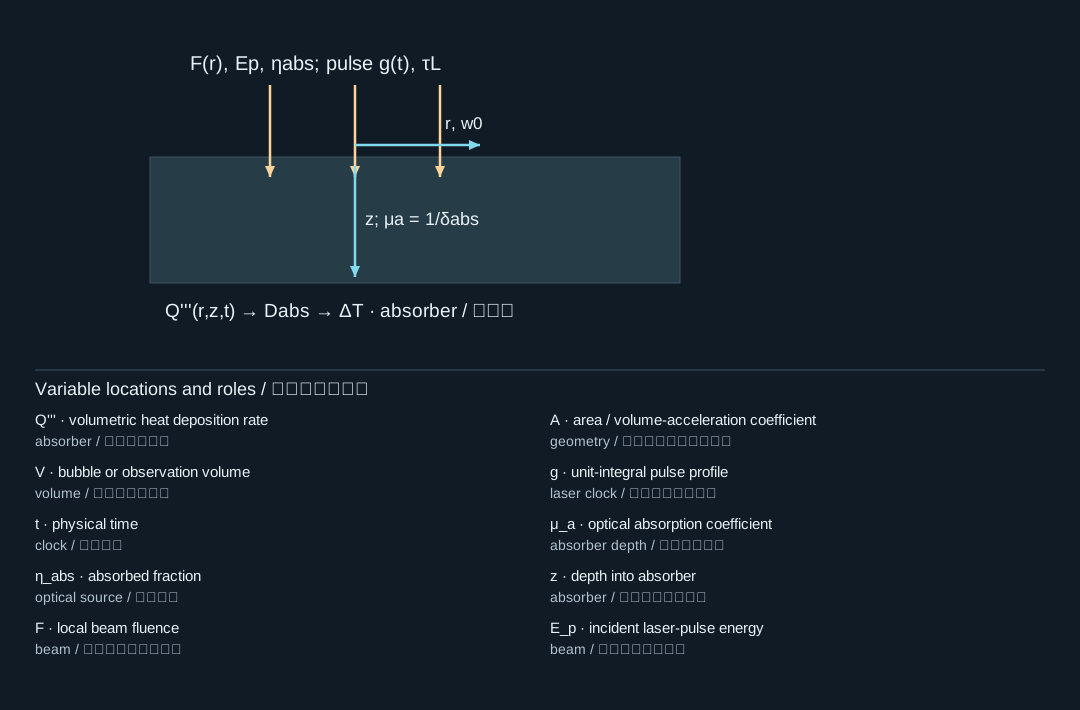
∫−∞∞∫VQ′′′ dV dt=ηabs(∫AF dA)(∫g dt)×(∫0∞μae−μaz dz)=ηabsEp.\begin{aligned} \int_{-\infty}^{\infty}\int_V Q'''\,dV\,dt &=\eta_{\mathrm{abs}}\left(\int_A F\,dA\right)\left(\int g\,dt\right)\\ &\quad\times\left(\int_0^\infty\mu_a e^{-\mu_a z}\,dz\right)\\ &=\eta_{\mathrm{abs}}E_p. \end{aligned}
1.3 From surface intensity to volumetric heating / 从表面光强到体积热源; Q''': volumetric heat deposition rate; V: bubble or observation volume; t: physical time; η_abs: absorbed fraction; F: local beam fluence; A: area / volume-acceleration coefficient; g: unit-integral pulse profile; μ_a: optical absorption coefficient; z: depth into absorber; E_p: incident laser-pulse energy

The diagram locates the physical system; its key lists the symbols in the formula. Read the definition in the surrounding derivation when a letter has different roles.

图示标出物理体系,图例列出公式中的符号。若某字母有多种作用,应以邻近推导中的定义为准。

Every factor has a clear purpose: the spatial integral supplies pulse energy; the time and depth integrals equal one. This is the energy closure emphasized on source page 1. [S1, p. 1]

每个因子都有明确作用:空间积分给出脉冲能量,时间积分与深度积分均等于1。这就是原始材料第1页强调的能量闭合。[S1,第1页]

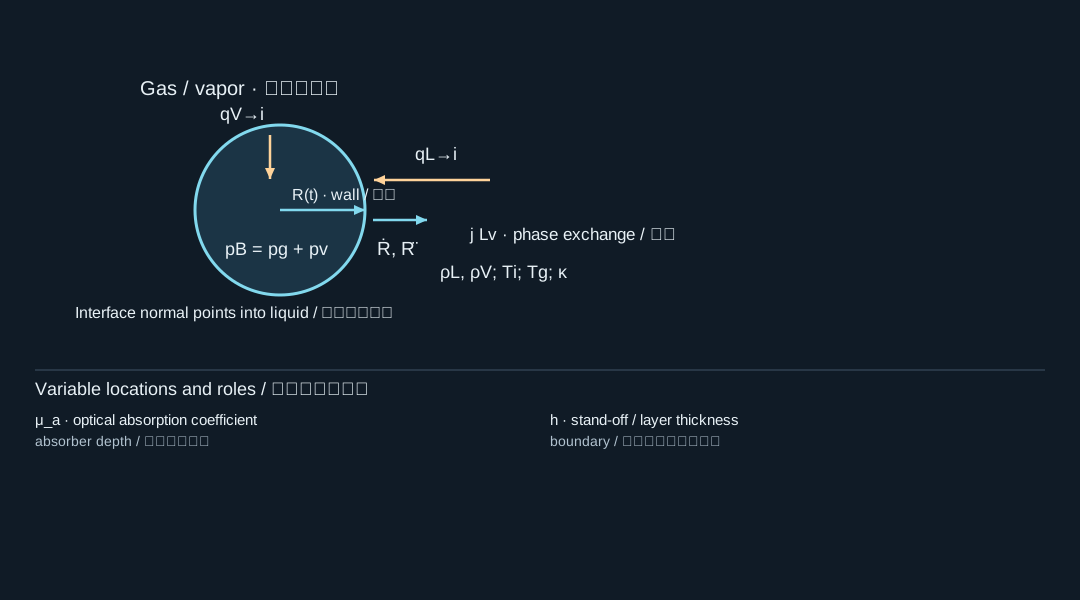
A finite simulation domain needs its own accounting. For example, a layer of thickness hh contains only the depth fraction

有限仿真域需要单独进行能量核算。 例如,厚度为 hh 的材料层仅包含如下深度积分比例:

1−e−μah.1-e^{-\mu_a h}.
1.3 From surface intensity to volumetric heating / 从表面光强到体积热源; μ_a: optical absorption coefficient; h: stand-off / layer thickness

The diagram locates the physical system; its key lists the symbols in the formula. Read the definition in the surrounding derivation when a letter has different roles.

图示标出物理体系,图例列出公式中的符号。若某字母有多种作用,应以邻近推导中的定义为准。

Consequently, the source above integrates to ηabsEp(1−e−μah)\eta_{\mathrm{abs}}E_p(1-e^{-\mu_a h}) over that layer. Whether this is the correct target, or whether the depth profile should be renormalized, depends on whether ηabs\eta_{\mathrm{abs}} denotes absorption over the entire deposition profile or absorption specifically in the finite layer. That interpretation must be fixed before implementing the source.

因此,在这一材料层内,上述热源的积分为 ηabsEp(1−e−μah)\eta_{\mathrm{abs}}E_p(1-e^{-\mu_a h})。这是否就是正确的目标值,或者是否需要重新归一化深度分布,取决于 ηabs\eta_{\mathrm{abs}} 表示整个沉积分布范围内的吸收比例,还是专指该有限厚度层内的吸收比例。在实现热源之前,必须明确这一含义。

The source’s numerical check is

原始材料给出的数值检查条件为
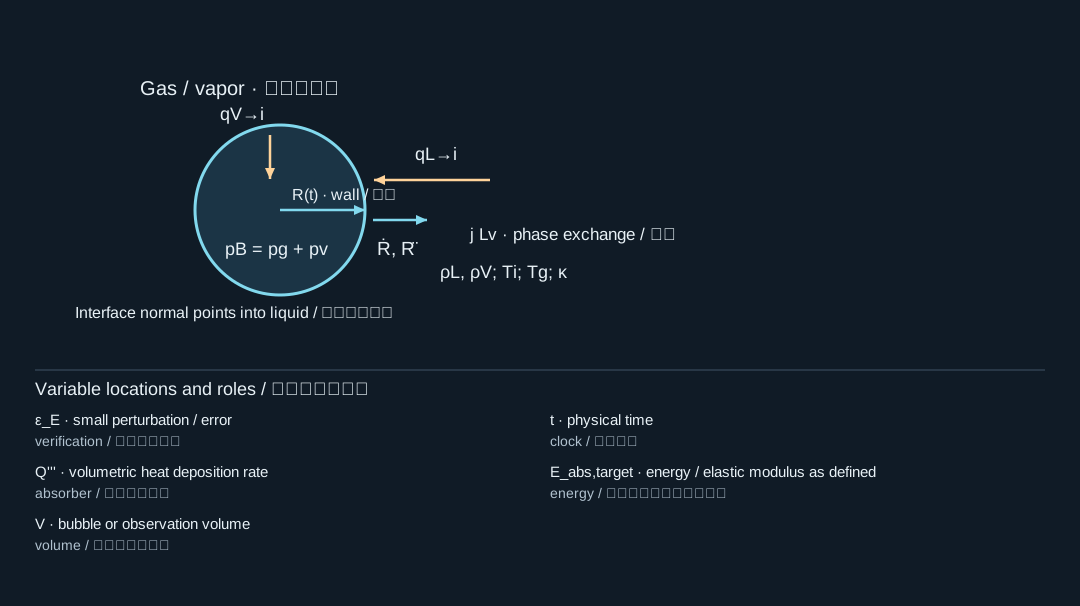
ϵE=∣∫ ⁣ ⁣∫VQ′′′ dV dt−Eabs,target∣Eabs,target<0.01.\boxed{\epsilon_E=\frac{\left|\displaystyle\int\!\!\int_V Q'''\,dV\,dt-E_{\mathrm{abs,target}}\right|}{E_{\mathrm{abs,target}}}<0.01}.
1.3 From surface intensity to volumetric heating / 从表面光强到体积热源; ε_E: small perturbation / error; Q''': volumetric heat deposition rate; V: bubble or observation volume; t: physical time; E_abs,target: energy / elastic modulus as defined

The diagram locates the physical system; its key lists the symbols in the formula. Read the definition in the surrounding derivation when a letter has different roles.

图示标出物理体系,图例列出公式中的符号。若某字母有多种作用,应以邻近推导中的定义为准。

Passing this check establishes correct energy bookkeeping—not correct cavitation physics.

通过这项检查说明能量核算正确,并不意味着空化物理模型已经正确。

1.4 Local dose, peak rate, and temperature rise

局部剂量、峰值速率与温升

The local absorbed energy per unit volume is

局部单位体积吸收能量为
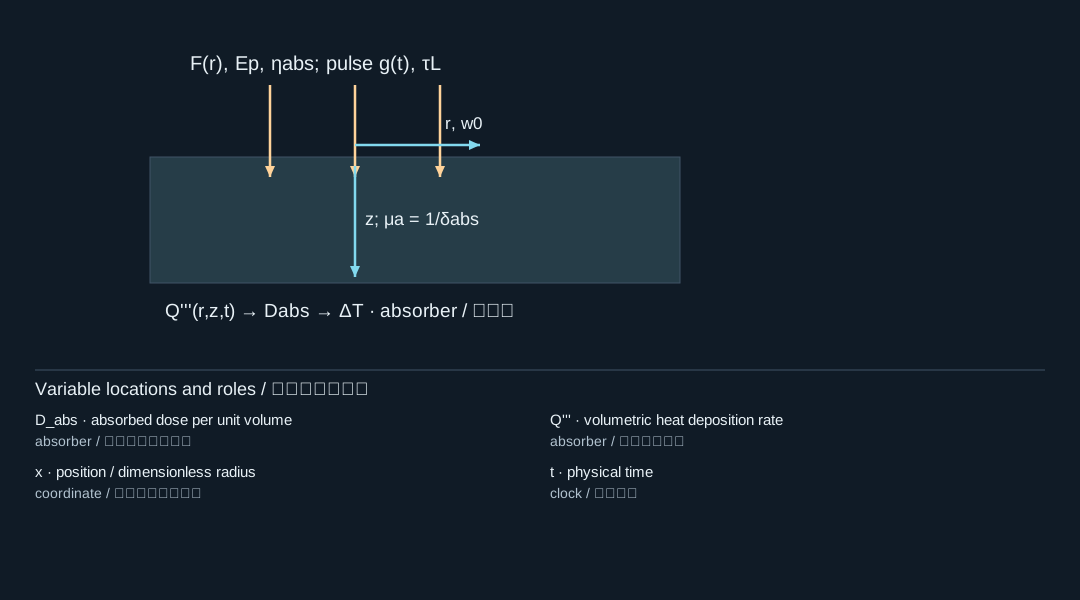
Dabs(x)=∫Q′′′(x,t) dt.D_{\mathrm{abs}}(\mathbf x)=\int Q'''(\mathbf x,t)\,dt.
1.4 Local dose, peak rate, and temperature rise / 局部剂量、峰值速率与温升; D_abs: absorbed dose per unit volume; x: position / dimensionless radius; Q''': volumetric heat deposition rate; t: physical time

The diagram locates the physical system; its key lists the symbols in the formula. Read the definition in the surrounding derivation when a letter has different roles.

图示标出物理体系,图例列出公式中的符号。若某字母有多种作用,应以邻近推导中的定义为准。

Using the normalized pulse,

利用归一化脉冲可得
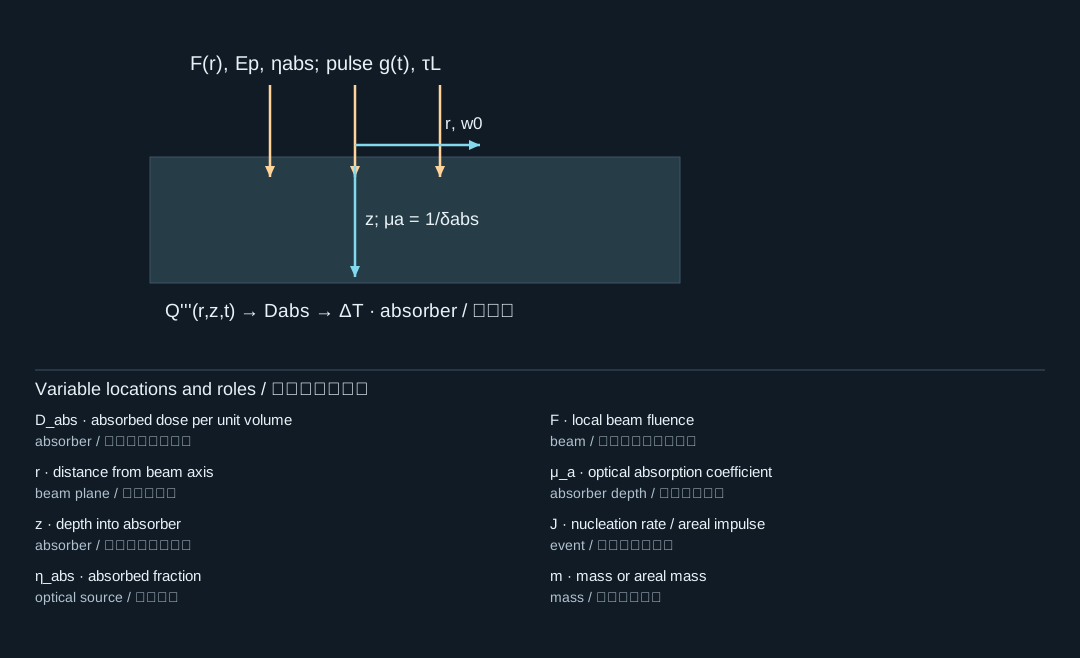
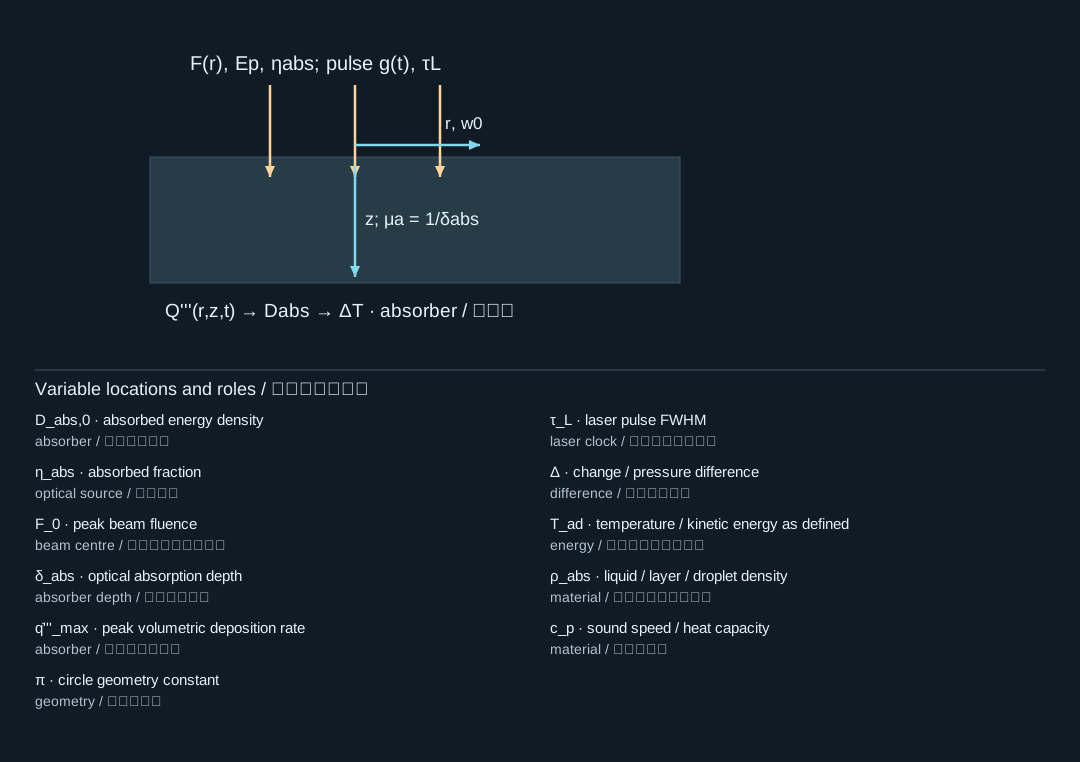
Dabs(r,z)=ηabsF(r)μae−μaz,[Dabs]=J m−3.\boxed{D_{\mathrm{abs}}(r,z)=\eta_{\mathrm{abs}}F(r)\mu_a e^{-\mu_a z}},\qquad [D_{\mathrm{abs}}]=\mathrm{J\,m^{-3}}.
1.4 Local dose, peak rate, and temperature rise / 局部剂量、峰值速率与温升; D_abs: absorbed dose per unit volume; r: distance from beam axis; z: depth into absorber; η_abs: absorbed fraction; F: local beam fluence; μ_a: optical absorption coefficient; J: nucleation rate / areal impulse; m: mass or areal mass

The diagram locates the physical system; its key lists the symbols in the formula. Read the definition in the surrounding derivation when a letter has different roles.

图示标出物理体系,图例列出公式中的符号。若某字母有多种作用,应以邻近推导中的定义为准。

The peak deposition rate is

峰值沉积速率为
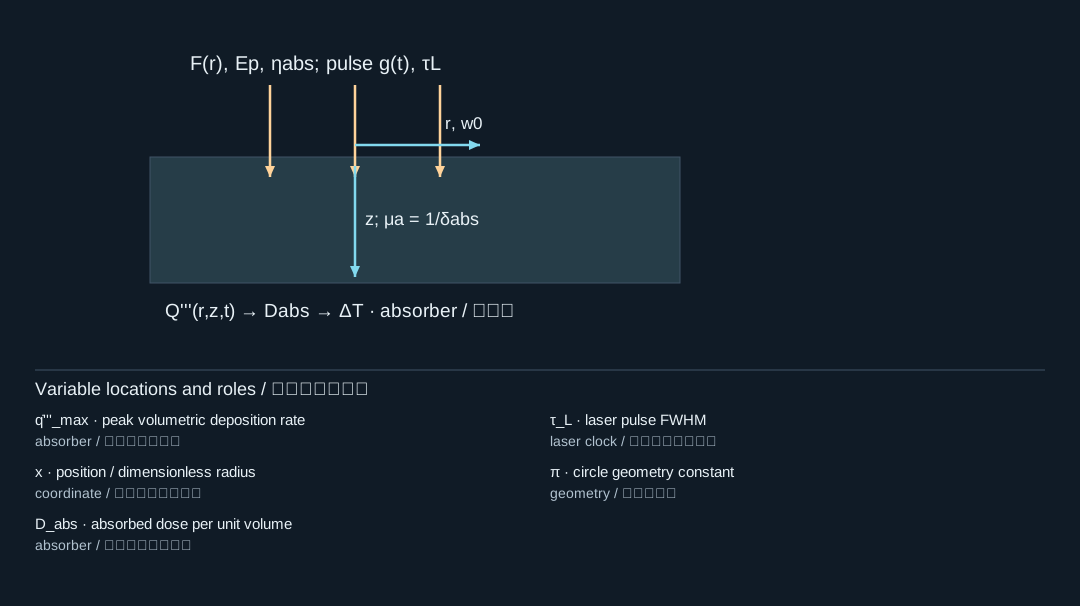
q˙max⁡′′′(x)=Dabs(x)1τL4ln⁡2π.\boxed{\dot q'''_{\max}(\mathbf x)=D_{\mathrm{abs}}(\mathbf x)\frac{1}{\tau_L}\sqrt{\frac{4\ln2}{\pi}}}.
1.4 Local dose, peak rate, and temperature rise / 局部剂量、峰值速率与温升; q̇'''_max: peak volumetric deposition rate; x: position / dimensionless radius; D_abs: absorbed dose per unit volume; τ_L: laser pulse FWHM; π: circle geometry constant

The diagram locates the physical system; its key lists the symbols in the formula. Read the definition in the surrounding derivation when a letter has different roles.

图示标出物理体系,图例列出公式中的符号。若某字母有多种作用,应以邻近推导中的定义为准。

Thus, for this pulse family, equal dose delivered in a shorter pulse means a larger peak heating rate. These are the two local predictors carried into source page 2. [S1, p. 2]

因此,对于这一类脉冲,在更短的时间内沉积相同剂量,就意味着更高的峰值加热速率。这两个量正是原始材料第2页采用的局部预测量。[S1,第2页]

To interpret the temperature-rise estimate on source page 5, add the following simple local energy balance. Assume constant properties, negligible heat loss during deposition, and no phase change:

为了理解原始材料第5页的温升估计,可引入下述简单的局部能量平衡。假设材料参数不变、沉积过程中热损失可忽略,且不发生相变:
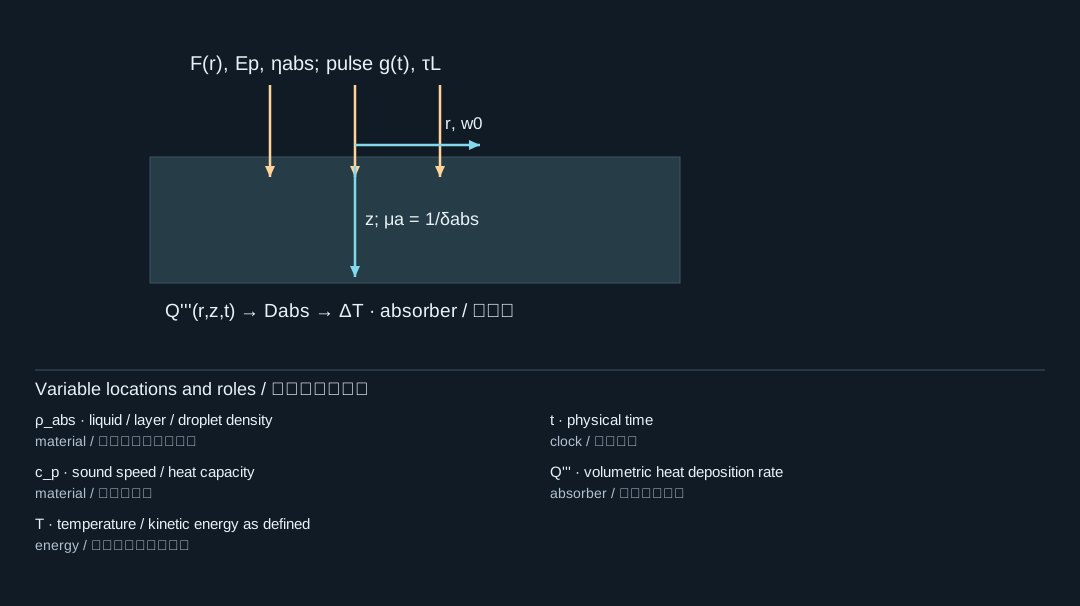
ρabscp∂T∂t=Q′′′.\rho_{\mathrm{abs}}c_p\frac{\partial T}{\partial t}=Q'''.
1.4 Local dose, peak rate, and temperature rise / 局部剂量、峰值速率与温升; ρ_abs: liquid / layer / droplet density; c_p: sound speed / heat capacity; T: temperature / kinetic energy as defined; t: physical time; Q''': volumetric heat deposition rate

The diagram locates the physical system; its key lists the symbols in the formula. Read the definition in the surrounding derivation when a letter has different roles.

图示标出物理体系,图例列出公式中的符号。若某字母有多种作用,应以邻近推导中的定义为准。

Integrating over the pulse gives

对整个脉冲积分得到
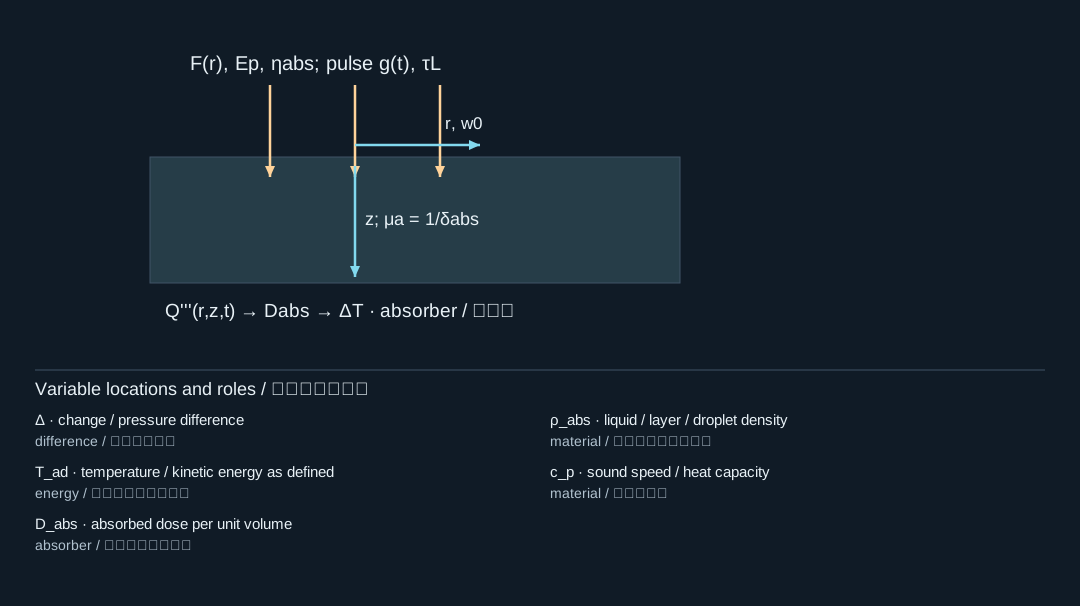
ΔTad=Dabsρabscp.\boxed{\Delta T_{\mathrm{ad}}=\frac{D_{\mathrm{abs}}}{\rho_{\mathrm{abs}}c_p}}.
1.4 Local dose, peak rate, and temperature rise / 局部剂量、峰值速率与温升; Δ: change / pressure difference; T_ad: temperature / kinetic energy as defined; D_abs: absorbed dose per unit volume; ρ_abs: liquid / layer / droplet density; c_p: sound speed / heat capacity

The diagram locates the physical system; its key lists the symbols in the formula. Read the definition in the surrounding derivation when a letter has different roles.

图示标出物理体系,图例列出公式中的符号。若某字母有多种作用,应以邻近推导中的定义为准。

At the beam centre and deposition surface,

在光束中心的能量沉积表面处,
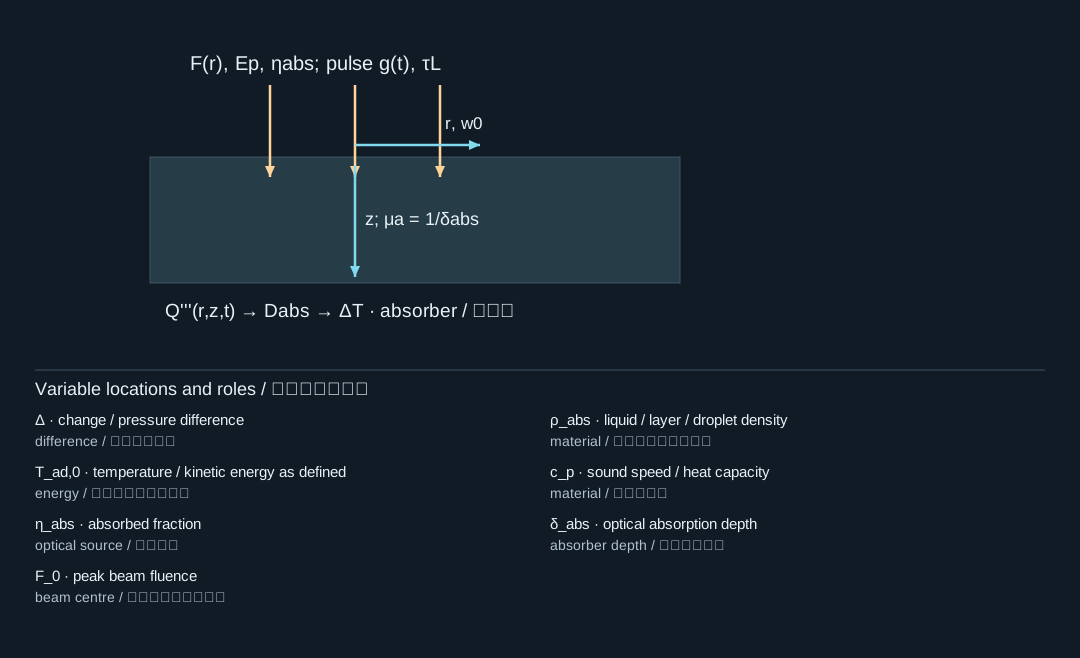
ΔTad,0=ηabsF0ρabscpδabs.\boxed{\Delta T_{\mathrm{ad},0}=\frac{\eta_{\mathrm{abs}}F_0}{\rho_{\mathrm{abs}}c_p\delta_{\mathrm{abs}}}}.
1.4 Local dose, peak rate, and temperature rise / 局部剂量、峰值速率与温升; Δ: change / pressure difference; T_ad,0: temperature / kinetic energy as defined; η_abs: absorbed fraction; F_0: peak beam fluence; ρ_abs: liquid / layer / droplet density; c_p: sound speed / heat capacity; δ_abs: optical absorption depth

The diagram locates the physical system; its key lists the symbols in the formula. Read the definition in the surrounding derivation when a letter has different roles.

图示标出物理体系,图例列出公式中的符号。若某字母有多种作用,应以邻近推导中的定义为准。

The density and heat capacity must belong to the material receiving the heat. They need not be those of the surrounding liquid.

这里的密度和比热容必须对应实际接收热量的材料,不一定是周围液体的参数。

The source reports a reference adiabatic rise of 7.19 K7.19\ \mathrm K, but the five pages do not provide all thermal properties and deposition-depth values needed to independently reproduce it. More importantly, this adiabatic calculation does not include latent heat or determine whether a droplet activates. [S1, p. 5]

原始材料给出的参考绝热温升为 7.19 K7.19\ \mathrm K,但这五页并未提供独立复现该结果所需的全部热物性与沉积深度数值。更重要的是,这项绝热计算不包含潜热,也不能判断液滴是否会被激活。[S1,第5页]

1.5 Why enough energy does not guarantee a bubble

为什么能量足够并不保证气泡形成

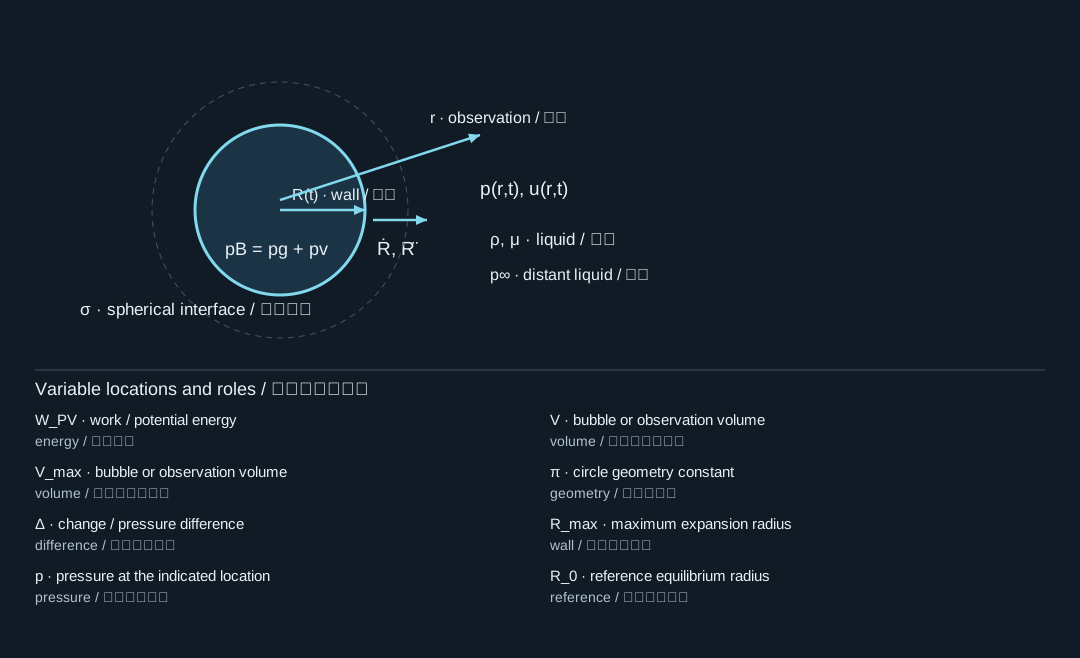
The pressure–volume work plot asks a narrower question: suppose a fraction ηB\eta_B of absorbed energy were available for bubble expansion. What radius could that energy support against a constant pressure difference?

压强–体积功曲线回答的是一个更有限的问题:假设吸收能量中有比例 ηB\eta_B 可用于气泡膨胀,那么在克服恒定压差的条件下,这部分能量最多能够支持多大的气泡半径?

With a resisting pressure Δp>0\Delta p>0,

对于阻碍膨胀的压差 Δp>0\Delta p>0,

WPV=∫V0Vmax⁡Δp dV=4π3Δp(Rmax⁡3−R03).W_{PV}=\int_{V_0}^{V_{\max}}\Delta p\,dV=\frac{4\pi}{3}\Delta p\left(R_{\max}^3-R_0^3\right).
1.5 Why enough energy does not guarantee a bubble / 为什么能量足够并不保证气泡形成; W_PV: work / potential energy; V_max: bubble or observation volume; Δ: change / pressure difference; p: pressure at the indicated location; V: bubble or observation volume; π: circle geometry constant; R_max: maximum expansion radius; R_0: reference equilibrium radius

The diagram locates the physical system; its key lists the symbols in the formula. Read the definition in the surrounding derivation when a letter has different roles.

图示标出物理体系,图例列出公式中的符号。若某字母有多种作用,应以邻近推导中的定义为准。

Equating this to the available energy gives the screening radius

令其等于可用能量,得到筛查半径
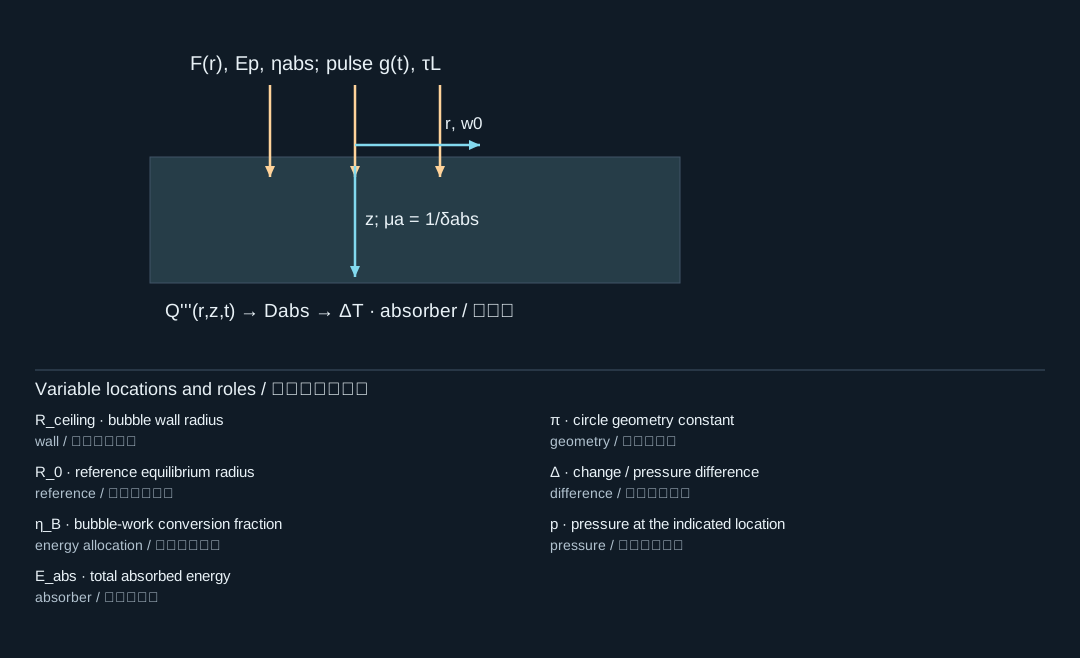
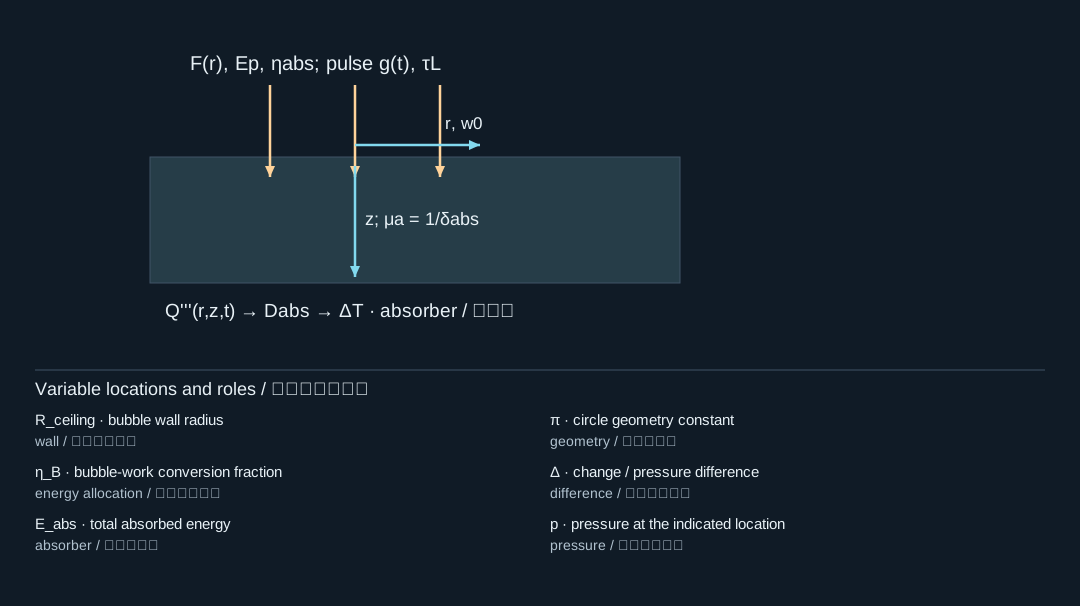
Rceiling=[R03+3ηBEabs4πΔp]1/3.\boxed{R_{\mathrm{ceiling}}=\left[R_0^3+\frac{3\eta_BE_{\mathrm{abs}}}{4\pi\Delta p}\right]^{1/3}}.
1.5 Why enough energy does not guarantee a bubble / 为什么能量足够并不保证气泡形成; R_ceiling: bubble wall radius; R_0: reference equilibrium radius; η_B: bubble-work conversion fraction; E_abs: total absorbed energy; π: circle geometry constant; Δ: change / pressure difference; p: pressure at the indicated location

The diagram locates the physical system; its key lists the symbols in the formula. Read the definition in the surrounding derivation when a letter has different roles.

图示标出物理体系,图例列出公式中的符号。若某字母有多种作用,应以邻近推导中的定义为准。

Neglecting R0R_0,

忽略 R0R_0 后,

Rceiling∼(ηBEabsΔp)1/3.R_{\mathrm{ceiling}}\sim\left(\frac{\eta_BE_{\mathrm{abs}}}{\Delta p}\right)^{1/3}.
1.5 Why enough energy does not guarantee a bubble / 为什么能量足够并不保证气泡形成; R_ceiling: bubble wall radius; η_B: bubble-work conversion fraction; E_abs: total absorbed energy; Δ: change / pressure difference; p: pressure at the indicated location

The diagram locates the physical system; its key lists the symbols in the formula. Read the definition in the surrounding derivation when a letter has different roles.

图示标出物理体系,图例列出公式中的符号。若某字母有多种作用,应以邻近推导中的定义为准。

This is not a complete bubble-energy balance. In particular, the plot explicitly excludes latent heat and contains no nucleation barrier or activation kinetics. It therefore cannot establish either activation or the actual Rmax⁡R_{\max}. [S1, p. 1]

这并不是完整的气泡能量平衡。尤其需要注意的是,该图明确排除了潜热,也没有包含成核势垒或激活动力学。因此,它既不能确定是否发生激活,也不能确定实际的 Rmax⁡R_{\max}。[S1,第1页]

The output of Stage 1 is a heating field and an energy budget—not yet a bubble.

阶段1的输出是一个热源场和一份能量预算,还不是一个气泡。
Integrated calculation and model check

综合计算与模型检查

Use the declared parameter set in each part. The values are teaching scenarios unless specifically identified as inherited project inputs. Each reference panel follows its question.

使用每小题明确给出的参数。除明确标为沿用项目输入外,数值均为教学情景。各参考解答紧随题目。

  1. For the supplied scenario F0 = 0.10 J/cm², w0 = 25 µm and ηabs = 0.30, compute pulse energy and absorbed energy. For μa h = 1, state how much is deposited in a finite layer.

    所给情景 F0 = 0.10 J/cm²、w0 = 25 µm、ηabs = 0.30,计算脉冲能量和吸收能量。μa h = 1 时,说明有限层内沉积比例。

    Reference answer / 参考答案
    Ep=πw02F0/2,Eabs=ηabsEp,E0<h=Eabs(1−e−μah)E_p=\pi w_0^2F_0/2,\quad E_{\mathrm{abs}}=\eta_{\mathrm{abs}}E_p,\quad E_{0<h}=E_{\mathrm{abs}}(1-e^{-\mu_ah})
    Optical deposition · original governing laws; E_p: incident laser-pulse energy; π: circle geometry constant; w_0: Gaussian beam waist radius; F_0: peak beam fluence; E_abs: total absorbed energy; η_abs: absorbed fraction; E_0<h: energy / elastic modulus as defined; μ_a: optical absorption coefficient; h: stand-off / layer thickness

    The diagram locates the physical system; its key lists the symbols in the formula. Read the definition in the surrounding derivation when a letter has different roles.

    图示标出物理体系,图例列出公式中的符号。若某字母有多种作用,应以邻近推导中的定义为准。

    Convert F0 to 1000 J/m². Ep = 0.98175 µJ, Eabs = 0.29452 µJ for the semi-infinite normalization. A depth of one absorption length captures 63.21%, or 0.18617 µJ. If ηabs denotes total finite-layer absorption, the depth profile must instead be renormalized; do not count absorption twice.

    F0 转换为 1000 J/m²。半无限归一化下 Ep = 0.98175 µJ、Eabs = 0.29452 µJ。一个吸收长度捕获 63.21%,即 0.18617 µJ。若 ηabs 表示有限层总吸收,则应重新归一化深度分布,避免重复计入吸收。

  2. For τL = 10 ns and δabs = 10 µm calculate the on-axis surface dose and peak deposition rate. Use an explicitly assumed ρabs cp = 4.17×10⁶ J/(m³ K) to estimate ΔTad.

    τL = 10 ns、δabs = 10 µm,计算轴心表面剂量和峰值沉积率。明确假设 ρabs cp = 4.17×10⁶ J/(m³ K),估算 ΔTad。

    Reference answer / 参考答案
    Dabs,0=ηabsF0/δabs,q˙max⁡′′′=Dabs,04ln⁡2/π/τL,ΔTad=Dabs,0/(ρabscp)D_{\mathrm{abs},0}=\eta_{\mathrm{abs}}F_0/\delta_{\mathrm{abs}},\quad \dot q'''_{\max}=D_{\mathrm{abs},0}\sqrt{4\ln2/\pi}/\tau_L,\quad \Delta T_{\mathrm{ad}}=D_{\mathrm{abs},0}/(\rho_{\mathrm{abs}}c_p)
    Optical deposition · original governing laws; D_abs,0: absorbed energy density; η_abs: absorbed fraction; F_0: peak beam fluence; δ_abs: optical absorption depth; q̇'''_max: peak volumetric deposition rate; π: circle geometry constant; τ_L: laser pulse FWHM; Δ: change / pressure difference; T_ad: temperature / kinetic energy as defined; ρ_abs: liquid / layer / droplet density; c_p: sound speed / heat capacity

    The diagram locates the physical system; its key lists the symbols in the formula. Read the definition in the surrounding derivation when a letter has different roles.

    图示标出物理体系,图例列出公式中的符号。若某字母有多种作用,应以邻近推导中的定义为准。

    Dose = 3.00×10⁷ J/m³, peak rate = 2.818×10¹⁵ W/m³, ΔTad = 7.19 K. The heat-capacity product is an illustrative explicit assumption, not identified by the five-page source. A carrier-average temperature rise is not a droplet-specific activation criterion.

    剂量 = 3.00×10⁷ J/m³,峰值率 = 2.818×10¹⁵ W/m³,ΔTad = 7.19 K。热容乘积是明确的示例假设,并非五页来源辨识结果。载液平均温升不是液滴专属激活判据。

  3. Using ηB = 0.10, Δp = 98,986 Pa and negligible initial cavity volume, compute a bubble-work radius ceiling. What connection remains missing?

    取 ηB = 0.10、Δp = 98,986 Pa、初始腔体积可忽略,求泡功半径上界,并指出缺失连接。

    Reference answer / 参考答案
    Rceiling=[3ηBEabs/(4πΔp)]1/3R_{\mathrm{ceiling}}=[3\eta_BE_{\mathrm{abs}}/(4\pi\Delta p)]^{1/3}
    Optical deposition · original governing laws; R_ceiling: bubble wall radius; η_B: bubble-work conversion fraction; E_abs: total absorbed energy; π: circle geometry constant; Δ: change / pressure difference; p: pressure at the indicated location

    The diagram locates the physical system; its key lists the symbols in the formula. Read the definition in the surrounding derivation when a letter has different roles.

    图示标出物理体系,图例列出公式中的符号。若某字母有多种作用,应以邻近推导中的定义为准。

    Rceiling = 41.4 µm before latent/surface/thermal losses. This conditional energy allocation does not produce p1 or R(t). Activation calibration and a closed source-to-phase-change model are the missing links.

    在潜热、表面和热损耗前,Rceiling = 41.4 µm。有条件能量分配不生成 p1 或 R(t)。激活标定及闭合源—相变模型仍缺失。

Brief conceptual synthesis

简短概念综合

After using the reference panels, give a short explanation of the physical mechanism, the strongest assumption, and one observation that could falsify this chapter’s model. Preparation of later chapters does not require waiting for that reply.

核对参考解答后,简述物理机制、最强假设,以及一个可证伪本章模型的观测。后续章节编写无需等待该回答。