This is an original textbook reference supplement. Its original appendix numbering is preserved inside the source text. The course’s two extension appendixes are hydrogel (A) and pressure limits (B).
这是原教材参考补充,正文保留原教材附录编号。课程的两个扩展附录为水凝胶(A)与压力极限(B)。
Appendix A. Symbols, dimensionless form, and model map
附录A:符号、无量纲形式与模型地图
A.1 Core notation
核心符号
Symbols have the meanings below unless a chapter explicitly introduces a local variant. In particular, keep liquid kinematic viscosity , solid Poisson ratio , gas heat-capacity ratio , and stand-off ratio separate.
除非章节明确引入局部变体,符号采用以下含义。尤其要区分液体运动黏度、固体泊松比、气体比热比和离壁比。
| Symbol / 符号 | Meaning / 含义 | SI unit / SI单位 |
|---|---|---|
| Instantaneous, reference-equilibrium, and maximum radius / 瞬时、参考平衡与最大半径 | m | |
| Bubble wall velocity / 气泡界面速度 | m/s | |
| Bubble interior, liquid-side interface, and far-field pressure / 泡内、界面液侧与远场压力 | Pa | |
| Noncondensable-gas partial pressure and vapor pressure / 不凝性气体分压与蒸气压 | Pa | |
| Liquid density, dynamic viscosity, kinematic viscosity / 液体密度、动力黏度、运动黏度 | kg/m, Pa s, m/s | |
| Surface tension, sound speed, thermal diffusivity / 表面张力、声速、热扩散率 | N/m, m/s, m/s | |
| Polytropic exponent and heat-capacity ratio / 多方指数与比热比 | 1 | |
| Bubble volume, liquid enthalpy difference, local sound speed / 气泡体积、液体焓差、局部声速 | m, m/s, m/s | |
| Pressure impulse field or scalar pressure impulse / 压力冲量场或标量压力冲量 | Pa s | |
| Modal force impulse / 模态力冲量 | N s for dimensionless modes / 无量纲模态时为N s | |
| Layer thickness, span scale, liquid depth in structural chapters / 结构章节中的层厚、跨距尺度和液深 | m | |
| Areal mass, bending rigidity, pretension per length / 面密度、弯曲刚度、单位长度预张力 | kg/m, N m, N/m | |
| Interfacial fracture energy, peak cohesive traction, final separation / 界面断裂能、峰值内聚牵引、最终分离量 | J/m, Pa, m |
The letter also denotes center-to-boundary stand-off in Chapters 8 and 15; its meaning is stated at each use. For a project implementation, rename these quantities unambiguously, for example film_thickness and bubble_standoff, rather than carrying an overloaded textbook symbol into software.
字母在第8和第15章中也表示气泡中心到边界的距离,具体含义均在使用处说明。在实际项目代码中,应采用例如film_thickness和bubble_standoff之类无歧义名称,而不是把教材中多义的符号直接带入软件。
A.2 Dimensionless Rayleigh–Plesset equation
无量纲Rayleigh–Plesset方程
Choose , , and . With , , and the equilibrium gas closure, a constant-ambient radial equation becomes
选取、和。令、,并采用平衡气体闭合,恒定环境压力下的径向方程变为
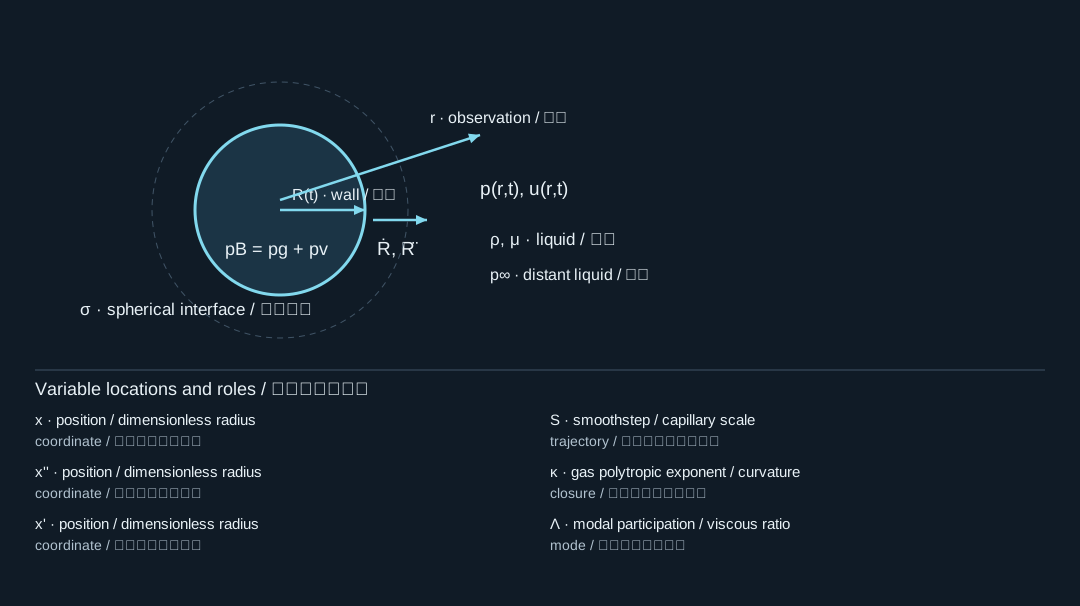
The diagram locates the physical system; its key lists the symbols in the formula. Read the definition in the surrounding derivation when a letter has different roles.
图示标出物理体系,图例列出公式中的符号。若某字母有多种作用,应以邻近推导中的定义为准。
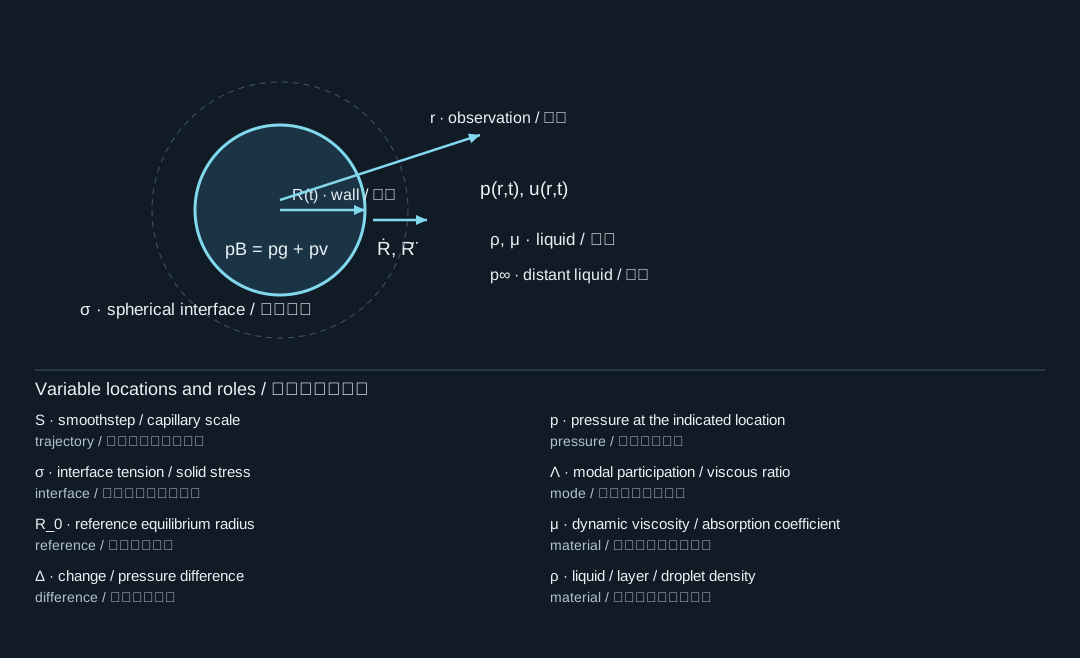
The diagram locates the physical system; its key lists the symbols in the formula. Read the definition in the surrounding derivation when a letter has different roles.
图示标出物理体系,图例列出公式中的符号。若某字母有多种作用,应以邻近推导中的定义为准。
Primes here mean differentiation with respect to . A prescribed ambient perturbation adds to the right-hand side in the incompressible model. The separate compressible forcing convention still requires the care described in Chapter 7.
这里撇号表示对求导。在不可压缩模型中,指定环境扰动会在右端增加。可压缩模型中的独立激励约定,仍需要按第7章所述谨慎处理。
Using the same length throughout, , , and satisfy , , and . A liquid-flow cavitation number is commonly defined as ; it characterizes a chosen flow and is not by itself a universal nucleation criterion.
若始终采用相同长度,则、和满足、以及。液体流动的空化数通常定义为,用于表征某个指定流动,本身并不是普适成核判据。
A.3 The model map
模型地图
For a newly created vapor embryo, begin with a nucleation model and a probability definition. For an existing nearly spherical bubble, begin with radial dynamics and a thermodynamic closure. Add liquid compressibility when acoustic emission or rapid collapse matters. Add interface shape when boundaries or jets matter. Add solid mechanics when the boundary moves, and an interfacial failure law when release is the target. These are successive modeling decisions, not interchangeable software modules.
对于新形成的蒸气胚核,应从成核模型与概率定义开始。对于已有近球形气泡,应从径向动力学与热力学闭合开始。当声发射或快速塌缩重要时加入液体可压缩性;当边界或射流重要时加入界面形状;当边界运动时加入固体力学;当目标是释放时加入界面失效定律。这些是依次作出的建模决策,而不是可任意互换的软件模块。
A useful stopping rule is: do not claim an observable that the model has no degree of freedom or constitutive law to represent. A radius-only model cannot predict jet direction. A perfectly bonded model cannot predict detachment. A prescribed-volume model cannot predict nucleation threshold. A nondamaging elastic solid cannot predict fracture.
一个实用停止原则是:不要宣称预测了模型缺乏相应自由度或本构关系的可观测量。只有半径的模型不能预测射流方向;完全粘接模型不能预测脱离;指定体积模型不能预测成核阈值;不含损伤的弹性固体不能预测断裂。
A.4 Recommended companion textbook
推荐配套教材
[B1] Christopher E. Brennen, Cavitation and Bubble Dynamics. Oxford University Press, 1995. ISBN 0195094093. This is my primary companion recommendation for your mechanics background. Its institutional description assumes basic fluid flow and heat transfer and develops the analytical methods from basic principles. Start with nucleation and individual-bubble growth, collapse, and oscillation; read translation and bubbly-flow topics later. Caltech's official repository provides the book and an online version. The access record is saved in source_manifest.json.
[B1] Christopher E. Brennen著,Cavitation and Bubble Dynamics,Oxford University Press,1995年,ISBN 0195094093。这是我针对你力学背景的首选配套教材。其机构介绍说明,读者需要基础流动与传热知识,而分析方法从基本原理展开。建议先学习成核、单气泡增长、塌缩和振荡,再阅读平移与含泡流。Caltech官方机构库提供全书及在线版本,访问记录保存在source_manifest.json中。
Use Brennen as the established theoretical reference and the present text as a bridge to your supplied laser, droplet, and film-transfer papers. No claim is made that this custom text replaces the breadth or authority of that published monograph.
可将Brennen作为成熟理论参考,将本书作为通向你所提供激光、液滴与薄膜转印论文的桥梁。本书不宣称替代该已出版专著的广度与学术权威性。