15. Capstone: a liquid–PVC–film research model
综合课题:液体—PVC—薄膜研究模型
15.1 Define the proposed system, not an imagined reproduction
定义研究体系,而不是想当然地复现
Consider the following proposed teaching geometry, motivated by your research direction: a volatile-liquid region below a PVC separator, with a thin solid payload initially attached on the other side. A localized bubble or prescribed expansion acts on the liquid side. The first objective is to predict separator and payload motion. This is not presented as the actual geometry of [S390], whose PVC has a different acoustic-isolation role.
考虑以下与你研究方向相关的建议教学几何:挥发性液体区域位于PVC隔离层下方,薄固体负载初始粘附在另一侧,局部气泡或指定膨胀在液体侧产生作用。第一阶段目标是预测隔离层与负载运动。这并非[S390]实际几何的复现,因为该文中PVC承担的是不同的声学隔离作用。
Unknown thicknesses, support conditions, liquid identity, absorber placement, and adhesion properties remain unknown, not guessed experimental facts. A simulation parameter ledger should label each entry as measured, independently sourced, assumed for teaching, calibrated, or unresolved.
未知的厚度、支承条件、液体身份、吸收体位置和黏附性质,都应保持为未知量,而不是猜测后当作实验事实。仿真参数台账应将每一项标记为实测、独立来源、教学假设、标定值或尚未确定。
15.2 Stage A: the smallest useful baseline
阶段A:最小但有用的基础模型
Begin with a homogeneous liquid and an axisymmetric geometry, provided the supports and loading justify axisymmetry. Keep the PVC and payload perfectly bonded. Omit receiver contact and delamination. Prescribe a smooth bubble-volume history or a moving inner boundary rather than simultaneously solving unknown nucleation, heat transfer, and adhesion. This stage asks whether the chosen bubble timescale and size can generate the required structural response.
如果支承与加载具有轴对称性,可从均匀液体和轴对称几何开始。保持PVC与负载完全粘接,暂不加入接收面接触和分层。先指定平滑气泡体积历程或运动内边界,而不是同时求解未知成核、传热和黏附。该阶段回答的是:所选气泡时间尺度和尺寸能否产生所需结构响应。
For example, prescribe a positive baseline volume plus a compact smooth expansion pulse. A convenient mathematical test shape is for , continued as outside that interval. The first and second derivatives vanish at both endpoints, reducing artificial acoustic transients compared with a discontinuous switch. It is a kinematic test input, not a predicted vaporization history.
例如,可以指定正的基础体积,并叠加紧支撑平滑膨胀脉冲:在内取,区间外保持。两端一、二阶导数均为零,可相对于不连续开关减少人为声学瞬态。它是运动学测试输入,而不是预测得到的汽化历程。
If the bubble boundary is prescribed, the surrounding pressure is a response. Do not independently prescribe an incompatible bubble pressure and radius on the same interface. That would overconstrain the problem and could create unphysical energy injection.
当气泡边界运动被指定时,周围压力应作为响应求出。不要在同一界面上再独立指定一个不相容的气泡压力和半径,否则会过度约束问题,并可能引入非物理能量输入。
15.3 Stage B: replace the effective source with a physical one
阶段B:用物理源替代有效源
Once Stage A is numerically verified, choose the actual mechanism. For remote laser-generated ultrasound, model or measure the transmitted acoustic waveform and its interaction with nuclei. For direct photothermal vaporization, model absorbed heat and phase change. For optical breakdown, use an initialization consistent with a hot compressed cavity and compressible liquid. For nanodroplets, retain the droplet-specific shell and activation physics. The source choice must follow the apparatus, not the software interface that happens to be easiest to activate.
阶段A通过数值验证后,再选择实际机制。对于远端激光产生超声,应建模或测量透射声压波形及其与气核的作用;对于直接光热汽化,应建模吸收热与相变;对于光学击穿,应采用与高温压缩空腔及可压缩液体相容的初始化;对于纳米液滴,应保留液滴特有的壳层与激活物理。源模型必须由装置决定,而不是由软件中哪个接口最容易开启决定。
Calibrate the source against bubble growth or a measured pressure waveform before using it to explain film release. Otherwise, an incorrect source and an incorrect adhesion law may compensate each other and still produce a plausible transfer threshold.
在用源模型解释薄膜释放之前,应先通过气泡增长或实测压力波形进行标定。否则,错误的源模型与错误的黏附定律可能相互补偿,仍然给出看似合理的转印阈值。
15.4 Stage C: introduce release, then capture
阶段C:先加入释放,再加入捕获
Add an experimentally informed cohesive interface between the payload and carrier. Track initiation, crack propagation, residual attachment, payload deformation, and outgoing velocity. Only after release is credible should receiver contact, adhesion, and impact be introduced. These additions need their own material data and verification problems.
在负载与载体之间加入由实验支持的内聚界面,跟踪损伤起始、裂纹传播、残余连接、负载变形和离开速度。只有在释放阶段可信之后,才加入接收面接触、黏附和冲击。这些新增过程需要各自的材料数据和验证问题。
The hydrogel stamp [S72], blister-associated cavitation [S343], and stress-wave delamination [S340] can guide hypotheses about release pathways, but none provides a universal cohesive law for your proposed PVC–payload interface. Adhesion parameters must correspond to the actual surfaces and loading rate.
水凝胶印章[S72]、鼓包相关空化[S343]以及应力波分层[S340]可以启发释放路径假设,但它们都没有为你拟研究的PVC—负载界面提供普适内聚定律。黏附参数必须对应实际表面和加载速率。
15.5 Dimensionless organization
无量纲组织方式
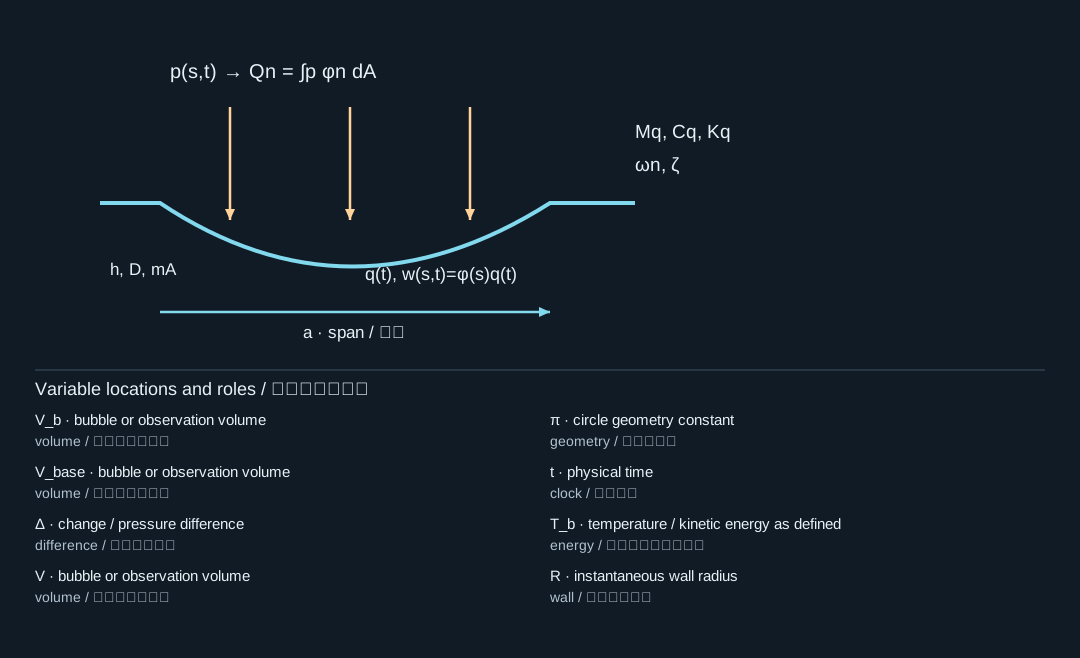
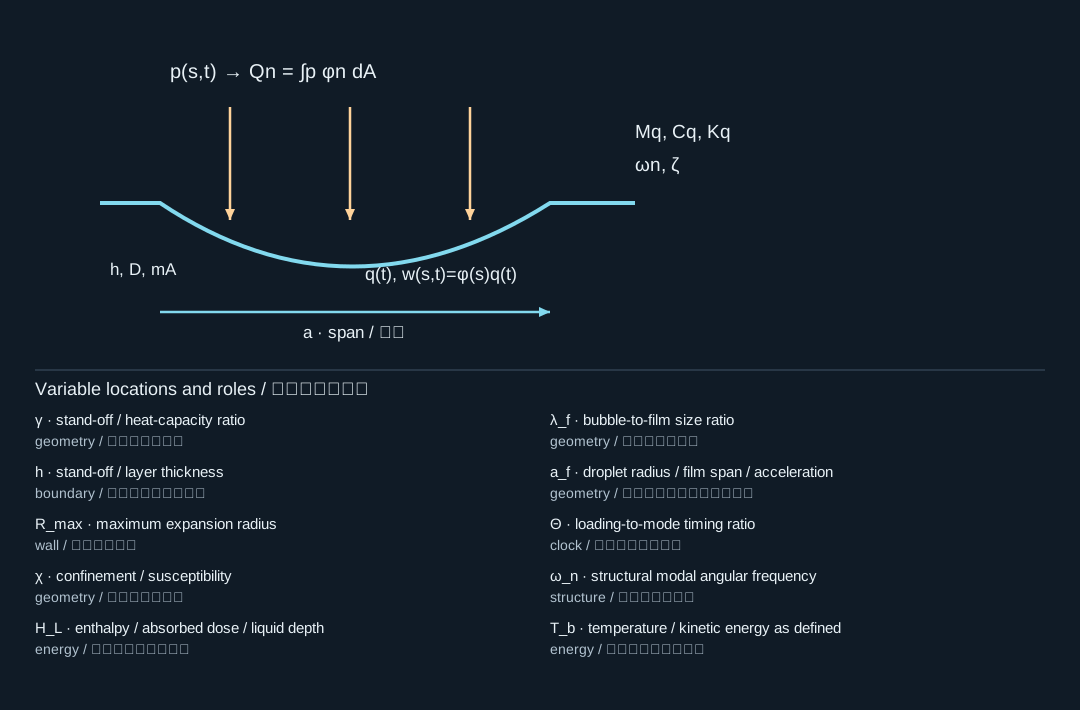
Organize parameter studies around physically interpretable ratios rather than arbitrary sweeps. Useful examples are bubble stand-off , confinement , bubble-to-span ratio , structural timing , Mach number, and capillary-to-driving-pressure ratio . Here is liquid depth and a film span scale.
参数研究应围绕具有明确物理意义的比值组织,而不是任意扫描。实用例子包括离壁比、约束比、气泡与膜跨距比、结构时间比、Mach数,以及毛细压力与驱动压差之比。其中为液深,为薄膜跨距尺度。
For a bending-dominated plate, estimates deflection relative to thickness, up to geometry factors; for a tension-dominated membrane, plays a similar role. These are screening ratios, not exact clamped-plate solutions. Large values warn that geometrically linear theory may fail.
对于弯曲主导薄板,可在几何系数意义下估计挠度与厚度之比;对于张力主导膜,具有类似作用。这些只是筛查比值,不是精确固支板解。较大数值意味着几何线性理论可能失效。
15.6 A research claim that can actually be tested
能够真正检验的科研命题
A useful first hypothesis is: “For fixed bubble-volume input and support geometry, the maximum payload velocity depends strongly on the ratio of bubble-loading time to the dominant coupled structural period.” Test this with a controlled timing sweep and compare mode-projected impulse, deformation, and transferred energy. This is more informative than sweeping laser energy while leaving the transduction mechanism unspecified.
一个实用初始假设是:“在气泡体积输入和支承几何固定时,负载最大速度显著依赖气泡加载时间与主导耦合结构周期之比。”可通过受控时间扫描检验,并比较模态投影冲量、变形和传递能量。这比在不明确能量转换机制的情况下直接扫描激光能量更有解释力。
A second hypothesis can concern release: “At equal deposited bubble work, load localization changes the competition between useful separation and payload bending damage.” This requires spatially resolved loading and a calibrated interface law. The outcome might disprove the hypothesis; that would still be scientifically valuable if the model and measurements are well controlled.
第二个假设可围绕释放展开:“在相同气泡输入功下,载荷局部化程度会改变有效分离与负载弯曲损伤之间的竞争。”这需要空间分辨载荷和经过标定的界面定律。结果可能否定假设;只要模型与测量控制可靠,否定结果仍然具有科学价值。
The minimum credible report contains the mechanism chain, geometry and boundary conditions, parameter provenance, equations and closures, numerical verification, independent validation, uncertainty, and a statement of what the model cannot predict. A beautiful animation is not a replacement for any of these.
最低限度可信的研究报告应包含机制链条、几何与边界条件、参数来源、方程与闭合、数值验证、独立实验验证、不确定性,以及模型无法预测什么的说明。精美动画不能替代其中任何一项。