9. Jets, pressure impulse, and liquid transfer
射流、压力冲量与液体转印
9.1 Two different objects called a jet
两种不同的“射流”
A re-entrant bubble jet penetrates a collapsing cavity because its interface is asymmetric. An ejected liquid jet leaves a free surface or donor layer and may later break into transferable droplets. They can be coupled, but they are not the same geometrical object. In Lee and colleagues' focused-ultrasound work, primary and secondary ejection stages are associated with different parts of bubble evolution. [S390, S355, S412]
气泡回入射流是由于界面非对称而穿入塌缩空腔的液体射流。喷出液体射流则从自由面或供体液层离开,之后可能断裂为可转移液滴。二者可以相互耦合,但并不是同一个几何对象。在Lee等人的聚焦超声研究中,初级和次级喷射阶段与气泡演化的不同阶段相关。[S390, S355, S412]
For transfer printing, bubble maximum radius alone does not specify ejected volume, jet direction, satellite production, or receiver wetting. A useful measurement record contains both bubble contours and the emerging liquid structure, with a shared time origin.
对于转印,气泡最大半径并不能单独决定喷出体积、射流方向、卫星液滴生成或接收面的润湿行为。有用的测量记录应同时包含气泡轮廓与形成中的液体结构,并采用统一时间原点。
9.2 Deriving pressure impulse
推导压力冲量
Suppose a pressure-loading episode is short compared with the time over which the geometry changes substantially. Integrate the inviscid momentum equation over that episode, neglecting the convective displacement to leading order. Define the scalar pressure impulse field
设一个压力加载过程相对于几何显著变化所需时间很短。对无黏动量方程在该时间段内积分,并在首阶近似中忽略对流引起的位移。定义标量压力冲量场
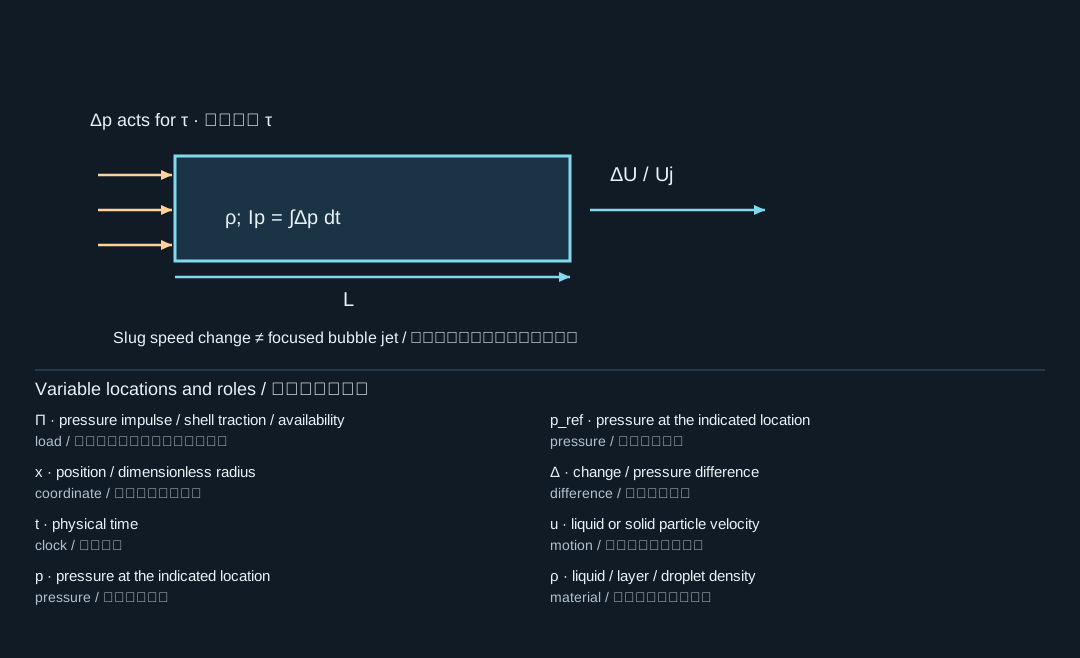
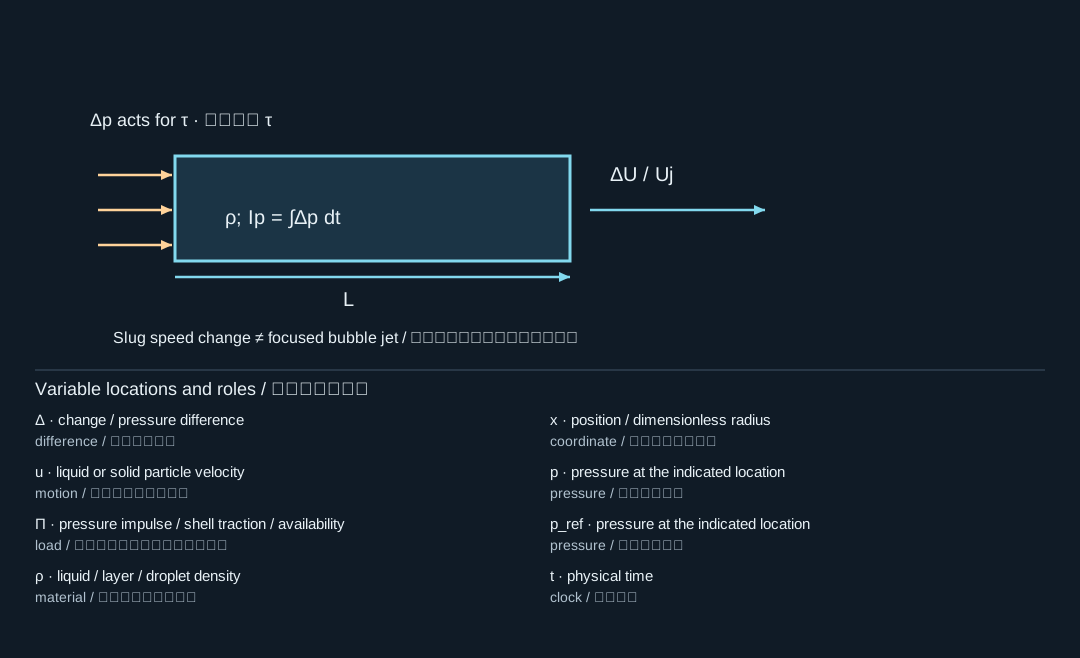
The diagram locates the physical system; its key lists the symbols in the formula. Read the definition in the surrounding derivation when a letter has different roles.
图示标出物理体系,图例列出公式中的符号。若某字母有多种作用,应以邻近推导中的定义为准。
has units of ; its spatial gradient has units of momentum per volume. In an incompressible region, taking the divergence gives , with boundary conditions that encode the loading and geometry. Thus it is the spatial variation of impulse, not just a single peak pressure, that creates the velocity field.
的单位为,其空间梯度的单位为单位体积动量。在不可压缩区域,对式(9.1)取散度可得,其边界条件包含加载与几何信息。因此,形成速度场的是冲量的空间变化,而不是某一个孤立峰值压力。
The approximation requires an appropriate scale separation. For a quasi-incompressible impulsive stage, a useful ordering is that acoustic equilibration across the region is faster than the modeled mechanical evolution. If the loading is shorter than the acoustic transit time and local wave propagation is central, do not replace that wave field by an instantaneous global pressure solution without justification.
该近似要求适当的尺度分离。对于准不可压缩冲量阶段,一个有用条件是区域内声学平衡比所研究机械演化更快。如果加载时间短于声传播时间,而且局部波传播本身十分关键,就不能未经论证将波场替换为瞬时全局压力解。
The laser-deformed-droplet paper [S250] uses pressure-impulse reasoning to explain shape change. Its tin-droplet geometry is not the same as cavitation in a liquid film. Its value here is methodological: the spatial loading profile can matter as much as total impulse.
激光变形液滴论文[S250]利用压力冲量思想解释形状变化。其锡液滴几何并不同于液膜中的空化问题。它对本书的价值在于方法论:空间加载分布的重要性可以与总冲量相当。
9.3 Impulse and energy answer different questions
冲量与能量回答不同问题
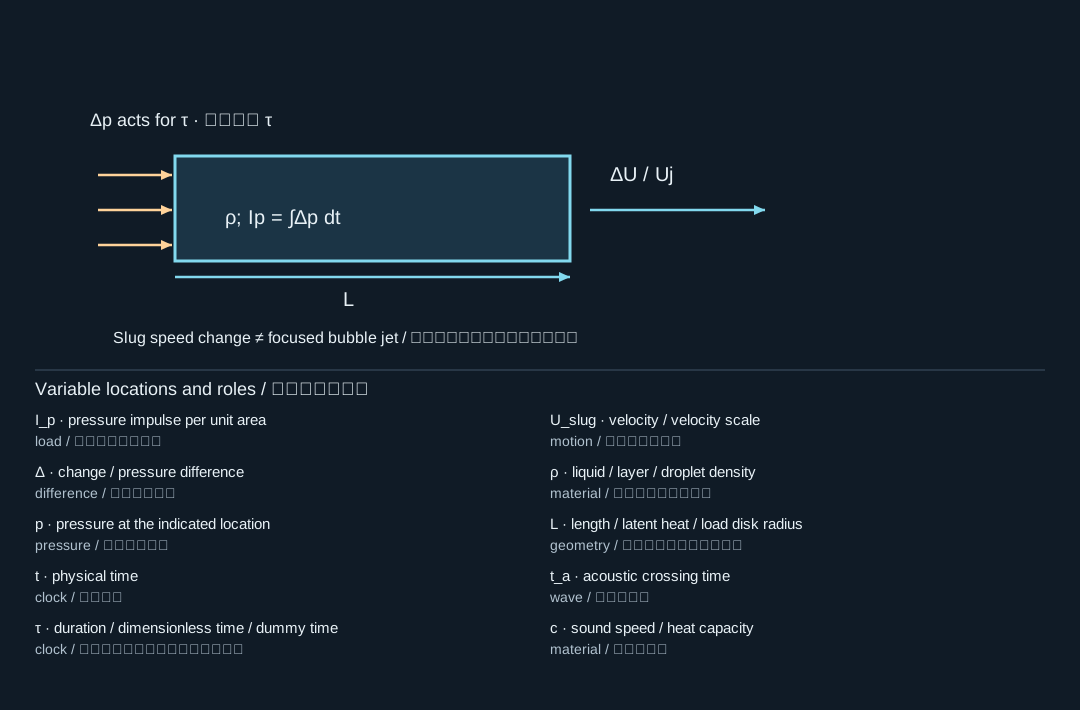
For a liquid slug of area , length , and mass , a uniform pressure difference acting for time gives . Thus , where is pressure impulse. The kinetic energy is , so equal impulse does not imply equal energy when different masses are accelerated.
对于截面积、长度、质量的液柱,均匀压差在时间内作用可给出,因此,其中为压力冲量。动能为,所以当被加速质量不同时,相同冲量不意味着相同能量。
Worked example. An idealized 100-micrometer-long water slug subjected to has at . This neglects lateral inflow, free-surface deformation, acoustic propagation, and viscous losses. It is a scale estimate, not a jet-speed prediction for an arbitrary bubble.
计算示例。密度、长度100微米的理想化水柱,在作用下有。该估计忽略侧向流入、自由面变形、声传播和黏性损失,因此只是尺度估计,而不是任意气泡体系的射流速度预测。
9.4 Capillarity and breakup
毛细作用与断裂
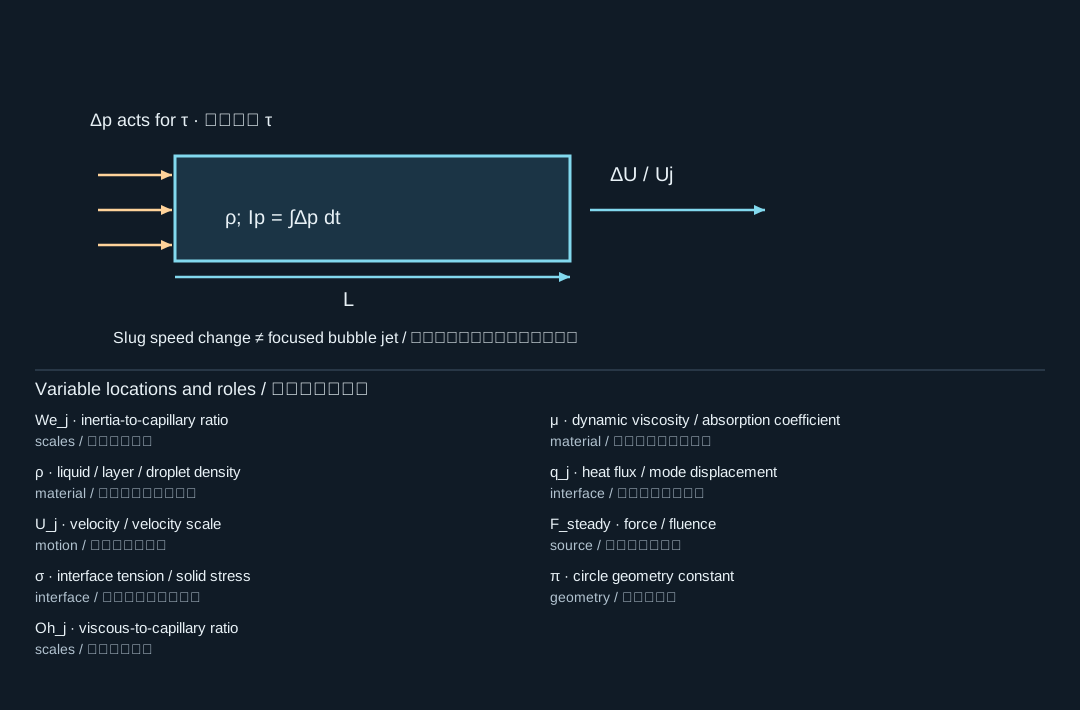
For an emerging jet of speed and diameter , define and . The Weber number compares inertia with capillarity; the Ohnesorge number compares viscous resistance with the combined inertia–capillary scale. Definitions based on radius instead of diameter differ by numerical factors, so record the length convention.
对于速度、直径的喷出射流,定义和。Weber数比较惯性与毛细作用;Ohnesorge数比较黏性阻力与惯性—毛细组合尺度。若采用半径而非直径,数值会相差固定因子,因此应明确长度定义。
A long cylindrical liquid filament can lower its surface energy by developing sufficiently long-wavelength variations of radius while conserving volume. This is the basis of capillary breakup. Viscosity, axial stretching, a finite jet head, non-Newtonian rheology, and nearby surfaces change the actual breakup pathway. There is no universal printability interval transferable unchanged between inkjet, laser-induced forward transfer, and bubble-driven ejection. [S346, S407, S410]
长柱形液丝在保持体积不变时,可以通过形成足够长波长的半径起伏降低表面能,这就是毛细断裂的基础。黏性、轴向拉伸、有限射流头、非牛顿流变和邻近表面,会改变实际断裂路径。不存在一个能够原封不动地通用于喷墨、激光诱导前向转移和气泡驱动喷射的普适可打印性区间。[S346, S407, S410]
9.5 Printing windows and failure modes
打印窗口与失效模式
The time-resolved liquid-transfer study [S346] distinguishes insufficient transfer, productive jetting, and excessive bursting or splashing as energy input changes in its apparatus. The destructive-mechanisms study [S345] identifies secondary cavitation and unwanted breakdown as routes to poor reproducibility. The correct lesson is not “more laser energy produces better printing,” but “the useful outcome occupies a mechanism-dependent window.”
时间分辨液体转移研究[S346]在其装置中区分了输入能量变化下的转移不足、有效射流,以及过度破裂或飞溅。[S345]中的破坏机制研究则指出,次生空化和非预期击穿可能降低重复性。正确结论不是“激光能量越大,打印越好”,而是“有用结果位于依赖具体机制的参数窗口内”。
Separate at least four success criteria: launch, coherent transport, receiver capture, and final placement accuracy. A successful launch is not automatically successful printing. This distinction becomes even more important when the transferred object is a solid film rather than a liquid drop.
至少应区分四个成功判据:发射、完整输运、接收面捕获和最终定位精度。发射成功不自动等于打印成功。当转移对象由液滴变为固体薄膜时,这一区分更加重要。