Core route · step 5/21 · source G05

主路线 · 第 5/21 步 · 来源 G05

Inertial collapse, energy focusing and rebound

惯性塌缩、能量集中与回弹

✓ Solved (inherited)

✓ 已完成(继承)

Completion credit carries forward from your earlier accepted answers. Covered work: ideal Rayleigh collapse-time scaling, the 0.915 coefficient, gas cushioning, and rebound limits.

完成记录沿用此前已接受的作答。已涵盖内容:理想 Rayleigh 塌缩时间的尺度关系、0.915 系数、气体缓冲及回弹的模型边界。

Source: supplied generic textbook, Chapter 5. The complete bilingual chapter follows, with its derivations and qualifications. Textbook source (Markdown) · Original Markdown.

来源:所给通用教材第 5。下方完整收录双语章节及推导和限定。教材原文(Markdown) · 原始 Markdown。

5. Inertial collapse, energy focusing, and rebound5.1 The empty-cavity idealization5.2 Integrating once5.3 The Rayleigh collapse time5.4 The near-collapse power law5.5 Why real bubbles rebound5.6 A conserved mechanical quantity for testing

5. Inertial collapse, energy focusing, and rebound

惯性塌缩、能量集中与回弹

5.1 The empty-cavity idealization

空腔理想化

To isolate liquid inertia, consider a spherical cavity that begins at rest at R=Rmax⁡R=R_{\max}. Neglect gas pressure, surface tension, viscosity, and compressibility. Let vapor pressure remain constant and let Δp=p∞−pv>0\Delta p=p_\infty-p_v>0. The radial equation becomes

为单独研究液体惯性,考虑一个从R=Rmax⁡R=R_{\max}处静止开始的球形空腔。忽略气体压力、表面张力、黏性和可压缩性。设蒸气压恒定,且Δp=p∞−pv>0\Delta p=p_\infty-p_v>0,则径向方程化为

RR¨+32R˙2=−Δpρ.(5.1)R\ddot R+\frac32\dot R^2=-\frac{\Delta p}{\rho}. \tag{5.1}
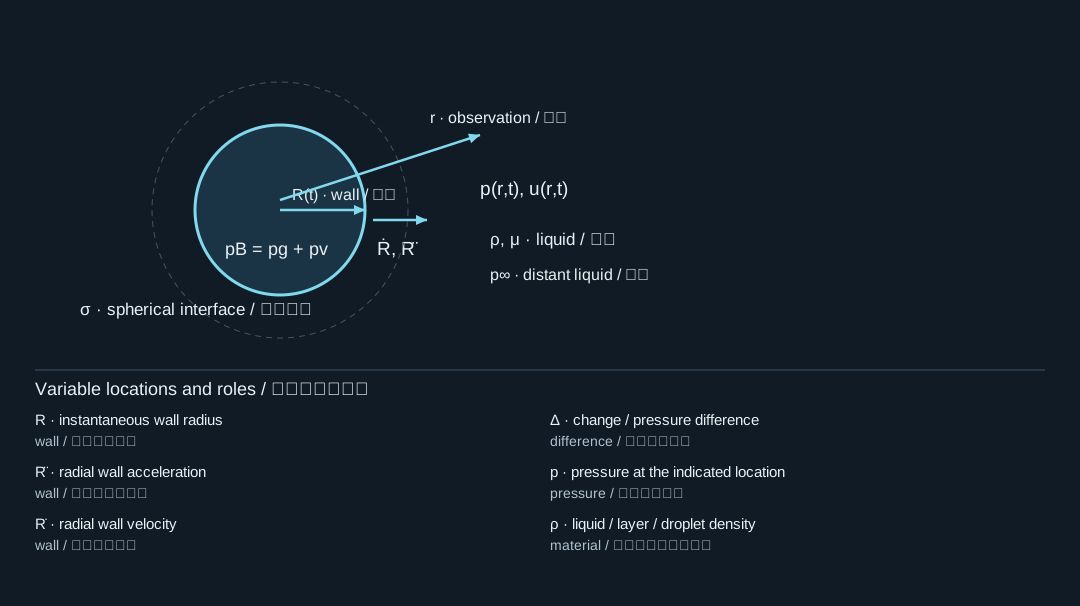
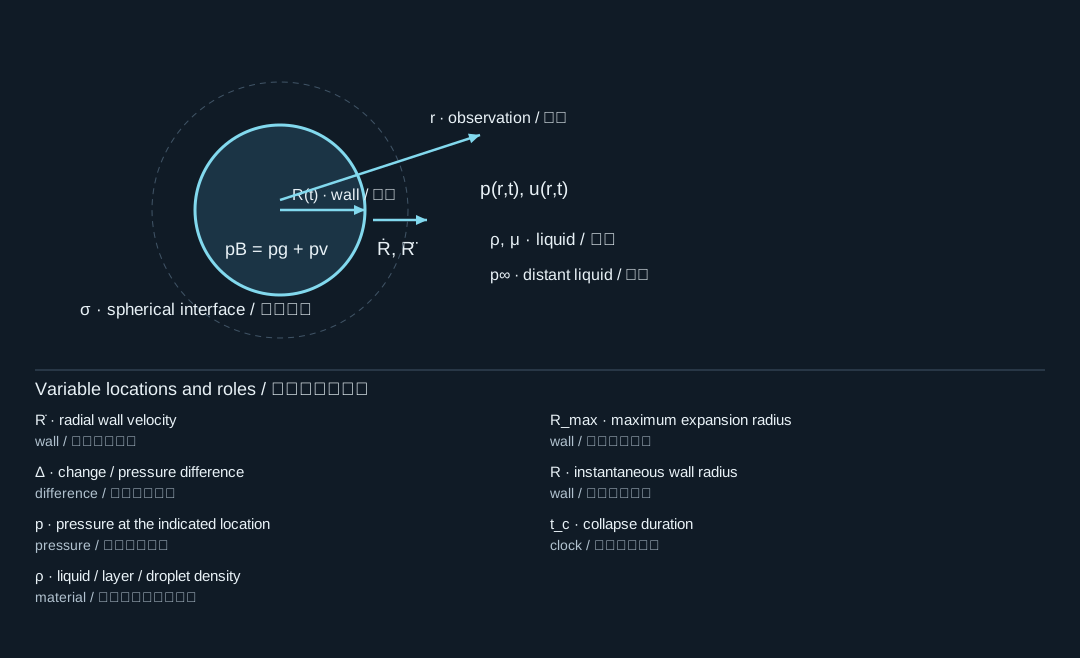
5.1 The empty-cavity idealization / 空腔理想化; R: instantaneous wall radius; R̈: radial wall acceleration; Ṙ: radial wall velocity; Δ: change / pressure difference; p: pressure at the indicated location; ρ: liquid / layer / droplet density

The diagram locates the physical system; its key lists the symbols in the formula. Read the definition in the surrounding derivation when a letter has different roles.

图示标出物理体系,图例列出公式中的符号。若某字母有多种作用,应以邻近推导中的定义为准。

This is a limit problem, not a literal assertion that a laboratory bubble has no contents. Its value is that it produces an analytic benchmark and exposes the singular nature of idealized collapse. The spherical-collapse framework and its physical limitations are central themes of the classical and compressible-bubble papers in your archive. [S419, S409]

这是一个极限模型,并不是说实验室中的气泡内部真正空无一物。它的价值在于提供解析基准,并揭示理想化塌缩的奇异性。球形塌缩理论及其物理局限,是你所提供经典理论与可压缩气泡论文的重要主题。[S419, S409]

5.2 Integrating once

第一次积分

Write y(R)=R˙2y(R)=\dot R^2, so R¨=12dy/dR\ddot R=\tfrac12dy/dR along a monotonic branch. Equation (5.1) becomes Ry′+3y=−2Δp/ρR y'+3y=-2\Delta p/\rho. Multiplication by R2R^2 gives an exact derivative. Applying y(Rmax⁡)=0y(R_{\max})=0 yields

在单调运动分支上,令y(R)=R˙2y(R)=\dot R^2,则R¨=12dy/dR\ddot R=\tfrac12dy/dR。式(5.1)变为Ry′+3y=−2Δp/ρRy'+3y=-2\Delta p/\rho。两边乘以R2R^2,即可构成全导数。利用y(Rmax⁡)=0y(R_{\max})=0,得到

R˙2=2Δp3ρ[(Rmax⁡R)3−1].(5.2)\dot R^2=\frac{2\Delta p}{3\rho} \left[\left(\frac{R_{\max}}{R}\right)^3-1\right]. \tag{5.2}
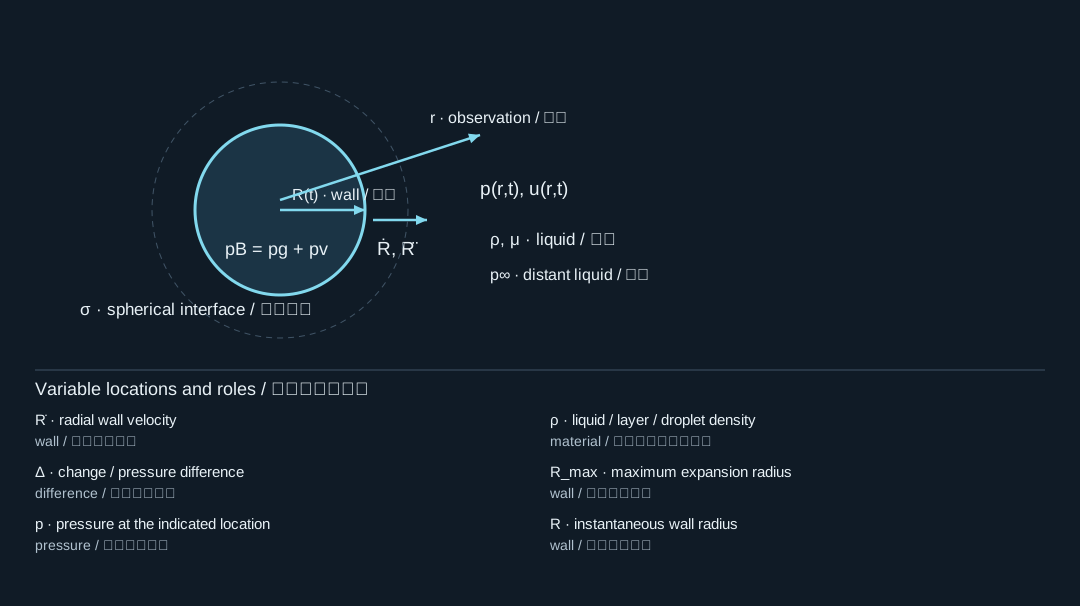
5.2 Integrating once / 第一次积分; Ṙ: radial wall velocity; Δ: change / pressure difference; p: pressure at the indicated location; ρ: liquid / layer / droplet density; R_max: maximum expansion radius; R: instantaneous wall radius

The diagram locates the physical system; its key lists the symbols in the formula. Read the definition in the surrounding derivation when a letter has different roles.

图示标出物理体系,图例列出公式中的符号。若某字母有多种作用,应以邻近推导中的定义为准。

Choose the negative square root during collapse. The speed is not constant; it accelerates strongly as the cavity becomes smaller. The same result follows from equating liquid kinetic energy to the pressure work released by the loss of cavity volume:

塌缩阶段应取负平方根。界面速度不是常数,而是随着空腔变小而迅速增大。同一结果也可以由液体动能等于空腔体积减少所释放的压力功得到:
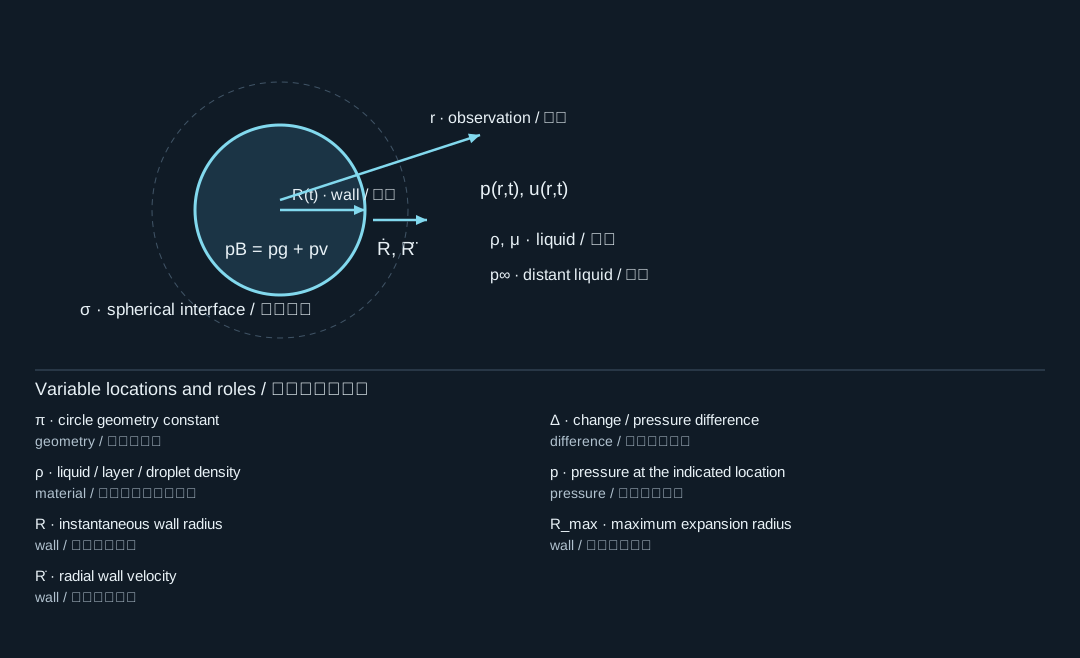
2πρR3R˙2=4π3Δp (Rmax⁡3−R3).(5.3)2\pi\rho R^3\dot R^2 =\frac{4\pi}{3}\Delta p\,(R_{\max}^3-R^3). \tag{5.3}
5.2 Integrating once / 第一次积分; π: circle geometry constant; ρ: liquid / layer / droplet density; R: instantaneous wall radius; Ṙ: radial wall velocity; Δ: change / pressure difference; p: pressure at the indicated location; R_max: maximum expansion radius

The diagram locates the physical system; its key lists the symbols in the formula. Read the definition in the surrounding derivation when a letter has different roles.

图示标出物理体系,图例列出公式中的符号。若某字母有多种作用,应以邻近推导中的定义为准。

The right-hand side remains finite as R→0R\to0, but the effective radial mass tends to zero. The model therefore places finite energy into an ever-smaller region with unbounded speed. That is energy focusing within a singular idealization, not a prediction that real water reaches infinite velocity.

当R→0R\to0时,右端保持有限,但有效径向质量趋于零。因此,该模型将有限能量集中到越来越小的区域,并给出无界速度。这是奇异理想化中的能量集中,而不是对真实水能够达到无限速度的预测。

5.3 The Rayleigh collapse time

Rayleigh塌缩时间

Let x=R/Rmax⁡x=R/R_{\max}. Integrating dt=−dR/∣R˙∣dt=-dR/|\dot R| from x=1x=1 to zero gives

令x=R/Rmax⁡x=R/R_{\max},将dt=−dR/∣R˙∣dt=-dR/|\dot R|从x=1x=1积分至零,得到

tc=Rmax⁡3ρ2Δp∫01x3/21−x3 dx=0.914681… Rmax⁡ρΔp.(5.4)t_c=R_{\max}\sqrt{\frac{3\rho}{2\Delta p}} \int_0^1\frac{x^{3/2}}{\sqrt{1-x^3}}\,dx =0.914681\ldots\,R_{\max}\sqrt{\frac{\rho}{\Delta p}}. \tag{5.4}
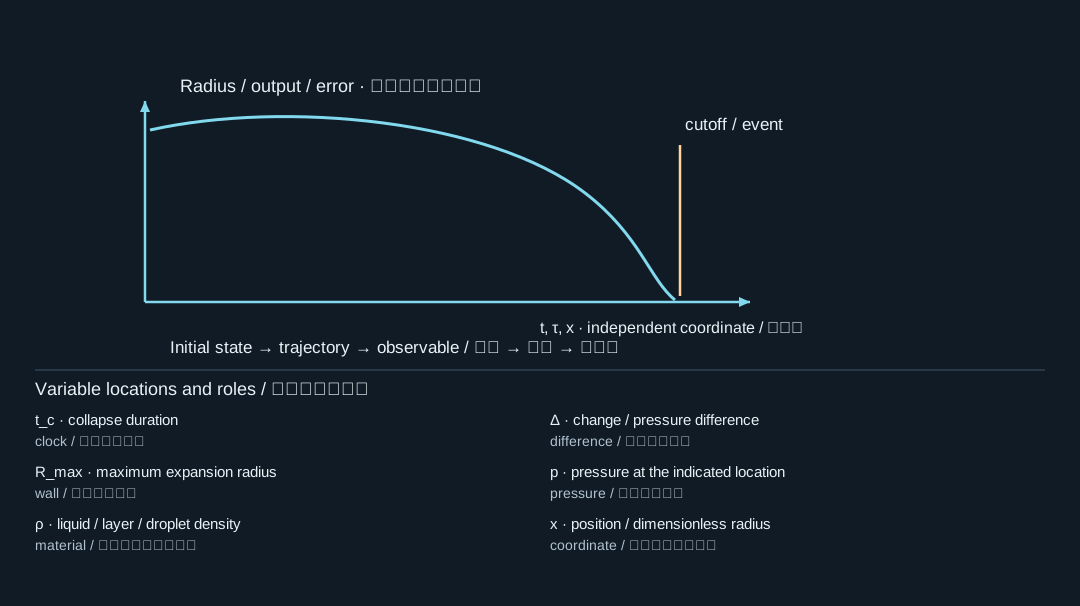
5.3 The Rayleigh collapse time / Rayleigh塌缩时间; t_c: collapse duration; R_max: maximum expansion radius; ρ: liquid / layer / droplet density; Δ: change / pressure difference; p: pressure at the indicated location; x: position / dimensionless radius

The diagram locates the physical system; its key lists the symbols in the formula. Read the definition in the surrounding derivation when a letter has different roles.

图示标出物理体系,图例列出公式中的符号。若某字母有多种作用,应以邻近推导中的定义为准。

The substitution z=x3z=x^3 turns the integral into 13B(5/6,1/2)\tfrac13 B(5/6,1/2), where BB is the beta function. The numerical coefficient is therefore not a fitted empirical constant. It follows from the stated assumptions.

作代换z=x3z=x^3,积分变为13B(5/6,1/2)\tfrac13B(5/6,1/2),其中BB为Beta函数。因此,这个数值系数不是实验拟合常数,而是由所列假设推导得到的结果。

Worked example. Use the teaching water values ρ=998 kg m−3\rho=998\ \mathrm{kg\,m^{-3}}, p∞=101325 Pap_\infty=101325\ \mathrm{Pa}, and pv=2339 Pap_v=2339\ \mathrm{Pa}. For Rmax⁡=100 μmR_{\max}=100\ \mu\mathrm m, Δp=98986 Pa\Delta p=98986\ \mathrm{Pa} and tc=9.184 μst_c=9.184\ \mu\mathrm s. The volume-work scale is ΔpVmax⁡=0.4146 μJ\Delta pV_{\max}=0.4146\ \mu\mathrm J. These are calculations for a chosen idealized parameter set, not measurements from a supplied paper.

计算示例。采用教学水参数ρ=998 kg m−3\rho=998\ \mathrm{kg\,m^{-3}}、p∞=101325 Pap_\infty=101325\ \mathrm{Pa}和pv=2339 Pap_v=2339\ \mathrm{Pa}。当Rmax⁡=100 μmR_{\max}=100\ \mu\mathrm m时,Δp=98986 Pa\Delta p=98986\ \mathrm{Pa},且tc=9.184 μst_c=9.184\ \mu\mathrm s。体积压力功尺度为ΔpVmax⁡=0.4146 μJ\Delta pV_{\max}=0.4146\ \mu\mathrm J。这些是所选理想化参数下的教学计算,而非所提供论文中的实验测量。

The capillary pressure at that maximum radius is 2σ/Rmax⁡=1440 Pa2\sigma/R_{\max}=1440\ \mathrm{Pa} for σ=0.072 N m−1\sigma=0.072\ \mathrm{N\,m^{-1}}, only about 1.5% of Δp\Delta p. Nevertheless, it increases as RR shrinks. A term negligible at maximum radius need not remain negligible throughout collapse.

若σ=0.072 N m−1\sigma=0.072\ \mathrm{N\,m^{-1}},该最大半径处的毛细压力为2σ/Rmax⁡=1440 Pa2\sigma/R_{\max}=1440\ \mathrm{Pa},仅约为Δp\Delta p的1.5%。但它会随着RR减小而增大。在最大半径处可以忽略的项,不一定在整个塌缩过程中都可以忽略。

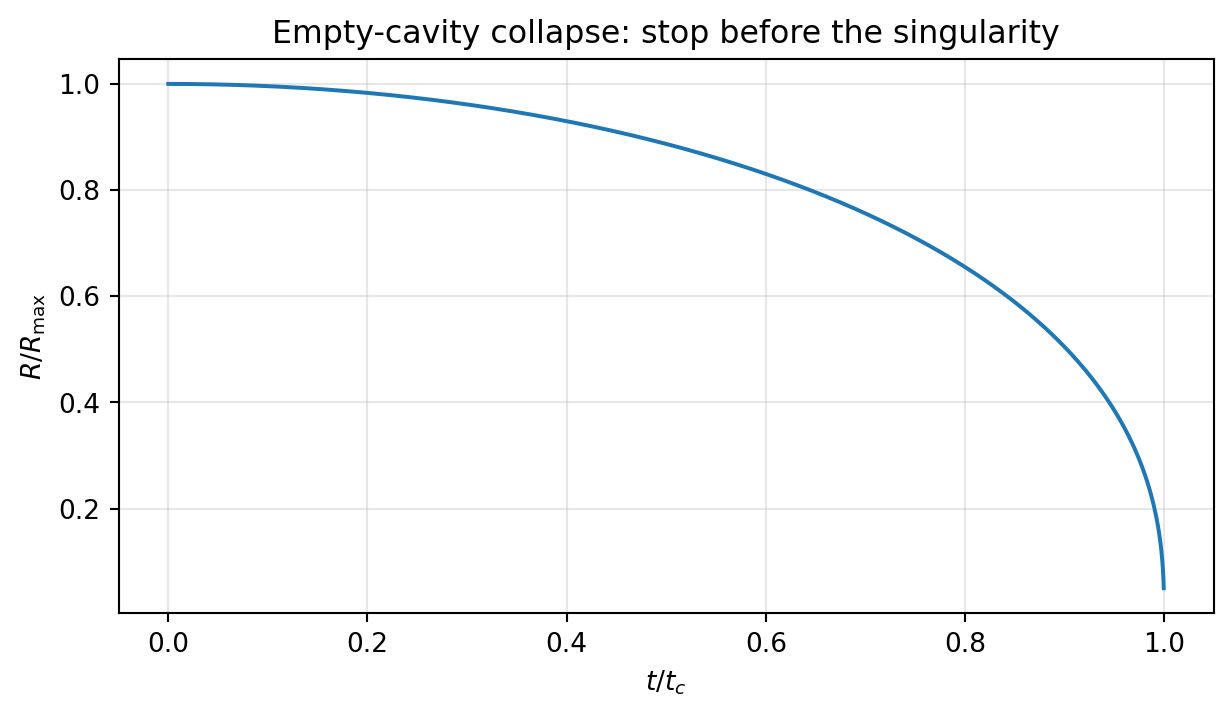
Numerical empty-cavity collapse normalized by the analytic collapse time, stopped at a finite radius. / 用解析塌缩时间归一化的空腔塌缩数值结果,在有限半径处停止。

Numerical empty-cavity collapse normalized by the analytic collapse time, stopped at a finite radius.

用解析塌缩时间归一化的空腔塌缩数值结果,在有限半径处停止。

5.4 The near-collapse power law

接近塌缩时的幂律

For R≪Rmax⁡R\ll R_{\max}, equation (5.2) gives R˙≃−KR−3/2\dot R\simeq-KR^{-3/2} with K=2ΔpRmax⁡3/(3ρ)K=\sqrt{2\Delta pR_{\max}^3/(3\rho)}. Integration then gives

当R≪Rmax⁡R\ll R_{\max}时,式(5.2)给出R˙≃−KR−3/2\dot R\simeq-KR^{-3/2},其中K=2ΔpRmax⁡3/(3ρ)K=\sqrt{2\Delta pR_{\max}^3/(3\rho)}。再次积分得

R≃[52K(tc−t)]2/5.(5.5)R\simeq\left[\frac52K(t_c-t)\right]^{2/5}. \tag{5.5}
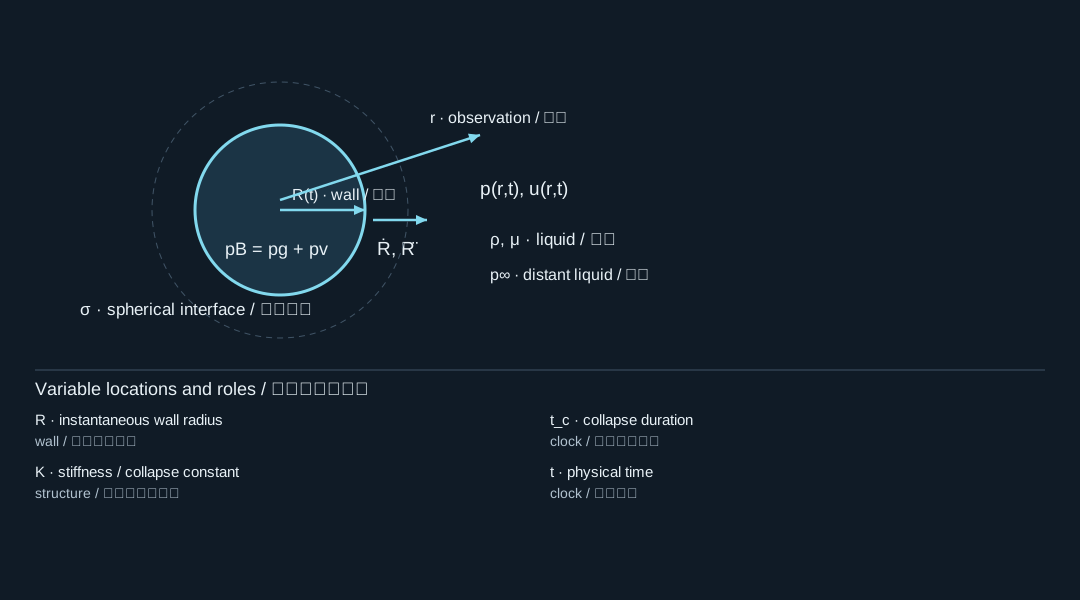
5.4 The near-collapse power law / 接近塌缩时的幂律; R: instantaneous wall radius; K: stiffness / collapse constant; t_c: collapse duration; t: physical time

The diagram locates the physical system; its key lists the symbols in the formula. Read the definition in the surrounding derivation when a letter has different roles.

图示标出物理体系,图例列出公式中的符号。若某字母有多种作用,应以邻近推导中的定义为准。

The exponent 2/52/5 is a useful asymptotic signature of this particular spherical, incompressible, inertia-dominated limit. It should not be applied automatically to a cylindrical cavity, a strongly nonspherical bubble, or a vapor bubble whose heat transfer controls its final dynamics.

指数2/52/5是这一球形、不可压缩、惯性主导极限的一个有用渐近特征。不能将它自动套用到柱形空腔、强非球形气泡,或者末期运动受传热控制的蒸气泡。

5.5 Why real bubbles rebound

真实气泡为何回弹

Noncondensable gas becomes strongly compressed as the bubble contracts. Its pressure eventually opposes collapse and may drive rebound. Vapor condensation, liquid compressibility, outgoing sound, viscosity, heat transfer, and jet formation influence how much energy remains available for rebound. A measured rebound radius is therefore information about losses and contents, not merely a second copy of the first oscillation. [S409, S339]

气泡收缩时,不凝性气体被强烈压缩,其压力最终抵抗塌缩,并可能驱动回弹。蒸气凝结、液体可压缩性、向外传播的声波、黏性、传热以及射流形成,都会影响回弹可利用的剩余能量。因此,测得的回弹半径包含损失和泡内组分信息,而不是第一次振动的简单重复。[S409, S339]

A rough estimate based on successive maximum radii is E2/E1≈(Rmax⁡,2/Rmax⁡,1)3E_2/E_1\approx(R_{\max,2}/R_{\max,1})^3 when the same pressure-work approximation is appropriate for both maxima. It is not an exact acoustic-energy fraction. Surface energy, residual gas energy, changing vapor content, and nonspherical motion can invalidate the shortcut.

如果两个最大半径时刻都适用相同压力功近似,可粗略估计E2/E1≈(Rmax⁡,2/Rmax⁡,1)3E_2/E_1\approx(R_{\max,2}/R_{\max,1})^3。但这不是精确的声能比例。表面能、残余气体能量、蒸气含量变化以及非球形运动,都可能使这一简化失效。

5.6 A conserved mechanical quantity for testing

用于检验的守恒力学量

For constant p∞=p0p_\infty=p_0 and pvp_v, with fixed polytropic gas content and κ≠1\kappa\ne1, define

对于恒定的p∞=p0p_\infty=p_0和pvp_v,以及固定多方气体含量,当κ≠1\kappa\ne1时,定义

E=2πρR3R˙2+(p0−pv)V+4πσR2+pgVκ−1.(5.6)\mathcal E=2\pi\rho R^3\dot R^2+(p_0-p_v)V +4\pi\sigma R^2+\frac{p_gV}{\kappa-1}. \tag{5.6}
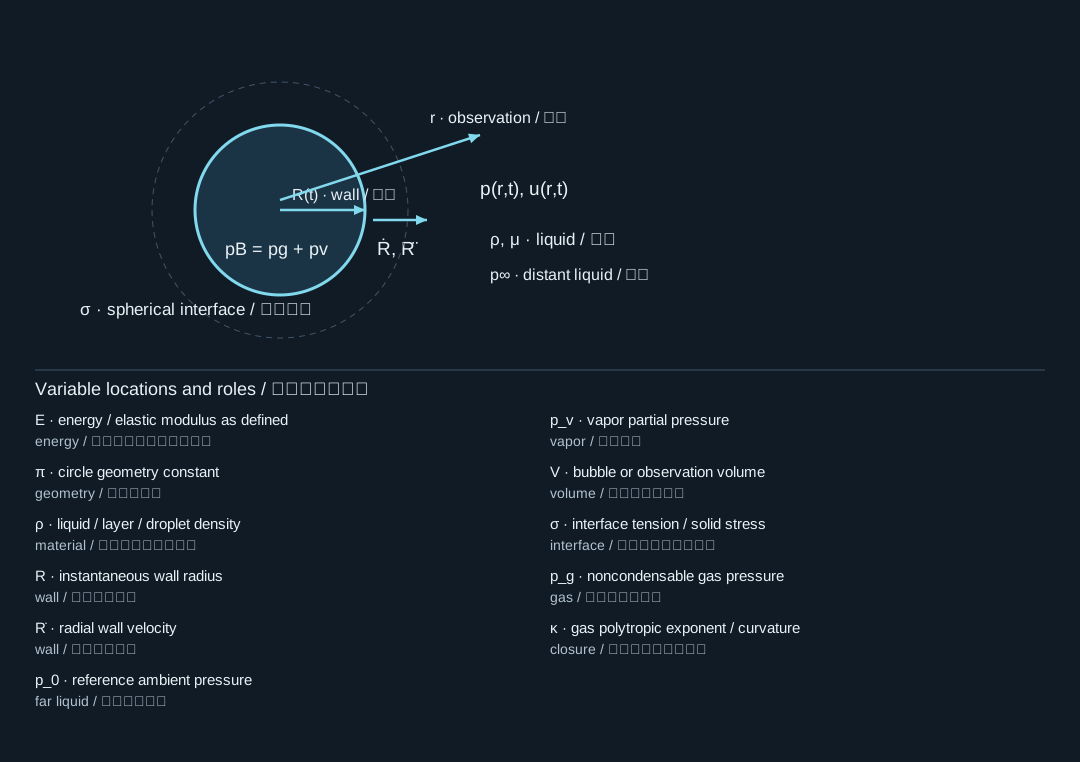
5.6 A conserved mechanical quantity for testing / 用于检验的守恒力学量; E: energy / elastic modulus as defined; π: circle geometry constant; ρ: liquid / layer / droplet density; R: instantaneous wall radius; Ṙ: radial wall velocity; p_0: reference ambient pressure; p_v: vapor partial pressure; V: bubble or observation volume; σ: interface tension / solid stress; p_g: noncondensable gas pressure; κ: gas polytropic exponent / curvature

The diagram locates the physical system; its key lists the symbols in the formula. Read the definition in the surrounding derivation when a letter has different roles.

图示标出物理体系,图例列出公式中的符号。若某字母有多种作用,应以邻近推导中的定义为准。

Then dE/dt=−16πμRR˙2d\mathcal E/dt=-16\pi\mu R\dot R^2. In the inviscid model it is constant. For κ=1\kappa=1, replace the last term by −pg0V0ln⁡(V/V0)-p_{g0}V_0\ln(V/V_0), up to an arbitrary additive constant. The gas term is a reversible mechanical potential for the chosen pressure law; it equals the usual ideal-gas internal energy only under the appropriate adiabatic thermodynamic interpretation.

于是dE/dt=−16πμRR˙2d\mathcal E/dt=-16\pi\mu R\dot R^2,在无黏模型中该量守恒。当κ=1\kappa=1时,将最后一项替换为−pg0V0ln⁡(V/V0)-p_{g0}V_0\ln(V/V_0),允许相差任意加法常数。这里的气体项是所选压力定律对应的可逆力学势;只有在适当的绝热热力学解释下,它才等于通常的理想气体内能。
Integrated calculation and model check

综合计算与模型检查

Use the declared parameter set in each part. The values are teaching scenarios unless specifically identified as inherited project inputs. Each reference panel follows its question.

使用每小题明确给出的参数。除明确标为沿用项目输入外,数值均为教学情景。各参考解答紧随题目。

  1. Starting from a stationary empty cavity of Rmax = 100 µm, derive the once-integrated speed and compute the ideal collapse time. Use ρ = 998 and Δp = 98,986 in SI units.

    从静止的 Rmax = 100 µm 空腔出发,推导一次积分速度并计算理想塌缩时间。使用 SI 单位的 ρ = 998 与 Δp = 98,986。

    Reference answer / 参考答案
    RR¨+32R˙2=−Δp/ρ,R˙2=2Δp3ρ[(Rmax⁡/R)3−1],tc=Rmax⁡ρ/Δp32∫01x3/21−x3dxR\ddot R+\tfrac32\dot R^2=-\Delta p/\rho,\quad \dot R^2=\frac{2\Delta p}{3\rho}\left[(R_{\max}/R)^3-1\right],\quad t_c=R_{\max}\sqrt{\rho/\Delta p}\sqrt{\tfrac32}\int_0^1\frac{x^{3/2}}{\sqrt{1-x^3}}dx
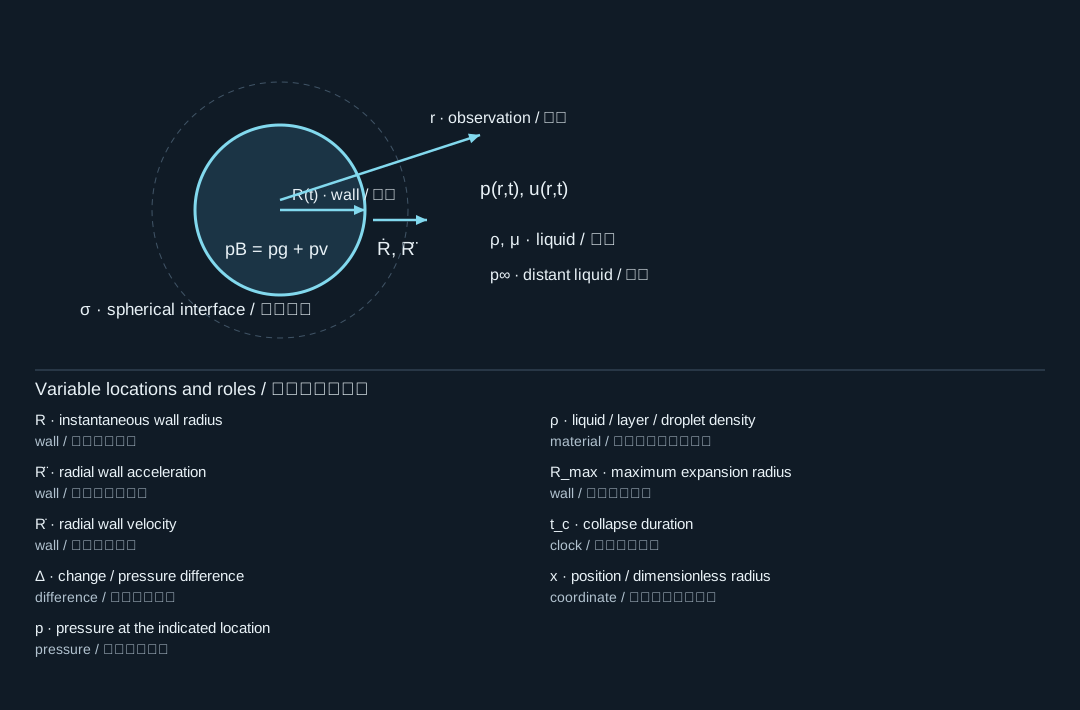
    Inertial collapse, energy focusing and rebound · original governing laws; R: instantaneous wall radius; R̈: radial wall acceleration; Ṙ: radial wall velocity; Δ: change / pressure difference; p: pressure at the indicated location; ρ: liquid / layer / droplet density; R_max: maximum expansion radius; t_c: collapse duration; x: position / dimensionless radius

    The diagram locates the physical system; its key lists the symbols in the formula. Read the definition in the surrounding derivation when a letter has different roles.

    图示标出物理体系,图例列出公式中的符号。若某字母有多种作用,应以邻近推导中的定义为准。

    Set v = Ṙ² so R̈ = (1/2)dv/dR. Multiplying Rv′+3v = −2Δp/ρ by R² makes a derivative of R³v; integrate from Rmax with v = 0. The integral coefficient is 0.9146813565, giving tc = 9.184 µs. It is a solved ideal limit, not a fitted coefficient.

    令 v = Ṙ²,则 R̈ = (1/2)dv/dR。对 Rv′+3v = −2Δp/ρ 乘以 R²,左端变为 R³v 的导数;从 v = 0 的 Rmax 积分。积分系数为 0.9146813565,得到 tc = 9.184 µs。这是理想极限的解,并非拟合系数。

  2. Compute wall speed at Rmax/2 and the time after quadrupling Δp. What does the zero-radius limit omit?

    计算 Rmax/2 处壁面速度及 Δp 增至四倍后的塌缩时间。零半径极限遗漏了什么?

    Reference answer / 参考答案
    R˙=−2Δp3ρ[(Rmax⁡/R)3−1],tc∝Δp−1/2\dot R=-\sqrt{\frac{2\Delta p}{3\rho}[(R_{\max}/R)^3-1]},\qquad t_c\propto\Delta p^{-1/2}
    Inertial collapse, energy focusing and rebound · original governing laws; Ṙ: radial wall velocity; Δ: change / pressure difference; p: pressure at the indicated location; ρ: liquid / layer / droplet density; R_max: maximum expansion radius; R: instantaneous wall radius; t_c: collapse duration

    The diagram locates the physical system; its key lists the symbols in the formula. Read the definition in the surrounding derivation when a letter has different roles.

    图示标出物理体系,图例列出公式中的符号。若某字母有多种作用,应以邻近推导中的定义为准。

    Ṙ = −21.514 m/s at half radius; quadrupling Δp gives 4.592 µs, with the same ideal coefficient. Gas cushioning, compressibility, heat and mass transfer, and nonspherical jet formation intervene before the singular limit. The ideal equation has no finite universal maximum speed.

    半径减半处 Ṙ = −21.514 m/s;Δp 增至四倍后时间为 4.592 µs,理想系数不变。气体缓冲、可压缩性、传热传质及非球形射流在奇异极限前介入。理想方程不存在有限普适最大速度。

  3. For viscous RP motion, state the energy identity that a solver should satisfy and the corresponding isothermal gas potential.

    对于含黏性的 RP 运动,写出求解器应满足的能量恒等式及等温气体势能。

    Reference answer / 参考答案
    E=2πρR3R˙2+(p0−pv)V+4πσR2+Wg,E˙=−16πμRR˙2,Wg,κ=1=−pg0V0ln⁡(V/V0)E=2\pi\rho R^3\dot R^2+(p_0-p_v)V+4\pi\sigma R^2+W_g,\quad \dot E=-16\pi\mu R\dot R^2,\quad W_{g,\kappa=1}=-p_{g0}V_0\ln(V/V_0)
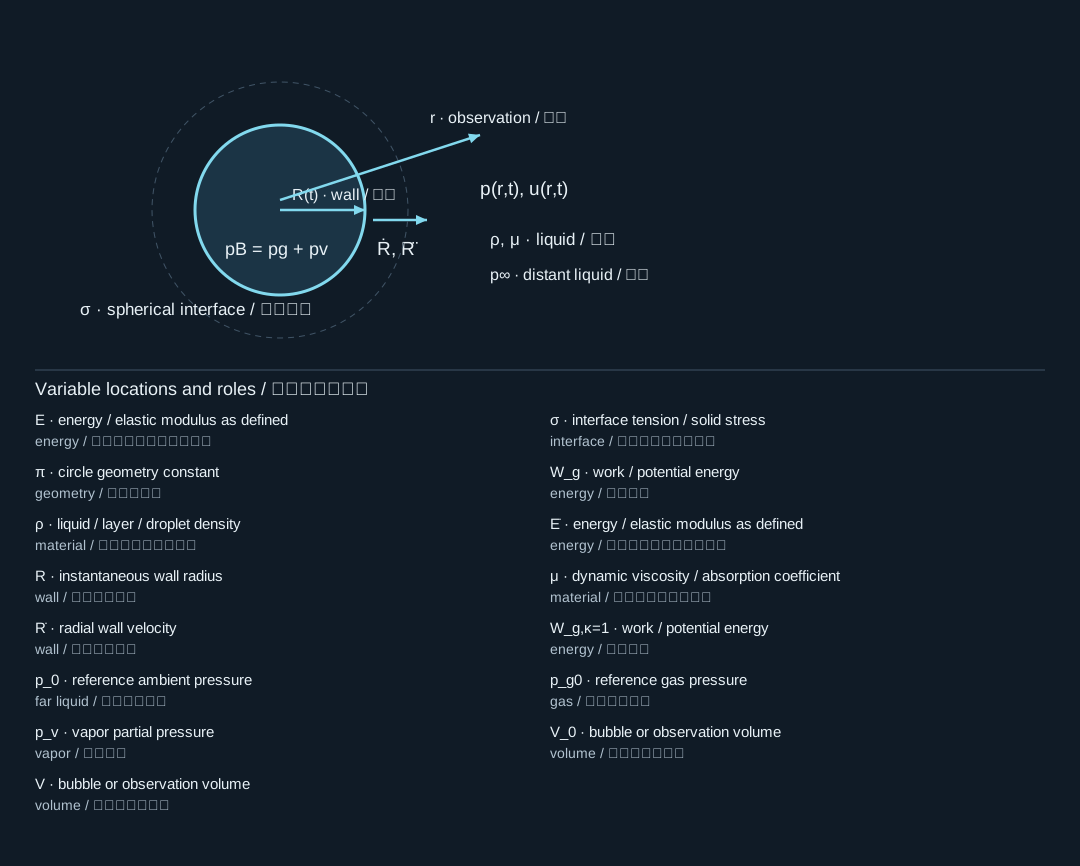
    Inertial collapse, energy focusing and rebound · original governing laws; E: energy / elastic modulus as defined; π: circle geometry constant; ρ: liquid / layer / droplet density; R: instantaneous wall radius; Ṙ: radial wall velocity; p_0: reference ambient pressure; p_v: vapor partial pressure; V: bubble or observation volume; σ: interface tension / solid stress; W_g: work / potential energy; Ė: energy / elastic modulus as defined; μ: dynamic viscosity / absorption coefficient; W_g,κ=1: work / potential energy; p_g0: reference gas pressure; V_0: bubble or observation volume

    The diagram locates the physical system; its key lists the symbols in the formula. Read the definition in the surrounding derivation when a letter has different roles.

    图示标出物理体系,图例列出公式中的符号。若某字母有多种作用,应以邻近推导中的定义为准。

    The dissipation rate is nonpositive for μ ≥ 0. Compare E(t)−E(0)+∫16πμRṘ²dt with zero. For κ ≠ 1 use Wg = pgV/(κ−1); its divergent additive constant as κ→1 must be removed before taking the logarithmic limit.

    μ ≥ 0 时耗散导致能量变化率非正。应将 E(t)−E(0)+∫16πμRṘ²dt 与零比较。κ ≠ 1 时使用 Wg = pgV/(κ−1);取 κ→1 的对数极限前,须去除发散加性常数。

Brief conceptual synthesis

简短概念综合

After using the reference panels, give a short explanation of the physical mechanism, the strongest assumption, and one observation that could falsify this chapter’s model. Preparation of later chapters does not require waiting for that reply.

核对参考解答后,简述物理机制、最强假设,以及一个可证伪本章模型的观测。后续章节编写无需等待该回答。