Core route · step 3/21 · source G03

主路线 · 第 3/21 步 · 来源 G03

Deriving Rayleigh–Plesset

推导 Rayleigh–Plesset 方程

✓ Solved (inherited)

✓ 已完成(继承)

Completion credit carries forward from your earlier accepted answers. Covered work: spherical continuity, radius-dependent liquid inertia, and the signed Rayleigh–Plesset pressure balance.

完成记录沿用此前已接受的作答。已涵盖内容:球形连续性、随半径变化的液体惯性及 Rayleigh–Plesset 压力平衡各项的符号。

Source: supplied generic textbook, Chapter 3. The complete bilingual chapter follows, with its derivations and qualifications. Textbook source (Markdown) · Original Markdown.

来源:所给通用教材第 3。下方完整收录双语章节及推导和限定。教材原文(Markdown) · 原始 Markdown。

3. Deriving the Rayleigh–Plesset equation3.1 Assumptions before algebra3.2 Continuity determines the velocity field3.3 Bernoulli produces the inertia terms3.4 Normal stress supplies capillarity and viscosity3.5 Closing the equation3.6 The same equation from theoretical mechanics

3. Deriving the Rayleigh–Plesset equation

推导Rayleigh–Plesset方程

3.1 Assumptions before algebra

先写假设,再做代数

Assume an isolated spherical bubble in an infinite, incompressible Newtonian liquid of constant density ρ\rho and viscosity μ\mu. The liquid is spherically symmetric and at rest infinitely far away. Ignore gravity, translation, neighboring bubbles, and interfacial mass flux in the kinematic condition. Let the gas pressure be spatially uniform and surface tension constant. These assumptions—not the name of the equation—define the baseline model. The classical spherical-cavity framework is represented in your archive by Plesset's paper; later closures and extensions add gas, viscosity, and compressibility as needed. [S419, S413]

假设一个孤立球形气泡位于密度ρ\rho、黏度μ\mu恒定的无限大不可压缩牛顿液体中。液体运动具有球对称性,无穷远处静止。忽略重力、平移、邻近气泡,并在运动学条件中忽略界面质量通量。泡内压力空间均匀,表面张力恒定。定义基础模型的是这些假设,而不是方程名称。你提供的Plesset论文代表了经典球形空腔理论框架;后续闭合与扩展根据需要加入气体、黏性和可压缩性。[S419, S413]

3.2 Continuity determines the velocity field

连续性决定速度场

For radial liquid velocity u(r,t)u(r,t), incompressibility gives r−2∂r(r2u)=0r^{-2}\partial_r(r^2u)=0. Therefore r2u=A(t)r^2u=A(t). With u(R,t)=R˙u(R,t)=\dot R, we obtain

对于液体径向速度u(r,t)u(r,t),不可压缩条件给出r−2∂r(r2u)=0r^{-2}\partial_r(r^2u)=0,因此r2u=A(t)r^2u=A(t)。代入u(R,t)=R˙u(R,t)=\dot R,得到

u(r,t)=R2R˙r2,ϕ(r,t)=−R2R˙r,u=∂rϕ.(3.1)u(r,t)=\frac{R^2\dot R}{r^2},\qquad \phi(r,t)=-\frac{R^2\dot R}{r},\qquad u=\partial_r\phi. \tag{3.1}
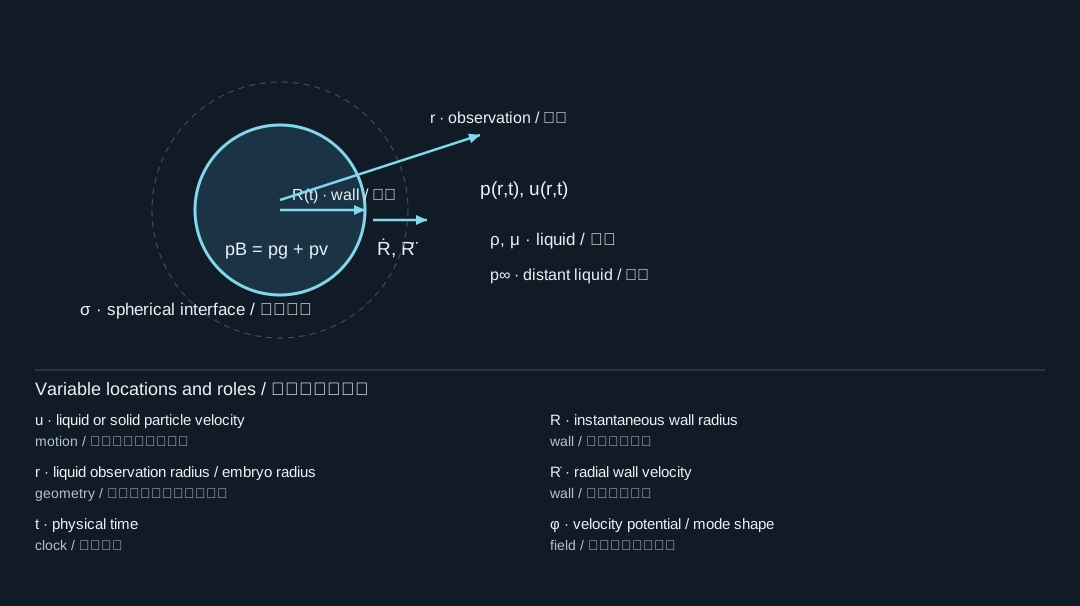
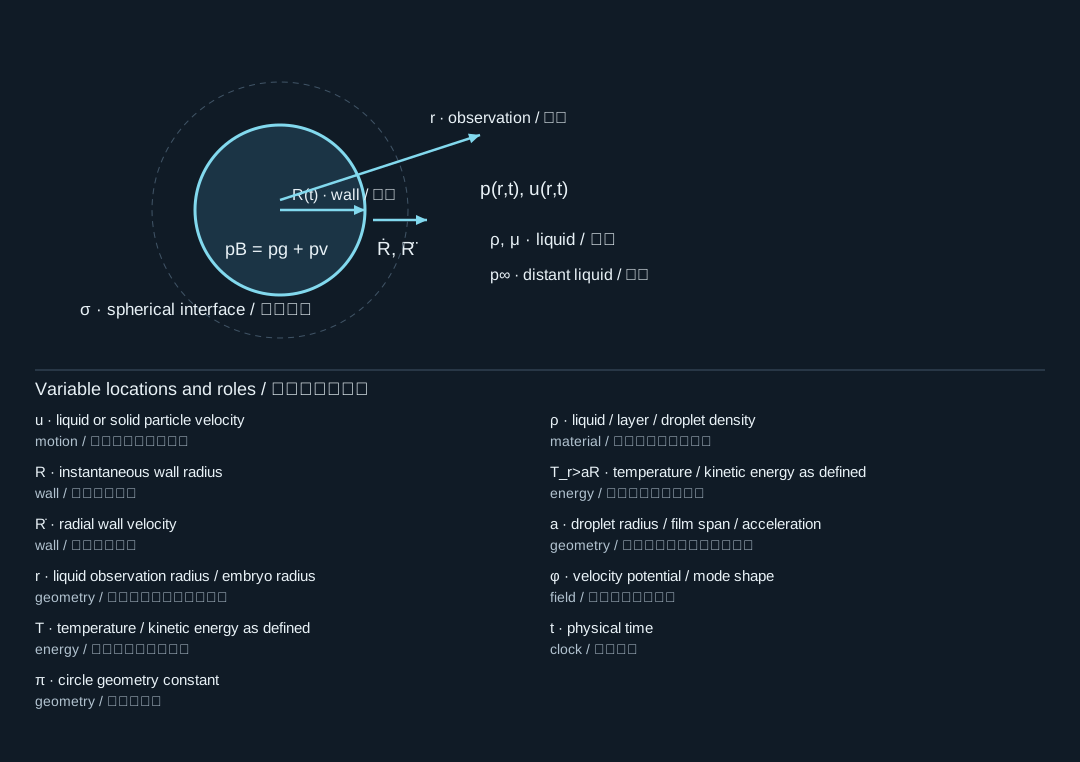
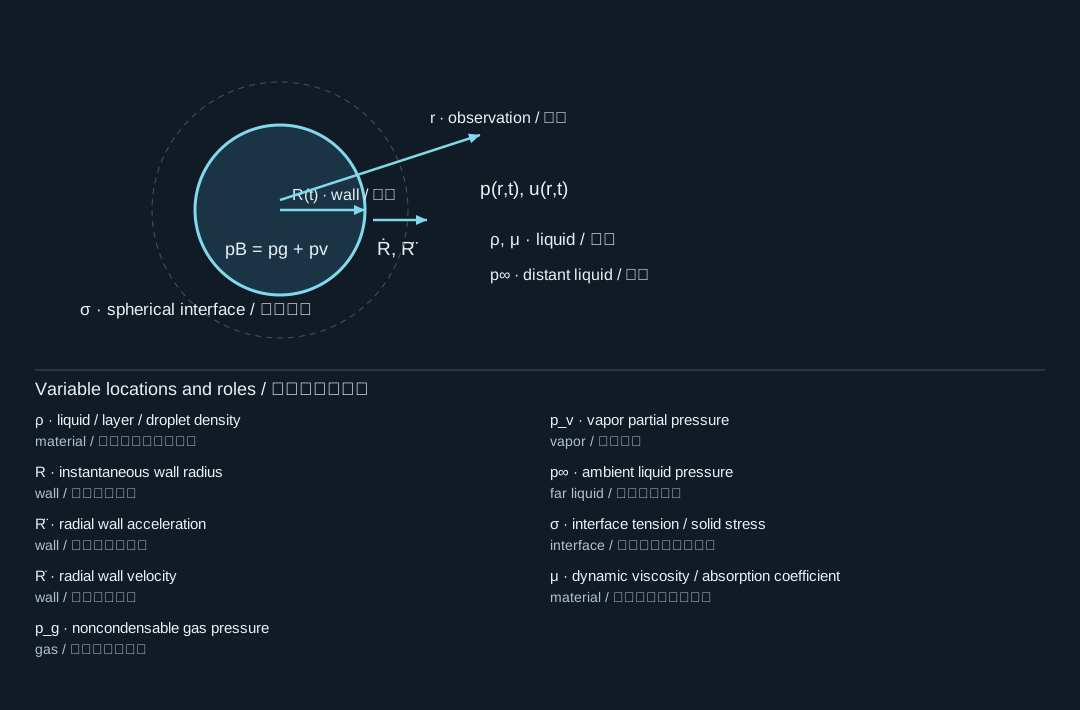
3.2 Continuity determines the velocity field / 连续性决定速度场; u: liquid or solid particle velocity; r: liquid observation radius / embryo radius; t: physical time; R: instantaneous wall radius; Ṙ: radial wall velocity; φ: velocity potential / mode shape

The diagram locates the physical system; its key lists the symbols in the formula. Read the definition in the surrounding derivation when a letter has different roles.

图示标出物理体系,图例列出公式中的符号。若某字母有多种作用,应以邻近推导中的定义为准。

Notice that liquid velocity decreases as r−2r^{-2}, not as r−1r^{-1}. The latter scaling will appear later for a radiated acoustic pressure in the far field. Confusing the incompressible near flow with the acoustic radiation field is a common conceptual error.

注意,液体速度按r−2r^{-2}衰减,而不是r−1r^{-1}。后者将在远场辐射声压中出现。把不可压缩近场流动与声辐射场混淆,是一个常见概念错误。

3.3 Bernoulli produces the inertia terms

Bernoulli方程给出惯性项

The unsteady Bernoulli equation, with the potential chosen to vanish at infinity, is ∂tϕ+u2/2+p/ρ=p∞/ρ\partial_t\phi+u^2/2+p/\rho=p_\infty/\rho. Differentiate ϕ\phi at fixed spatial position rr, and only afterwards set r=R(t)r=R(t):

取无穷远处势函数为零,非定常Bernoulli方程为∂tϕ+u2/2+p/ρ=p∞/ρ\partial_t\phi+u^2/2+p/\rho=p_\infty/\rho。应先在固定空间位置rr处对ϕ\phi求时间偏导,然后再令r=R(t)r=R(t):

∂tϕ∣r=R=−(2R˙2+RR¨),pL−p∞ρ=RR¨+32R˙2.(3.2)\left.\partial_t\phi\right|_{r=R} =-(2\dot R^2+R\ddot R),\qquad \frac{p_L-p_\infty}{\rho}=R\ddot R+\frac32\dot R^2. \tag{3.2}
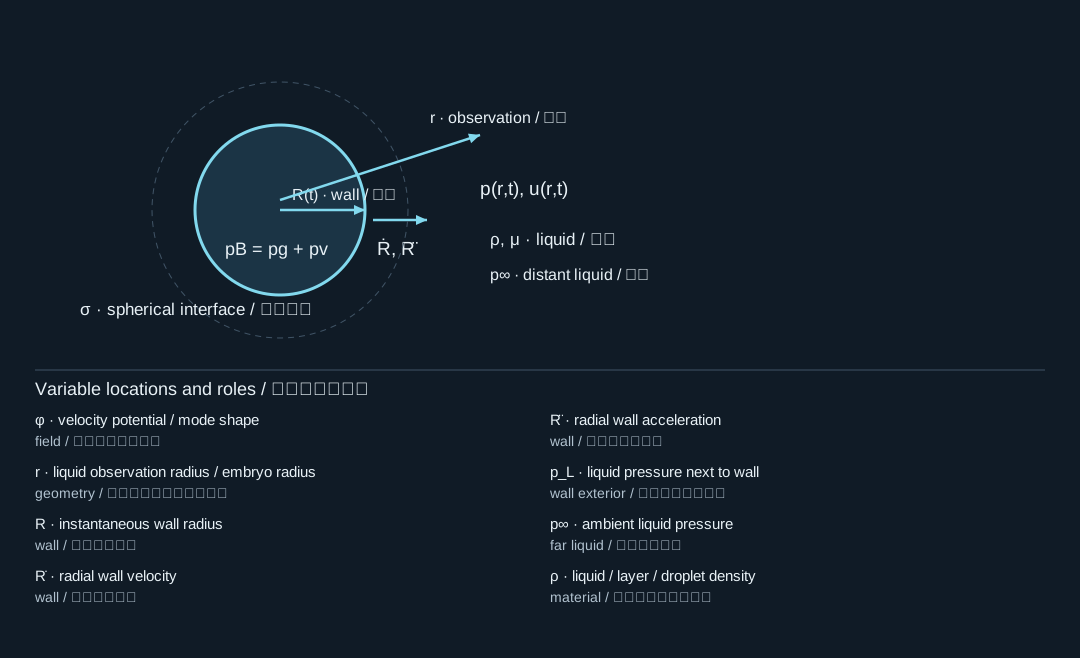
3.3 Bernoulli produces the inertia terms / Bernoulli方程给出惯性项; φ: velocity potential / mode shape; r: liquid observation radius / embryo radius; R: instantaneous wall radius; Ṙ: radial wall velocity; R̈: radial wall acceleration; p_L: liquid pressure next to wall; p∞: ambient liquid pressure; ρ: liquid / layer / droplet density

The diagram locates the physical system; its key lists the symbols in the formula. Read the definition in the surrounding derivation when a letter has different roles.

图示标出物理体系,图例列出公式中的符号。若某字母有多种作用,应以邻近推导中的定义为准。

Differentiating ϕ(R(t),t)\phi(R(t),t) as a total derivative at the start would introduce an extra moving-boundary term and give the wrong coefficient. This is the exact point at which many otherwise sound derivations lose the factor 3/23/2.

如果一开始就对ϕ(R(t),t)\phi(R(t),t)求全导数,就会额外引入运动边界项,导致系数错误。许多看似合理的推导,正是在这里丢失了正确的3/23/2系数。

3.4 Normal stress supplies capillarity and viscosity

法向应力给出毛细项和黏性项

The liquid normal stress is Trr=−p+2μ∂ruT_{rr}=-p+2\mu\partial_r u. Equation (3.1) gives ∂ru∣R=−2R˙/R\partial_r u|_R=-2\dot R/R, so Trr,L=−pL−4μR˙/RT_{rr,L}=-p_L-4\mu\dot R/R. Balancing normal traction across the spherical interface, with negligible gas viscosity, gives

液体法向应力为Trr=−p+2μ∂ruT_{rr}=-p+2\mu\partial_r u。由式(3.1),有∂ru∣R=−2R˙/R\partial_r u|_R=-2\dot R/R,因此Trr,L=−pL−4μR˙/RT_{rr,L}=-p_L-4\mu\dot R/R。忽略气体黏性,对球形界面作法向牵引平衡,得到

pL=pB−2σR−4μR˙R.(3.3)p_L=p_B-\frac{2\sigma}{R}-\frac{4\mu\dot R}{R}. \tag{3.3}
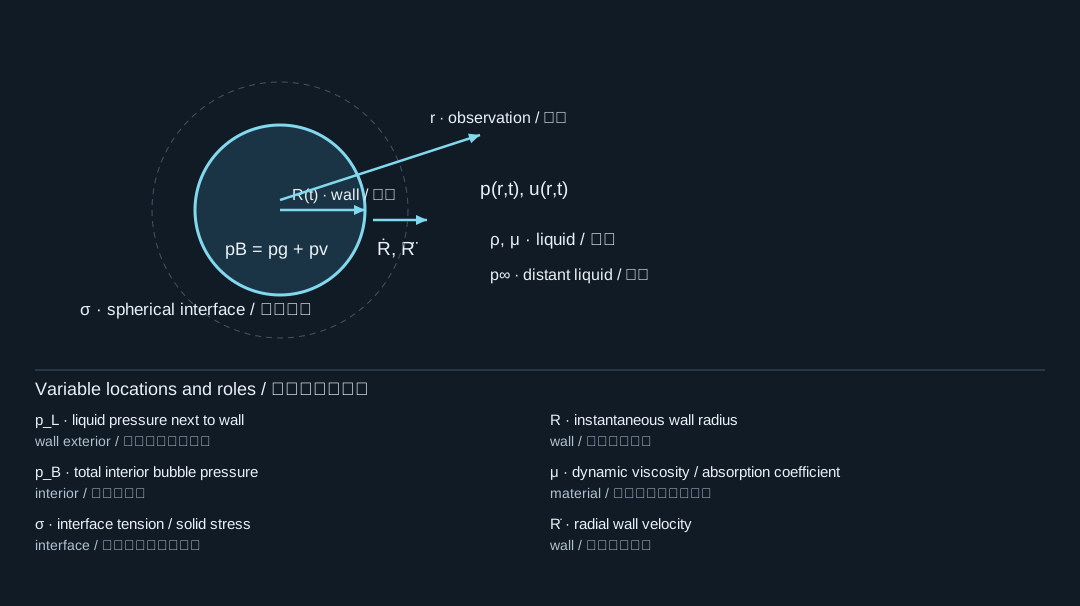
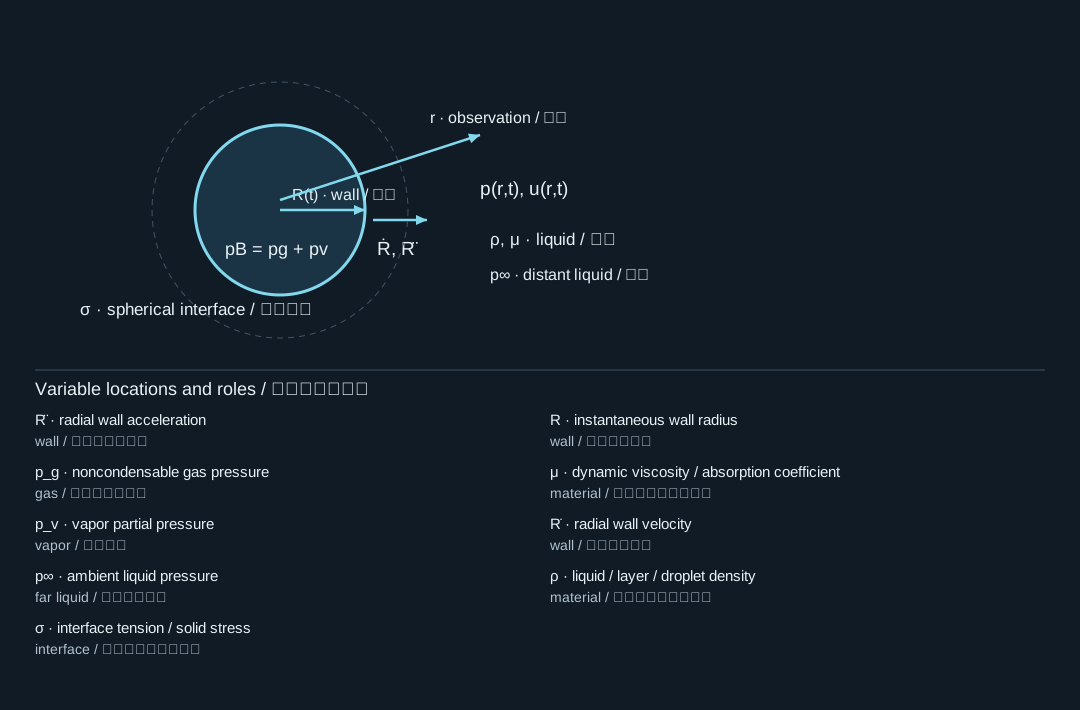
3.4 Normal stress supplies capillarity and viscosity / 法向应力给出毛细项和黏性项; p_L: liquid pressure next to wall; p_B: total interior bubble pressure; σ: interface tension / solid stress; R: instantaneous wall radius; μ: dynamic viscosity / absorption coefficient; Ṙ: radial wall velocity

The diagram locates the physical system; its key lists the symbols in the formula. Read the definition in the surrounding derivation when a letter has different roles.

图示标出物理体系,图例列出公式中的符号。若某字母有多种作用,应以邻近推导中的定义为准。

Combining (3.2) and (3.3) produces the Rayleigh–Plesset equation in its common incompressible form:

联立式(3.2)和(3.3),得到常用不可压缩形式的Rayleigh–Plesset方程:
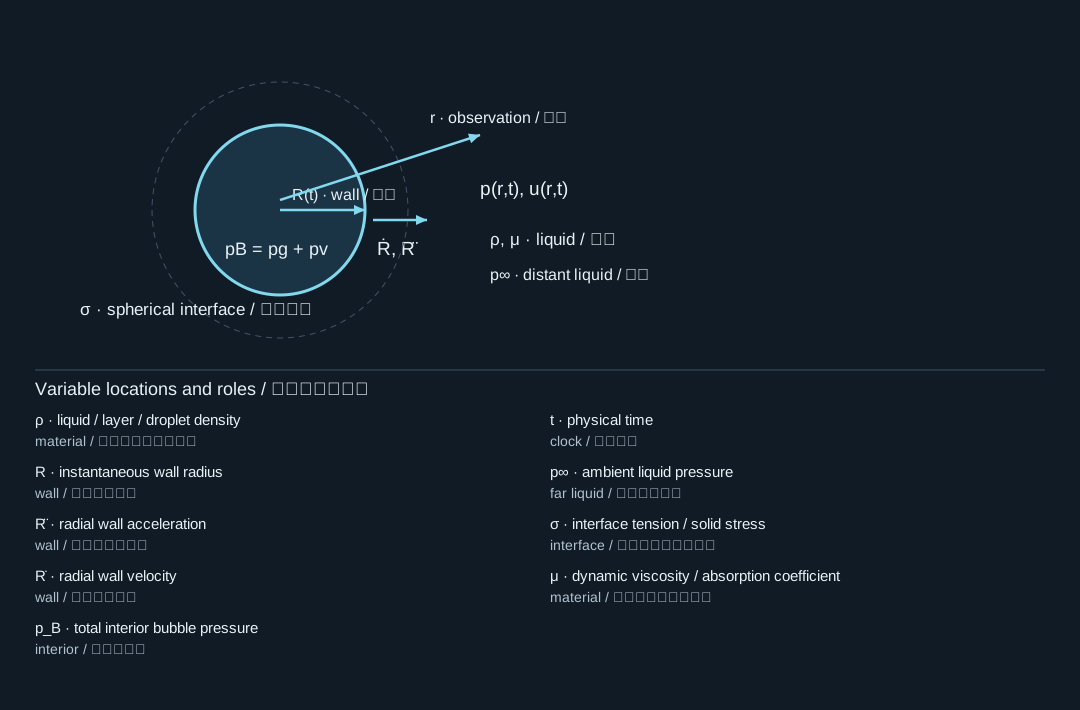
ρ(RR¨+32R˙2)=pB(t)−p∞(t)−2σR−4μR˙R.(3.4)\boxed{\rho\left(R\ddot R+\frac32\dot R^2\right) =p_B(t)-p_\infty(t)-\frac{2\sigma}{R}-\frac{4\mu\dot R}{R}.} \tag{3.4}
3.4 Normal stress supplies capillarity and viscosity / 法向应力给出毛细项和黏性项; ρ: liquid / layer / droplet density; R: instantaneous wall radius; R̈: radial wall acceleration; Ṙ: radial wall velocity; p_B: total interior bubble pressure; t: physical time; p∞: ambient liquid pressure; σ: interface tension / solid stress; μ: dynamic viscosity / absorption coefficient

The diagram locates the physical system; its key lists the symbols in the formula. Read the definition in the surrounding derivation when a letter has different roles.

图示标出物理体系,图例列出公式中的符号。若某字母有多种作用,应以邻近推导中的定义为准。

During expansion, the viscous term opposes outward motion. During collapse, R˙<0\dot R<0, so it contributes outward resistance. The sign is therefore physically consistent in both directions. Surface tension always favors reduced area; it is not a damping term, because it can reversibly store and release energy.

在膨胀阶段,黏性项阻碍向外运动;在塌缩阶段,R˙<0\dot R<0,该项则形成向外的阻力。因此,它在两个方向上的符号都符合物理意义。表面张力始终倾向于减小面积,但它不是阻尼项,因为它可以可逆地储存和释放能量。

3.5 Closing the equation

方程如何闭合

A frequently useful teaching closure separates gas from vapor:

一个常用教学闭合关系,将不凝性气体与蒸气分开处理:
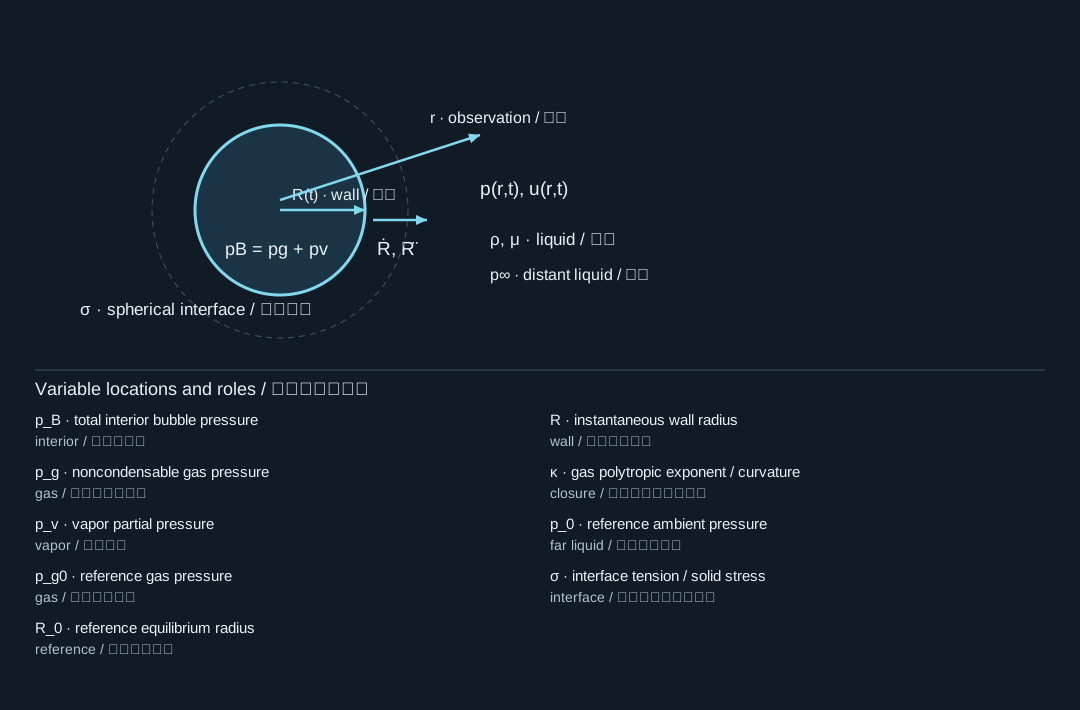
pB=pg+pv,pg=pg0(R0R)3κ,pg0=p0−pv+2σR0.(3.5)p_B=p_g+p_v,\qquad p_g=p_{g0}\left(\frac{R_0}{R}\right)^{3\kappa},\qquad p_{g0}=p_0-p_v+\frac{2\sigma}{R_0}. \tag{3.5}
3.5 Closing the equation / 方程如何闭合; p_B: total interior bubble pressure; p_g: noncondensable gas pressure; p_v: vapor partial pressure; p_g0: reference gas pressure; R_0: reference equilibrium radius; R: instantaneous wall radius; κ: gas polytropic exponent / curvature; p_0: reference ambient pressure; σ: interface tension / solid stress

The diagram locates the physical system; its key lists the symbols in the formula. Read the definition in the surrounding derivation when a letter has different roles.

图示标出物理体系,图例列出公式中的符号。若某字母有多种作用,应以邻近推导中的定义为准。

Here R0R_0 is an equilibrium reference radius at ambient pressure p0p_0, not necessarily the radius at the chosen simulation start. If the simulation starts at maximum expansion Rmax⁡R_{\max}, the gas content still has to be specified. Setting R0=Rmax⁡R_0=R_{\max} automatically redefines the gas content and can accidentally create a bubble that is in equilibrium when it should collapse.

这里R0R_0是环境压力p0p_0下的平衡参考半径,不一定等于所选仿真起始时刻的半径。若从最大膨胀半径Rmax⁡R_{\max}开始计算,仍必须另行指定气体含量。直接令R0=Rmax⁡R_0=R_{\max}会重新定义气体含量,可能误将本应塌缩的气泡设置为平衡态。

The initial-value problem requires R(t0)>0R(t_0)>0, R˙(t0)\dot R(t_0), a forcing history, and closure parameters. A single measured maximum radius does not determine initial gas mass, vapor content, temperature, and source energy independently.

初值问题需要R(t0)>0R(t_0)>0、R˙(t0)\dot R(t_0)、外部激励历程和闭合参数。单独测得一个最大半径,不能独立确定初始气体质量、蒸气含量、温度以及源能量。

3.6 The same equation from theoretical mechanics

从理论力学重新得到同一方程

Integrating the liquid kinetic energy gives

对液体动能积分得
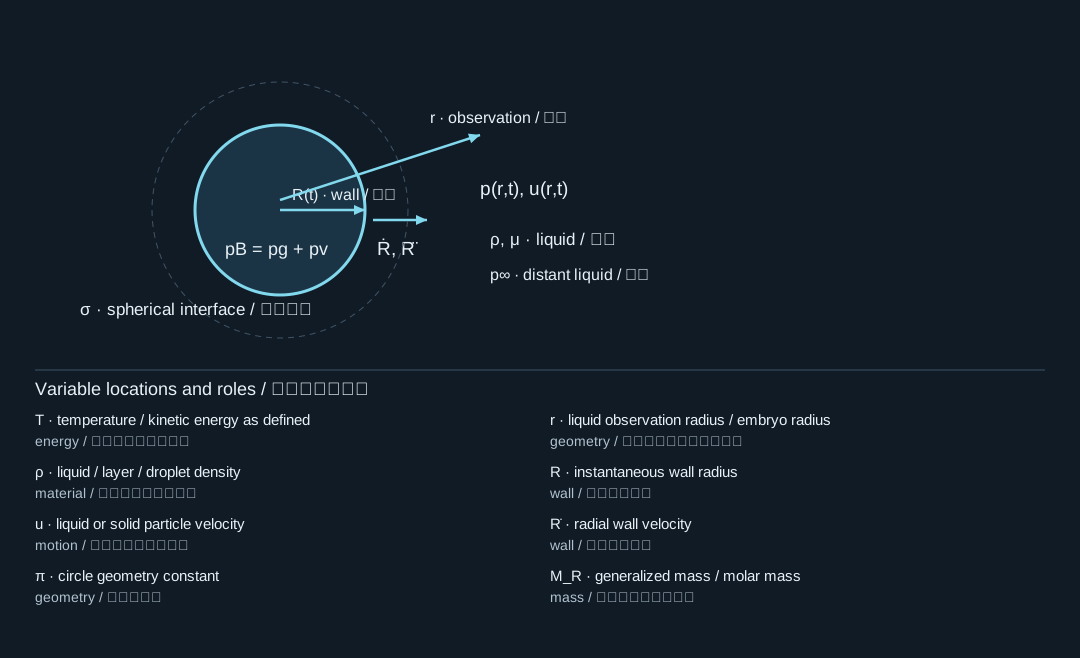
T=12ρ∫R∞u2 4πr2dr=2πρR3R˙2=12MR(R)R˙2,MR=4πρR3.(3.6)T=\frac12\rho\int_R^\infty u^2\,4\pi r^2dr =2\pi\rho R^3\dot R^2 =\frac12 M_R(R)\dot R^2,\qquad M_R=4\pi\rho R^3. \tag{3.6}
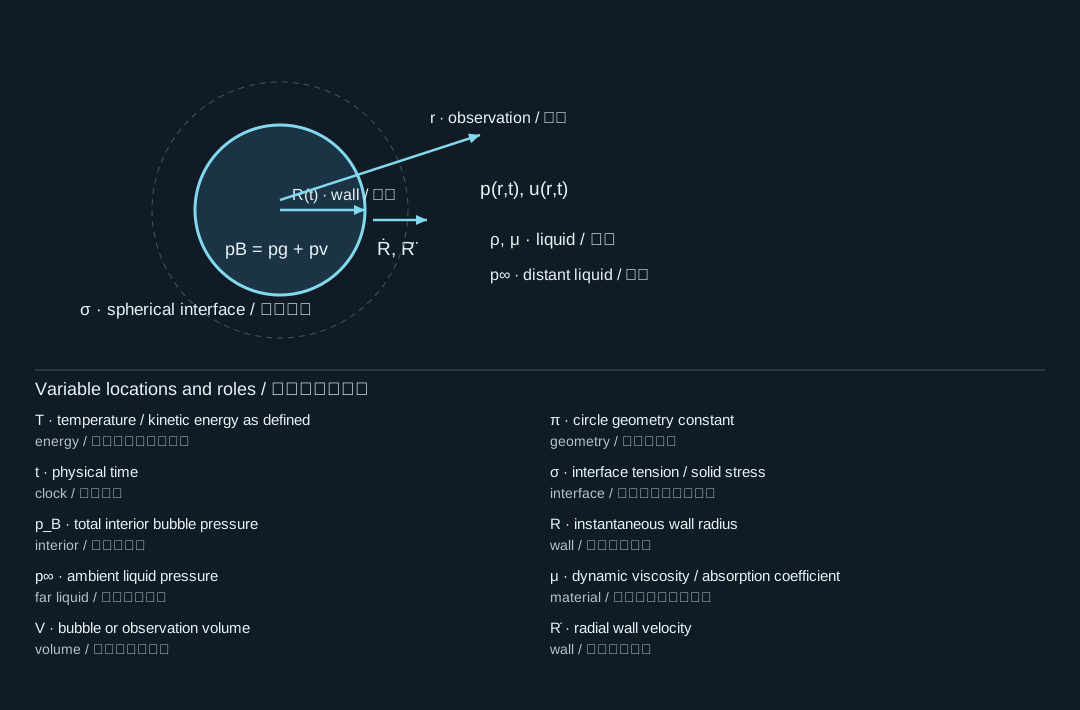
3.6 The same equation from theoretical mechanics / 从理论力学重新得到同一方程; T: temperature / kinetic energy as defined; ρ: liquid / layer / droplet density; u: liquid or solid particle velocity; π: circle geometry constant; r: liquid observation radius / embryo radius; R: instantaneous wall radius; Ṙ: radial wall velocity; M_R: generalized mass / molar mass

The diagram locates the physical system; its key lists the symbols in the formula. Read the definition in the surrounding derivation when a letter has different roles.

图示标出物理体系,图例列出公式中的符号。若某字母有多种作用,应以邻近推导中的定义为准。

The radial generalized mass is configuration-dependent. It is not the translational added mass of a sphere. The generalized pressure force is Qp=4πR2(pB−p∞)Q_p=4\pi R^2(p_B-p_\infty); the surface energy is 4πσR24\pi\sigma R^2; and the viscous generalized force is Qμ=−16πμRR˙Q_\mu=-16\pi\mu R\dot R. Substituting into Lagrange's equation recovers (3.4).

径向广义质量随构型变化,它不是球体平移运动的附加质量。广义压力力为Qp=4πR2(pB−p∞)Q_p=4\pi R^2(p_B-p_\infty),表面能为4πσR24\pi\sigma R^2,黏性广义力为Qμ=−16πμRR˙Q_\mu=-16\pi\mu R\dot R。将它们代入Lagrange方程,即可重新得到式(3.4)。

This derivation reveals the meaning of 3R˙2/23\dot R^2/2: part of the radial force accelerates newly recruited liquid as the generalized mass changes. It is not an arbitrary nonlinear correction. Multiplying (3.4) by 4πR2R˙4\pi R^2\dot R yields a useful power balance:

这一推导揭示了3R˙2/23\dot R^2/2的意义:随着广义质量变化,一部分径向驱动力用于加速新带动的液体。它并非任意添加的非线性修正。将式(3.4)乘以4πR2R˙4\pi R^2\dot R,得到实用的功率平衡:

dTdt=(pB−p∞)dVdt−ddt(4πσR2)−16πμRR˙2,V=4πR33.(3.7)\frac{dT}{dt}=(p_B-p_\infty)\frac{dV}{dt} -\frac{d}{dt}(4\pi\sigma R^2)-16\pi\mu R\dot R^2, \qquad V=\frac{4\pi R^3}{3}. \tag{3.7}
3.6 The same equation from theoretical mechanics / 从理论力学重新得到同一方程; T: temperature / kinetic energy as defined; t: physical time; p_B: total interior bubble pressure; p∞: ambient liquid pressure; V: bubble or observation volume; π: circle geometry constant; σ: interface tension / solid stress; R: instantaneous wall radius; μ: dynamic viscosity / absorption coefficient; Ṙ: radial wall velocity

The diagram locates the physical system; its key lists the symbols in the formula. Read the definition in the surrounding derivation when a letter has different roles.

图示标出物理体系,图例列出公式中的符号。若某字母有多种作用,应以邻近推导中的定义为准。

The last term is nonnegative dissipation with a minus sign. This identity is one of the strongest numerical checks available for an incompressible radial solver.

最后一项是带负号的非负耗散量。这个恒等式是检验不可压缩径向求解器的有力工具之一。
Integrated calculation and model check

综合计算与模型检查

Use the declared parameter set in each part. The values are teaching scenarios unless specifically identified as inherited project inputs. Each reference panel follows its question.

使用每小题明确给出的参数。除明确标为沿用项目输入外,数值均为教学情景。各参考解答紧随题目。

  1. At R = 50 µm, Ṙ = −20 m/s, pg = 8000 Pa, pv = 2339 Pa and p∞ = 101325 Pa, use ρ = 998 kg/m³, μ = 0.001 Pa s, σ = 0.072 N/m. Calculate every signed pressure term and R̈.

    R = 50 µm、Ṙ = −20 m/s、pg = 8000 Pa、pv = 2339 Pa、p∞ = 101325 Pa。取 ρ = 998 kg/m³、μ = 0.001 Pa s、σ = 0.072 N/m,逐项计算带符号压力与 R̈。

    Reference answer / 参考答案
    ρ(RR¨+32R˙2)=pg+pv−p∞−2σ/R−4μR˙/R\rho(R\ddot R+\tfrac32\dot R^2)=p_g+p_v-p_\infty-2\sigma/R-4\mu\dot R/R
    Deriving Rayleigh–Plesset · original governing laws; ρ: liquid / layer / droplet density; R: instantaneous wall radius; R̈: radial wall acceleration; Ṙ: radial wall velocity; p_g: noncondensable gas pressure; p_v: vapor partial pressure; p∞: ambient liquid pressure; σ: interface tension / solid stress; μ: dynamic viscosity / absorption coefficient

    The diagram locates the physical system; its key lists the symbols in the formula. Read the definition in the surrounding derivation when a letter has different roles.

    图示标出物理体系,图例列出公式中的符号。若某字母有多种作用,应以邻近推导中的定义为准。

    Gas plus vapor minus ambient is −90,986 Pa; capillarity contributes −2880 Pa; viscosity contributes +1600 Pa. Total RHS = −92,266 Pa. R̈ = [(−92,266/998)−1.5(20²)]/(50×10⁻⁶) = −1.3849×10⁷ m/s². Both Ṙ and R̈ are inward: inward speed increases.

    气体加蒸气减环境压力为 −90,986 Pa;毛细项为 −2880 Pa;黏性项为 +1600 Pa。右端合计 −92,266 Pa。R̈ = [(−92,266/998)−1.5(20²)]/(50×10⁻⁶) = −1.3849×10⁷ m/s²。Ṙ 和 R̈ 均向内,向内速率增大。

  2. Calculate u at r = 2R, the total liquid kinetic energy and the fraction beyond 2R. Explain why differentiating Φ on the moving wall gives a wrong inertia coefficient.

    计算 r = 2R 处的 u、液体总动能以及 2R 外的动能比例。解释直接在运动壁面上求 Φ 导数为何得到错误惯性系数。

    Reference answer / 参考答案
    u=R2R˙/r2,T=2πρR3R˙2,Tr>aR/T=1/a,dϕ(R(t),t)dt=∂tϕ+R˙∂rϕu=R^2\dot R/r^2,\quad T=2\pi\rho R^3\dot R^2,\quad T_{r>aR}/T=1/a,\quad \frac{d\phi(R(t),t)}{dt}=\partial_t\phi+\dot R\partial_r\phi
    Deriving Rayleigh–Plesset · original governing laws; u: liquid or solid particle velocity; R: instantaneous wall radius; Ṙ: radial wall velocity; r: liquid observation radius / embryo radius; T: temperature / kinetic energy as defined; π: circle geometry constant; ρ: liquid / layer / droplet density; T_r>aR: temperature / kinetic energy as defined; a: droplet radius / film span / acceleration; φ: velocity potential / mode shape; t: physical time

    The diagram locates the physical system; its key lists the symbols in the formula. Read the definition in the surrounding derivation when a letter has different roles.

    图示标出物理体系,图例列出公式中的符号。若某字母有多种作用,应以邻近推导中的定义为准。

    u(2R) = −5 m/s and T = 0.3135 µJ. Half the kinetic energy lies outside 2R. At the moving wall the total derivative includes Ṙ ∂rΦ = Ṙ²; subtract it to obtain the fixed-position partial derivative and the correct 3/2 coefficient.

    u(2R) = −5 m/s,T = 0.3135 µJ。一半动能位于 2R 外。在运动壁面上,全导数包含 Ṙ ∂rΦ = Ṙ²;必须减去它,才能得到固定位置偏导及正确的 3/2 系数。

  3. If pg + pv = p∞ while Ṙ is negative, is this necessarily minimum radius? Specify a condition for outward radial acceleration.

    Ṙ 为负时,如果 pg + pv = p∞,这一定是最小半径吗?给出径向加速度向外的条件。

    Reference answer / 参考答案
    R¨>0 ⟺ pg+pv−p∞−2σ/R−4μR˙/R>32ρR˙2\ddot R>0\ \Longleftrightarrow\ p_g+p_v-p_\infty-2\sigma/R-4\mu\dot R/R>\tfrac32\rho\dot R^2
    Deriving Rayleigh–Plesset · original governing laws; R̈: radial wall acceleration; p_g: noncondensable gas pressure; p_v: vapor partial pressure; p∞: ambient liquid pressure; σ: interface tension / solid stress; R: instantaneous wall radius; μ: dynamic viscosity / absorption coefficient; Ṙ: radial wall velocity; ρ: liquid / layer / droplet density

    The diagram locates the physical system; its key lists the symbols in the formula. Read the definition in the surrounding derivation when a letter has different roles.

    图示标出物理体系,图例列出公式中的符号。若某字母有多种作用,应以邻近推导中的定义为准。

    No. Minimum radius requires Ṙ = 0, followed by reversal. Equal interior and ambient pressures do not eliminate capillary stress, viscosity or radial inertia. Outward acceleration may coexist with inward velocity during deceleration.

    不是。最小半径要求 Ṙ = 0,随后反向。内外压力相等并不消除毛细应力、黏性或径向惯性。减速阶段可同时存在向外加速度与向内速度。

Brief conceptual synthesis

简短概念综合

After using the reference panels, give a short explanation of the physical mechanism, the strongest assumption, and one observation that could falsify this chapter’s model. Preparation of later chapters does not require waiting for that reply.

核对参考解答后,简述物理机制、最强假设,以及一个可证伪本章模型的观测。后续章节编写无需等待该回答。